
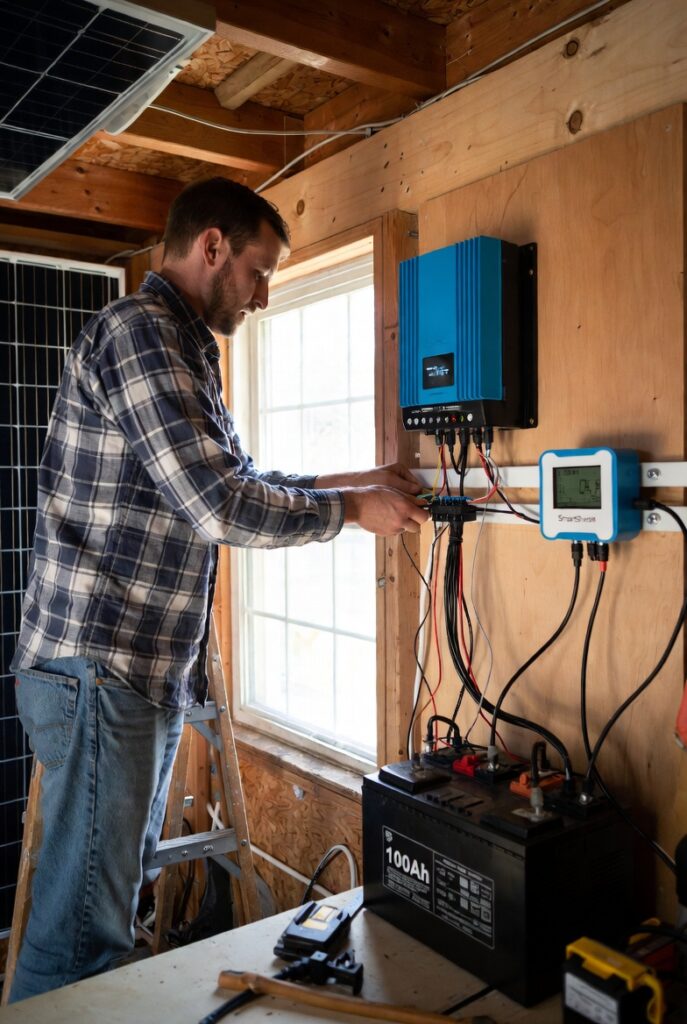
A solar power system has four components, panels, charge controller, battery bank, and inverter, and the most common Ontario beginner mistake is sizing one component correctly while leaving another dangerously undersized. In spring 2024, a homeowner on Woodlawn Road West in Guelph, Wellington County assembled his solar power system using a YouTube video as a guide. His component list: one 400W panel array, one 100Ah LFP battery at 12V, and a 3,000W pure sine wave inverter. The wiring was correct and the battery charged to 100% SoC on the first clear afternoon.
By the second morning his battery showed 42% SoC despite no loads being actively connected. By the third morning it was at 11% SoC. He contacted me expecting a wiring fault or a defective battery. There was no fault. The 3,000W inverter was drawing approximately 30W in standby mode while powered on but idle, a normal specification for a high-capacity inverter maintaining its internal circuits. At 30W continuous, the inverter consumed 720Wh per day from the battery regardless of whether any appliance was connected.
I reviewed the system at the commissioning check in June 2024. A 100Ah LFP battery at 12V provides approximately 1,200Wh of rated capacity and approximately 960Wh of usable capacity at 80% depth of discharge. At 720Wh per day of inverter standby draw alone, the battery depleted to 80% DoD in approximately 1.3 days with no other loads running. The correct specification was either a battery bank of at least 300Ah at 12V to handle 3 days of standby at the gray streak reserve, or an inverter with a search mode reducing standby to approximately 2 to 5W.
His Victron SmartShunt showed the 30W baseline drain clearly in the consumption graph, a flat 2.5A load at 12V present 24 hours per day. See our Ontario solar sizing guide before finalising any solar power system component list.
The solar power system four-component chain: what each part does and why it matters
| Component | Function | Ontario sizing rule | Common mistake |
|---|---|---|---|
| Solar panels | DC electricity from sunlight | Size for 1.5 PSH January | Sizing for July average |
| MPPT charge controller | Panel voltage → battery voltage | Battery first, then panels | Connecting panels before battery |
| Battery bank (LFP) | Stores energy, powers loads | 3-day gray streak reserve incl. standby | Forgetting inverter standby draw |
| Pure sine wave inverter | DC battery → 120V AC loads | Include standby in daily load | Oversized inverter, no search mode |
Solar panels produce DC electricity proportional to sunlight. A 100W panel produces approximately 120Wh on a clear Ontario January day at 1.5 PSH and 360Wh on a clear July day at 4.5 PSH. The MPPT charge controller converts the panel’s variable high voltage (typically 18 to 40V for a 12V panel) to the correct battery charging voltage, recovering approximately 15 to 30% more energy than a PWM controller. Always connect the battery to the charge controller before connecting the panels, the controller reads the battery voltage on startup to configure itself, and connecting panels first with no reference voltage can cause a voltage spike that damages the controller.
A first-time property owner near Campbellville in Halton Region built his solar power system correctly in summer 2024 by following the 4-component sequence. Load audit: 55Ah per day at 12V. Battery sizing: 55 x 3 = 165Ah usable at 80% LFP DoD = 206Ah rated, rounded to 200Ah (two Battle Born 100Ah LFP batteries in parallel). Array sizing: 200Ah x 12V / 0.80 = 3,000Wh to restore, at 1.5 PSH January = 208W panel minimum, rounded to 400W.
Inverter: 1,500W/3,000W surge with search mode, standby in search mode approximately 3W (72Wh/day). His SmartShunt confirmed 100% SoC by Sunday afternoon after Saturday commissioning. His first Ontario January: battery never below 45% SoC on consecutive gray streak days. See our solar battery storage guide for LFP chemistry selection and our solar inverter types guide for PSW vs MSW.
The correct connection sequence: battery first, then panels, then inverter
The four connection steps in a solar power system must follow a specific order. Step 1: connect the battery to the charge controller. Step 2: install the SmartShunt on the battery negative line before any other negative connections. Step 3: connect the panels to the charge controller only after the battery is connected. Step 4: connect the inverter to the battery terminals through a properly rated fuse. The MPPT charge controller reads the battery voltage at startup to configure its output, connecting panels first with no battery reference can cause an input voltage spike that damages the controller’s circuits. In practice, skipping this sequence is the most common installation error that produces immediate faults after commissioning.
The SmartShunt installation detail requires attention. The SmartShunt installs on the battery negative line, between the battery negative terminal and all other negative connections in the system. Every current flowing in or out of the battery passes through the SmartShunt, which is how it tracks net Ah and calculates SoC. Installing the SmartShunt after some negative connections are already on the bus produces inaccurate readings for those loads because their current bypasses the shunt. Install the SmartShunt first, before any load or charger negative connection is made. A correctly installed SmartShunt shows the complete system energy flow including inverter standby, panel input, and all load draws in one real-time display.
The solar power system inverter idle trap: why a 30W standby draw kills an undersized bank
Inverter standby draw is a permanent daily load in any solar power system where the inverter remains powered on. Small inverters (300W) draw 2 to 8W standby. Medium inverters (1,500W) draw 5 to 20W. Large inverters (3,000W) draw 15 to 50W. At 30W standby, the daily drain is 720Wh, the equivalent of a DC compressor fridge running all day, consumed before any appliance is switched on.
The Woodlawn Road West Guelph result: 30W x 24h = 720Wh, 960Wh usable LFP bank, 1.33 days to 80% DoD with zero loads. The fix is either a battery bank sized to include 3 days of standby draw in the gray streak reserve, or an inverter with search mode that reduces standby to 2 to 5W when no load is present.
Search mode reduces standby draw by pulsing the AC output approximately once per second to check for a connected load, powering up fully only when one is detected. In search mode, standby drops from 30W to approximately 2 to 5W, reducing daily standby drain from 720Wh to 48 to 120Wh. For the Campbellville 200Ah LFP bank at 80% DoD (1,920Wh usable), search mode standby at 3W draws 72Wh per day versus 720Wh in the Woodlawn Road West system, a 648Wh per day improvement on the same battery bank.
If the inverter cycles on and off audibly every few seconds in search mode, a phantom load is keeping it from staying in sleep state. Identify and eliminate it using the SmartShunt live current display.
Pro Tip: Before finalising any solar power system inverter selection, run the standby test first. Connect the inverter to a fully charged battery with no AC loads connected and no SmartShunt installed. Set a timer for 24 hours. Check the battery SoC via the charge controller display at the start and end of the 24-hour period. The SoC drop with no loads is entirely the inverter standby draw. Multiply the SoC drop percentage by the rated battery capacity to get the Wh consumed overnight. At 30W standby on a 100Ah 12V bank: 30W x 24h = 720Wh, which is 60% of the 1,200Wh rated capacity drawn in 24 hours with zero loads. If the standby test result is more than 10% of the daily usable bank capacity, either select a search mode inverter or increase the battery bank to absorb the standby draw within the 3-day gray streak reserve.
The Ontario January floor rule: why summer production is irrelevant to system survival
The Ontario January floor rule applies to every solar power system in Wellington and Halton County. A 100W Renogy monocrystalline panel produces approximately 100 x 1.5 x 0.80 = 120Wh on a clear Ontario January day. A 400W array produces approximately 480Wh on a clear January day. If the total daily load including inverter standby exceeds 480Wh, the array cannot recharge the bank on January clear days. Add cloudy days and the bank declines steadily through January regardless of how well it performed in July. The solar power system designed for July average production at 4.5 PSH (1,440Wh from a 400W array) appears adequate until the first Ontario winter.
The January sizing check: divide the total daily load including inverter standby by Ontario January production per watt (approximately 1.5 PSH x 0.80 = 1.2Wh per watt per clear day). Round up to the next 100W increment and add 25% safety margin. The Campbellville result: 55Ah/day x 12V = 660Wh plus 72Wh inverter search mode standby = 732Wh total. 732Wh / 1.2Wh per watt = 610W minimum array, rounded with safety margin to 400W given the conservative load management and well-insulated enclosure. See our solar panel angle guide for how the 60-degree winter tilt adds approximately 12% to January production from the same panel array.
NEC and CEC: Ontario requirements for permanent off-grid solar system installations
NEC 690 governs solar PV installations. A permanently installed solar power system must comply with NEC 690 requirements for panel array wiring, DC overcurrent protection, charge controller installation, battery storage, and inverter output wiring. The DC wiring from the panel array to the charge controller must be sized for the panel short-circuit current (Isc) plus a 25% safety factor, with appropriate fusing at the array output. The battery cables from the battery bank to the charge controller and inverter must be sized for each device’s maximum current draw with appropriate fusing at the battery positive terminal. Contact the NFPA at nfpa.org for current NEC 690 requirements for standalone off-grid solar power system installations.
CEC Section 64 governs solar PV installations in Ontario. A permanently installed solar power system requires an ESA permit identifying all four system components: the panel array (wattage, configuration, and mounting method), the charge controller, the battery bank (chemistry, rated capacity, voltage, and location), and the inverter (rated wattage and type). The wiring between components must comply with the Ontario Electrical Safety Code for the circuit type and current rating. A portable solar power system not permanently mounted to a structure does not require an ESA permit. Contact the Electrical Safety Authority Ontario at esasafe.com before permanently installing any solar power system in Ontario.
The solar power system verdict: sizing every component for Ontario winter
- Ontario off-grid property owner whose battery bank depletes overnight with no loads running: the Woodlawn Road West Guelph diagnosis applies. Check the Victron SmartShunt baseline current draw with all loads off and the inverter powered on. A consistent reading of 1.5A or more at 12V (18W or more) means inverter standby is the culprit. Either add battery capacity to cover 3 days of standby draw within the gray streak reserve, or replace the inverter with a search mode unit. The SmartShunt daily consumption graph confirms the standby reduction on the day of the swap, the flat baseline current drops immediately when a search mode inverter replaces a full-standby unit.
- Ontario first-time solar power system builder who wants to commission correctly on the first attempt: follow the 4-component sizing sequence without skipping steps. Load audit first. Size the battery bank for the 3-day gray streak reserve including the inverter standby draw at the selected inverter specification. Size the array for Ontario January 1.5 PSH floor. Select the inverter last, after the battery bank and array are confirmed, and choose a search mode inverter if the standby draw of a full-size unit exceeds 10% of the daily usable bank capacity per 24 hours. The Campbellville Halton result: correct sequence on Saturday, 100% SoC by Sunday, January never below 45% SoC.
- Ontario off-grid property owner planning a year-round primary residence with heavy winter loads: the solar power system must account for both the January floor production and propane generator backup for gray streaks beyond 3 days. The 3-day rule handles approximately 90% of Ontario gray streaks. Extended 5 to 7-day gray streaks occur 1 to 3 times per Ontario winter and require either a propane generator to supplement or a significantly larger battery bank. See our off grid Ontario guide for how the 4-component solar power system integrates with propane generator backup in a complete Ontario off-grid installation.
Frequently Asked Questions
Q: What are the four components of an off-grid solar power system?
A: The four components are solar panels, MPPT charge controller, battery bank, and pure sine wave inverter. Panels convert sunlight to DC electricity. The charge controller steps down panel voltage to the correct battery charging voltage and must be connected to the battery before the panels are connected. The battery bank stores energy and must be sized for the 3-day Ontario gray streak reserve including the inverter standby draw. The pure sine wave inverter converts DC battery power to 120V AC for appliances, modified sine wave is not acceptable as it damages motors and smart chargers. Each component must be sized individually and then verified as a system using the SmartShunt.
Q: Why does my battery keep dying even when I’m not using anything?
A: Inverter standby draw is almost always the cause. A 3,000W inverter draws approximately 30W in standby mode when powered on but with no AC loads connected. At 30W continuous, that is 720Wh per day, enough to deplete a 100Ah 12V LFP bank (960Wh usable) to 80% DoD in approximately 1.3 days with zero intentional loads. Check the SmartShunt current reading with the inverter on and all loads physically unplugged. If the reading is 1.5A or more at 12V, the inverter standby is the cause. The fix is either a search mode inverter (2 to 5W standby) or a larger battery bank sized to absorb the standby draw within the 3-day gray streak reserve.
Q: How do I size a solar power system for Ontario winter?
A: Size every component for Ontario January production at 1.5 PSH, not July average at 4.5 PSH. Step 1: calculate total daily load in Wh including inverter standby. Step 2: apply the 3-day gray streak rule, multiply daily load by 3 and divide by the battery chemistry DoD to get the minimum rated bank size. Step 3: divide the total daily load by 1.2Wh per watt per clear January day to get the minimum array wattage, then add 25% safety margin.
Step 4: select a pure sine wave inverter with search mode if the standby draw exceeds 10% of daily usable capacity. The Campbellville Halton result at 55Ah/day is the worked example: 200Ah LFP, 400W array, 1,500W search mode inverter, January never below 45% SoC.
This build is engineered within the 48V DC Safety Ceiling. Diagnostic logic is based on 20+ years of technical service experience. All structural and electrical installations must be verified by a Licensed Professional and comply with your Local AHJ.
About the Author
Robert Bertrand spent 20 years as a service advisor in the automotive industry (Lexus and Nissan), where precision diagnostics, wiring integrity, and documentation standards were non-negotiable. He brings that same technical discipline to GridFree Guide, where he researches, tests, and documents off-grid solar systems for Ontario conditions. Based in Rockwood, Ontario, every article is built on verified specifications, manufacturer data, and the real-world climate constraints of Canadian off-grid living.
As an Amazon Associate I earn from qualifying purchases. This site also contains affiliate links to other products and services. GridFree Guide earns a small commission at no extra cost to you.