
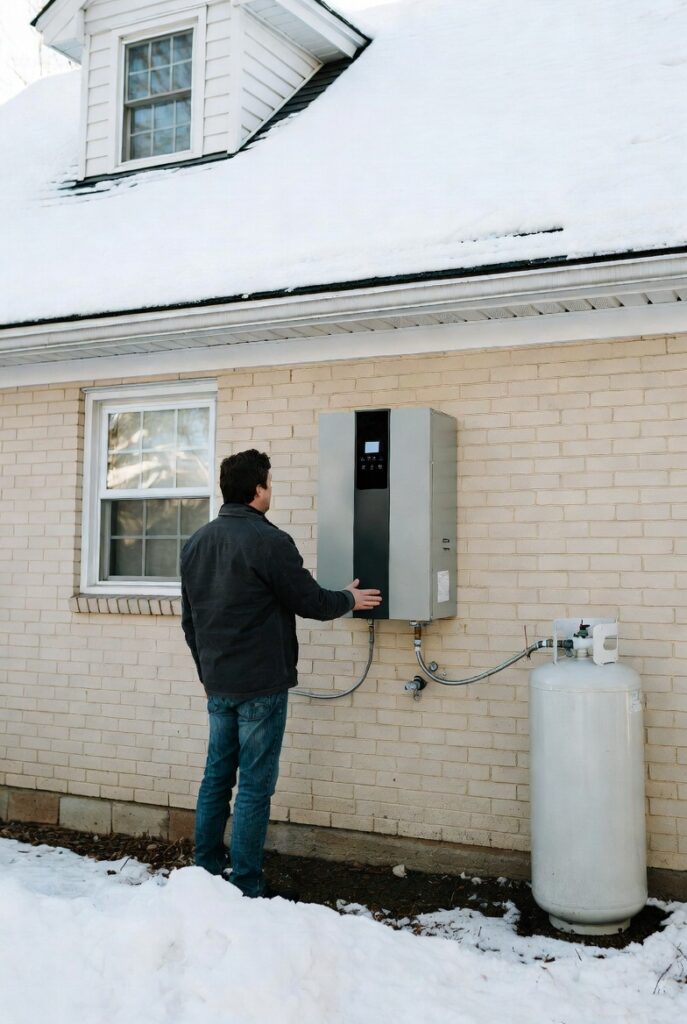
An off grid shower is only as reliable as its hot water source, and in Ontario the correct answer for year-round comfort is propane tankless, not solar thermal, not electric on-demand, and not a wood-fired tank that requires 45 minutes of planning before every shower. A homeowner on Woolwich Street in Guelph, Wellington County built a full off-grid home system in the spring of 2023 and decided that electric on-demand water heating was the clean, modern solution for his off grid shower.
He installed an 1,800W point-of-use electric heater at the shower head. His battery bank was a 100Ah LFP at 12V, approximately 960Wh of usable capacity at 80% DoD. Two people taking 8-minute showers back to back drew approximately 480Wh from the battery bank, reducing it from approximately 90% SoC to approximately 40% SoC before 8 AM.
At 40% SoC with a January clear day producing approximately 480Wh from his 400W array, the system entered each day already at its gray streak reserve threshold. Any overcast January day following a morning shower left the system below 30% SoC by mid-afternoon. He spent three weeks debugging the system, checking the MPPT settings and the Victron SmartShunt data, before the installer reviewed the logs remotely and identified the electric heater as the cause. The 480Wh shower load was consuming approximately 50% of the bank usable capacity every morning. His daily January solar production, approximately 480Wh, was entirely consumed by the shower load with nothing remaining for lighting, Starlink, or the fridge.
I reviewed the corrected system configuration with him in February 2024 after he replaced the electric heater with a propane tankless unit. The propane tankless draws approximately 1W for the electronic ignition, compared to 1,800W continuous for the electric heater. His January SmartShunt logs after the propane switch showed the battery bank stable at 85 to 95% SoC through the full morning routine including two showers and dish washing. His off grid shower hot water supply became unlimited and his solar system was freed entirely for electrical loads. The cost of the propane tankless installation: approximately $800 including labour. See our Ontario solar sizing guide before designing any system that includes a hot water load.
The off grid shower energy problem: why electric on-demand fails in Ontario
| Heat source | Electrical draw | Per shower energy | 2 showers on 100Ah 12V LFP | Ontario winter verdict |
|---|---|---|---|---|
| Propane tankless | ~1W (ignition only) | ~$0.30 propane | 0% battery draw | Year-round ✓ |
| Solar thermal | ~50W (pump only) | Free (May-Sept) | Minimal | Summer supplement ✓ |
| Electric 1,800W | 1,800W continuous | 240Wh | 480Wh = 50% of bank | System killer ✗ |
| Electric 3,500W | 3,500W continuous | 467Wh | 934Wh = 97% of bank | Single-shower blackout ✗ |
A typical 1,800W point-of-use electric heater draws approximately 240Wh per 8-minute shower. Two showers back to back consume approximately 480Wh. On a 100Ah 12V LFP battery bank with 960Wh usable capacity, two showers consume 50% of the daily energy before lighting, Starlink, or the fridge have drawn a single watt. Even on a larger 200Ah 12V bank with 1,920Wh usable, two showers consume 25% of daily capacity before 8 AM, still a major load on any Ontario off grid shower system.
The January production problem compounds the math. A 400W solar array in Ontario produces approximately 480Wh on a clear January day at 1.5 peak sun hours. Each shower load on the electric heater equals one full clear day of winter solar production. The system enters every January morning in deficit, with the shower energy drawing down the bank before the sun rises. A 3,500W unit draws approximately 467Wh per 8-minute shower, two people showering would consume approximately 97% of a 100Ah 12V bank in a single morning.
The only acceptable electric on-demand use case for an off grid shower system is a point-of-use under-sink unit at 1,200W used for handwashing only, approximately 40Wh per use. See our off grid washing guide for how hot water loads interact with laundry system planning.
Propane tankless: the Ontario hot water standard
A high-output residential propane tankless unit at 150,000 BTU delivers instant hot water at any flow rate the plumbing can supply, drawing approximately 1W for the electronic ignition. Propane remains liquid to approximately -42C, maintains full BTU output regardless of ambient temperature, and requires no battery SoC monitoring for shower planning. There is no gray streak concern, no rationing of hot water to protect the battery bank, and no morning routine that starts with checking whether the system can afford a shower. Propane tankless is the correct off grid shower hot water solution for any Ontario property with year-round occupancy.
A cottage owner on Main Street East in Milton, Halton County chose propane tankless for her off grid shower from day one in 2024. Her installer reviewed her 600W panel array and 200Ah LFP 12V bank and calculated that two showers daily at 240Wh each would consume approximately 25% of her 1,920Wh usable bank before other loads ran. The propane tankless removed that load entirely. Her battery bank opens each Ontario morning at the same SoC it closed the previous evening, adjusted only for overnight loads.
She runs four to five winter weekends without a generator supplement because the electrical loads preserved by moving the shower off the battery bank are exactly the margin that keeps the system balanced through the gray streaks. The propane cost per person per off grid shower: approximately $0.30. The battery cost: zero.
Pro Tip: Before switching from electric to propane tankless, review the SmartShunt daily production and consumption logs on the two or three lowest production days of the most recent January. Add up the hot water draw, it typically shows as a sustained 1,800W block lasting 8 to 16 minutes in the morning. Multiply that block by the number of days in January and you have the exact kWh your electric off grid shower has been consuming from the battery bank each month. Compare that to the cost of a $800 to $1,500 propane tankless installation. In most Ontario Tier 1 and Tier 2 systems, the propane switch pays for itself in avoided generator run time within one winter. The SmartShunt also shows the baseline draw drop immediately after the switch, the 1,800W morning block disappears and the bank stabilises at its previous-evening SoC through the full morning routine.
Solar thermal: the seasonal supplement with an Ontario winter trap
Solar thermal systems use evacuated tube collectors or flat plate panels to heat a circulating fluid that transfers heat to a storage tank. For any Ontario installation a closed-loop glycol system is mandatory. Plain water in outdoor solar thermal collectors will freeze on the first clear night below -5C and shatter the vacuum tubes or burst the flat plate panel channels. This is not a seasonal risk, it is a certainty on the first Ontario fall night if the system is not glycol-protected. The glycol loop requirement adds approximately $500 to $1,000 to system cost and complexity compared to a direct flat plate system and requires annual glycol concentration testing.
Solar thermal is genuinely useful for seasonal cottage owners with May through September occupancy. A properly sized system with a glycol loop provides approximately 80 to 100% of domestic hot water requirements for an off grid shower during those five months at no operating cost. Drain and winterize in October, recommission in May. For year-round properties, propane backup is required from November through April because solar thermal output in December and January is minimal at 1.5 peak sun hours and low sun angle.
The propane backup requirement means any year-round Ontario property needs propane regardless, at which point propane tankless alone is typically the simpler and lower total-cost solution. See our Ontario off-grid roadmap for how hot water system selection fits into the full six-step build sequence.
NEC and CEC: Ontario requirements for off-grid hot water installations
NEC 690 governs the solar PV portion of an off-grid system. A dedicated circuit for an electric water heater connected to the inverter output must comply with NEC 422 appliance requirements and NEC 240 overcurrent protection for branch circuits. An electric on-demand water heater at 1,800W on a 120V circuit draws 15A continuous and must be protected by a minimum 20A dedicated breaker on the inverter output panel. A 3,500W unit requires a dedicated 30A circuit. These circuit requirements must be documented in the ESA permit application for the off-grid inverter system. Contact the NFPA at nfpa.org for current NEC requirements for appliance circuits in residential off-grid solar PV systems.
CEC Section 64 governs solar PV installations in Ontario, and the TSSA Act governs propane gas appliances. Propane tankless water heaters in Ontario must be installed by a TSSA-licensed gas fitter regardless of property type. The ESA permit covers the electrical components; a separate TSSA-compliant propane installation with a gas fitter sign-off is required for the gas appliance connections and venting. If the off grid shower system includes a solar thermal installation, the glycol loop and collector mounting may require a building permit under the Ontario Building Code in addition to the ESA electrical permit for any circulation pump wiring.
Contact the Electrical Safety Authority Ontario at esasafe.com before wiring any hot water appliance circuit in a permitted Ontario off-grid installation.
How to plan an off grid shower hot water system for Ontario winters
Step 1: calculate the daily hot water energy requirement. Two people x 8-minute showers x 240Wh each = 480Wh per day. Compare this to the January daily solar production: Array Watts x 1.5 PSH x 0.80 = clear-day Wh. If the shower energy exceeds 25% of clear-day production, electric on-demand will create a chronic winter deficit. For a 400W array producing 480Wh: 480Wh shower load = 100% of production, the electric off grid shower is the entire system’s daily output. Step 2: confirm the water supply. A pressure pump typically draws 300 to 800W while running, an additional load on top of the heater that must factor into the daily load calculation.
Step 3: select the heat source based on the energy budget. If battery capacity is below 200Ah at 12V or 100Ah at 24V, propane is the only viable option for two daily showers. Ontario well water temperature in Wellington and Halton County runs approximately 5 to 10C year-round due to ground insulation. The temperature rise to a comfortable shower at 40C is approximately 30 to 35C.
Propane tankless handles this rise instantly at any Ontario air temperature. If the shower load exceeds 25% of usable battery capacity per day using the 3-day gray streak formula from our solar battery bank sizing guide, propane is the correct choice regardless of system size. The Woolwich Street result confirms this: 480Wh shower load versus 480Wh January production from a 400W array, a system that was perpetually at zero net daily energy before noon.
The off grid shower verdict: propane, solar thermal, or electric
- Ontario off-grid homeowner planning a year-round property with two or more daily showers: propane tankless is the correct specification. The Woolwich Street Guelph result quantifies the electric alternative: 480Wh per morning = 50% of a 100Ah 12V bank consumed before the day begins in January, with the entire clear-day solar production required just to recover the shower load. A propane tankless at $800 to $1,500 installed draws approximately 1W for ignition and costs approximately $0.30 per person per shower in propane. The TSSA-licensed gas fitter installation is not optional in Ontario. Budget it into the system cost from the beginning and the off grid shower hot water problem is permanently solved.
- Ontario seasonal cottage owner with May through September occupancy only: solar thermal with a glycol loop is worth evaluating as a supplement. Free hot water for five months at no operating cost is a meaningful advantage for a property with a predictable seasonal window. The glycol system adds $500 to $1,000 to total system cost versus propane tankless alone. Drain and winterize in October, recommission in May. Evaluate based on the number of summer weekends occupied and the propane break-even calculation for that usage pattern. For year-round properties, solar thermal requires a propane backup regardless, which typically makes propane tankless alone the simpler total-cost solution.
- Ontario off-grid owner experiencing chronic battery depletion who already has an electric on-demand heater installed: review the SmartShunt daily logs first, then replace with propane. If hot water is consuming more than 20% of clear-day battery capacity, replacing the electric heater with propane tankless is the single highest-impact system improvement available. If the battery enclosure is in an unheated space below 0C, add a Battle Born heated LFP to ensure the bank can accept a charge on cold mornings after the propane switch restores the daily energy budget. The Victron SmartShunt log will confirm the improvement immediately: the 1,800W morning shower block disappears from the consumption graph and the bank stabilises at its previous-evening SoC.
Frequently Asked Questions
Q: What is the best hot water system for an off-grid shower in Ontario?
A: Propane tankless is the year-round answer for any Ontario off grid shower with two or more daily users. It provides unlimited hot water with approximately 1W of electrical draw for the electronic ignition, costs approximately $0.30 per person per shower in propane, and requires zero battery capacity for the hot water load. The alternative, electric on-demand at 1,800W, consumes approximately 240Wh per shower, two showers on a 100Ah 12V LFP bank consume 50% of the bank usable capacity before 8 AM, which is approximately equal to the entire January daily solar production from a 400W array.
The Woolwich Street Guelph result confirms the cost of the wrong choice: three weeks of diagnostic work followed by an $800 propane installation that should have been the original specification.
Q: Can I run an electric on-demand water heater on a solar battery system?
A: An electric on-demand unit at 1,200W used only for handwashing at approximately 40Wh per use is acceptable on any properly sized system. An electric on-demand off grid shower at 1,800W or above is not recommended on any system below Tier 3 (10kWh usable or more) in Ontario. The energy calculation is straightforward: 1,800W x 8 minutes = 240Wh per shower. Two showers = 480Wh. On a 100Ah 12V LFP bank (960Wh usable), two showers consume 50% of the daily energy budget before other loads run.
On a clear Ontario January day with a 400W array producing approximately 480Wh, the shower load equals the entire day’s solar production. The system runs at zero net energy from the moment the second shower ends until the next clear day.
Q: Do I need a glycol system for solar thermal hot water in Ontario?
A: Yes, unconditionally. Plain water in any outdoor solar thermal collector in Ontario will freeze on the first clear night below -5C and shatter the vacuum tubes or burst the flat plate panel channels. This is not a risk to manage, it is a certainty that will destroy the collector array within the first Ontario fall. A closed-loop glycol system is mandatory for any solar thermal off grid shower installation in Ontario.
The glycol loop adds approximately $500 to $1,000 to total system cost and requires annual glycol concentration testing to confirm freeze protection. For seasonal cottage owners, the system is drained and winterized in October. For year-round properties, the glycol loop prevents freeze damage but a propane backup is still required from November through April when solar thermal output is insufficient.
This build is engineered within the 48V DC Safety Ceiling. Diagnostic logic is based on 20+ years of technical service experience. All structural and electrical installations must be verified by a Licensed Professional and comply with your Local AHJ.
About the Author
Robert Bertrand spent 20 years as a service advisor in the automotive industry (Lexus and Nissan), where precision diagnostics, wiring integrity, and documentation standards were non-negotiable. He brings that same technical discipline to GridFree Guide, where he researches, tests, and documents off-grid solar systems for Ontario conditions. Based in Rockwood, Ontario, every article is built on verified specifications, manufacturer data, and the real-world climate constraints of Canadian off-grid living.
As an Amazon Associate I earn from qualifying purchases. This site also contains affiliate links to other products and services. GridFree Guide earns a small commission at no extra cost to you.