
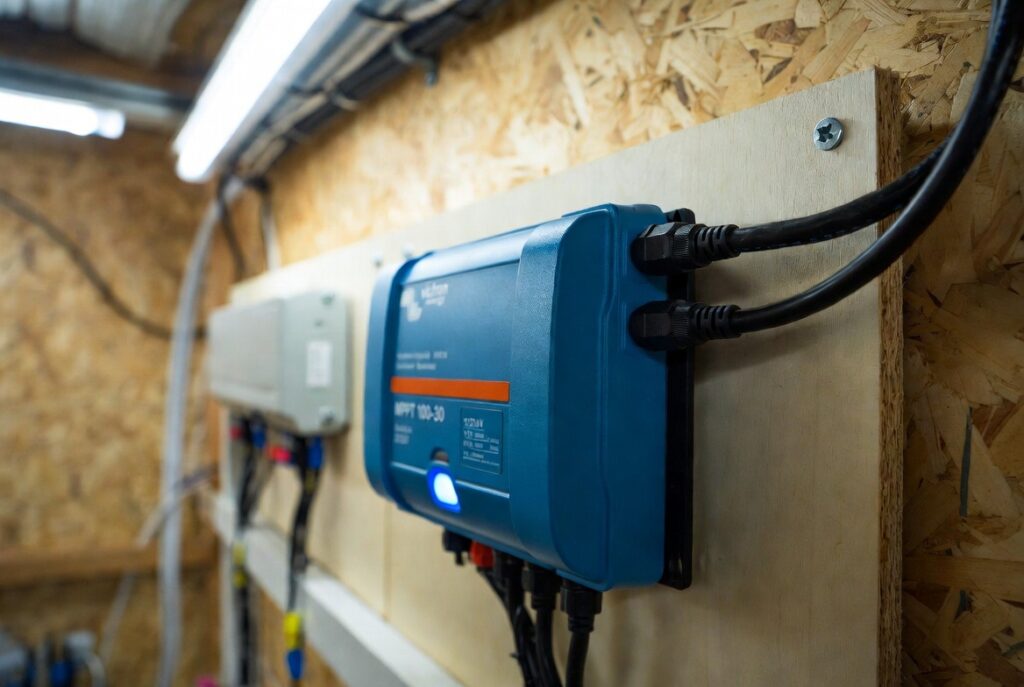
A solar charge controller regulates voltage from your panels to your battery, and without one the battery dies within weeks. Even a single 100W panel pushes 24.3V open-circuit voltage into a 12V battery continuously. That unregulated voltage holds the battery above 14.8V for hours, boiling off electrolyte and destroying capacity. The solar charge controller prevents this by cycling through bulk, absorb, and float charging stages.
The two types of solar charge controller are PWM and MPPT. PWM is cheaper but wastes excess panel voltage as heat, losing up to 30 percent of potential harvest. MPPT converts that excess voltage into additional charging amperage, recovering 15 to 30 percent more energy from the same panels. In Ontario, where cold temperatures push panel voltage well above STC ratings, the MPPT advantage compounds through every winter month.
This guide covers how the solar charge controller protects your battery and when to choose MPPT over PWM. It also explains how to size for Ontario’s cold Voc reality. If you are building your first system, start with our solar power system guide for the full sizing sequence.
| Feature | PWM Controller | MPPT Controller |
|---|---|---|
| Cost | $30 to $80 | $100 to $400 |
| Efficiency | 70 to 80 percent | 93 to 97 percent |
| How it works | Chops voltage to match battery | Converts excess voltage to amperage |
| Ontario winter advantage | None, wastes cold Voc spike | Harvests cold Voc as extra current |
| Best for | Systems under 200W | Systems 200W and above |
| Example | Renogy Starter Kit PWM | Victron MPPT 100/30 or 100/50 |
What a solar charge controller does and why every system needs one
A solar charge controller regulates the voltage flowing from your panels to your battery. It prevents overcharge by switching through three stages: bulk, absorb, and float. Without this regulation, a panel’s open-circuit voltage pushes directly into the battery with no limit. A single Renogy 100W Monocrystalline Panel at 24.3V can ruin a 12V battery in three weeks.
The solar charge controller also blocks reverse current at night. Without it, stored energy flows backward from the battery into the panel after sunset. That silent drain reduces your available power every morning. Even the cheapest $35 PWM controller stops this loss completely.
Bulk, absorb, and float charging stages explained
Bulk stage sends maximum available current into the battery until voltage reaches 14.4V for AGM or 14.6V for LFP. This is the most aggressive phase, designed to restore lost capacity quickly. The solar charge controller monitors voltage continuously during this stage. It transitions to absorb once the target is reached.
Absorb stage holds voltage steady while current gradually tapers as the battery fills. Float stage then drops voltage to 13.5V to maintain full charge without stress. These three stages prevent sulphation and extend solar battery lifespan significantly. Our charge controller settings guide covers the exact values for each chemistry.
MPPT versus PWM solar charge controller selection
PWM controllers chop the panel voltage down to match the battery voltage. The difference is wasted as heat. At 70 to 80 percent efficiency, a PWM controller on a 200W array loses 40 to 60 Wh daily. PWM works for small systems under 200W where the voltage gap is narrow.
MPPT controllers convert excess panel voltage into additional charging amperage. That conversion runs at 93 to 97 percent efficiency. In Ontario winter, cold temperatures push Voc 15 percent above STC, and the MPPT captures that bonus as usable current. Our MPPT charge controller selection guide covers the full comparison.
Cold Voc and why Ontario winters change controller sizing
Panel voltage rises as temperature drops because silicon cells become more efficient in cold conditions. A Renogy 100W panel rated at 24.3V STC climbs to approximately 28V at negative 10 degrees C. Two panels in series produce 56V at cold temperatures. Four panels in series hit 114V, exceeding most 100V controllers.
The solar charge controller’s max PV input voltage must exceed the cold-corrected string voltage. Always multiply STC Voc by 1.15 for Ontario winter estimates. The Victron MPPT 100/30 accepts up to 100V input. Check our solar panel wiring guide before connecting any series string.
The Perth County PWM-to-MPPT upgrade
A cottage owner in Perth County ran two Renogy 100W panels through a $35 PWM controller on a 12V system. The system worked adequately through summer at 5.5 PSH. When November arrived and production dropped to 2.0 PSH, the PWM wasted 40 percent of available voltage as heat. The Victron SmartShunt showed daily harvest dropping to 160 Wh from a 200W array.
I replaced the PWM with a Victron MPPT 100/30. The same two panels on the same day immediately produced 218 Wh. That is a 36 percent increase from identical hardware with only the controller changed. The MPPT converted excess panel voltage into additional charging amperage.
Over the full winter, the MPPT harvested 28 percent more energy than the PWM had delivered the previous year. The $130 cost difference paid for itself in one season of improved battery health. Battery SOC never dropped below 55 percent that winter compared to 35 percent lows the year before. The upgrade extended the battery’s projected lifespan by at least two years.
The Lanark County no-controller failure
A first-time builder in Lanark County connected a single Renogy 100W panel directly to a 100Ah AGM battery. He assumed one small panel could not overcharge a large battery. The panel’s 24.3V Voc pushed unregulated voltage into the 12V battery continuously. He had no SmartShunt or voltage monitor to track the damage.
Within three weeks, the AGM battery began gassing through its pressure relief valves. The unregulated voltage held the battery above 14.8V for hours each day. That is over half a volt past the safe absorption limit of 14.4V for AGM chemistry. The battery lost 30 percent of its capacity permanently from sustained overcharge.
The $250 AGM battery was ruined in 21 days to save $35 on a PWM controller. A $35 PWM would have capped voltage at 14.4V and protected the battery completely. A $130 Victron MPPT 100/30 would have done the same while harvesting 25 percent more energy. The solar charge controller is the cheapest insurance in any off-grid build.
NEC and CEC code requirements for charge controller installations
NEC 690.8 requires proper overcurrent protection and conductor sizing for all solar charge controller circuits. The controller’s maximum input voltage rating must exceed the cold-corrected Voc of the connected array. An installation that exceeds the controller’s rated input creates a fire hazard from sustained over-voltage. Contact the NFPA at nfpa.org for current NEC 690 requirements.
CEC Section 64 mandates that all off-grid solar installations in Ontario be permitted through the ESA. Systems exceeding 250 volts or 10 amps require formal inspection. Skipping permits risks insurance denial and legal liability for any electrical incident. Contact the Electrical Safety Authority at esasafe.com before installing any solar charge controller.
Pro Tip: Before buying a solar charge controller, calculate your cold Voc first. Multiply each panel’s STC Voc by the number of panels in series, then multiply by 1.15. If the result exceeds 100V, you need either a higher-rated controller or a series-parallel string layout. The $12 MC4 branch connector that splits your string is cheaper than a $500 controller replacement.
Solar charge controller verdict: never skip, always size for cold
- Beginners with one or two panels under 200W: Buy the Renogy 100W Starter Kit with its included PWM controller. It is the simplest entry point with no compatibility risk. Upgrade to MPPT when your system grows past 200W.
- Cottage and workshop builders with 200W to 700W: Buy a Victron MPPT 100/30 or Victron MPPT 100/50. The MPPT harvests 25 to 30 percent more energy than PWM in Ontario winter. Always verify cold Voc stays under the controller’s 100V input limit.
- Full off-grid home builders with 700W or more: Buy a 150V or 250V rated MPPT controller. Series strings in Ontario winter easily exceed 110V on larger arrays. Professional sizing and ESA permitting are mandatory at this scale.
Frequently asked questions
Q: Do I need a charge controller for one solar panel?
A: Yes. Even a single Renogy 100W panel can overcharge a 12V battery within days. The open-circuit voltage of 24.3V far exceeds the safe absorption limit of 14.4V. A $35 PWM controller costs less than replacing a ruined $250 AGM battery.
Q: Is MPPT worth the extra cost over PWM?
A: Yes, for any system above 200W. In Ontario winter, MPPT harvests 25 to 30 percent more energy by converting excess voltage into amperage. That gain pays back the $100 cost difference within one season through improved battery health.
Q: What size charge controller do I need?
A: Match the controller’s amp rating to your total array output current. Then calculate cold Voc by multiplying STC voltage by 1.15 to verify your string stays under the controller’s max input. Our MPPT charge controller selection guide covers sizing in detail.
This build is engineered within the 48V DC Safety Ceiling. Diagnostic logic is based on 20+ years of technical service experience. All structural and electrical installations must be verified by a Licensed Professional and comply with your Local AHJ. See our legal and safety disclosure for full scope.
About the Author
Robert Bertrand spent 20 years as a service advisor in the automotive industry (Lexus and Nissan), where precision diagnostics, wiring integrity, and documentation standards were non-negotiable. He brings that same technical discipline to GridFree Guide, where he researches, tests, and documents off-grid solar systems for Ontario conditions. Based in Rockwood, Ontario, every article is built on verified specifications, manufacturer data, and the real-world climate constraints of Canadian off-grid living.
As an Amazon Associate I earn from qualifying purchases. This site also contains affiliate links to other products and services. GridFree Guide earns a small commission at no extra cost to you.