
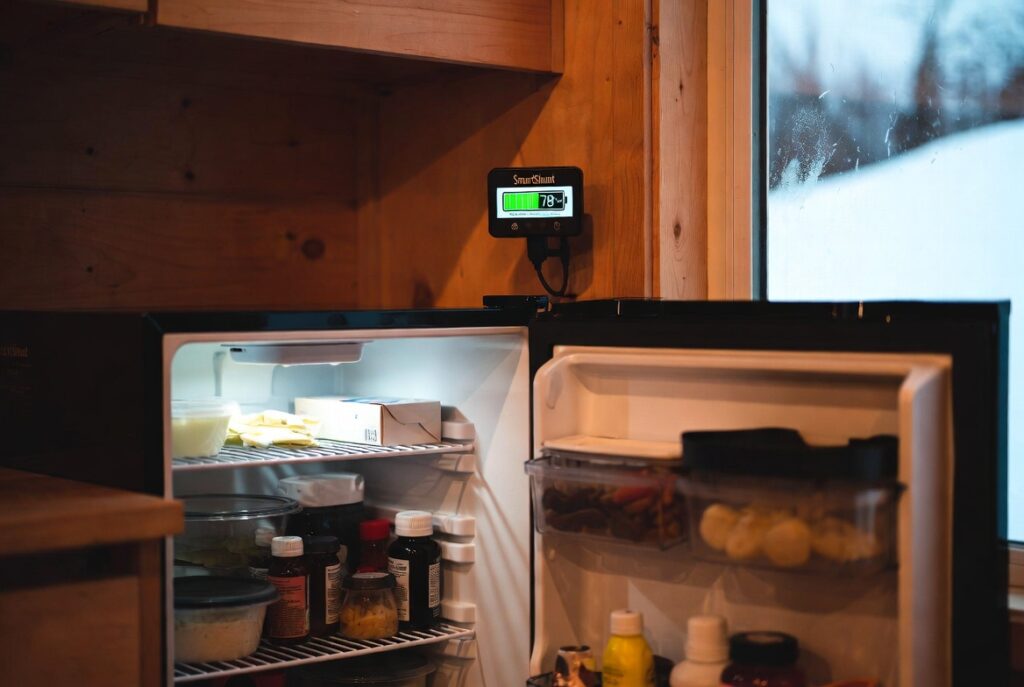
The solar fridge ontario question that most Ontario property owners get wrong is not how many panels they need but whether their existing bank is large enough to run a fridge through a 4-day Ontario November gray streak, because the property owner in Haliburton County who added a standard 18 cu ft fridge to his Tier 1 200W cabin system discovered within one October weekend that his 100Ah LFP bank was depleted to 8 percent SoC by Saturday morning after running the fridge from Thursday afternoon through Friday night.
His existing Tier 1 system was correctly sized for lights, pump, and phone charging at approximately 190Wh daily. A standard 18 cu ft fridge adds approximately 1,800Wh per day to the system load. The Tier 1 100Ah bank holds approximately 1,280Wh of usable capacity, less than one day of fridge-only load.
The SmartShunt told the story in numbers. At approximately 1,990Wh total daily load (fridge plus lights, pump, and charging), the 100Ah bank was depleted at a rate of approximately 710Wh more per day than the 200W array could replenish at October irradiance levels. The bank reached 8 percent SoC in approximately 36 hours , faster than any gray streak, and on a weekend with no generator available. The fix was a Tier 2 upgrade: 400W array, 200Ah bank, MPPT 100/50.
The solar fridge ontario reality is that a fridge is the single largest load in any Ontario off-grid system. At 1,080Wh per day for an efficient 45W 12V DC unit or 1,800Wh per day for a standard AC fridge, the fridge load alone exceeds the entire lights-only daily draw of the Tier 1 specification by 5 to 9 times. Any Ontario property owner adding a fridge to an existing system must recalculate the entire specification , array size, bank capacity, charge controller rating, and gray streak autonomy , before connecting the fridge. See our Ontario solar sizing guide before any solar fridge ontario installation.
The solar fridge ontario load reality: 1,080Wh daily for an efficient fridge, 1,800Wh for a standard model
| Fridge type | Running draw | Daily hours | Daily Wh | Ontario Tier required |
|---|---|---|---|---|
| Efficient 12V DC off-grid fridge | 45W | 24 hours | 1,080Wh | Tier 2 (400W, 200Ah) |
| Standard 18 cu ft AC fridge | 150W | 12 hours compressor | 1,800Wh | Tier 2+ or 12V swap |
| Mini fridge (small cabin) | 25W | 24 hours | 600Wh | Tier 2 minimum |
| Lights + pump + phone only (no fridge) | varies | varies | 190Wh | Tier 1 (200W, 100Ah) |
The real daily load numbers confirm why adding a fridge changes everything. An efficient 45W 12V DC off-grid fridge running 24 hours consumes approximately 1,080Wh per day. A standard 18 cu ft AC fridge drawing 150W through 12 hours of compressor cycles consumes approximately 1,800Wh per day. Both loads exceed the entire Tier 1 lights-only daily draw of 190Wh by factors of 5 to 9. The fridge is not a supplemental load , it is the dominant load in any Ontario off-grid system that includes one.
The reason the fridge load is so much larger than most Ontario property owners expect is that the fridge is the only load that runs all 24 hours. Lights run for 5 hours. The water pump runs for 30 minutes. Phone charging runs for 3 hours. The fridge compressor cycles all night, drawing from the bank during the 12 to 16 hours of Ontario darkness when no solar input is available. Every other load stops at some point. The fridge does not. See our Ontario cabin solar guide for the full Tier 1 to Tier 2 progression.
The Ontario Tier 2 specification: 400W array, MPPT 100/50, and 200Ah heated LFP
| Spec | Tier 1 (no fridge) | Tier 2 (with fridge) |
|---|---|---|
| Array | 200W (2 x Renogy 100W) | 400W (4 x Renogy 100W) |
| Charge controller | MPPT 100/30 | MPPT 100/50 |
| Battery bank | 100Ah LFP | 200Ah heated LFP (2 x Battle Born 100Ah) |
| Daily load capacity | 190Wh (lights only) | 1,080Wh+ (fridge + lights + pump) |
| Gray streak autonomy | 6.7 days | 1.2 days fridge-only; 2.2 days with partial solar |
The correct Ontario fridge solar specification is a 400W array (four Renogy 100W panels), a Victron MPPT 100/50 charge controller, a 200Ah Battle Born heated LFP bank (two 100Ah units), and the SmartShunt on the battery negative terminal. The MPPT 100/50 handles the 400W array output at 12V , the MPPT 100/30 is undersized for this configuration at peak summer output. The heated LFP bank is mandatory for any Ontario cabin that is not climate-controlled year-round for the same reason as the cabin system: BMS charge block at 0 degrees C.
At 1,080Wh daily efficient fridge load and 1.5 PSH January harvest of approximately 510Wh from the 400W array, the net daily draw from the bank is approximately 570Wh. The 200Ah bank (1,280Wh usable at 80 percent DoD at 12V) provides approximately 2.2 days of net fridge-only autonomy when the panel is contributing at the January clear-day rate. Without any panel input during a gray streak, the same bank provides approximately 1.2 days of fridge-only reserve. Any Ontario gray streak beyond 2 days at fridge loads requires a generator top-up. See our Ontario battery generator guide for the hybrid backup plan.
The solar fridge ontario January problem: 1.5 PSH and why 200Ah is the minimum bank for fridge operation
Ontario January averages approximately 1.5 peak sun hours per day. A 400W array harvests approximately 510Wh on a clear January day , covering approximately 47 percent of the 1,080Wh daily efficient fridge load, with the bank covering the remaining 570Wh. During a 5-day November gray streak at approximately 25Wh daily array output, the bank carries approximately 1,055Wh of the 1,080Wh daily fridge load every day. The 200Ah bank provides approximately 1.2 days of unassisted fridge-only reserve from a full charge , enough buffer for a 1 to 2 day weather event, but not a standard 4 to 5 day Ontario gray streak without panel contribution or generator top-up.
The Haliburton property owner confirmed this after the Tier 2 upgrade. With the 400W array, MPPT 100/50, and 200Ah bank installed, the SmartShunt showed stable bank performance through the first October gray streak: the panel contributed approximately 200Wh per day during the overcast period, the bank depleted at approximately 880Wh per day net, and the 1,280Wh usable bank provided approximately 1.5 days of autonomy before dropping below 50 percent SoC. The difference from the original Tier 1 outcome was not just survival time , it was the ability to monitor the depletion rate on the SmartShunt display and make a generator decision before the bank was critically depleted. See our Ontario winter solar guide for the full gray streak protocol.
The 12V DC fridge upgrade: why one swap beats adding two more panels
The single biggest improvement for any Ontario property owner running a standard AC fridge on solar is not more panels , it is switching to a purpose-built 12V DC compressor fridge. A standard AC fridge draws approximately 1,800Wh daily. A 12V DC off-grid compressor fridge draws approximately 200 to 400Wh daily , a 65 to 80 percent reduction in the single largest load in the system. The switch converts a Tier 2 problem back into a Tier 1 solution.
A property owner on the Grey Bruce Peninsula made exactly this switch. His existing 200W Tier 1 system could not sustain his standard AC fridge through any Ontario gray streak , the same pattern as Haliburton County, confirmed by SmartShunt depletion data. After switching to a purpose-built 12V DC off-grid compressor fridge drawing approximately 300Wh daily, the SmartShunt showed the existing 200W array and 100Ah LFP bank now providing approximately 3-day gray streak autonomy including the fridge load. The daily total load dropped from approximately 1,990Wh to approximately 490Wh.
The 12V DC compressor fridge is more efficient for two compounding reasons. First, it eliminates the DC-to-AC inverter conversion loss , every AC inversion costs approximately 10 to 15 percent of the energy drawn, which the 12V fridge bypasses entirely. Second, the 12V DC compressor is designed for variable-voltage DC input from a solar bank , it runs efficiently across the 11V to 14.6V operating range of a 12V LFP bank without the performance degradation that AC fridges experience when powered through modified-sine-wave inverters. See our Ontario solar storage guide for the full LFP bank specification.
NEC and CEC: Ontario permit requirements for off-grid fridge wiring
NEC 690 and NEC 690.9 cover fridge wiring in a solar fridge ontario system. Any permanently wired fridge connected to an off-grid solar bank requires correct overcurrent protection , a Class T fuse within 18 inches of the battery positive terminal per NEC 690.9. The fridge compressor surge current at 3 to 5 times running wattage must not trip the overcurrent protection during normal startup. A correctly sized Class T fuse rated for 125 percent of the maximum continuous fridge draw plus surge headroom is required.
For an AC fridge drawing 150W running current, the Class T fuse must be rated for at least 125 percent of the maximum inverter input current at full fridge surge draw. Contact the NFPA at nfpa.org for current NEC 690 requirements.
CEC Section 64 governs Ontario electrical installations. A permanently wired off-grid fridge connection requires an ESA permit before installation begins. The ESA inspector will verify the overcurrent protection placement within 18 inches of the battery positive terminal, the inverter rating if an AC fridge is used, and the conductor sizing for the fridge circuit. A 12V DC fridge wired directly to the battery bank through a fused connection is a simpler installation than an AC fridge through an inverter, but both require an ESA permit for permanent wiring. Contact the Electrical Safety Authority Ontario at esasafe.com before beginning any permanently wired Ontario off-grid fridge installation.
Pro Tip: Before connecting any fridge to an Ontario off-grid system, run the SmartShunt for one full 24-hour cycle with the fridge as the only connected load. Record the daily Wh draw displayed on the SmartShunt. This confirms the actual fridge consumption in your specific Ontario ambient temperature , cold Ontario cabins cause the compressor to run less frequently than in warm kitchens, so the real draw may be 10 to 20 percent lower than the nameplate rating. Use the confirmed SmartShunt number, not the nameplate, for your system sizing calculation.
The solar fridge ontario verdict: Tier 2 for AC fridge, 12V DC fridge for Tier 1 systems
- Ontario property owner running a standard AC fridge on an existing Tier 1 200W system: upgrade to Tier 2 before the next gray streak. The Haliburton result confirmed: 36 hours to 8 percent SoC at combined fridge and cabin loads. The Tier 2 specification is four Renogy 100W panels, MPPT 100/50, and 200Ah Battle Born heated LFP bank. Add a generator backup plan for any Ontario gray streak beyond 2 days at fridge loads. The SmartShunt confirms the bank depletion rate and tells you exactly when to start the generator before the bank is critically low.
- Ontario property owner building a new system with a fridge from day one: specify Tier 2 from the start, not Tier 1 with a future upgrade plan. At 1,080Wh daily efficient fridge load, the 400W array covers approximately 47 percent of the daily draw on a clear January day. The 200Ah bank carries the rest and provides approximately 1.2 days of unassisted fridge reserve. Size the system for the January baseline, not the summer peak , Ontario winter conditions are the design constraint for any solar fridge ontario system that must operate year-round.
- Ontario property owner who wants to run a fridge on an existing Tier 1 system without a full Tier 2 upgrade: switch to a purpose-built 12V DC compressor fridge first. The Grey Bruce result confirmed: the switch from a standard AC fridge (1,800Wh daily) to a 12V DC off-grid fridge (300Wh daily) dropped the total daily system load from approximately 1,990Wh to approximately 490Wh, and the existing Tier 1 200W system provided 3-day gray streak autonomy including the fridge load. The 12V fridge swap costs less than the Tier 2 upgrade and delivers more gray streak resilience at any system level.
Frequently Asked Questions
Q: How many solar panels do I need to run a refrigerator off-grid in Ontario?
A: For an efficient 45W 12V DC off-grid fridge drawing 1,080Wh daily, the correct solar fridge ontario specification is a 400W array , four Renogy 100W panels producing approximately 510Wh on a clear January day at 1.5 PSH. This covers approximately 47 percent of the daily fridge load on clear days; the 200Ah LFP bank covers the rest. A standard 18 cu ft AC fridge drawing 1,800Wh daily requires the same 400W array minimum plus a generator backup plan for Ontario gray streaks beyond 2 days. A 200W array alone cannot sustain any fridge through an Ontario gray streak , the Haliburton result confirmed: 36 hours to 8 percent SoC with a 200W array and standard fridge running simultaneously.
Q: Can I run a standard home fridge on a 200W solar system in Ontario?
A: No. A standard 18 cu ft AC fridge draws approximately 1,800Wh per day , more than the entire usable capacity of the Tier 1 100Ah LFP bank (1,280Wh usable) in a single day. A 200W array at Ontario January irradiance produces approximately 255Wh per clear day, covering approximately 14 percent of the fridge’s daily draw. The bank would reach critical depletion within 36 to 48 hours of adding the fridge to an existing Tier 1 solar fridge ontario system , confirmed by the Haliburton SmartShunt data. The correct options are: upgrade to the Tier 2 400W, 200Ah specification, or switch to a 12V DC off-grid compressor fridge drawing approximately 300Wh daily.
The Tier 1 system sustains the 12V DC fridge through 3-day gray streaks.
Q: What is the most efficient fridge for an Ontario off-grid solar system?
A: A purpose-built 12V DC compressor fridge is the most efficient option for any Ontario solar fridge ontario system. It draws approximately 200 to 400Wh daily versus approximately 1,080 to 1,800Wh for AC fridges. That is a 65 to 80 percent reduction.
The 12V DC fridge eliminates the DC-to-AC inverter conversion loss of approximately 10 to 15 percent per inversion, and the 12V DC compressor is designed for variable-voltage solar bank input across the full 11V to 14.6V operating range. The Grey Bruce result confirmed: switching from an AC fridge to a 12V DC compressor fridge on an existing Tier 1 system changed the gray streak autonomy from less than 2 days to approximately 3 days at the same 200W array and 100Ah bank specification.
This build is engineered within the 48V DC Safety Ceiling. Diagnostic logic is based on 20+ years of technical service experience. All structural and electrical installations must be verified by a Licensed Professional and comply with your Local AHJ. See our legal and safety disclosure for full scope.
About the Author
Robert Bertrand spent 20 years as a service advisor in the automotive industry (Lexus and Nissan), where precision diagnostics, wiring integrity, and documentation standards were non-negotiable. He brings that same technical discipline to GridFree Guide, where he researches, tests, and documents off-grid solar systems for Ontario conditions. Based in Rockwood, Ontario, every article is built on verified specifications, manufacturer data, and the real-world climate constraints of Canadian off-grid living.
As an Amazon Associate I earn from qualifying purchases. This site also contains affiliate links to other products and services. GridFree Guide earns a small commission at no extra cost to you.