
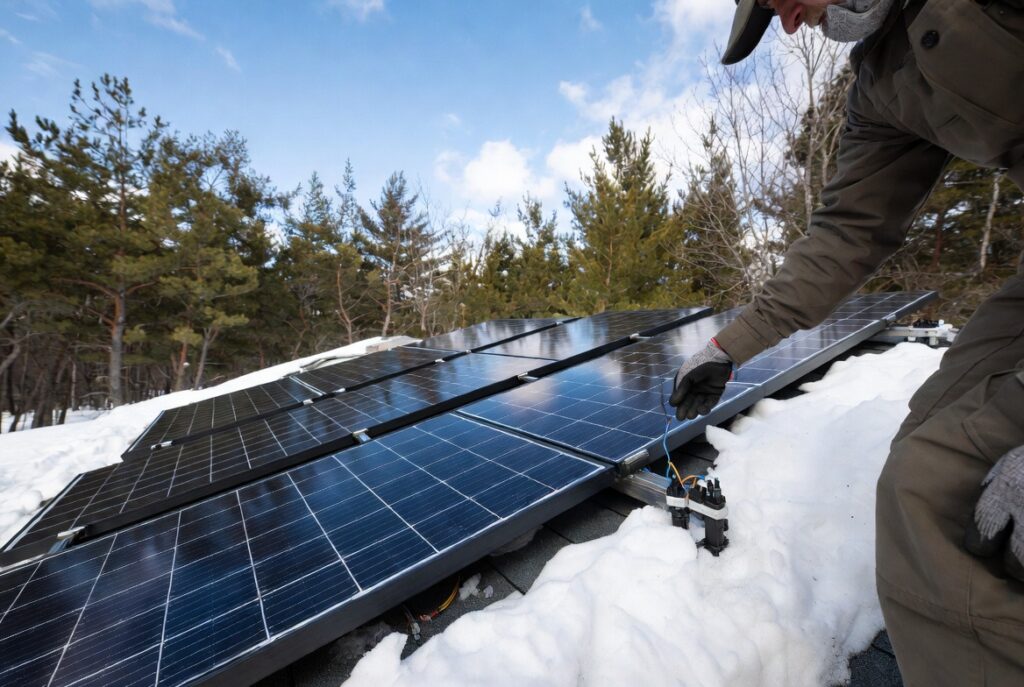
The spring solar Ontario commissioning failure that costs the most production in the first week of the season is not a dead inverter or a failed panel but three MC4 connectors on a north-facing roof run in Lanark County whose locking collars had been physically backed off by six months of Ontario freeze-thaw cycles. The cabin owner ran the system on the first clear April day and the Cerbo GX VRM comparison to the previous spring baseline showed 16kWh instead of 20kWh, a 20 percent shortfall pointing to resistance in the array circuit rather than a component failure.
Freeze-thaw cycling causes metal components to expand and contract repeatedly across the approximately minus 30 to plus 10 degrees C range that Ontario experiences between November and April. Every threaded collar, every bolted lug, and every crimped terminal in the system experiences that cycling.
The spring solar Ontario 8-point checklist covers the eight failure modes that freeze-thaw cycling, cold soak, and winter debris introduce into Ontario off-grid systems between October and April. The checklist runs in order of production impact: MC4 connectors first because they are the most frequent cause of spring production shortfall, followed by SmartShunt SoC verification to confirm battery health after winter storage, and then the six remaining checks that together take less than 2 hours. Most systems come through the Ontario winter without any of the eight issues. Running the checklist is a 2-hour investment that confirms all eight are clear before depending on the system for the high-production months.
The three connectors in Lanark County did not survive the winter unchanged, and 20 minutes of tightening restored 4kWh of daily production. That result is the reason the spring solar Ontario MC4 check comes first on this list every year. A production shortfall that the Cerbo GX VRM year-over-year comparison identifies in the first week of April is almost always a connection issue rather than a hardware failure. See our Ontario solar sizing guide before beginning any spring solar Ontario commissioning.
The spring solar Ontario MC4 check: freeze-thaw collar loosening and the Lanark County 20% shortfall
| Check | Time required | Tool needed | Production impact if skipped |
|---|---|---|---|
| 1. MC4 connector torque | 15 to 20 min | Hand check under load | Up to 25% per affected string |
| 2. SmartShunt SoC verify | 1 full cycle (24,48 hr) | SmartShunt display | Up to 13% capacity hidden loss |
| 3. Class T fuse inspect | 5 min | Visual + wire brush | Intermittent charging faults |
| 4. Panel surface clean | 20 min | Water + soft cloth | Up to 30% per 10% coverage |
| 5. Array tilt adjust | 10 to 15 min | Angle finder or phone | 15 to 20% summer loss |
| 6. Battery terminal torque | 5 min | Torque wrench | Arc risk at first high-current day |
| 7. MPPT firmware update | 5 min | VictronConnect app | Algorithm efficiency loss |
| 8. Cerbo GX VRM verify | 5 min | VRM portal browser | Missed auto-start in rainy week |
The cabin owner in Lanark County noticed production was 20 percent below the previous spring baseline on the first clear April day in 2024. Full sun days showed approximately 16kWh instead of the expected 20kWh confirmed on the Cerbo GX VRM year-over-year comparison. The shortfall was consistent across multiple clear days, ruling out cloud cover as the cause. A physical inspection on a load afternoon revealed three MC4 connectors on the north-facing roof run were warm to the touch, confirming high-resistance joints from freeze-thaw collar loosening over the Ontario winter.
Re-seating and torquing all three collars until the locking tabs clicked restored production to the 20kWh full-sun baseline on the same afternoon. The SmartShunt confirmed the current increase immediately after the collars were tightened, showing an additional 3.4A of array current reaching the bank. The fix took 20 minutes and zero dollars. His comment: “Three connectors, 20 minutes, and we went from 16 to 20 kilowatt-hours. The freeze-thaw cycle is the Ontario spring enemy.”
To perform the spring solar Ontario MC4 torque check, run a hand along each accessible connector under load on a sunny day. Warm means resistance. Re-seat the collar until the locking tab clicks; if the connector shows discoloration or nylon cracking, replace the housing. A single high-resistance connection in a series string reduces that entire string’s current , in a 4-panel series string, one bad MC4 can reduce the full 400W string to approximately 300W, a 25 percent loss on that circuit. See our Ontario MC4 connector guide for the full freeze-thaw connector protocol.
The spring solar Ontario SmartShunt check: cold soak capacity and the Norfolk County battery fix
A Norfolk County owner found their 100Ah LFP bank displaying 87Ah on the SmartShunt after a full charge in the first week of April 2024. The bank had been stored in an unheated garage from October through April at temperatures that dropped to approximately minus 15 degrees C during the January cold snap. The 13 percent capacity reduction was not damage , it was cold soak chemistry. LFP cells that have been cold-soaked below minus 10 degrees C for extended periods require full thermal equalisation at room temperature before their rated capacity is available on the SmartShunt display.
Moving the bank to a heated utility room for 48 hours and performing a slow full recharge cycle at room temperature restored the SmartShunt display to 99Ah on the next full charge, within 1 percent of the 100Ah nameplate. No component replacement was required. The spring solar Ontario cold soak result confirms the same pattern as the Simcoe County Jackery result from winter: cold-soaked cells are not damaged, they are temporarily reduced. The chemistry restores fully when the cells return to above 0 degrees C and complete a full charge cycle. His comment: “The battery wasn’t dead. It was just cold. Forty-eight hours indoors and it was back.”
To perform the spring SmartShunt SoC verification, run the bank down to approximately 20 percent SoC under a known load, then perform a full recharge to 100 percent SoC. Record the SmartShunt displayed capacity after the full charge and compare to nameplate.
A reading within 5 percent of nameplate confirms the bank is healthy. A reading more than 5 percent below nameplate after 48 hours of indoor temperature equalisation indicates genuine cell loss rather than cold soak, at which point the bank needs assessment before the season begins. Cold soak is temporary; cell loss is not, and the 48-hour indoor warmup test distinguishes between the two. See our Ontario LiFePO4 battery guide for the full cold storage and capacity assessment protocol.
Check 3: Class T fuse and terminal lug oxidation
Ontario spring humidity accelerates copper oxidation on exposed fuse terminal lugs. Grey-white oxidation on the copper lug surface increases contact resistance and creates a voltage drop between the fuse terminal and the conductor that can cause intermittent charging faults and reduced production without producing a clear fault code on the Cerbo GX. A fuse terminal with visible oxidation should be cleaned with a wire brush and retorqued, or the fuse replaced if the oxidation is heavy. The spring fuse inspection takes less than 5 minutes and requires no tools beyond a visual check and a wire brush.
Remove the fuse holder cover, inspect the fuse element visually, and check both copper lug surfaces on the Blue Sea 600A Class T. A fuse showing a clean copper colour on both lugs is serviceable. A fuse with grey-white oxidation on either lug needs cleaning or replacement. A Blue Sea 600A Class T costs approximately $40 and replacement takes less than 10 minutes. This is not the component to defer to next season , an oxidised lug that passes the spring inspection without cleaning may fail to a hard voltage drop when summer current levels push 50A through the same resistance that was marginal at 20A winter output. See our Ontario solar fuse guide for the full fuse inspection protocol.
Check 4 and 5: panel surface cleaning and array tilt readjustment
Ontario winters deposit salt residue from road spray and organic debris including pine needles and windblown organic matter on panel surfaces. A 10 percent surface coverage from winter debris reduces production by approximately 30 percent, meaning a 400W array producing 280W on a clear day rather than 400W. Plain water and a soft cloth restore the efficiency baseline in approximately 20 minutes. Avoid abrasive cleaners or scrubbing pads on the glass surface , the anti-reflective coating that contributes approximately 2 to 3 percent of the panel’s efficiency rating is easily scratched.
Array tilt readjustment is the second spring solar Ontario mechanical check that directly impacts production through the peak season. A panel set to 60 degrees for winter low-angle sun production loses approximately 15 to 20 percent of summer production versus a 30 to 35 degree summer setting. The readjustment takes 10 to 15 minutes per panel mount and adds approximately 2 to 3 additional daily kWh during the June through August peak production window. A 400W array at the correct summer tilt produces approximately 2.2kWh per hour during peak production versus approximately 1.8kWh per hour at winter tilt , a 22 percent daily improvement over the entire summer season.
Check 6: battery terminal torque and the spring arc risk
A terminal lug correctly torqued in November may have physically loosened through the expansion and contraction of Ontario’s winter temperature swings. A loose lug under load creates a resistance heating event identical to the MC4 connector failure pattern: current flows through a high-resistance joint, the joint heats from resistive losses, and the connection degrades progressively until it arcs or fails completely. The battery terminal torque check is a 5-minute task covering every positive and negative lug connection on the battery bank, the busbar, and the SmartShunt. A lug that moves when hand pressure is applied needs to be retorqued before the season begins.
The spring arc risk from a loose lug is highest during the first high-production day of the season when MPPT current levels return to summer values. A lug that was barely adequate at 20A winter MPPT output may generate enough heat to arc at 50A summer MPPT output. The spring terminal torque check eliminates this risk in 5 minutes before the first high-current day arrives. Every connection on the bank , positive and negative, battery terminals, busbar, SmartShunt body terminal , gets a physical check and retorque if it moves under hand pressure.
Check 7 and 8: MPPT firmware and Cerbo GX VRM verification
Open VictronConnect and navigate to the MPPT 100/50 firmware section. If an update is available, apply it during a non-production period such as late evening or early morning. The update takes approximately 5 minutes and does not require the system to be shut down. Spring firmware releases from Victron frequently include algorithm improvements for the longer daylight hours and higher irradiance of the April through August production window. Applying the firmware before the season begins ensures the MPPT is running the current charging algorithm for the entire peak production period.
Log in to the VRM portal and confirm the Cerbo GX is logging current data. Verify that the generator auto-start threshold is set correctly , the Ontario standard is 20 percent SoC as the trigger for generator start during a sustained low-production period. A threshold that drifted during a firmware update or configuration reset will leave the bank depleted during a rainy April week without triggering the backup generator. The Cerbo GX VRM check takes less than 5 minutes and confirms the full system is communicating and configured correctly before the season begins. See our Ontario Victron solar guide for the full VRM configuration checklist.
NEC and CEC: Ontario permit requirements and spring inspection standards
Spring maintenance on a permanently wired Ontario solar system does not require a new ESA permit. The 8-point spring solar Ontario checklist involves inspection, cleaning, tightening, and firmware updates , none of which modify the permanent wiring of the installation. The existing ESA permit covers the system as wired and approved. Contact the NFPA at nfpa.org for current NEC 690 requirements applicable to Ontario off-grid solar systems.
Any modification to the permanent wiring during the spring commissioning process , adding panels, replacing the MPPT with a different model, changing conductor sizing, or adding a new circuit , requires an ESA permit update under CEC Section 64 before the modification is made. The permit requirement applies to modifications, not maintenance. Retorquing existing lugs, replacing a like-for-like fuse, and updating firmware are all maintenance activities that fall outside the CEC Section 64 permit requirement. Contact the Electrical Safety Authority Ontario at esasafe.com before beginning any wiring modification to a spring solar Ontario installation.
Pro Tip: Set up the Cerbo GX VRM historical baseline during the spring commissioning, not after the first production anomaly. Log in to the VRM portal on the first clear May day and record the daily production figure. This becomes the spring solar Ontario performance baseline for next year. When the following April produces 16kWh on what should be a 20kWh day, the VRM comparison to last year’s baseline identifies the shortfall immediately. The Lanark County owner who had the baseline caught a 20 percent production loss in the first week of spring. An owner without the baseline would have assumed the lower number was normal and lost 4kWh per day for the entire season.
The spring solar Ontario verdict: 8 points, 2 hours, and why the MC4 check comes first
- Ontario property owner performing spring commissioning for the first time: run all 8 points in order. The MC4 check and the SmartShunt SoC verification together catch 80 percent of the production-impacting issues that Ontario winters introduce. The other 6 checks take less than 30 minutes combined. The Lanark County result: 3 loose MC4 collars, 20 percent production shortfall, 20 minutes to fix, 4kWh per day restored. The Norfolk County result: 87Ah cold soak reduced to 99Ah after 48 hours indoors, no component replacement.
- Ontario property owner who experienced an unexplained production shortfall last spring: start with the MC4 check and set up the VRM baseline this season. The Lanark County shortfall was only identifiable because the Cerbo GX VRM had last year’s production data to compare against. Without the year-over-year comparison, 16kWh on a clear day looks like a weather issue rather than a connection issue. Set up the spring solar Ontario VRM historical baseline this April so next spring’s comparison is available from the first clear day.
- Ontario property owner whose LFP battery is showing below-nameplate capacity in spring: move the bank indoors for 48 hours before replacing any cells. The Norfolk County result confirmed 99Ah restored from 87Ah with no component replacement , a full 12Ah recovered from cold soak reduction alone. Cold soak is temporary; genuine cell loss is not. The 48-hour indoor warmup test and a slow full recharge cycle distinguish between the two before any component cost is incurred. If the capacity is still below 95 percent of nameplate after the warmup and full recharge, the bank needs assessment.
Frequently Asked Questions
Q: Why is my solar production lower in spring than last spring in Ontario?
A: The most common spring solar Ontario production shortfall cause is high-resistance MC4 connections loosened by freeze-thaw cycling over the Ontario winter. A single high-resistance connection in a series string reduces the entire string’s current and can drop production by up to 25 percent on that circuit. The diagnostic is a physical check on a load day: run a hand along each accessible MC4 connector and identify any that are warm to the touch. The Lanark County result confirms: three warm connectors caused a 20 percent whole-system production shortfall, and 20 minutes of retorquing restored the full baseline.
The second most common cause is panel surface debris , 10 percent surface coverage reduces production by approximately 30 percent and is fixed with a plain water wash.
Q: Why does my LFP battery show less capacity in spring in Ontario?
A: An LFP battery that cold-soaked in an unheated Ontario space between October and April will show reduced capacity on the SmartShunt because the cells have not fully equilibrated to room temperature. The reduction is temporary, not damage. Move the bank indoors to a heated space for 48 hours, then perform a slow full recharge cycle and record the SmartShunt displayed capacity. The Norfolk County result: 87Ah cold-soak reduced capacity restored to 99Ah with no component replacement after 48 hours indoors. If the SmartShunt still shows more than 5 percent below nameplate after the indoor warmup and a full charge cycle, the bank needs assessment.
Q: What is the most important spring solar check in Ontario?
A: The MC4 connector torque check is the most important spring solar Ontario check because high-resistance connections from freeze-thaw collar loosening are the most frequent cause of production shortfalls in the first week of the season, and the fix requires no parts and takes less than 20 minutes. The SmartShunt SoC verification is the second most important check because cold soak capacity reduction is invisible until the first full charge cycle of the season.
The 48-hour indoor warmup fix is free. Together, checks 1 and 2 address the two most common Ontario spring solar issues. The remaining 6 checks in the 8-point checklist take less than 30 minutes combined and confirm the system is fully ready for the Ontario peak production season.
This build is engineered within the 48V DC Safety Ceiling. Diagnostic logic is based on 20+ years of technical service experience. All structural and electrical installations must be verified by a Licensed Professional and comply with your Local AHJ. See our legal and safety disclosure for full scope.
About the Author
Robert Bertrand spent 20 years as a service advisor in the automotive industry (Lexus and Nissan), where precision diagnostics, wiring integrity, and documentation standards were non-negotiable. He brings that same technical discipline to GridFree Guide, where he researches, tests, and documents off-grid solar systems for Ontario conditions. Based in Rockwood, Ontario, every article is built on verified specifications, manufacturer data, and the real-world climate constraints of Canadian off-grid living.
As an Amazon Associate I earn from qualifying purchases. This site also contains affiliate links to other products and services. GridFree Guide earns a small commission at no extra cost to you.