
Your Truck as a Battery and Why F-150 Lightning Solar Integration Wins
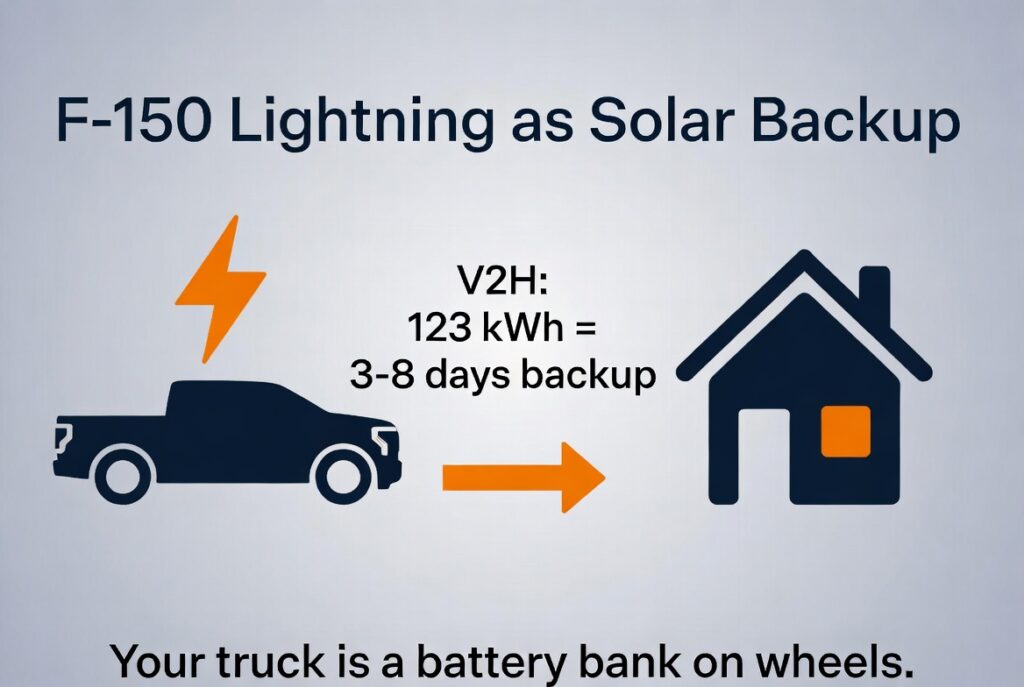
An F-150 Lightning solar backup strategy turns your truck into a 123 kWh battery bank on wheels that can power your Ontario home for 4 to 7 days depending on your load. The 2026 model carries a 123 kWh usable battery. The 2022 to 2024 extended range models carry 131 kWh. That is 10 times more capacity than any portable power station on the market. No home battery system under $30,000 matches this capacity in a single unit.
At 635W of critical loads (fridge, furnace fan, LED lights, Starlink, and CPAP), a fully charged 123 kWh Lightning provides approximately 8 days of runtime. At a whole-house average of 1,800W, it provides approximately 3 days. Realistic mixed use with periodic well pump cycling gives 3 to 5 days depending on the season and load discipline. The F-150 Lightning solar backup delivers 30 times the runtime of the largest portable power station at a fraction of the cost per kWh. For the complete product comparison, see our solar buyers guide.
The Rockwood V2H Success
A homeowner in Rockwood installed Ford Intelligent Backup Power with a used Ford Charge Station Pro and a GenerLink transfer switch. His 2023 F-150 Lightning extended range had a 131 kWh battery. During a 72-hour ice storm in January, the V2H system activated automatically when the grid failed. The truck powered his well pump, furnace blower, fridge, LED lights, and Starlink from the driveway.
The V2H system was so seamless that the family forgot the power was out until they noticed the streetlights were dark. The truck ran the entire house at an average load of 1,800W for 72 hours, consuming approximately 130 kWh. The system had already switched to minimum load shedding at 10 percent SoC to preserve emergency driving range. He still had enough charge for a 15-minute drive to the nearest charging station in Guelph if needed.
Using an F-150 Lightning solar strategy is like having a service truck with a 100-gallon auxiliary fuel tank parked in your driveway. Most home battery systems are like a 5-gallon jerry can. They get you to the station, but the truck is the station. The 131 kWh battery in his Lightning is 12 times the capacity of a $4,500 EcoFlow DELTA Pro 3. His F-150 Lightning solar backup delivered more runtime than a $30,000 Victron whole-home build.
V2H vs Pro Power Onboard and Two Ways to Power Your Home
Ford offers two methods for using the F-150 Lightning as home backup. V2H (Vehicle-to-Home) through Ford Intelligent Backup Power provides automatic transfer when the grid fails. It requires a Ford Charge Station Pro (no longer sold new by Ford, available used for $1,500 to $2,000) and a GenerLink transfer switch at $500 to $800 installed. Standard range Lightnings require an additional $500 software activation fee for V2H capability. For the complete backup strategy comparison, see our backup power guide.
Pro Power Onboard is the manual alternative that works on all trims without a special charger. It delivers up to 9.6 kW through 10 x 120V outlets and 1 x 240V outlet in the truck bed. Connect a GenerLink transfer switch to your main panel and run the truck as a generator. The F-150 Lightning solar advantage over a gas generator is zero emissions, zero noise, and zero fuel cost. The disadvantage is finite capacity. Once the battery is empty, you need grid power or a Level 2 charger to refill it.
The Runtime Math and How Long 123 kWh Lasts in Ontario
Critical loads only at 635W (fridge 80W, furnace fan 400W, LED lights 50W, Starlink 75W, CPAP 30W) divide into 123,000Wh to give 193 hours or approximately 8 days. Whole-house average at 1,800W gives 68 hours or approximately 2.8 days. Realistic mixed use with a well pump cycling at 800W for 5 minutes every hour adds approximately 400Wh per day to the baseline load. This brings the mixed-use runtime to 3 to 5 days depending on season and load discipline.
Compare this to the largest portable power stations. An EcoFlow DELTA Pro 3 at 4,096Wh runs critical loads for 6.4 hours. An Anker SOLIX C1000 at 1,056Wh runs critical loads for 1.7 hours. The F-150 Lightning delivers 30 times the runtime of the DELTA Pro 3 and 116 times the runtime of the C1000. The truck is not competing with portable power stations. It is competing with $15,000 to $30,000 whole-home battery installations. For the complete payback analysis, see our solar payback guide.
The Solar Recharging Gap and Why Small Arrays Fail Your F-150 Lightning Solar Strategy
A DIYer in Milton tried to solar-charge his 2024 F-150 Lightning using a single Renogy 100W panel and a portable inverter. He planned to keep the truck topped up between outages using free solar energy. His Lightning had a 98 kWh standard range battery. He connected the panel to an Anker SOLIX C1000 and ran an extension cord from the C1000 to the truck’s 120V onboard charger.
At 100W of panel output and 5 PSH per day, the panel produced 500Wh daily. The 98 kWh battery needs 98,000Wh to fill from empty. That is 196 days of full sunshine to refill the truck. The truck’s 120V onboard charger draws more idle power than the 100W panel can deliver. The high-voltage pack went into protection mode to preserve its remaining 5 percent SoC. The 12V lead-acid starter battery died first because the main pack stopped supporting it.
Solar-charging an F-150 Lightning requires a minimum 2,400W to 4,000W array with a Level 2 charger to make meaningful progress. A 100W panel is the wrong tool for a 98 kWh battery. The correct F-150 Lightning solar strategy uses the truck as a backup power source and charges it from the grid between outages. A separate fixed solar bank with a Victron SmartShunt handles daily household loads independently. The Anker SOLIX C1000 works as a buffer station for small loads so you do not wake the truck’s high-voltage system for a phone charger. For panel sizing details, see our solar panel guide. For the complete wiring integration, see our off-grid electrical wiring guide.
Frequently Asked Questions
Q: How long can an F-150 Lightning power my house?
A: On critical loads only at 635W, a fully charged 123 kWh Lightning provides approximately 8 days of runtime. On whole-house loads at 1,800W average, it provides approximately 3 days. Realistic mixed use with periodic well pump cycling gives 3 to 5 days depending on the season and load discipline.
Q: Do I need the Ford Charge Station Pro for V2H?
A: Yes, for automatic V2H through Ford Intelligent Backup Power, but the Charge Station Pro is no longer sold new by Ford and costs $1,500 to $2,000 used. The alternative is Pro Power Onboard, which provides the same 9.6 kW output through manual connection via the bed outlets and a GenerLink transfer switch. Standard range Lightnings also require a $500 software activation fee for V2H capability.
Q: Can I solar charge my F-150 Lightning?
A: Not practically with a small panel array because a 100W panel produces 500Wh per day and the battery holds 98,000 to 131,000Wh. Meaningful solar charging requires a 2,400W to 4,000W array with a Level 2 charger, which is a $5,000 to $10,000 solar carport installation. The better strategy is to charge from the grid between outages and use a separate solar bank for daily household loads.
NEC Article 625 covers EV charging equipment and vehicle-to-home installation requirements including transfer switch integration, grounding, and overcurrent protection. All V2H installations must comply with local electrical code and be performed by a certified electrician. Current standards are published at nfpa.org.
CEC Section 64 governs EV charging and V2H installation requirements in Ontario including transfer switch permits and inspection standards. All permanently installed V2H systems require ESA approval before energizing. The Electrical Safety Authority (ESA) provides current compliance guidelines at esasafe.com.
This build is engineered within the 48V DC Safety Ceiling. Diagnostic logic is based on 20+ years of technical service experience. All structural and electrical installations must be verified by a Licensed Professional and comply with your Local AHJ. See our legal and safety disclosure for full scope.
About the Author
Robert Bertrand spent 20 years as a service advisor in the automotive industry (Lexus and Nissan), where precision diagnostics, wiring integrity, and documentation standards were non-negotiable. He brings that same technical discipline to GridFree Guide, where he researches, tests, and documents off-grid solar systems for Ontario conditions. Based in Rockwood, Ontario, every article is built on verified specifications, manufacturer data, and the real-world climate constraints of Canadian off-grid living.
As an Amazon Associate I earn from qualifying purchases. This site also contains affiliate links to other products and services. GridFree Guide earns a small commission at no extra cost to you.