
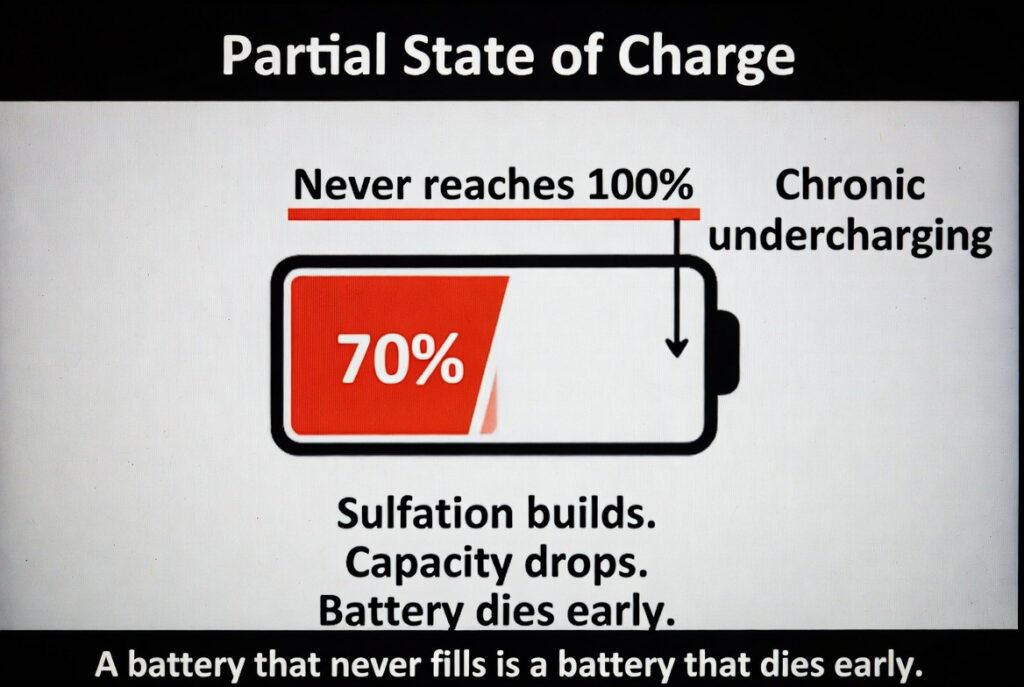
The Stagnation Trap and What Is Partial State Charge
A partial state charge condition occurs when your battery bank repeatedly cycles between 40 and 80 percent without ever reaching 100 percent, and in Ontario’s dark December stretches this silent pattern destroys battery capacity in months. This condition is common during short winter days with only 1.5 peak sun hours. Undersized arrays and consecutive overcast days make the problem worse. The battery needs a full charge cycle to 100 percent at least once per week to prevent damage.
The consequences differ by chemistry but the root cause is the same. AGM batteries develop permanent sulfation from chronic undercharging. LFP batteries develop BMS calibration drift that makes the SOC percentage inaccurate. Both result in a battery bank that appears healthy on the display while silently losing capacity underneath. For the complete battery selection guide, see our solar battery guide.
The Rockwood Weekly Full Cycle
A homeowner in Rockwood noticed his LFP bank was stuck in a partial state charge loop for three consecutive weeks during December overcast weather. His panels could only charge the bank to 85 percent SOC before sunset each day. Instead of accepting the partial charge, he ran his dual fuel generator for 2 hours every Sunday morning to force the bank to 100 percent. He monitored the charge with his Victron SmartShunt to confirm the bank truly reached 100 percent, not just a surface charge.
Forcing the 100 percent charge triggered the absorption stage, which allowed his Victron MPPT 100/50 to hold the voltage at 56.8V while current tapered to 2 percent. This absorption phase gave the BMS time to balance the cells and reset its “full” baseline. Without the weekly full cycle, his SmartShunt would have drifted 5 to 10 percent from true SOC within 60 days. After 2 years of heavy daily cycling with a weekly full charge, his capacity test showed 98 percent of original rated capacity.
Living in a partial state charge is like driving a car and never filling the tank past half. Eventually, the fuel gauge forgets where “full” is and starts guessing. In a lead-acid system, it is even worse. It is like leaving old gas in the bottom half of the tank until it turns into varnish and clogs the fuel pump. To keep the engine clean, you have to top it off and let the cleaners do their work. His 2-hour Sunday generator run costs $1.50 in propane and saves $950 in battery replacement every 2 years.
PSOC and AGM Batteries and the Sulfation Death Spiral
Lead-sulfate crystals form on AGM plates during normal discharge. During a full charge, the absorption stage dissolves these crystals back into the electrolyte. When the bank never reaches 100 percent, the crystals remain on the plates and continue to grow. After 30 to 60 days of chronic undercharging, the crystals harden into a permanent state called sulfation. For the complete voltage reference, see our battery voltage guide.
Sulfation is irreversible on AGM batteries once the crystals have hardened. The only prevention is a full charge to 100 percent at least once every 7 days. In Ontario, the risk of sulfation increases dramatically during winter when batteries spend more time in a partial state charge due to shorter daylight hours and consecutive overcast days. A 200Ah AGM bank that never reaches full charge in November will lose measurable capacity by January.
PSOC and LFP Batteries and Why Partial State Charge Causes BMS Drift
LFP does not sulfate. Instead, partial state charge on LFP causes BMS calibration drift. The BMS uses the “full” reference point at 14.2V (12V system) or 56.8V (48V system) to calibrate its SOC percentage. If the bank never reaches that reference, the BMS percentage drifts 5 to 10 percent from true SOC within 60 days. A SmartShunt with coulomb counting is more accurate than the BMS percentage, but even a SmartShunt needs a periodic sync at 100 percent to maintain accuracy. For the complete charging parameter guide, see our charging stages guide. For the full capacity verification method, see our battery capacity test guide.
A DIYer in Milton relied solely on his undersized 400W solar array to charge his 200Ah AGM battery bank during a cloudy November. His panels could not push the bank above 75 percent SOC on most days. He assumed 75 percent was “good enough” because his loads still ran. He did not own a generator or a grid charger to supplement the solar during gray streaks.
The AGM bank never rose above 75 percent for 60 straight days. The lead-sulfate crystals on the plates hardened into permanent sulfation. By January, his “200Ah” batteries only delivered 120Ah before the voltage collapsed. Because the capacity had effectively shrunk, his charge controller began short-cycling, showing “full” at 120Ah instead of 200Ah, tricking him into thinking the batteries were charged when they were actually damaged.
His $800 AGM bank lost 40 percent of its capacity in 14 months because he never completed a full charge cycle. A $15 per week generator run to force 100 percent SOC would have prevented the sulfation entirely. The total cost of the partial state charge damage was $800 for the replacement bank plus the wasted capacity over 14 months. The rule is simple: never let any battery bank go more than 7 days without reaching 100 percent SOC regardless of the weather.
The PSOC Effects Comparison Table
| Feature | AGM / Lead-Acid | Lithium (LFP) |
|---|---|---|
| Primary Risk | Permanent Sulfation | BMS Calibration Drift |
| Capacity Loss | Rapid and Permanent | Temporary (until re-calibrated) |
| Cell Balance | Self-balancing at Float | Requires 100% for top-balancing |
| Recovery Path | Equalization Charge (High Risk) | Full 100% Charge Cycle |
| Ontario Winter Risk | Extreme (Freezing at low SOC) | Moderate (Accuracy Loss) |
The table shows why AGM is more vulnerable to partial state charge than LFP. AGM damage from sulfation is permanent and irreversible. LFP damage from BMS drift is temporary and reversible with a single full charge cycle. However, both chemistries require the weekly full cycle to maintain accuracy and health.
The Ontario winter risk column highlights a critical difference. An AGM battery at low SOC in freezing temperatures can freeze and crack the case because the electrolyte becomes more water-like as SOC drops. An LFP battery at low SOC in freezing temperatures loses accuracy but does not freeze. For the complete temperature analysis, see our battery temperature guide.
Frequently Asked Questions
Q: How often should I fully charge my battery bank?
A: Complete a full charge to 100 percent SOC at least once every 7 days regardless of weather or load conditions. Use a generator or grid charger to supplement solar during Ontario’s December gray streaks when panels cannot reach 100 percent. A 2-hour generator run once per week costs $1.50 in propane and prevents hundreds of dollars in battery damage.
Q: Can I recover an AGM battery that has been in partial state charge?
A: If sulfation has been present for less than 30 days, a controlled equalization charge at 15.5V for 12V systems may dissolve the soft crystals, but this procedure risks overheating and must be monitored continuously. After 60 days of chronic undercharging, the crystals harden into permanent sulfation that cannot be reversed by any charging method. Prevention through weekly full cycles is the only reliable strategy because recovery is risky and often unsuccessful.
Q: Does partial state of charge affect LFP the same way as AGM?
A: No, because LFP does not sulfate, but PSOC causes BMS calibration drift where the percentage display becomes inaccurate by 5 to 10 percent within 60 days. The fix for LFP is simpler than AGM because a single full charge cycle to 100 percent resets the BMS calibration and restores accurate SOC readings. LFP capacity loss from PSOC is temporary and reversible, while AGM capacity loss from sulfation is permanent.
NEC Article 480 covers battery maintenance and safety requirements including proper charging protocols, ventilation, and overcurrent protection for residential battery installations. Regular full charge cycles are part of the maintenance standard that prevents premature battery degradation. Current standards are published at nfpa.org.
CEC Section 64 governs battery installation and maintenance requirements in Ontario including charging system configuration and safety monitoring. All battery installations require ESA-compliant charging parameters to prevent damage from chronic undercharging. The Electrical Safety Authority (ESA) provides current compliance guidelines at esasafe.com.
This build is engineered within the 48V DC Safety Ceiling. Diagnostic logic is based on 20+ years of technical service experience. All structural and electrical installations must be verified by a Licensed Professional and comply with your Local AHJ. See our legal and safety disclosure for full scope.
About the Author
Robert Bertrand spent 20 years as a service advisor in the automotive industry (Lexus and Nissan), where precision diagnostics, wiring integrity, and documentation standards were non-negotiable. He brings that same technical discipline to GridFree Guide, where he researches, tests, and documents off-grid solar systems for Ontario conditions. Based in Rockwood, Ontario, every article is built on verified specifications, manufacturer data, and the real-world climate constraints of Canadian off-grid living.
As an Amazon Associate I earn from qualifying purchases. This site also contains affiliate links to other products and services. GridFree Guide earns a small commission at no extra cost to you.