
Solar Generator Pros and Cons and Why Honesty Matters More Than Hype
Breaking down the solar generator pros and cons honestly is the only way to decide whether this technology fits your Ontario household before you spend $1,000 or more. Most solar generator articles list only the advantages and skip the limitations. This article gives equal weight to both sides with specific Ontario numbers, real costs, and the scenarios where a solar generator is the wrong tool for the job.
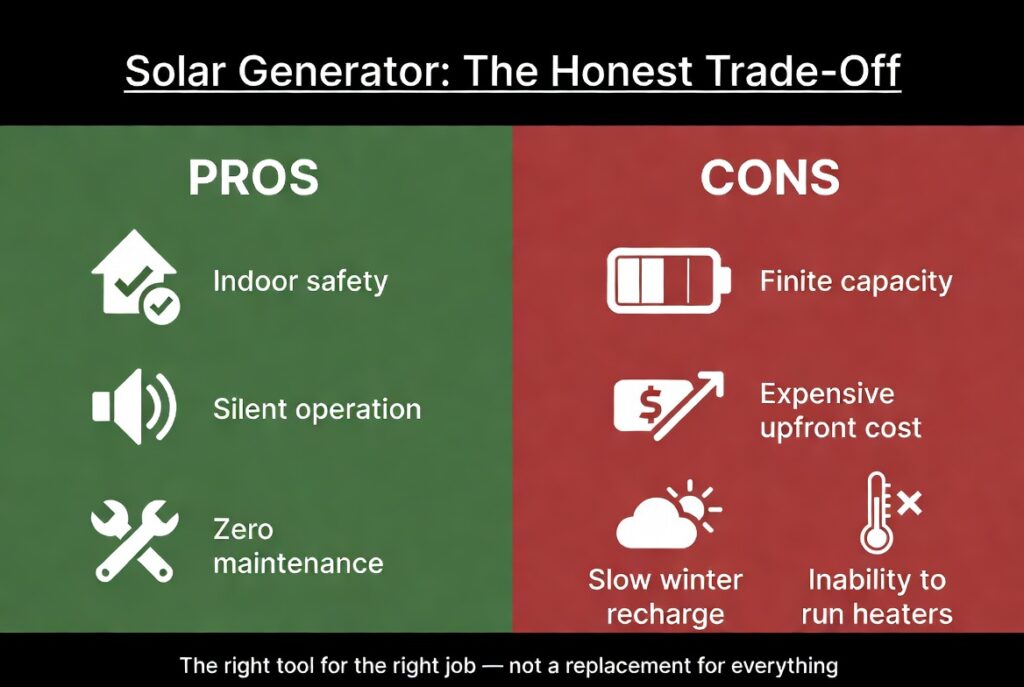
The biggest pro is indoor safety. Every Ontario winter, families suffer carbon monoxide poisoning from gas generators running in garages and near open windows. A solar generator produces zero emissions and operates safely on a nightstand, a kitchen counter, or next to the couch. The biggest con is finite battery capacity combined with slow winter recharging. When the battery hits 0 percent, it stays at 0 percent until you can recharge it. Gas generators run as long as you have fuel.
Understanding both sides of the solar generator pros and cons equation prevents two expensive mistakes. Buying a unit that cannot handle your loads wastes $1,000 or more. Skipping a unit that could save your family during an ice storm is worse. This article covers the seven genuine pros, the seven honest cons, the Ontario winter recharging problem, and who should buy versus who should skip. For a broader overview, see our solar generator Ontario guide.
The Seven Genuine Pros of Owning a Solar Generator
Zero emissions makes a solar generator the only backup power source safe to operate indoors. There is no exhaust, no carbon monoxide, and no combustion. Silent operation at 30 to 40 dB fan noise replaces the 70+ dB roar of a gas generator that wakes neighbours and violates municipal noise bylaws. Zero maintenance eliminates oil changes, spark plug replacements, fuel stabilizer, and the annual pull-cord frustration of a cold gas engine. Push-button start delivers power in under 2 seconds.
Solar recharging provides free fuel after the initial panel purchase. A 100W panel produces approximately 500Wh per day in July at 5 peak sun hours. LFP battery longevity at 3,000 to 3,500 cycles gives 8 to 10 years of daily use or 30+ years of weekend cottage use. Portability ranges from 7.7 lbs on an EcoFlow RIVER 2 to 80 lbs on an EcoFlow DELTA Pro 3. For lifespan details, see our solar generator lifespan guide.
Solar Generator Pros and Cons and the Seven Honest Disadvantages
Finite capacity means the battery is a fixed fuel tank with no refueling option during a blackout unless you have solar panels deployed. Gas generators run indefinitely with fuel. Upfront cost ranges from $300 to $4,500 CAD for a solar generator versus $400 to $1,200 CAD for an equivalent-wattage gas unit. Slow winter recharging is the Ontario-specific con that changes everything. A 100W panel produces only 150Wh per day in January at 1.5 PSH versus 500Wh in July. For the runtime math, see our solar generator watt-hour guide.
A solar generator cannot run heating appliances efficiently. A 1,500W space heater drains a 2,000Wh battery in 70 minutes. Large units at 60 to 80 lbs require wheels and are not portable in the traditional sense. Some brands including Anker and Jackery have no expansion ports, locking you into the original capacity permanently. Finally, a solar generator is useless without pre-charging. If you forget to plug it in before the outage, it is a dead box when you need it most. For expansion details, see our solar generator brand guide.
The Ontario Winter Recharging Problem and Why January Changes Everything
Ontario receives approximately 1.5 peak sun hours per day in January versus 5 PSH in July. A 200W solar panel produces only 250Wh per day in January. A full-sized fridge at 80W average draw consumes approximately 1,920Wh per day. That 200W panel recharges 13 percent of what the fridge uses in a single January day. The solar generator pros and cons math tips heavily toward the cons by day 3 of any winter outage with insufficient panel capacity.
You need 600W to 800W of solar panels to keep up with a fridge in January, which costs $600+ CAD in panels alone. This means the total system cost for winter-resilient backup is the generator plus an equal or greater investment in panels. If you cannot afford that panel capacity, a gas generator or a propane heater paired with a small solar generator is the more honest answer for multi-day winter outages. For the full gas comparison, see our solar generator versus gas generator comparison.
The Rockwood Ice Storm Safety Win
A family in Rockwood was trapped indoors for 48 hours during a January ice storm. They had a Bluetti AC200L in their living room next to the couch. The roads were impassable. Their neighbours with a gas generator had to trudge outside in freezing rain every 4 hours to refuel and restart the unit in their garage.
The family ran their phones, a CPAP machine, LED lights, and a small electric kettle for two full days without leaving the living room. There was no noise, no fumes, and no risk of CO poisoning. They recharged partially from a 200W panel propped in a south-facing window during a brief sunny break on day two. The neighbours with the gas generator had to crack the garage door for ventilation, which let freezing air into the house and reduced their heating efficiency.
The solar generator in this scenario was like having an electric vehicle in the garage versus a diesel truck that needs to idle outside in the cold. The EV starts silently, produces zero exhaust, and operates in an enclosed space. The diesel runs louder, produces fumes, and requires outdoor operation. For Ontario ice storms where families are sealed indoors for days, the indoor safety pro of a solar generator outweighs every con on the list.
The Milton January Recharge Wall
A client in Milton bought a 2,000Wh unit and 200W of solar panels expecting to run his full-sized fridge indefinitely during a winter outage. His fridge draws 80W average including compressor cycling. That is approximately 1,920Wh per day. His 2,000Wh battery covered day one completely.
On day 2, he deployed his 200W panel on the back deck. It was a typical grey Ontario January day at 1.5 peak sun hours. The panel produced only 250Wh all day. His fridge consumed 1,920Wh. He recharged 13 percent of what the fridge used. By the end of day 3, the battery hit 10 percent and he had to unplug the fridge to save power for phones and the CPAP.
He bought a long-haul truck with a large fuel tank but his only gas station was a single pump that dispensed one gallon per hour. The tank was the right size. The refueling rate was the bottleneck. In Ontario, if you do not over-provision your solar panels for January at 1.5 PSH, the solar generator pros and cons math tips heavily toward the cons by day 3 of any winter outage. He needed 600W to 800W of panels to keep up with the fridge, not 200W.
Solar Generator Pros and Cons Verdict and Who Should Buy Versus Who Should Skip
This solar generator pros and cons verdict splits into three profiles based on your living situation, budget, and outage expectations.
- Apartment and condo residents, medical needs users running CPAP or oxygen concentrators, noise-sensitive environments, and short-duration outage preppers should buy. An Anker SOLIX C1000 or Jackery Explorer 300 Plus is the only legal and safe indoor backup option for apartment dwellers. The pros dominate this profile completely.
- Weekend cottage users and 24 to 48 hour outage preppers should buy with planning. A Bluetti AC200L with 400W+ of solar panels handles most Ontario outages. Budget for panels equal to or greater than the generator cost for winter resilience. The pros win this profile if you invest in sufficient panel capacity.
- Whole-home heating users, budget buyers who need 3,000W for a sump pump, and multi-day outage preppers without solar panel budget should skip or augment. A space heater drains any portable battery in 70 minutes. A $400 gas generator delivers 3,000W continuously for the price of a small solar unit. For these users, a gas generator or a propane heater paired with a small solar generator is the honest answer. The cons win this profile.
Frequently Asked Questions
Q: Is solar generator power really free?
A: The solar energy is free but the equipment is not. Think of it as a prepaid electricity plan where you pay the full cost upfront and every watt-hour after that costs nothing. The break-even versus grid power depends on how often you use the unit and how many outages it covers.
Q: Can I leave a solar generator plugged into the wall all the time?
A: Yes. Most modern units have BMS protection that prevents overcharging. This configuration keeps the unit at 100 percent and ready for instant deployment during an outage. Some units with UPS mode provide automatic switchover in under 20ms when grid power fails.
Q: Are solar generators waterproof?
A: Most are not. They have open cooling vents that allow water ingress. Unlike gas generators that can sit outside under a canopy, a solar generator must stay indoors or under solid cover at all times. Water damage is not covered under any manufacturer warranty.
NEC Article 702 covers portable power equipment safety including installation and use requirements for temporary electrical power systems during outages. All portable power equipment must comply with applicable consumer safety standards. Current standards are published at nfpa.org.
CEC Section 64 governs portable power equipment safety and consumer protection requirements in Ontario. All units must carry CSA or UL certification for residential indoor use. The Electrical Safety Authority (ESA) provides current compliance guidelines at esasafe.com.
This build is engineered within the 48V DC Safety Ceiling. Diagnostic logic is based on 20+ years of technical service experience. All structural and electrical installations must be verified by a Licensed Professional and comply with your Local AHJ. See our legal and safety disclosure for full scope.
About the Author
Robert Bertrand spent 20 years as a service advisor in the automotive industry (Lexus and Nissan), where precision diagnostics, wiring integrity, and documentation standards were non-negotiable. He brings that same technical discipline to GridFree Guide, where he researches, tests, and documents off-grid solar systems for Ontario conditions. Based in Rockwood, Ontario, every article is built on verified specifications, manufacturer data, and the real-world climate constraints of Canadian off-grid living.
As an Amazon Associate I earn from qualifying purchases. This site also contains affiliate links to other products and services. GridFree Guide earns a small commission at no extra cost to you.