
How Long Do Solar Generators Last and What Determines the Lifespan
Understanding how long do solar generators last is essential before committing $1,000 or more to a backup power system because the answer depends entirely on the battery chemistry and your storage habits. Modern solar generators use LiFePO4 batteries rated for 3,000 to 3,500 cycles to 80 percent capacity. A cycle is one full discharge and recharge. At 80 percent capacity, the unit still works. It just holds 20 percent less energy than it did on day one.
The battery is the limiting component in every solar generator. The inverter electronics typically last 10 to 15 years with proper ventilation. The charging circuitry is rated for the same cycle count as the battery. Everything else in the unit outlasts the cells. However, even the battery does not die at 3,500 cycles. A 2,000Wh unit at 80 percent still holds 1,600Wh, which covers most Ontario emergency loads for a full night.
For most Ontario households, the solar generator will become technologically obsolete before the battery chemistry degrades enough to matter. A unit bought today for emergency backup at 10 cycles per year mathematically lasts over 100 years to 80 percent capacity. The technology will advance far beyond the current generation in that time. For a broader overview, see our solar generator Ontario guide. For cycle life details on battery banks, see our solar battery lifespan guide.
The Lifespan Table by Use Pattern and What the Cycle Numbers Actually Mean
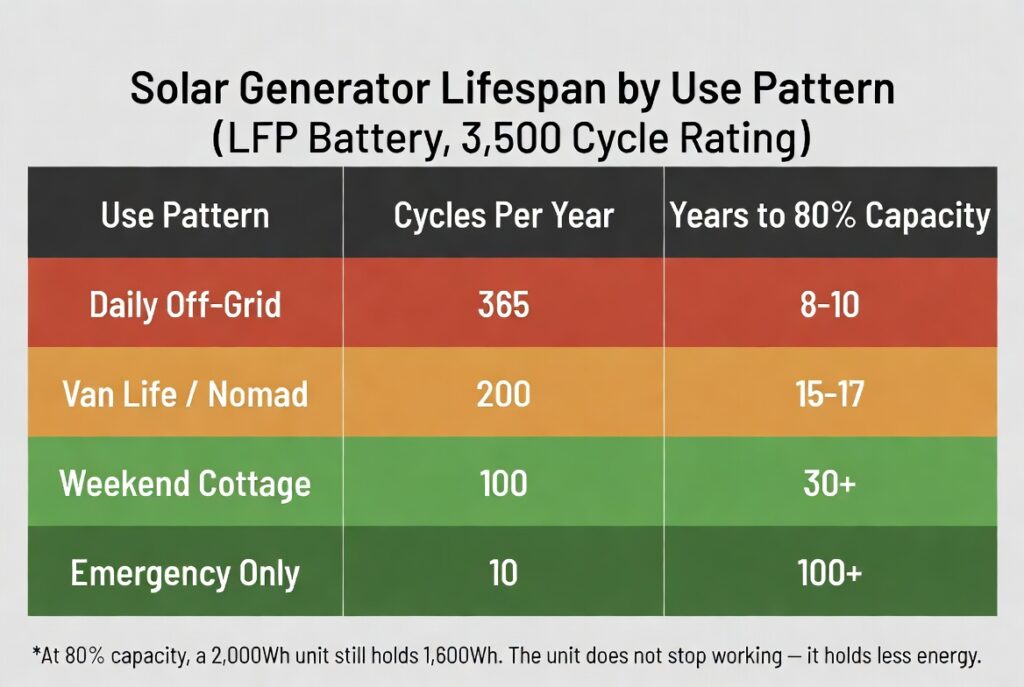
The table below shows how long solar generators last based on four common use patterns. The cycle rating is the same across all rows. The difference is how quickly you consume those cycles. An emergency-only user at 10 cycles per year will never reach 3,500 cycles in a human lifetime. A daily off-grid user reaches it in under a decade.
| Use Pattern | Cycles Per Year | Years to 80% Capacity |
|---|---|---|
| Daily off-grid | 365 | 8 to 10 years |
| Van life / digital nomad | 200 | 15 to 17 years |
| Weekend cottage | 100 | 30+ years |
| Emergency backup only | 10 | 100+ years (functionally indefinite) |
Partial cycles count proportionally. Running the battery from 100 percent to 50 percent and recharging counts as half a cycle. Two half cycles equal one full cycle in the degradation math. This means even daily users who only partially discharge get significantly more calendar years from their unit than the worst-case full-cycle estimate suggests.
How Long Do Solar Generators Last When Stored Correctly Versus Incorrectly
Correct storage extends lifespan dramatically. Store the unit at 50 to 60 percent SoC in a cool dry location. A basement at 10 to 18 degrees C is ideal in Ontario. Check and top up to 50 to 60 percent every 3 to 6 months. The self-discharge rate on LFP is approximately 2 to 3 percent per month, so a unit stored at 60 percent will sit at approximately 48 percent after 6 months without intervention.
Incorrect storage kills units prematurely. Storing at 0 percent SoC for months allows the BMS parasitic draw to pull cells below critical voltage, triggering a permanent lockout. Storing at 100 percent SoC for months accelerates calendar aging of the cell chemistry. Leaving the unit in a hot car trunk where internal temperatures exceed 45 degrees C causes exponential degradation. The storage habit is the single biggest variable in real-world lifespan. For the full maintenance protocol, see our solar generator maintenance guide.
What Kills a Solar Generator Prematurely and the Five Mistakes to Avoid
The first killer is storing at 0 percent SoC for months. The BMS draws approximately 1mA continuously to maintain its internal protection circuits. Over months, this parasitic draw pulls the cells below 2.5V, triggering a permanent BMS lockout that cannot be reset. The second killer is storing at 100 percent SoC for extended periods, which accelerates calendar aging of the cathode material even when the unit is not being cycled.
The third killer is heat exposure above 45 degrees C, which occurs inside parked cars during Ontario summers. The fourth is blocking ventilation during heavy loads, which overheats the inverter electronics and shortens their 10 to 15 year expected lifespan. The fifth is using fast charging exclusively, which generates more heat per cycle than slow charging from solar or wall power. Ontario cool basement storage at 10 to 18 degrees C year-round is the ideal environment. Unheated cottage sheds are acceptable only if the unit is stored at 50 to 60 percent SoC.
The Rockwood 10-Year Storage Success
An early adopter in Rockwood bought one of the first LFP portable power stations nearly a decade ago. He used it exclusively for occasional ice storms and summer power failures. His total cycle count over 10 years was approximately 40 full cycles. He stored the unit in his basement at 60 percent SoC and topped it up twice a year.
After 10 years of ownership, the unit still holds 98 percent of its original capacity. The LFP cells aged so slowly at 40 cycles over a decade that the calendar aging was negligible. The cool basement at 14 degrees C and the 60 percent storage SoC kept the cells in their lowest-stress state for the entire decade. A comparable unit tested with a SmartShunt would show virtually no degradation in usable capacity.
This is like a classic car stored in a climate-controlled garage with fresh fluids and a battery tender. It does not matter how old the model year is. The engine is pristine because it was never abused or neglected. For Ontario emergency-only users, the answer to how long do solar generators last is functionally indefinite. The unit will be technologically obsolete before the battery chemistry degrades enough to notice.
The Milton Cottage Freeze Fatality
A client in Milton left his solar generator in an unheated shed when he closed his cottage in October. The unit was at approximately 5 percent SoC because he had used it on his last weekend trip and did not recharge before storing. The shed temperature dropped below minus 20 degrees C during January. The unit sat untouched for 7 months until he returned in May.
The BMS inside the unit draws approximately 1mA continuously to maintain its internal clock and protection circuits. Over 7 months, that parasitic draw pulled the remaining 5 percent SoC below the critical cell voltage threshold. When cell voltage drops below approximately 2.5V per cell, the BMS locks the battery permanently to prevent unsafe charging of a deeply depleted cell. He returned to a unit that would not power on, would not charge, and could not be reset.
This is like leaving a car battery dead in the driveway during a minus 30 degrees C cold snap. The internal chemistry fails, the plates sulfate permanently, and no amount of boost charging brings it back. He turned a $2,000 generator into a 28 lb paperweight because he did not spend 5 minutes plugging it in before closing the cottage. A $15 calendar reminder to check SoC before winter would have saved the entire unit.
How Long Do Solar Generators Last Verdict and Who Needs to Plan for Replacement
The answer to how long do solar generators last depends entirely on your use pattern and storage discipline.
- Emergency-only users who keep the unit in a basement closet do not need to plan for replacement. At 10 cycles per year, the battery outlasts you. Focus on the storage protocol: 50 to 60 percent SoC, check twice a year, never leave at 0 percent over winter. An Anker SOLIX C1000 stored correctly will serve emergency duty for 20+ years.
- Weekend cottage and camping users at 50 to 200 cycles per year will get 15 to 30 years to 80 percent capacity. Technology will make your unit obsolete long before the battery dies. Buy the best unit your budget allows today and focus on storage habits. A Bluetti AC200L with proper storage will outlast the cottage roof. For ecosystem planning, see our solar generator brand guide.
- Daily off-grid users at 365 cycles per year should plan for battery replacement or unit upgrade at 8 to 10 years. An EcoFlow DELTA Pro 3 at 3,500 cycles gives approximately 9.5 years of daily use. At that point the unit still holds 80 percent capacity, which may be sufficient. Budget for a replacement unit in year 10 but you may find it still meets your needs. For component details, see our portable power station guide.
Frequently Asked Questions
Q: Can I replace the battery in a portable solar generator?
A: In most portable units, no. The cells are integrated into the chassis and sealed by the manufacturer. Expansion batteries like the Bluetti B300 can be replaced or added as the main unit ages. For DIY battery bank systems, individual cells can be replaced but this requires technical knowledge and proper safety equipment.
Q: Does fast charging reduce the lifespan?
A: Occasional fast charging has minimal impact on cycle life. Using turbo or fast charging exclusively generates more heat per cycle, which can reduce long-term lifespan by 10 to 15 percent. Charge slowly from solar or wall power when time allows and save fast charging for emergencies.
Q: Will the unit still work after the rated cycle count?
A: Yes. It does not stop working at 3,500 cycles. It retains approximately 80 percent of original capacity, which means a 2,000Wh unit still holds 1,600Wh. Many users continue operating at 80 percent capacity for years beyond the rated cycle count because it still meets their needs.
NEC Article 480 covers battery storage system installation, maintenance, and consumer safety labeling requirements. All portable power stations must display accurate cycle life and capacity ratings. Current standards are published at nfpa.org.
CEC Section 64 governs portable battery storage equipment safety and labeling requirements in Ontario. All units must carry CSA or UL certification with accurate capacity and cycle life disclosures. The Electrical Safety Authority (ESA) provides current compliance guidelines at esasafe.com.
This build is engineered within the 48V DC Safety Ceiling. Diagnostic logic is based on 20+ years of technical service experience. All structural and electrical installations must be verified by a Licensed Professional and comply with your Local AHJ. See our legal and safety disclosure for full scope.
About the Author
Robert Bertrand spent 20 years as a service advisor in the automotive industry (Lexus and Nissan), where precision diagnostics, wiring integrity, and documentation standards were non-negotiable. He brings that same technical discipline to GridFree Guide, where he researches, tests, and documents off-grid solar systems for Ontario conditions. Based in Rockwood, Ontario, every article is built on verified specifications, manufacturer data, and the real-world climate constraints of Canadian off-grid living.
As an Amazon Associate I earn from qualifying purchases. This site also contains affiliate links to other products and services. GridFree Guide earns a small commission at no extra cost to you.