
How to Fuse Solar System Components and Why Every Positive Wire Needs Protection
Learning how to fuse solar system components correctly is the single most important safety step in any DC power build because an unfused short circuit delivers thousands of amps in a fraction of a second. A fuse protects the wire, not the device. It is a sacrificial component designed to melt and break the circuit before the wire insulation ignites. Without overcurrent protection, a short circuit on a 200Ah LFP battery bank delivers over 3,000 amps through the conductor instantly.
CEC Section 64 requires overcurrent protection on every ungrounded conductor in a DC power system. The fuse must be positioned within 7 to 12 inches of the battery terminal to minimize the length of unfused wire that could short to ground. Unfused DC systems are the number one cause of solar-related fires in residential and mobile installations. A $15 fuse protects a $3,000 inverter and prevents a building fire.
This article covers fuse sizing by wire gauge, fuse placement locations, fuse types for DC systems, and why AC breakers cannot be used in solar builds. Every positive conductor in your system needs a fuse. There are no exceptions and no current level too low to skip this step. For a broader look at Ontario solar options, see our solar generator Ontario guide.
The Fuse Sizing Rule and the Wire Gauge Chart
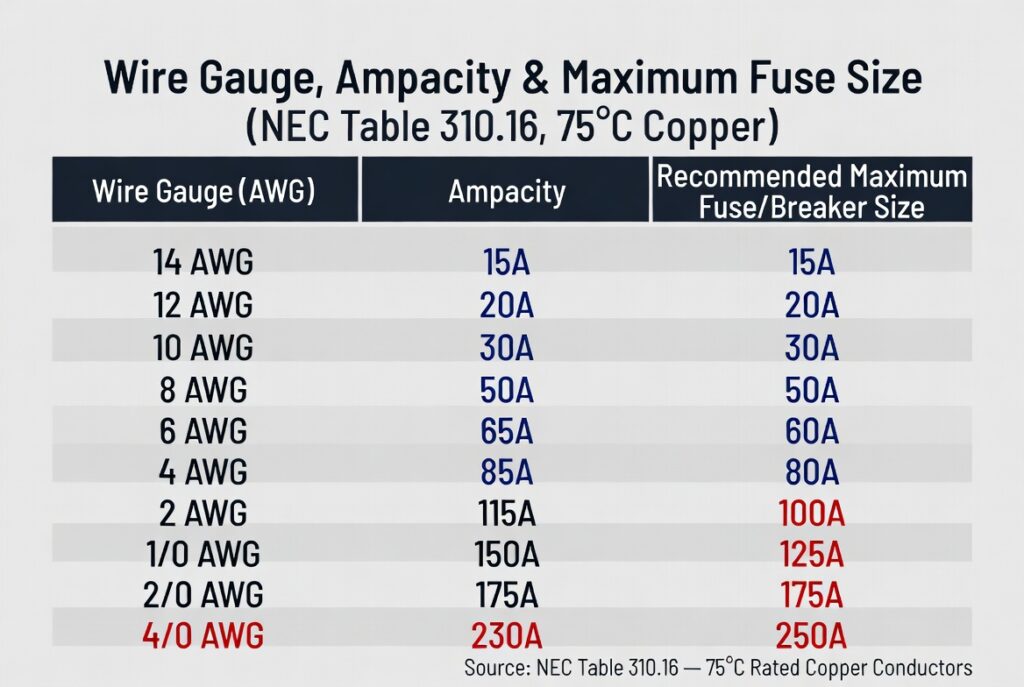
The fuse must be rated above the maximum expected current but below the wire’s ampacity. The sizing formula is: Fuse Size = Max Continuous Current x 1.25. This 25 percent margin prevents nuisance blowing under normal load while ensuring the fuse opens before the wire overheats. Never size a fuse to the device draw. Always size it to the wire ampacity.
| Wire Gauge (AWG) | Max Wire Ampacity | Recommended Max Fuse | Use Case |
|---|---|---|---|
| 10 AWG | 40A | 30A | Portable solar panels |
| 8 AWG | 55A | 50A | Small charge controllers |
| 4 AWG | 95A | 80A | 1,000W inverters |
| 2/0 AWG | 190A | 175A | 2,000W inverters |
| 4/0 AWG | 260A | 250A | 3,000W inverters |
A Victron MPPT 100/50 charge controller on 4 AWG wire needs an 80A fuse between the battery and controller. A 2,000W inverter on 2/0 AWG wire needs a 175A fuse. Using a fuse larger than the wire ampacity defeats the purpose entirely. The wire melts before the oversized fuse blows.
Where to Fuse Solar System Wiring and the Placement Rule
Every fuse must be on the positive conductor, as close to the power source as possible. The CEC 7 to 12 inch rule requires the fuse within that distance of the battery positive terminal. This minimizes the length of unfused conductor that could contact ground and create a short. The four mandatory fuse locations are: between battery positive and inverter, between battery and charge controller, between solar panels and charge controller, and between battery and DC load panel.
In a van or cottage build, the battery-to-inverter fuse is the most critical. This connection carries the highest current in the system. A Blue Sea 600A ANL fuse block bolted to the battery terminal box is the standard solution for this connection. The panel-to-controller fuse is often overlooked because panel current seems low. But any positive conductor without a fuse is a conductor that can start a fire if the insulation is compromised. For more on AC panel connections, see our transfer switch guide.
Fuse Types for DC Solar Systems and Why AC Breakers Cannot Be Used
ANL fuses are the most common choice for high-current battery connections from 100A to 500A. They are bolt-down style with visible fuse elements. Class T fuses have the highest interrupt capacity and fastest blow speed, making them mandatory for large lithium battery banks where short circuit current can exceed 5,000 amps. ATC and ATO blade fuses handle individual DC circuits from 1A to 40A for accessories, lights, and small loads.
AC breakers cannot be used in DC solar systems under any circumstances. An AC breaker relies on the alternating current’s zero-crossing point to extinguish the arc when the contacts open. DC current has no zero crossing. A DC short can weld an AC breaker’s contacts shut, allowing current to flow indefinitely through a closed breaker while the wire behind it burns. Always use fuses and breakers specifically rated for DC voltage and DC interrupt capacity. For more on surge loads through fused connections, see our solar generator surge wattage guide.
The Milton Short Circuit Save
A client in Milton was installing a 2,000W inverter connected to a 200Ah LFP battery bank. He installed a Blue Sea 250A ANL fuse on the positive battery terminal before running the cable to the inverter. The fuse was positioned within 8 inches of the battery terminal per CEC requirements. The total cable run from battery to inverter was 4 feet of 2/0 AWG copper.
During the installation, a wrench slipped and bridged the positive battery terminal to the metal chassis of the inverter mounting bracket. There was a loud pop and a small spark. The 250A ANL fuse blew instantly, breaking the circuit in less than 100 milliseconds. Without that fuse, the 200Ah LFP battery would have delivered over 3,000 amps through the wrench, welding it to the frame and potentially triggering a thermal event in the battery.
That fuse is a safety shear bolt. In an engine, a shear bolt is designed to break before the crankshaft does when something jams the rotating assembly. It is a $5 part that protects a $5,000 component. The $15 ANL fuse protected a $3,000 inverter, a $2,400 battery bank, and potentially the building itself from a fire that would have started in under 2 seconds.
The Rockwood Unfused Panel Fire
A DIYer in Rockwood added a second 100W solar panel to his van roof and ran the positive wire to his charge controller without installing an inline fuse. He reasoned that 10 amps of solar current was too low to cause a problem. The wire was 10 AWG copper rated for 40A. He assumed the low current meant fusing was unnecessary.
A tree branch rubbed through the wire insulation where it passed through a roof penetration, creating a dead short between the positive conductor and the metal roof. Because there was no fuse, the wire stayed energized by the sun. The 10 AWG wire reached nearly 400 degrees at the short point, melting the plastic roof vent and starting a smoldering fire in the headliner. The fire was caught before it spread, but the roof vent, headliner, and 6 feet of wire were destroyed.
Running unfused wires in a solar system is like driving with a fuel leak dripping onto a hot exhaust manifold. You might drive a hundred miles without incident, but the first vibration that opens the drip into a stream ignites everything. A $3 inline fuse on that panel wire would have blown the instant the short occurred, cutting power before the wire heated up. Every positive conductor needs a fuse. There is no current level too low to skip this step when you fuse solar system wiring. For ongoing system care, see our solar generator maintenance guide.
How to Fuse Solar System Verdict and Who Needs Which Fuse Type
This fuse solar system verdict splits into three profiles based on your system type and build complexity.
- Portable solar generator users do not need external fuses. The fusing is built into your unit. You only need external fuses if you permanently mount solar panels on a roof and run wires to the generator’s solar input. In that case, install an inline fuse on the positive panel wire sized to the wire gauge from the chart above.
- DIY battery bank builders need a Class T fuse at the battery bank positive terminal. This is the only fuse type fast enough to interrupt a short circuit from a 200Ah+ LFP bank safely. Use a Blue Sea ANL fuse block for the battery-to-inverter connection. Torque all fuse nuts to the manufacturer’s specified torque value. A loose connection creates resistance, generates heat, and can melt the fuse holder without blowing the fuse.
- Van and cottage builders who want a clean professional installation should use a Victron Lynx Distributor. It combines busbars and fuse holders into one unit that makes inspection and maintenance straightforward. Wire every positive conductor through a fused position. No exceptions. No current level is too low to skip a fuse.
Frequently Asked Questions
Q: Can I use an AC breaker for a DC solar system?
A: No. AC breakers are not designed to extinguish the arc from a DC short circuit. A DC short can weld an AC breaker shut, allowing the current to flow indefinitely. Always use fuses and breakers specifically rated for DC voltage and DC interrupt capacity.
Q: Where exactly do I put the fuse?
A: Always on the positive wire, as close to the power source as possible. CEC requires the fuse within 7 to 12 inches of the battery terminal. This minimizes the length of unfused conductor that could short to ground and start a fire.
Q: What happens if I use a fuse that is too large?
A: The wire melts or catches fire before the oversized fuse blows. This defeats the entire purpose of overcurrent protection. Always match the fuse rating to the wire ampacity, not to the device draw.
NEC Article 240 covers overcurrent protection requirements for all conductors including DC solar system wiring. Every ungrounded conductor must have a fuse or breaker rated for the wire ampacity and positioned to minimize unfused conductor length. Current standards are published at nfpa.org.
CEC Section 64 governs DC overcurrent protection and fuse placement requirements in Ontario. Fuses must be installed within 7 to 12 inches of the battery terminal on every positive conductor. The Electrical Safety Authority (ESA) provides current compliance guidelines and DC wiring safety resources at esasafe.com.
This build is engineered within the 48V DC Safety Ceiling. Diagnostic logic is based on 20+ years of technical service experience. All structural and electrical installations must be verified by a Licensed Professional and comply with your Local AHJ. See our legal and safety disclosure for full scope.
About the Author
Robert Bertrand spent 20 years as a service advisor in the automotive industry (Lexus and Nissan), where precision diagnostics, wiring integrity, and documentation standards were non-negotiable. He brings that same technical discipline to GridFree Guide, where he researches, tests, and documents off-grid solar systems for Ontario conditions. Based in Rockwood, Ontario, every article is built on verified specifications, manufacturer data, and the real-world climate constraints of Canadian off-grid living.
As an Amazon Associate I earn from qualifying purchases. This site also contains affiliate links to other products and services. GridFree Guide earns a small commission at no extra cost to you.