
How to Expand Solar Generator Capacity and Why Expansion Beats Buying a Second Unit
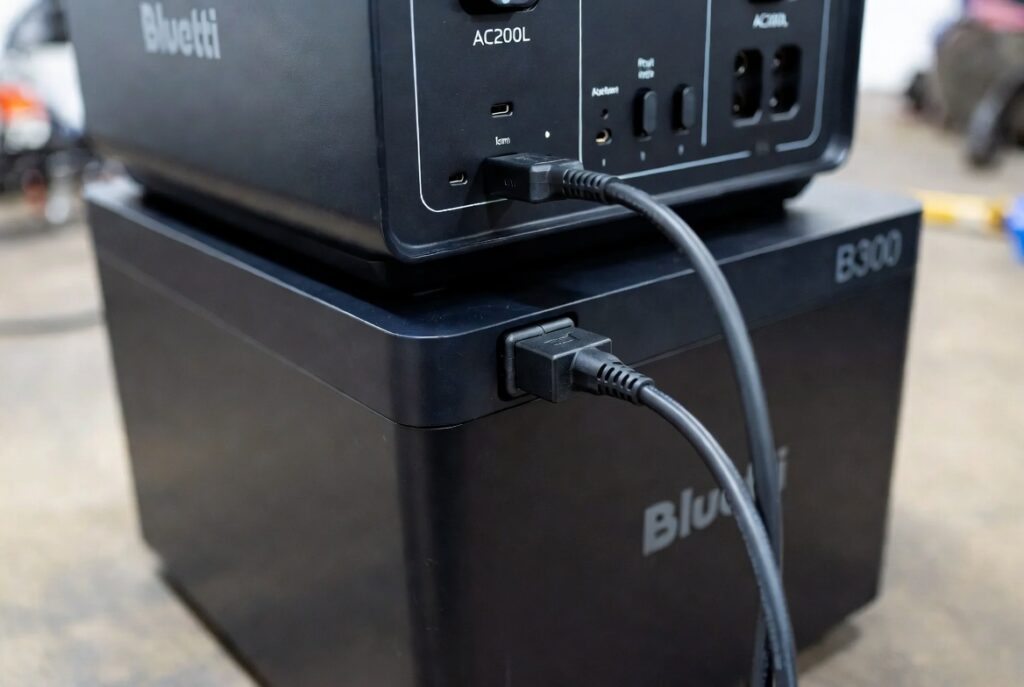
Learning how to expand solar generator capacity with extra batteries is the logical next step after your first Ontario outage proves the base unit is not enough. A 2,048Wh battery at 200W essentials draw lasts approximately 8.5 hours. If the outage starts at 6 PM, the battery dies at 3 AM. Expansion solves this by adding raw battery capacity to the base unit without duplicating the inverter, display, or charging system.
This approach makes expansion 30 to 40 percent cheaper per kWh than buying a second standalone generator. Adding a Bluetti B300 at 3,072Wh costs approximately $2,000 CAD. A second standalone 2,000Wh generator costs over $2,500 CAD and gives you less total capacity. The math favours expansion every time for units that support it.
However, expansion only works if your base unit has a dedicated expansion port. Most units under 1,000Wh lack this option. If you bought a non-expandable model, you are stuck with the capacity you have. This article covers which units expand, which do not, and why the expansion decision should happen before the first purchase, not after the first outage. For a broader look at Ontario generator options, see our solar generator Ontario guide.
The Expansion Compatibility Matrix for 2026
Before buying an expansion battery, verify that your base unit has a dedicated expansion port. Standard USB or AC ports cannot be used to expand capacity. The table below separates expandable units from non-expandable units. If your unit appears in the bottom two rows, there is no upgrade path.
| Base Unit | Expansion Battery Options | Max Total Capacity |
|---|---|---|
| Bluetti AC200L | B210 (1,024Wh), B230 (2,048Wh), B300 (3,072Wh) | 8,192Wh |
| EcoFlow DELTA Pro 3 | Extra Battery (3,600Wh) | 11,600Wh |
| Jackery Explorer 2000 Plus | Battery Pack 2042 (2,042Wh) | 24,000Wh |
| Anker SOLIX C1000 Gen 2 | None | 1,056Wh (fixed) |
| Bluetti AC200P | None | 2,000Wh (fixed) |
The Bluetti AC200L offers the widest expansion range with three battery sizes up to 8,192Wh total. The EcoFlow DELTA Pro 3 reaches 11,600Wh with two expansion units. The Anker SOLIX C1000 and Bluetti AC200P have no expansion path at all.
The Brand Lock Rule and Why You Cannot Mix Expansion Batteries
Expansion batteries use proprietary BMS communication via a dedicated data cable. A Bluetti B300 only communicates with Bluetti head units. The internal firmware must match for the BMS handshake to complete. You cannot connect a Bluetti expansion battery to an EcoFlow generator or vice versa. The communication protocol is proprietary and brand-specific.
This means your expansion path is locked to the brand you chose for the base unit. If you buy a Bluetti AC200L, your expansion options are B210, B230, and B300. If you buy an EcoFlow DELTA Pro 3, your option is the DELTA Pro 3 Extra Battery. Choose the brand with the expansion ecosystem you want before buying the base unit. Switching brands later means selling the base unit and starting over. For the full AC200P comparison, see our Bluetti AC200P review.
How to Expand Solar Generator for Ontario Runtime and the 10-Hour Rule
A 2,000Wh unit at 200W essentials draw lasts approximately 8.5 hours. That covers an outage from 6 PM to 2:30 AM. It does not cover a full night. The 10-hour rule states that if your essentials load exceeds 150W continuous, a standard 2,000Wh unit will not bridge the gap from sunset to sunrise in Ontario. Expansion is the fix that eliminates the 3 AM dead battery. For the full outage protocol, see our solar generator outage protocol.
Adding a B300 at 3,072Wh brings the total system to 5,120Wh. At 200W essentials draw, that runs for 21+ hours. It bridges a full night, a grey morning, and most of the following day on a single charge. The expansion cost of approximately $2,000 CAD buys 12 additional hours of runtime. A second standalone 2,000Wh unit would cost $2,500+ and only add 8.5 hours. The per-hour cost of expansion is 40 percent lower. For load details, see our 2000W solar generator load guide.
The Frontenac Three-Day Triumph
A property owner in Frontenac County started with a Bluetti AC200L running his essentials load at approximately 200W continuous. The base 2,048Wh unit gave him approximately 8.5 hours of runtime. During his first winter outage, the battery died at 3:30 AM. He added a Bluetti B300 expansion battery at 3,072Wh, bringing his total system to 5,120Wh.
During the next multi-day ice storm, he discovered that the larger combined battery actually made his solar charging more efficient. With the base unit alone, the battery would reach 100 percent by noon and waste the remaining 3 hours of afternoon sun. With the B300 attached, the larger total capacity absorbed every available watt of solar until sunset. The system captured approximately 40 percent more solar energy per day simply because the battery was never full when the sun was still shining.
Adding an expansion battery is like upgrading from a 50-litre fuel tank to a 150-litre tank. It does not just let you drive further on one fill. It lets you take full advantage of every gas station you pass without stopping to top off an already full tank. The combined 5,120Wh system ran his essentials for 21+ hours per charge, bridging a full night and a grey morning without stress. For solar charge time math, see our solar panel charge time guide.
The Kawartha Expansion Port Regret
A cottager in the Kawarthas bought a Bluetti AC200P on clearance because the price was $1,100 CAD less than the AC200L. He assumed that because it was a 2,000W unit from the same brand, he could add expansion batteries later if his off-grid fridge drained the battery faster than expected. He ran the fridge, a few LED lights, and a phone charger. The 2,000Wh base unit lasted approximately 14 hours before hitting zero.
When he called to order a B300 expansion battery, he learned that the AC200P lacks the dedicated expansion port found on the AC200L. The P model and the L model look nearly identical from the outside, but the P has no physical connector for expansion batteries. The internal BMS firmware does not support expansion communication. He was at a dead end with no upgrade path on the unit he owned.
Buying a non-expandable generator is like buying a truck without a tow hitch. If you realize later that you need to carry more gear, you cannot just bolt one on. You have to trade in the entire vehicle for a model that was built with the mounting points. He sold the AC200P at a loss and bought an AC200L with a B300, spending $1,400 more than if he had bought the expandable model from the start.
Expand Solar Generator Verdict and Who Should Buy Expansion Batteries
This expand solar generator verdict splits into three profiles based on what you already own and what you need.
- Owners of expandable units who ran out during their first outage should buy the largest expansion battery their base unit supports. For the Bluetti AC200L, add a B300 at 3,072Wh. For the EcoFlow DELTA Pro 3, add the Extra Battery at 3,600Wh. The per-kWh cost of expansion is 30 to 40 percent lower than buying a second standalone unit. For more options, see our best solar generator for home backup guide.
- Buyers who have not purchased a base unit yet should buy an expandable model from the start. The AC200L at $2,200 CAD with a B300 at approximately $2,000 CAD gives you 5,120Wh for $4,200 CAD total. That is cheaper per kWh than two standalone 2,000Wh units. Plan for expansion before the first outage, not after.
- Owners of non-expandable units like the AC200P or Anker C1000 cannot add expansion batteries. Your options are to buy a second standalone unit, trade in for an expandable model, or accept the fixed capacity. If you hit the runtime wall regularly, trading up to an expandable model is cheaper long-term than running two non-expandable units side by side. For the full AC200P comparison, see our Bluetti AC200P review.
Frequently Asked Questions
Q: Can I use a generic battery with my solar generator?
A: No. Expansion batteries must have compatible BMS firmware to communicate with the main unit via the proprietary data cable. Connecting an incompatible battery will not work and could damage both units. Always buy the expansion battery specified for your exact model.
Q: Do I charge the expansion battery separately?
A: Some expansion batteries like the Bluetti B300 have their own AC and solar charging ports for independent charging. In most configurations, you charge both batteries through the main unit’s AC or solar input. Independent charging ports let you recharge the expansion battery faster by connecting it to a separate power source.
Q: Does expansion make the system heavier?
A: Yes, significantly. A Bluetti B300 weighs approximately 79 lbs on top of the AC200L at 62 lbs. Treat expansion batteries as permanent installations rather than portable equipment. The combined system at 141 lbs is cottage or home backup equipment, not camping gear.
NEC Article 480 covers battery storage systems including high-current DC connections, overcurrent protection, and disconnecting means for expansion battery installations. All components must be listed and installed according to the manufacturer’s instructions. Current standards are published at nfpa.org.
CEC Section 64 governs battery storage expansion and high-current DC connection requirements in Ontario. All expansion batteries must be CSA or UL certified and installed per manufacturer specifications. The Electrical Safety Authority (ESA) provides current compliance guidelines at esasafe.com.
This build is engineered within the 48V DC Safety Ceiling. Diagnostic logic is based on 20+ years of technical service experience. All structural and electrical installations must be verified by a Licensed Professional and comply with your Local AHJ. See our legal and safety disclosure for full scope.
About the Author
Robert Bertrand spent 20 years as a service advisor in the automotive industry (Lexus and Nissan), where precision diagnostics, wiring integrity, and documentation standards were non-negotiable. He brings that same technical discipline to GridFree Guide, where he researches, tests, and documents off-grid solar systems for Ontario conditions. Based in Rockwood, Ontario, every article is built on verified specifications, manufacturer data, and the real-world climate constraints of Canadian off-grid living.
As an Amazon Associate I earn from qualifying purchases. This site also contains affiliate links to other products and services. GridFree Guide earns a small commission at no extra cost to you.