
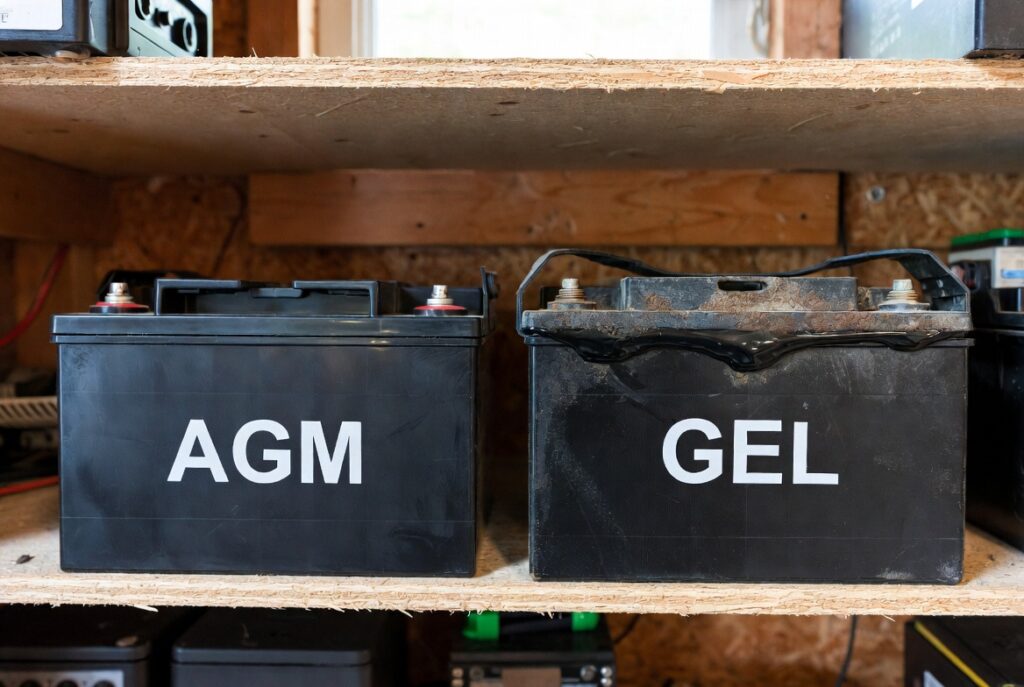
Gel vs AGM is the wrong question for most Ontario builders because AGM wins the lead-acid category outright. Gel batteries cost $180 per 100Ah but require precise charging voltage that budget controllers cannot deliver. AGM costs $125 per 100Ah, is fully sealed, and works with any controller. The gel vs AGM decision is settled by charging tolerance, not by marketing labels.
Flooded lead-acid is the cheapest at $90 per 100Ah but requires monthly distilled water topping. A cottage left empty for 5 months cannot receive that maintenance. The electrolyte drops below the plates, the lead sulphates permanently, and the battery dies. All three lead-acid types share the same 50 percent DoD limit.
This guide compares all three lead-acid chemistries with real Ontario numbers and two cautionary I-moments. For the full chemistry comparison including LFP, see our solar battery guide for Ontario.
| Feature | Flooded (FLA) | AGM (Sealed) | Gel (Sealed) |
|---|---|---|---|
| Cost per 100Ah | $90 | $125 | $180 |
| Maintenance | Monthly water | Zero | Zero |
| Hydrogen venting | High | Minimal | Minimal |
| Max absorption voltage | 14.8V | 14.4V | 14.1 to 14.4V |
| Overcharge risk | Low | Moderate | High (permanent) |
| Cycle life (50% DoD) | 300 to 500 | 400 to 600 | 500 to 700 |
| Ontario best use | Daily-use budget | Seasonal/off-grid | High-heat only |
Gel vs AGM vs flooded and why the electrolyte decides everything
Flooded lead-acid uses liquid sulfuric acid that sits between the plates. It costs $90 per 100Ah and vents hydrogen gas freely during charging. Monthly distilled water topping is mandatory. If you skip that maintenance, the plates dry out and sulphate permanently.
AGM holds acid in fibreglass mats, making it sealed and maintenance-free. Gel suspends acid in silica gel to prevent leaks. However, gel demands precise charging voltage that most budget controllers cannot provide. The gel vs AGM choice comes down to charging tolerance, not longevity.
Why gel batteries fail in Ontario off-grid builds
Gel batteries require absorption voltage between 14.1 and 14.4V for a 12V system. Most budget PWM controllers output a fixed 14.8V as the default bulk charge. That 0.4V difference creates oxygen bubbles inside the silica gel. Those bubbles form permanent dry voids on the plates that reduce capacity irreversibly.
Within 2 to 4 months of overcharging, a gel battery can lose 30 to 40 percent of its rated capacity. The battery spec sheet guide shows how to find the correct absorption voltage before connecting any battery. No amount of reconditioning can restore what overcharging destroys in gel chemistry.
The gel vs AGM charging voltage difference that kills capacity
AGM tolerates 14.4V absorption safely with any modern charge controller. Gel cannot handle that same voltage without damage. A $35 PWM controller with a fixed 14.8V profile will destroy a gel battery within one season. The depth of discharge guide confirms that DoD limits are identical for both chemistries.
Only programmable MPPT controllers like the Victron MPPT 100/30 allow manual absorption voltage setting. Without it, gel batteries die within months from sustained overvoltage. The gel vs AGM voltage gap is only 0.4V, but that gap costs hundreds in premature replacements.
Why flooded batteries fail at seasonal Ontario cottages
Flooded batteries need monthly distilled water to keep the plates submerged. A cottage closed from October to March cannot receive that maintenance. Over 5 months, the electrolyte level drops below the plates. The exposed lead reacts with air and forms irreversible sulphation.
The recondition lead-acid batteries guide explains why sulphation from exposed plates cannot be reversed. FLA costs $90 per 100Ah but rarely lasts more than 18 months without consistent monthly attention. For seasonal Ontario properties, FLA is a false economy. The gel vs AGM debate gets the attention, but FLA is the worst choice of all three.
The Oxford County gel overcharge failure
A cottage owner in Oxford County bought two 100Ah gel batteries at $180 each for a 2-panel shed system. The salesman told him gel lasts longer than AGM. He connected them to a $35 PWM controller with a fixed absorption voltage of 14.8V. He did not know gel batteries require a maximum of 14.4V.
The 14.8V overvoltage created gas bubbles inside the silica gel that formed permanent dry voids. Within 4 months, the Victron SmartShunt showed both batteries had lost 40 percent capacity. The LED lights dimmed by 7:00 PM instead of lasting until midnight. The gel vs AGM voltage difference destroyed $360 worth of batteries.
He replaced both with AGM units at $125 each and upgraded to a Victron MPPT 100/30 set to 14.4V absorption. The AGM pair has now run 18 months with zero capacity loss. The gel vs AGM decision cost him $110 more than buying AGM from the start. One incorrect controller setting turned a premium purchase into a 4-month failure.
The Hastings County flooded maintenance failure
A cabin owner in Hastings County installed two 100Ah flooded lead-acid batteries at $90 each. He maintained them perfectly through summer with weekly water topping. In October he closed the cabin for winter and left the batteries connected. He assumed the system would manage itself without intervention.
Over 5 months without maintenance, the electrolyte dropped below the plates. The exposed lead surfaces suffered irreversible sulphation from contact with air. The charge controller continued pushing current through the dry plates. By February, both batteries read zero volts under load.
The $180 FLA pair lasted 14 months with constant summer maintenance. An AGM pair at $250 would have run 4 years maintenance-free in the same application. The $70 purchase savings cost him $180 in replacement batteries plus a day hauling dead weight to the recycler. Gel vs AGM gets the attention, but FLA versus AGM is equally important.
NEC and CEC code requirements for lead-acid installations
NEC 480.9 requires proper ventilation for all lead-acid battery installations to prevent hydrogen accumulation. Any enclosed space housing FLA, AGM, or gel batteries must allow for pressure relief under fault conditions. Overcharge events produce hydrogen regardless of sealed labelling. Contact the NFPA at nfpa.org for current NEC 480 requirements.
CEC Section 64 mandates that all energy storage systems in Ontario meet ESA safety standards. Your insurance may not cover damage from a non-compliant battery installation. The ESA at esasafe.com publishes certified equipment lists and installation guidelines. Verify compliance before connecting any lead-acid battery in a permanent off-grid system.
Pro Tip: Before connecting any gel battery, check the absorption voltage on your charge controller’s display or spec sheet. If it reads 14.8V and you cannot adjust it, do not connect a gel battery. Buy AGM instead. The $55 price difference between gel and AGM is cheaper than the $360 replacement cost when gel fails from overvoltage.
Gel vs AGM verdict: AGM wins lead-acid, LFP wins everything
- Budget builders choosing lead-acid: Buy AGM at $125 per 100Ah. It is sealed, maintenance-free, and works with any controller. Do not buy gel unless you own a programmable MPPT with adjustable absorption voltage.
- Seasonal cottage owners leaving systems unattended: AGM is the only safe lead-acid choice for Ontario. FLA dies without monthly maintenance. Gel dies from overcharging on budget controllers. Only AGM handles 4 to 6 months of seasonal absence.
- Builders ready for long-term value: Skip lead-acid entirely. Buy a Battle Born 100Ah LFP at $400. The LFP versus AGM comparison shows $0.13 per cycle versus $0.83. The premium pays back within two years.
Frequently asked questions
Q: Is gel better than AGM for solar?
A: No, for most Ontario builds gel is more fragile than AGM. Gel requires strict voltage control that budget PWM controllers cannot provide. AGM tolerates normal charging profiles without damage and costs $55 less per 100Ah.
Q: Can I use flooded batteries in a seasonal cottage?
A: Not recommended. FLA needs monthly distilled water topping that is impossible during a 4 to 6 month winter absence. Exposed plates develop irreversible sulphation within weeks of drying out. AGM or LFP are the only safe choices for seasonal Ontario properties.
Q: Which lead-acid battery lasts longest?
A: Gel offers 500 to 700 cycles if charged with precise voltage control. AGM delivers 400 to 600 cycles and is far more forgiving under imperfect conditions. A Renogy 100W panel paired with LFP at 3,000 or more cycles beats all three lead-acid types.
This build is engineered within the 48V DC Safety Ceiling. Diagnostic logic is based on 20+ years of technical service experience. All structural and electrical installations must be verified by a Licensed Professional and comply with your Local AHJ. See our legal and safety disclosure for full scope.
About the Author
Robert Bertrand spent 20 years as a service advisor in the automotive industry (Lexus and Nissan), where precision diagnostics, wiring integrity, and documentation standards were non-negotiable. He brings that same technical discipline to GridFree Guide, where he researches, tests, and documents off-grid solar systems for Ontario conditions. Based in Rockwood, Ontario, every article is built on verified specifications, manufacturer data, and the real-world climate constraints of Canadian off-grid living.
As an Amazon Associate I earn from qualifying purchases. This site also contains affiliate links to other products and services. GridFree Guide earns a small commission at no extra cost to you.