
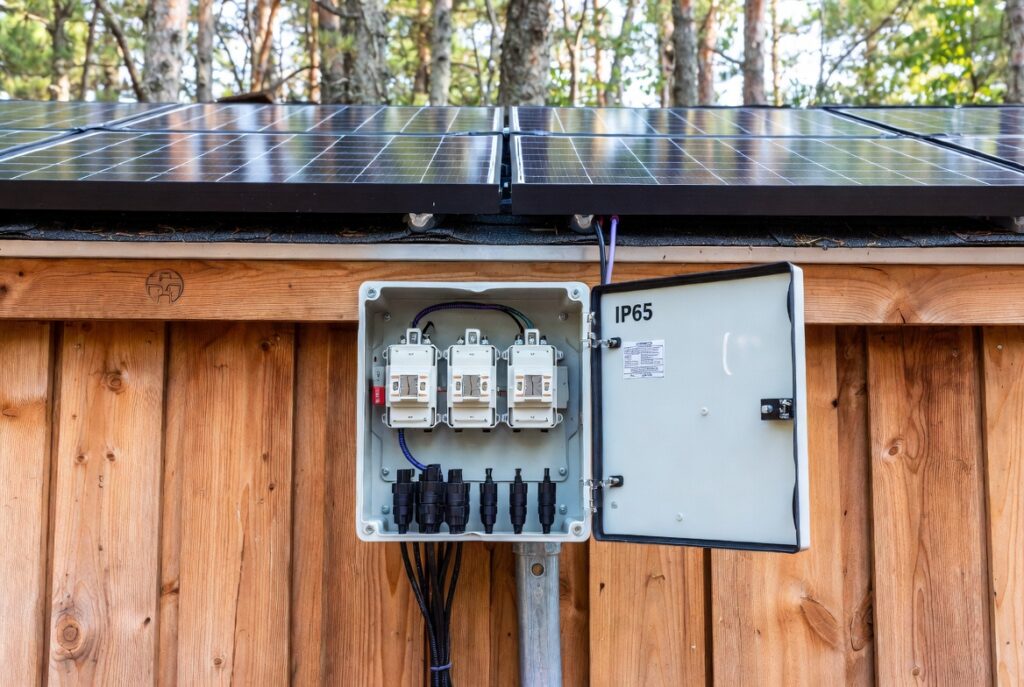
The solar combiner Ontario failure that limits a Wellington County 1,200W three-string array to 800W production on a clear July afternoon is not a panel defect or an MPPT programming issue but a single blown 15A fuse inside the combiner box that disconnected one entire string from the array. The fuse element failed open from a current spike caused by a loose MC4 connection. The SmartShunt confirmed the 33 percent current reduction immediately.
A solar combiner Ontario box consolidates 2 to 4 separate panel string conductors into a single positive and negative conductor pair that runs from the box to the MPPT 100/50 input. With a combiner mounted near the array, one cable pair carries the combined array current from the box to the MPPT regardless of the number of strings.
Mounting the combiner near the array minimises the main output conductor length and limits roof penetrations to one opening.
The solar combiner Ontario string fuse is the component that makes the combiner more than a wire junction. Each string in the combiner requires its own 15A fuse on the positive conductor before the combine point. The 15A fuse protects the string wiring from backfeed current from the other strings if one string develops a fault, partial shade, or low voltage condition. The Haldimand County result confirmed what happens when this fuse is omitted: a single 30A output fuse on the combined conductor could not protect the individual string conductors from backfeed heating, and string 2 wiring showed heat damage before the output fuse saw enough current to act.
Both Ontario results share the same root cause: a combiner box that was either missing a fuse or had one fail. The Wellington County blown fuse and the Haldimand County missing per-string fuses are the two most common solar combiner Ontario failures in Ontario off-grid installations. Both are preventable with correct installation and a 5-minute annual visual inspection of each fuse element. See our Ontario solar sizing guide before any solar combiner Ontario installation.
The solar combiner Ontario function: consolidating multiple strings into one MPPT input conductor
| Configuration | Combiner needed? | String fuses required? | Correct solution |
|---|---|---|---|
| 1 string to MPPT | No | No | Direct MC4 connection to MPPT input |
| 2 parallel strings to MPPT | Yes (or MC4 branch) | Yes , 15A per string | MC4 branch connector or combiner box |
| 3 to 4 parallel strings to MPPT | Yes | Yes , 15A per string | Combiner box with per-string fuses |
| Mixed orientations (south + east) | Yes | Yes , 15A per string | Combiner box , not MC4 branch |
A solar combiner Ontario box takes 2 to 4 parallel MC4 positive and negative string conductors from separate panel arrays and combines them into a single positive and negative conductor pair. Without a combiner, each string requires its own separate wire run to the MPPT, creating multiple roof penetrations and multiple separate conductors through the wall. With a combiner mounted near the array, one cable pair carries the combined array current to the MPPT regardless of the number of strings. Mounting the box exterior near the array minimises the main output conductor length, reducing voltage drop and limiting the number of roof penetrations to one.
For 2-string systems with matched panels at the same orientation, an MC4 branch connector provides a simpler combine function without a full box. The branch connector does not provide individual string fuse protection but is acceptable for matched 2-string systems at the same orientation and age where shade differences between strings are minimal. For any system with mixed orientations, different panel ages, or potential shade differences between strings, a proper combiner box with 15A per-string fuses is the correct solar combiner Ontario specification. See our Ontario MC4 connector guide for the branch connector installation protocol.
When a combiner box is required: single string versus multiple parallel strings
A single string connecting directly to the MPPT does not require a combiner. Two or more parallel strings feeding the same MPPT input must combine before the MPPT input terminals to avoid unequal current distribution and unsafe wiring. In Ontario off-grid systems with roof arrays on multiple orientations , south-facing primary and east-facing secondary, for example , the combiner is required because the strings produce different current levels at different times of day. The combiner’s per-string fuses protect each string from the other during those orientation-driven current imbalances.
The correct solar combiner Ontario mounting position is near the array. An exterior IP65-rated combiner box mounted on the wall below the array or inside the roof penetration junction handles Ontario conditions including freeze-thaw cycling, ice loading, and rain ingress. Interior mounting near the MPPT is also correct when the roof penetration distance is short. In either case, the main output conductor from the combiner box to the MPPT is one heavy cable pair rated for the combined array current, rather than multiple lighter string conductors running separately to the MPPT input.
The solar combiner Ontario string fuse rule: 15A per string and the backfeed protection principle
Each string in a solar combiner Ontario box requires its own 15A fuse on the positive conductor before the combine bus. The 15A rating is derived from NEC 690.9: string fuses are sized at 2.5 times the panel maximum short-circuit current (Isc). A standard 100W panel with an Isc of approximately 6A requires a fuse of 6A x 2.5 = 15A. The individual string fuse performs a specific protection function that the combined output fuse cannot: it limits the backfeed current from the other strings in the event that one string drops below the combined bus voltage due to shading, a panel fault, or a connection issue.
A Haldimand County new build installed a 3-string combiner with a single 30A fuse on the combined output only , no individual 15A fuses per string. The 30A output fuse was correctly sized for the combined array current. Partial shade from a tree branch dropped string 2 voltage below the combined bus voltage one July afternoon. Strings 1 and 3 began backfeeding current through the unfused string 2 positive conductor. The backfeed current heated the string 2 wire.
By the time the owner detected the smell from the enclosure, approximately 6 inches of string 2 positive insulation had heat-discoloured and partially melted. The 30A output fuse never opened because the fault current was not on the combined output conductor , it was on the individual string conductor between string 2 and the combine bus. See our Ontario solar fuse guide for the full fuse sizing protocol.
The Haldimand County backfeed result: why the output fuse alone is not enough
The Haldimand County owner had done everything else correctly: IP65 combiner box, correctly sized 30A output fuse, proper MC4 connections, and exterior mounting near the array. The one omission was the individual 15A fuses per string. The system ran without incident for the first two months of operation because all three strings were producing at similar current levels. The shade event on string 2 was the first condition that created a meaningful voltage difference between strings , the first time the backfeed protection function of the individual string fuses was needed.
The rewire added a 15A blade fuse on each string positive conductor before the combine bus, while retaining the 30A output fuse for combined conductor protection. Both fuse levels serve different functions and both are required. The 15A per-string fuses protect each string conductor from backfeed from the other strings. The 30A output fuse protects the combined output conductor from an overcurrent event downstream of the combine point. Neither fuse can do the other’s job. The Haldimand County result confirmed the consequence of relying on the output fuse alone: 6 inches of insulation damage before detection.
The correct solar combiner Ontario installation has one 15A fuse per string positive conductor before the combine bus, plus one output fuse sized for the total combined short-circuit current after the combine point. For 3 strings with Isc of 6A each, the combined Isc is approximately 18A; a 20A or 30A output fuse is correct. The individual string fuses do not need to be the same type as the output fuse , 15A blade automotive fuses are acceptable for string-level protection at the panel current levels of standard 100W to 200W Ontario array panels.
The Wellington County blown fuse result: 800W from a 1,200W array, one fuse, thirty seconds
A Wellington County homeowner had a 1,200W array across three 400W strings feeding a 3-string combiner box. On a clear July afternoon, the MPPT showed consistent 800W production despite full sun. The SmartShunt confirmed the current reading was approximately 33 percent below expected for the irradiance conditions visible on the Cerbo GX estimate. No fault codes appeared on the Cerbo GX. All MC4 connections at the panels appeared intact from ground level. The 800W reading was steady and consistent, which ruled out intermittent shading or a loose connection still making intermittent contact.
Opening the combiner box revealed two intact 15A fuses and one fuse with a visible gap in the fuse element. The failed fuse was on the string whose MC4 connector showed slight discolouration on the collar , evidence that a brief overvoltage event from a momentary loose connection had caused a current spike sufficient to blow the 15A fuse. The fuse had done exactly what it was designed to do: interrupt the fault current before it could damage the string conductor. The two remaining strings had continued producing normally, explaining the steady 800W rather than a complete system outage.
Replacing the blown 15A fuse and re-torquing the loose MC4 connector collar restored full 1,200W production within seconds of closing the combiner box lid. The SmartShunt confirmed the current increase immediately as the third string reconnected to the combine bus. The owner’s comment: “Thirty seconds and a $2 fuse. That’s all it was.” The solar combiner Ontario fuse inspection should be part of the annual spring commissioning checklist , the same visual check that catches the MC4 freeze-thaw collar loosening on the array also catches any fuse element failures in the combiner box.
The failed string fuse diagnostic: SmartShunt current reading and the continuity check
The solar combiner Ontario failed string fuse diagnostic starts with the SmartShunt current reading on a clear day. Divide the SmartShunt total current by the number of strings to check for equal contribution. Three strings each producing approximately 10A should show approximately 30A combined on the SmartShunt; a reading of 20A on a clear day indicates one string is offline. The Cerbo GX VRM history shows the moment production dropped as a sudden step reduction in total current , not a gradual decline from shading or cloud cover, but a discrete step down that corresponds to the moment the fuse failed.
Physical diagnosis takes less than 5 minutes. Open the combiner box, visually inspect each 15A fuse element for a visible gap in the metal strip inside the fuse body, then confirm with a multimeter continuity test. A 15A blade fuse costs approximately $2 and the swap takes approximately 30 seconds. Before installing the replacement fuse, check the MC4 connectors on that string for discolouration, deformation, or loose collar tightness , the same fault that caused the overvoltage spike may have left a damaged connector that will blow the replacement fuse if not corrected first. See our Ontario solar fault guide for the complete current-dropout diagnostic sequence.
NEC and CEC: Ontario permit requirements for solar combiner installations
Any permanently wired solar combiner Ontario installation requires an ESA permit under CEC Section 64 before installation begins. The combiner box, string fuses, and main output conductor are all part of the permanent DC wiring that falls under the permit requirement. NEC 690.9 governs DC overcurrent protection sizing for photovoltaic systems, including the 2.5x Isc string fuse sizing rule that produces the 15A specification for standard Ontario array panels. Contact the NFPA at nfpa.org for current NEC 690 requirements applicable to Ontario solar combiner installations.
CEC Section 64 requires the ESA permit before any permanent wiring begins. The ESA inspector will verify that each string has individual overcurrent protection, that the combined output fuse is correctly sized, and that the combiner box has the appropriate IP rating for its installation location. An exterior Ontario combiner box requires IP65 minimum for weather protection. The main battery circuit fuse , the Blue Sea 600A Class T at the battery positive terminal , is a separate protection requirement from the string fuses and must be installed regardless of whether a combiner box is present. Contact the Electrical Safety Authority Ontario at esasafe.com before beginning any permanently wired solar combiner Ontario installation.
Pro Tip: Add the combiner box fuse inspection to your spring solar Ontario commissioning checklist. Open the box on the first warm weekend of April, visually check each string fuse element for visible gaps, test continuity with a multimeter on any fuse that looks unclear, and re-torque all MC4 connections entering the box. The same freeze-thaw cycles that loosen MC4 collars on the roof also create the micro-vibrations that loosen fuse holder contact points inside the combiner box. A 5-minute spring inspection prevents the Wellington County scenario: arriving on a clear July day to 800W from a 1,200W array because a blown fuse went undetected all winter.
The solar combiner Ontario verdict: individual string fuses, IP65 mounting, SmartShunt confirms all strings contributing
- Ontario owner with two or more parallel panel strings: install a solar combiner Ontario with individual 15A fuses per string before the MPPT. The Haldimand County result confirms the consequence of relying on a single output fuse: backfeed current heated string 2 wiring to insulation damage without any fuse opening to stop it. The 15A per-string fuse is the only protection that limits backfeed current on individual string conductors. A correctly wired combiner box has one 15A fuse per string positive conductor before the combine bus, plus one combined output fuse sized at 2.5x the total array Isc.
- Ontario owner whose SmartShunt shows below-expected current on a clear day: check the combiner box fuses before investigating panels or the MPPT. The Wellington County result: one blown 15A fuse reduced a 1,200W array to 800W with no fault codes anywhere in the system. The diagnostic is simple , SmartShunt total current divided by number of strings reveals the missing string. Fuse replacement takes 30 seconds. Always check the associated MC4 connections on the failed string before installing the replacement fuse.
- Ontario owner building a 2-string system: the MC4 branch connector is a valid alternative for matched strings at the same orientation. It does not provide per-string fuse protection but is acceptable when both strings produce similar current throughout the day and shade differences between strings are minimal. For any system with mixed panel orientations, different panel ages, or shade differences, a full combiner box with 15A per-string fuses is the correct specification regardless of the additional cost and installation time.
Frequently Asked Questions
Q: Do I need a solar combiner box for my Ontario off-grid system?
A: A solar combiner Ontario box is required whenever two or more parallel strings of panels feed the same MPPT input. A single string connects directly to the MPPT without a combiner. Two or more parallel strings must combine before the MPPT input to avoid unequal current distribution and unsafe individual string conductors entering the MPPT separately. For 2-string systems with matched panels at the same orientation, an MC4 branch connector is a simpler alternative to a full combiner box.
The branch connector does not provide individual string fuse protection. For any system with mixed orientations, different panel ages, or shade differences between strings, a proper combiner box with 15A per-string fuses is the correct specification. The Haldimand County result confirms the consequence of omitting per-string fuse protection: backfeed heating to insulation damage with no fuse blowing to stop it.
Q: What fuse size should I use in a solar combiner box in Ontario?
A: Each string in a solar combiner Ontario requires a 15A fuse on the positive conductor before the combine point, based on NEC 690.9 fuse sizing at 2.5 times the panel maximum short-circuit current (Isc). A standard 100W panel with an Isc of approximately 6A requires a fuse of 6A x 2.5 = 15A. Standard 200W panels have similar Isc values and also use 15A string fuses. Higher-wattage panels may have higher Isc values requiring recalculation. Always check the panel specification sheet for the Isc value before selecting string fuse ratings.
The combined output fuse is sized separately based on the total combined Isc of all strings: three strings at 6A Isc each = 18A combined, requiring a 20A to 30A output fuse.
Both fuse levels are required for a correctly protected solar combiner Ontario installation.
Q: How do I know if a string fuse has blown in my Ontario solar combiner box?
A: The solar combiner Ontario failed string fuse diagnostic starts with the SmartShunt current reading on a clear day. Divide the total SmartShunt current by the number of strings: if one string has gone offline, the total current will be proportionally lower than expected. A 3-string 1,200W array showing 800W production on a clear day is showing exactly 33 percent below expected, which matches one of three strings offline. The Cerbo GX VRM history shows the failure moment as a sudden step reduction in current rather than a gradual decline.
Physical confirmation takes 5 minutes. Open the combiner box, visually inspect each 15A fuse element for a visible gap, and test continuity with a multimeter. Before replacing the blown fuse, check the MC4 connections on that string for the overvoltage fault that blew it , the Wellington County result showed that the loose MC4 collar was the root cause, not the fuse itself.
This build is engineered within the 48V DC Safety Ceiling. Diagnostic logic is based on 20+ years of technical service experience. All structural and electrical installations must be verified by a Licensed Professional and comply with your Local AHJ. See our legal and safety disclosure for full scope.
About the Author
Robert Bertrand spent 20 years as a service advisor in the automotive industry (Lexus and Nissan), where precision diagnostics, wiring integrity, and documentation standards were non-negotiable. He brings that same technical discipline to GridFree Guide, where he researches, tests, and documents off-grid solar systems for Ontario conditions. Based in Rockwood, Ontario, every article is built on verified specifications, manufacturer data, and the real-world climate constraints of Canadian off-grid living.
As an Amazon Associate I earn from qualifying purchases. This site also contains affiliate links to other products and services. GridFree Guide earns a small commission at no extra cost to you.