
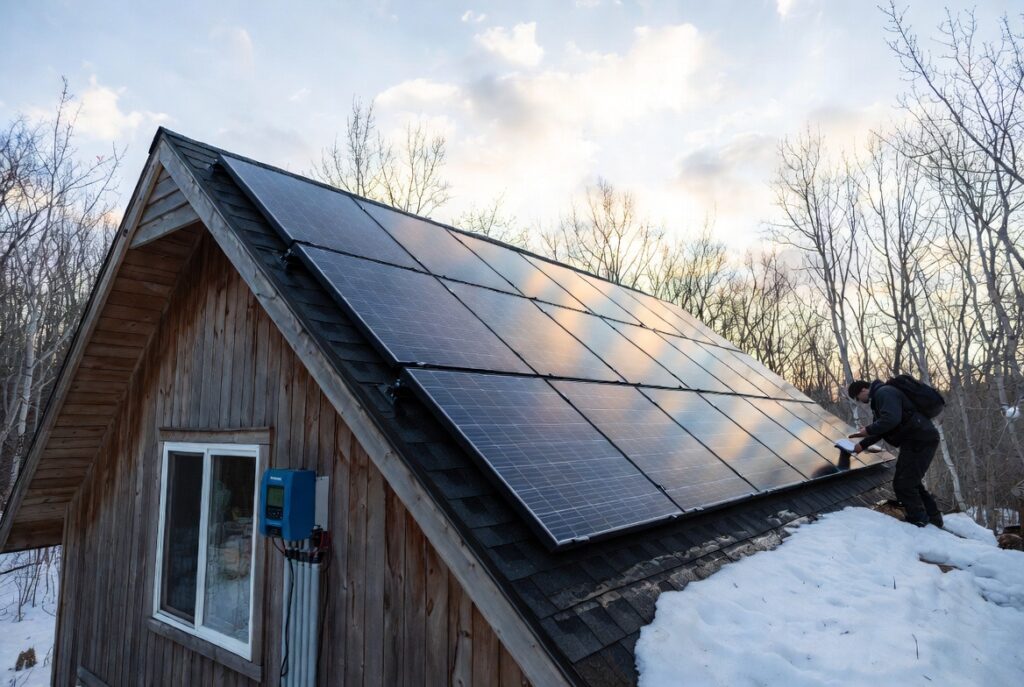
The solar maintenance Ontario failure that produced three blown combiner fuses, two high-resistance MC4 connections, and a SmartShunt capacity reading 15 percent below the 2019 commissioning baseline in a Dufferin County system was not caused by a product defect or an Ontario weather event but by three consecutive years of skipped annual maintenance visits. The owner assumed the system was running correctly based on the lights staying on while the underlying connection and chemistry degradation compounded undetected across three winters.
Three summers of heat stress compounded the freeze-thaw damage invisibly. Ontario off-grid solar systems experience more physical stress per year than most installed equipment. The temperature range from approximately minus 30 degrees C in January to plus 35 degrees C in July produces approximately 65 thermal expansion and contraction cycles on every threaded collar, bolted lug, and crimped terminal in the system.
The Hastings County owner who ran the full 12-task solar maintenance Ontario checklist every April and October for 3 years arrived at the spring 2024 visit with a VRM history showing 95 percent of expected production in every month and a SmartShunt spring baseline of 97Ah versus the 99Ah 2021 commissioning baseline , a 2 percent reduction over 3 years, within normal LFP cycle degradation.
The maintenance approach was the only difference between the two systems. The Dufferin County owner who skipped all maintenance from 2020 through 2022 arrived at the spring 2023 visit with a system operating at 33 percent reduced capacity from blown fuses, two high-resistance MC4 connections, and a 15 percent SmartShunt capacity reduction. Same Ontario climate. Same system age. Vastly different outcomes from different maintenance decisions.
Most connections in an Ontario off-grid system survive the annual thermal cycling intact. Those that do not , the MC4 collar that backs off, the lug that loosens, the fuse element that fails under a current spike , continue to carry current through an increasingly degraded contact point until the resistance heating becomes visible or a fuse finally opens. The 12-task solar maintenance Ontario annual checklist is the tool that catches those developing failures before they compound. See our Ontario solar sizing guide before beginning any solar maintenance Ontario inspection on a new system.
The solar maintenance Ontario spring visit: 7 tasks in 75 minutes before the production season opens
| Task | Season | Time | Tool | What it catches |
|---|---|---|---|---|
| 1. MC4 torque check | Spring | 15 min | Hand check under load | Freeze-thaw collar loosening |
| 2. SmartShunt baseline | Spring & Autumn | 5 min | SmartShunt display | Annual capacity change |
| 3. Fuse and lug inspect | Spring & Winter | 10 min | Visual + multimeter | Blown fuses, oxidised lugs |
| 4. Panel surface clean | Spring | 20 min | Water + soft cloth | Winter debris, salt residue |
| 5. Array tilt to 30 degrees | Spring | 10 min | Angle finder | Winter tilt left at 60 degrees |
| 6. MPPT firmware update | Spring | 5 min | VictronConnect | Algorithm improvements |
| 7. Cerbo GX VRM baseline | Spring | 5 min | VRM portal browser | Annual production reference |
| 8. SoC low-point review | Summer (monthly) | 5 min | SmartShunt history | Undersized system or load growth |
| 9. Irradiance spot check | Summer (monthly) | 5 min | SmartShunt + Cerbo GX | Connection or shading issues |
| 10. Combiner visual | Summer (monthly) | 5 min | Visual inspection | Backfeed heating early signs |
| 11. Capacity comparison | Autumn | 5 min | SmartShunt display | Summer heat stress on cells |
| 12. Generator threshold raise | Winter | 5 min | VictronConnect | January gray streak protection |
The spring visit is the most important solar maintenance Ontario task of the year. Task 1 , MC4 torque check , is the highest-priority item because freeze-thaw cycling physically backs off MC4 locking collars over the Ontario winter, creating high-resistance joints that reduce production and generate heat. Run a hand along each accessible connector under load on a clear day. Warm means resistance. Task 2 , SmartShunt capacity baseline , records the starting point for all annual comparisons. Run the bank from 100 percent to 20 percent SoC under a known load, then recharge to 100 percent and record the displayed Ah. This is the spring baseline.
Tasks 3 and 4 cover fuse and lug inspection and panel surface cleaning. Inspect each Blue Sea 600A Class T fuse visually and check both copper lug surfaces for grey-white oxidation. A fuse terminal with visible oxidation should be cleaned or replaced. The panel surface clean removes winter debris , salt residue, pine needles, and organic matter , that reduces irradiance reaching the cells. Plain water and a soft cloth restore the efficiency baseline in approximately 20 minutes. Together, tasks 3 and 4 take approximately 30 minutes and directly restore production to its clean-panel, low-resistance baseline.
Tasks 5 through 7 take approximately 20 minutes combined. Task 5 adjusts array tilt from the winter 60-degree angle back to the summer 30 to 35-degree optimum. Task 6 opens VictronConnect and updates the MPPT 100/50 and Cerbo GX firmware if updates are available. Task 7 logs into the VRM portal and records the date, SmartShunt baseline, and expected daily production for the spring month. This VRM entry is the reference point for every future annual comparison. See our Ontario spring solar guide for the complete spring protocol with timing and diagnostic triggers.
The Dufferin County 3-year neglect result: blown fuses, warm MC4 collars, and 15 percent capacity loss
A Dufferin County homeowner installed a correctly specified 400W system in spring 2019 with the SmartShunt commissioning baseline recorded at 99Ah. The first spring after commissioning, the owner skipped the maintenance visit citing time constraints. The second spring the same. The third spring the same. The system appeared to be running because critical loads remained powered throughout , the lights stayed on, the fridge ran, and no fault codes appeared on the Cerbo GX display. The Cerbo GX VRM portal was not being reviewed. The gradual production decline from 2020 through 2022 was not visible to the owner.
The spring 2023 visit, prompted by noticeably slower battery recovery on sunny days, revealed three separate problems developing in parallel. Three combiner string fuses had blown from undetected overvoltage events, leaving 33 percent of the array disconnected from the combine bus. Two MC4 collars were warm to the touch under load, confirming three years of freeze-thaw loosening had created high-resistance joints drawing resistive heat from the circuit. The SmartShunt capacity baseline recorded at 84Ah versus the 99Ah 2019 commissioning baseline represented a 15 percent reduction that exceeded normal LFP cycle degradation , the high-resistance MC4 connections had been forcing the MPPT to draw excess current from the remaining strings, stressing the cells through three summers of heat cycling.
Every one of these issues was catchable at year 1 for approximately $6 in replacement fuses and 30 minutes of collar re-torquing. The blown fuses at year 1 would have been $2 each. The MC4 collars at year 1 would have been a 5-minute re-seat. The SmartShunt baseline comparison at year 1 would have shown a capacity reading within 1 to 2 percent of the commissioning baseline, confirming normal operation. The solar maintenance Ontario lesson from Dufferin County: three years of $0 in maintenance produced a system requiring approximately $800 in battery assessment, combiner rewiring, and MC4 replacement , at least 10 years of the annual maintenance cost incurred in one remediation visit.
The summer monitoring tasks: SmartShunt low-point review, irradiance spot check, combiner visual
The three summer solar maintenance Ontario tasks take approximately 15 minutes per month in June, July, and August. Task 8 is the monthly SmartShunt SoC low-point review: open the SmartShunt history and check the lowest SoC recorded in the previous 30 days. If the low point is consistently below 40 percent SoC in June or July when production is at its seasonal peak, the system is either undersized for the current loads or production is impaired by a connection issue. A June low-point below 40 percent is one of the earliest signals that a maintenance issue is developing.
Task 9 is the irradiance spot check: on a clear July day at solar noon, check SmartShunt production against the expected output for the visible sky conditions. At 650 to 700 W/m2 summer irradiance, a 400W array should produce approximately 260 to 280W. If SmartShunt shows more than 15 percent below this expected range on a clear day, investigate MC4 connections and combiner fuses before assuming a panel fault. Task 10 is the monthly combiner box visual: open the combiner lid, check each string fuse element visually, and look for any heat discolouration inside the box. A summer combiner check catches the early signs of the Haldimand County backfeed heating scenario before it reaches insulation damage.
The autumn layup tasks: capacity comparison, terminal torque, winter tilt
The three autumn solar maintenance Ontario tasks take approximately 20 minutes combined. Task 11 is the SmartShunt capacity comparison to the spring baseline. Run a full discharge and recharge cycle and record the Ah capacity. A summer reading of 94Ah versus a spring reading of 97Ah from a 100Ah bank represents a 3Ah summer loss , within the normal 80 percent DoD cycling range. A summer reading of 88Ah versus a spring reading of 97Ah represents a 9 percent single-season reduction that requires investigation for heat-related cell stress before winter. Battery terminal torque rounds out the autumn tasks. Check all lug connections for loosening from summer thermal cycling before the battery bank goes into winter operation.
The autumn SmartShunt baseline comparison is the single most diagnostic measurement in the annual solar maintenance Ontario calendar because it identifies summer heat stress before it compounds into winter capacity loss. The Hastings County owner’s autumn comparison in 2021, 2022, and 2023 each showed capacity within 1 to 2 Ah of the spring baseline, confirming no summer cell stress was accumulating. The Dufferin County autumn comparisons from 2020 through 2022 , had they been taken , would have shown the progressive capacity decline from 99Ah to 95Ah to 91Ah to 84Ah that the undetected high-resistance connections were causing. See our Ontario solar winterize guide for the full autumn tilt adjustment and layup protocol.
The winter check tasks: Cerbo GX threshold, fuse inspection, LFP heater confirmation
The three winter solar maintenance Ontario tasks take approximately 15 minutes combined and are best completed before the first forecast below-zero night in October. Task 12 raises the Cerbo GX generator auto-start threshold from the summer 20 percent SoC to the winter 30 percent SoC. The adjustment takes approximately 5 minutes in VictronConnect. At Ontario January 1.5 PSH, a bank that hits 20 percent SoC may not recover before the next gray streak , the 30 percent threshold triggers generator backup 10 percent earlier, providing the reserve that the lower January production cannot guarantee.
The pre-winter fuse and lug inspection repeats the spring task 3 check before the enclosure is closed for the season. Inspect each Blue Sea 600A Class T fuse and both lug surfaces visually, and clean any grey-white oxidation before closing the enclosure lid. A lug that shows early oxidation in October will accumulate further corrosion by February if not cleaned first. The LFP heater confirmation verifies that the heated LFP self-heater activation indicator is active at ambient temperatures below 2 degrees C , confirming the heater will engage before the BMS cold block triggers on the first overnight below 0 degrees C.
The solar maintenance Ontario annual cost comparison: Dufferin County neglect versus Hastings County discipline
The Hastings County owner ran the full solar maintenance Ontario annual protocol from commissioning in April 2021 through spring 2024. VRM portal history shows 95 percent or higher of expected production in every month from 2021 through 2024. All MC4 connections have passed the warmth check every April. All combiner fuses have passed the continuity check every April and every monthly summer visual. The spring 2024 SmartShunt baseline of 97Ah versus the 99Ah 2021 commissioning baseline represents a 2Ah reduction over 3 years , within the normal LFP cycle degradation curve for a system cycling at 80 percent DoD daily. Total 3-year solar maintenance Ontario investment: approximately 10.5 hours of maintenance time and approximately $60 in consumables.
The Dufferin County outcome over the same 3-year period: approximately $800 in remediation visits, battery assessment, combiner rewiring, and MC4 replacement. The VRM production history showed a decline that was visible in retrospect but was never reviewed during the 3 years of operation. Setting up the VRM production baseline on commissioning day and reviewing it at each annual solar maintenance Ontario visit takes 5 minutes and provides the earliest possible signal of a developing issue. A month that produces 10 percent below the same month in the previous year is the first detectable signal of a developing issue. This signal arrives earlier than any SmartShunt alarm, earlier than any Cerbo GX fault code, earlier than any owner-visible symptom.
NEC and CEC: Ontario permit requirements and annual inspection compliance
Annual solar maintenance Ontario inspection tasks , MC4 torque checks, fuse replacements, panel cleaning, tilt adjustments, firmware updates, and SmartShunt baseline recordings , do not require ESA permits. These are maintenance activities on an existing permitted installation. The permit covers the system as wired and approved; maintenance that does not modify the permanent wiring falls outside the CEC Section 64 permit requirement. Contact the NFPA at nfpa.org for current NEC 690 requirements applicable to Ontario solar installations.
Any modification to the permanent wiring during a solar maintenance Ontario visit requires an ESA permit update under CEC Section 64 before the work begins. Replacing a like-for-like fuse, re-torquing existing lugs, and cleaning panel surfaces are maintenance. Adding a new string to the combiner box, replacing the MPPT with a different model, or changing conductor sizing are modifications requiring permit update. The distinction matters because Ontario ESA inspections verify the as-built installation against the permit , unpermitted wiring modifications discovered at inspection require remediation. Contact the Electrical Safety Authority Ontario at esasafe.com before beginning any wiring modification during a solar maintenance Ontario visit.
Pro Tip: Set a recurring calendar reminder for the first weekend of April and the first weekend of October as your solar maintenance Ontario visits. The April date catches the post-winter freeze-thaw damage before the high-production months begin. The October date transitions the system to winter mode before the first hard frost. Both visits together take approximately 3.5 hours per year. The Dufferin County result confirms the alternative: 3 years without those 7 hours of maintenance produced a single remediation visit requiring more time and cost than the entire 3-year maintenance calendar would have required.
The solar maintenance Ontario verdict: spring and autumn visits, VRM baseline, 3.5 hours per year
- Ontario owner who has never run a formal maintenance checklist: start with the spring visit this April. The MC4 torque check and SmartShunt capacity baseline are the two highest-priority tasks. Record the capacity baseline , this is the reference point for every future annual comparison. If the spring visit reveals warm MC4 collars, blown combiner fuses, or a SmartShunt reading significantly below the commissioning baseline, you are experiencing the Dufferin County scenario. Each issue is correctable for a fraction of what the compound neglect repair cost.
- Ontario owner setting up the maintenance schedule for the first time: run the full 12-task checklist in spring and the 3-task autumn check in October. Add the three summer monthly spot checks in June, July, and August. Total annual investment: approximately 3.5 hours and approximately $20 in consumables. The Hastings County result over 3 years: 95 percent production maintained, SmartShunt within 2 percent of commissioning baseline, zero unplanned service calls. This is what a correctly maintained Ontario solar system looks like at year 3.
- Ontario owner reviewing VRM production history for the first time: set up the annual production baseline if it does not already exist. Log in to the VRM portal, navigate to the production history, and record the monthly production averages for the current year. Review this baseline at each spring and autumn solar maintenance Ontario visit. A month that produces significantly below the same month in a previous year is the earliest signal of a developing connection or battery issue , earlier than any SmartShunt reading, earlier than any MPPT fault code. The VRM baseline is the free tool that turns the annual maintenance visit from a checklist exercise into a diagnostic comparison.
Frequently Asked Questions
Q: How often should I service my solar system in Ontario?
A: The solar maintenance Ontario annual schedule consists of a full 7-task spring visit in April (approximately 75 minutes), three monthly 15-minute monitoring checks in June, July, and August, a 3-task autumn check in October (approximately 20 minutes), and a 3-task winter check before the first frost (approximately 15 minutes). Total annual investment: approximately 3.5 hours.
The spring visit is the most critical because it catches the freeze-thaw cycle damage from the Ontario winter and establishes the SmartShunt capacity baseline for the year. The Dufferin County result confirms that skipping the spring visit for 3 consecutive years allowed three separate issues to compound to the point of requiring approximately $800 in remediation. The Hastings County result confirms that the 3.5-hour annual investment over 3 years maintained the system within 2 percent of its commissioning performance baseline.
The spring visit is the single most important of the four annual maintenance events.
Q: What is the most important annual solar maintenance task in Ontario?
A: The MC4 torque check and the SmartShunt capacity baseline recording are the two highest-priority solar maintenance Ontario tasks. The MC4 torque check catches the freeze-thaw collar loosening that is the most common cause of spring production shortfalls in Ontario off-grid systems. The SmartShunt baseline establishes the annual capacity reference point that makes every future comparison meaningful. Without a recorded baseline, a spring reading of 88Ah on a 100Ah bank has no context , with a baseline of 99Ah from the commissioning visit, the same reading identifies an 11 percent capacity decline requiring investigation.
Q: How do I know if my battery has degraded from lack of maintenance in Ontario?
A: The two primary indicators of maintenance-related battery degradation are the SmartShunt capacity baseline comparison and the VRM production history.
Run a full discharge and recharge cycle and record the displayed Ah capacity on the SmartShunt. Compare this reading to the commissioning baseline or the most recent annual spring baseline. A reduction greater than 5 percent from the previous year’s spring baseline warrants investigation. A reduction greater than 15 percent , as the Dufferin County result showed , indicates accelerated degradation from heat stress or connection issues rather than normal LFP cycle aging. The VRM production history review supplements the SmartShunt comparison: log in to the VRM portal and compare monthly production averages to the same months in previous years. A gradual monthly decline visible across two or more years is the earliest signal of a developing issue.
This signal is typically detectable before the SmartShunt capacity baseline shows a significant reduction.
This build is engineered within the 48V DC Safety Ceiling. Diagnostic logic is based on 20+ years of technical service experience. All structural and electrical installations must be verified by a Licensed Professional and comply with your Local AHJ. See our legal and safety disclosure for full scope.
About the Author
Robert Bertrand spent 20 years as a service advisor in the automotive industry (Lexus and Nissan), where precision diagnostics, wiring integrity, and documentation standards were non-negotiable. He brings that same technical discipline to GridFree Guide, where he researches, tests, and documents off-grid solar systems for Ontario conditions. Based in Rockwood, Ontario, every article is built on verified specifications, manufacturer data, and the real-world climate constraints of Canadian off-grid living.
As an Amazon Associate I earn from qualifying purchases. This site also contains affiliate links to other products and services. GridFree Guide earns a small commission at no extra cost to you.