
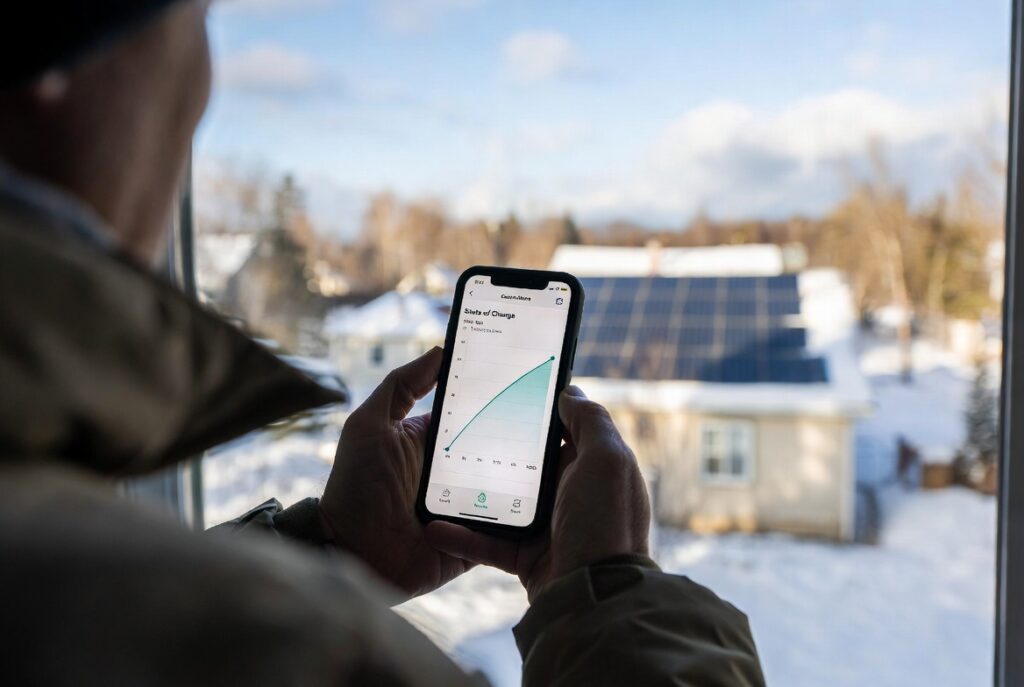
The most common Ontario solar charge ontario failure is invisible: the MPPT charge controller is still set to a lead-acid profile from the original installation, the battery bank has since been upgraded to Battle Born LFP, and the controller is completing its absorption phase by timer and then dropping to the 13.8V lead-acid float voltage, leaving the LFP bank at approximately 85% SoC every morning while the SmartShunt shows near-zero charging current and the display reads “Float, Charged.” A property owner on Eramosa Road in Guelph, Wellington County installed two Battle Born heated LFP batteries in fall 2023, replacing his original AGM bank.
He kept the existing Victron MPPT 100/30 settings unchanged, the controller was still programmed for AGM with absorption at 14.6V, float at 13.8V, and a 2-hour absorption timer. The SmartShunt showed the bank reaching “float” every clear day, which he interpreted as a full 100% charge.
The problem revealed itself in January 2024 during a furnace demand surge. The bank appeared to read 98% SoC on the display. His furnace blower started, drew 80W, and the system voltage dropped immediately to 12.3V under that modest load, a sag that would not occur on a truly full 200Ah LFP bank. His SmartShunt history showed that every day the controller had entered float at 13.8V after approximately 90 minutes of absorption, regardless of the actual SoC. The LFP bank had been ending each day at approximately 85% charged for three months without anyone noticing.
I reconfigured his Victron MPPT 100/30 to the LFP profile: absorption voltage 14.2V, absorption termination by tail current below 2A (1% of 200Ah capacity), float voltage 13.5V. The following clear January day, the Victron SmartShunt confirmed the difference: absorption phase ran 3.1 hours instead of 90 minutes, tail current dropped to 1.8A at 14.2V, and the bank reached true 100% SoC by 1:30 PM. His solar charge ontario system had been undercharging the bank every single day since the LFP upgrade. See our Ontario solar sizing guide before specifying any solar charge ontario system.
The solar charge ontario LFP absorption trap: why 13.8V float leaves the bank at 85% SoC every morning
| MPPT setting | Lead-acid profile (default) | LFP profile (correct) | Ontario result |
|---|---|---|---|
| Absorption voltage | 14.6 to 14.8V | 14.2 to 14.4V | LFP overcharged on lead-acid ✗ / correct on LFP profile ✓ |
| Absorption end method | Timer (2 hours) | Tail current below 2A | Timer quits early, LFP stuck at 85% SoC ✗ |
| Float voltage | 13.8V | 13.5V | 13.8V = 85% SoC for LFP; 13.5V = holding voltage ✓ |
| SmartShunt current at “full” | ~0A at 13.8V float | ~0A at 14.2V (after tail) | Lead-acid profile “full” is actually 85% LFP ✗ |
| January absorption duration | 90 minutes (timer) | 3.1 hours (Eramosa Road) | Extra 100 minutes of charge captured ✓ |
The lead-acid MPPT profile uses timer-based absorption, typically 2 hours, then drops to 13.8V float. For LFP cells, 13.8V = approximately 80 to 85% SoC, the controller displays “Charged” while the SmartShunt confirms 85%. Lead-acid chemistry accepts charge quickly early in absorption and slows as it approaches full, so a 2-hour timer catches most of the capacity. LFP accepts charge at a nearly constant rate through absorption, a 2-hour timer quits while LFP is still actively accepting current at near-peak rate. This is the core of the solar charge ontario LFP mismatch problem.
The correct fix: switch the MPPT to its LFP profile. Absorption voltage 14.2 to 14.4V. Absorption termination by tail current below 2A (1% of the 200Ah bank capacity) rather than by timer. Float voltage 13.5V. The MPPT holds 14.2V until the SmartShunt reads below 2A, that is the 100% SoC confirmation for LFP. The Eramosa Road result: 3.1 hours of absorption on a clear January day versus the previous 90-minute timer cutoff, tail current to 1.8A at 1:30 PM, and the bank confirmed at 100% SoC. See our solar battery ontario guide for the heated LFP specification that requires this correct charging profile.
The SmartShunt tail current diagnostic: confirming true 100% SoC versus the lead-acid float trap
The SmartShunt provides the only field diagnostic that distinguishes true 100% SoC from the 13.8V float trap. A correctly configured LFP bank on a clear Ontario January day shows a predictable SmartShunt pattern: bulk charge current peaks within 15 minutes of morning sun, holds near peak through mid-morning as the bank climbs through 80 to 90% SoC, then gradually reduces as the bank enters absorption at 14.2V, and eventually tapers to below 2A as the bank reaches 100% SoC. The entire clear-day cycle takes approximately 3 to 4 hours with a 400W array, 510Wh produced (400W × 1.5 PSH × 0.85 efficiency), sufficient to recover a 200Ah bank from 40% SoC.
The 13.8V float trap diagnostic: SmartShunt shows current dropping to near zero, but the bank SoC reads only 85 to 88%. The controller display reads “Float, Charged.” To distinguish this from a genuine 100% SoC state, check the SmartShunt SoC reading at the moment current drops to near zero. Below 95% SoC when current drops = the MPPT ended absorption by timer, not tail current. A correctly configured LFP solar charge ontario system will show SmartShunt current dropping below 2A with SoC simultaneously reaching 99 to 100%. See our solar charge controller guide for the complete MPPT LFP profile settings.
Pro Tip: After switching the MPPT to LFP profile, run the first three clear-day absorption cycles and record the absorption duration and tail current endpoint from the SmartShunt. On a 200Ah LFP bank at 40% SoC, the first full charge should take approximately 3 to 4 hours of absorption. If the absorption phase is completing in under 90 minutes, the bank was at higher SoC than expected going into the morning, not a problem. If the absorption phase runs longer than 5 hours on multiple clear days, the bank capacity may have degraded slightly from months of undercharging on the lead-acid profile. Most LFP banks recover fully within 3 to 5 proper full charge cycles after the profile correction.
The solar charge ontario ULO arbitrage: 3.9 cents overnight versus 39.1 cents on-peak is the Ontario charging equation
The ULO overnight rate at 3.9¢/kWh versus on-peak at 39.1¢/kWh is a 10× rate differential. For HRSP grid-tied Ontario systems with a Victron MultiPlus-II, this differential drives a documented $1,200/year in additional savings over TOU. The strategy: configure the Victron MultiPlus-II to accept grid charging only during the ULO overnight window (11 PM to 7 AM), charge the bank to 100% SoC at 3.9¢/kWh, then supply all on-peak loads (4 PM to 9 PM at 39.1¢/kWh) from the battery bank. The SmartShunt confirms whether the bank has reached 100% SoC by 7 AM each morning.
A property owner in Rockwood, Wellington County configured an HRSP grid-tied system with a Victron MultiPlus-II and switched to the ULO rate plan in late 2024. Charging from grid only during the overnight window (11 PM to 7 AM at 3.9¢/kWh), his SmartShunt confirmed the bank reached 100% SoC every morning by 7 AM before the ULO window closed. During the on-peak window (4 PM to 9 PM at 39.1¢/kWh), the battery bank supplied all load with zero grid draw. Documented savings in the first year: $1,200 in avoided on-peak charges. System payback on the battery component: 36 months at $1,200/year savings. See our solar energy ontario guide for the full HRSP and ULO program details.
The Ontario rate comparison: ULO, TOU, and Tiered for solar battery systems
The three Ontario rate plans and their interaction with a solar battery system. ULO: optimal for HRSP load displacement systems with MultiPlus-II, charge at 3.9¢/kWh overnight (11 PM to 7 AM), supply on-peak loads at 39.1¢/kWh from battery, avoid grid draw during on-peak entirely. SmartShunt goal: 100% SoC confirmed by 7 AM on every clear day. TOU: appropriate for grid-tied systems without battery storage, or systems where the owner cannot shift majority of consumption overnight. TOU on-peak at 20.3¢/kWh is significantly lower than ULO on-peak at 39.1¢/kWh, if the battery cannot cover the full 4 PM to 9 PM window, TOU may be preferable to avoid high ULO on-peak charges.
Tiered pricing removes the time-of-day variable: 10.3¢/kWh for the first 1,000 kWh per month (winter threshold), 12.5¢/kWh above that. For off-grid solar charge ontario properties with no grid connection, the rate plan comparison is irrelevant, they are not grid customers. For HRSP grid-tied systems deciding between ULO and TOU, the $1,200/year additional savings from ULO arbitrage (documented Rockwood result) makes ULO the correct plan for any system that can guarantee 100% SoC by 7 AM on most winter mornings through the SmartShunt tail current confirmation.
NEC and CEC: Ontario permit requirements for permanent solar charging installations
NEC 690 governs the solar charging system in any solar charge ontario installation. The charge controller, battery bank connections, and overcurrent protection must all comply with NEC 690 requirements for solar PV systems. For grid-tied HRSP systems using the Victron MultiPlus-II, the grid-connection side must additionally comply with NEC 705 (interconnected electric power production sources) requirements. All wiring between the array, charge controller, and battery bank must be sized for 125% of the maximum continuous current. Contact the NFPA at nfpa.org for current NEC 690 and NEC 705 requirements for residential solar charging installations.
CEC Section 64 governs electrical installations in Ontario. Any permanently installed solar charge ontario system in a habitable structure requires an ESA permit before installation begins. For HRSP-eligible grid-tied systems, the ESA inspection is a program requirement, the rebate is not released without proof of ESA and LDC final inspection. Contact the Electrical Safety Authority Ontario at esasafe.com before beginning any permanent solar charge ontario installation in Ontario.
The solar charge ontario verdict: LFP profile first, SmartShunt tail current confirmed, ULO for grid-tied systems
- Ontario property owner who recently upgraded from AGM to LFP batteries without reconfiguring the MPPT: check the charge controller profile before the next clear day, the bank may have been at 85% SoC every morning since the upgrade. If the controller still reads “Lead Acid” or “AGM” in the settings, switch to LFP profile: absorption voltage 14.2V, absorption termination by tail current below 2A, float 13.5V. Install a Victron SmartShunt and verify the following clear day: 3 to 4 hours absorption, tail current below 2A at 14.2V, and SoC simultaneously confirming 99 to 100%, not a drop to 13.8V float at 85%.
- Ontario property owner specifying a new off-grid solar charge ontario system: configure the MPPT LFP profile at commissioning on day one, before the first charge cycle. Set the Victron MPPT 100/30 to LFP profile: absorption 14.2V, tail current 2A, float 13.5V. Pair it with a Battle Born heated LFP battery bank. Verify tail current on the first clear winter day, the SmartShunt should read below 2A at 14.2V with SoC simultaneously at 99 to 100%.
- Ontario property owner with an HRSP grid-tied system evaluating the ULO rate plan: the $1,200/year documented savings from Rockwood makes ULO the correct plan if the system can guarantee 100% SoC by 7 AM. Configure the Victron MultiPlus-II to charge from grid only during the ULO overnight window (11 PM to 7 AM at 3.9¢/kWh). Switch to ULO with the local distribution company. The SmartShunt tail current confirmation is the daily verification that the strategy is working: 100% SoC by 7 AM, zero grid draw from 4 PM to 9 PM at 39.1¢/kWh.
Frequently Asked Questions
Q: What is the correct LFP absorption voltage for Ontario off-grid solar?
A: For Battle Born LFP batteries, set absorption voltage to 14.2 to 14.4V and configure absorption termination by tail current below 2A (1% of bank Ah capacity) rather than by timer. Float voltage should be set to 13.5V, not the lead-acid default of 13.8V. At 13.8V, LFP cells sit at approximately 80 to 85% SoC. At 14.2V with tail current confirmation, the bank reaches true 100% SoC. The Eramosa Road Guelph result confirmed this: switching from a 2-hour lead-acid absorption timer to LFP tail current termination extended the absorption phase from 90 minutes to 3.1 hours on a clear January day, with the SmartShunt confirming tail current of 1.8A at 14.2V and 100% SoC by 1:30 PM.
Q: How do I know if my solar battery is actually reaching 100% SoC in Ontario winter?
A: Install a Victron SmartShunt and check two readings simultaneously: the charging current and the battery SoC at the moment the controller enters float. If the SoC reads below 95% when current drops to near zero, the MPPT ended absorption by timer before the bank was full, the 13.8V float trap is active. A correctly configured solar charge ontario LFP system shows current dropping below 2A at exactly the same moment the SoC reading reaches 99 to 100%. If you see the SmartShunt read “0.3A, 87% SoC” when the controller shows “Float, Charged,” the MPPT is still on a lead-acid profile and needs to be switched to LFP tail current termination.
Q: Is the ULO rate plan worth it for Ontario solar battery systems?
A: Yes, for HRSP grid-tied systems that can consistently reach 100% SoC by 7 AM on most winter mornings. The ULO overnight rate (3.9¢/kWh, 11 PM to 7 AM) versus on-peak (39.1¢/kWh, 4 PM to 9 PM) creates a 35.2¢/kWh arbitrage spread for every kWh shifted from grid to battery storage. The Rockwood Wellington County result: $1,200 documented first-year savings in avoided on-peak charges, with 36-month battery payback at that savings rate. The ULO plan is not advantageous for systems without battery storage or for grid-tied properties that cannot shift majority of consumption to overnight hours, the 39.1¢/kWh on-peak rate will increase bills if on-peak draw cannot be eliminated.
This build is engineered within the 48V DC Safety Ceiling. Diagnostic logic is based on 20+ years of technical service experience. All structural and electrical installations must be verified by a Licensed Professional and comply with your Local AHJ. See our legal and safety disclosure for full scope.
About the Author
Robert Bertrand spent 20 years as a service advisor in the automotive industry (Lexus and Nissan), where precision diagnostics, wiring integrity, and documentation standards were non-negotiable. He brings that same technical discipline to GridFree Guide, where he researches, tests, and documents off-grid solar systems for Ontario conditions. Based in Rockwood, Ontario, every article is built on verified specifications, manufacturer data, and the real-world climate constraints of Canadian off-grid living.
As an Amazon Associate I earn from qualifying purchases. This site also contains affiliate links to other products and services. GridFree Guide earns a small commission at no extra cost to you.