
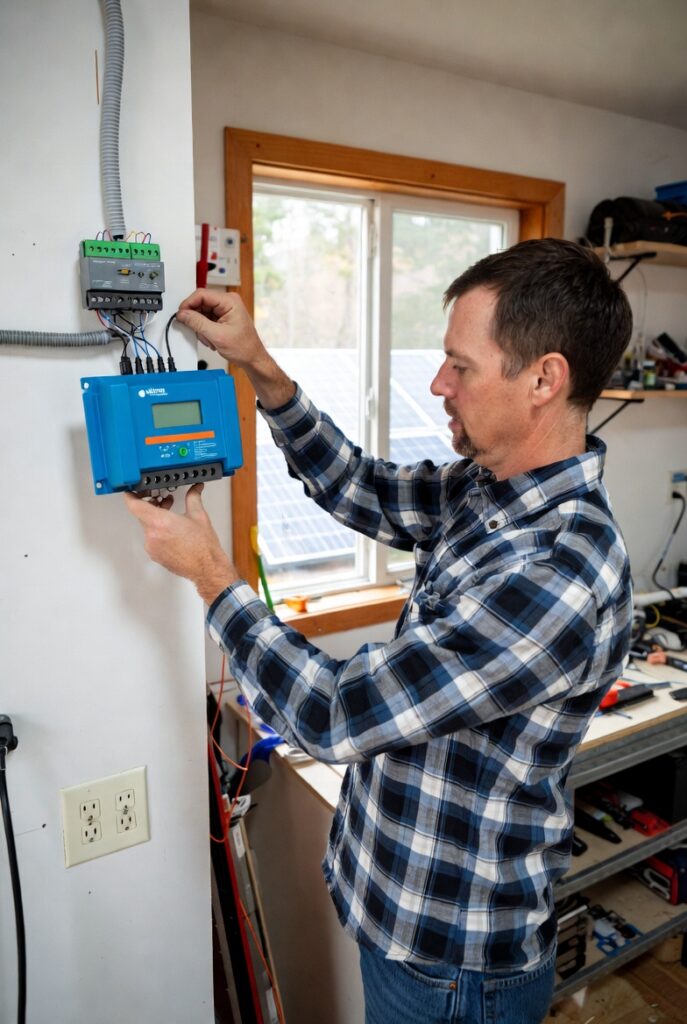
The most common Ontario solar charge controller mistake is purchasing a PWM unit to save $80 and discovering on the second day of a January gray streak that the controller has been discarding 25 to 30% of available solar production as waste heat because it cannot operate the panels at their maximum power point, a loss that turns a 3-day gray streak into a 4-day one and a 4-day gray streak into a system shutdown.
A property owner on Woodlawn Road West in Guelph, Wellington County commissioned a year-round off-grid cabin with a 400W array and a 200Ah LFP battery bank in fall 2022. She selected a PWM solar charge controller to save approximately $80 versus the Victron MPPT 100/30. Her daily load was approximately 480Wh, LED lighting, DC fridge, laptop, and a propane furnace blower. Her 400W array should have delivered approximately 600Wh per clear day at January PSH, which is sufficient to maintain the bank and cover her daily load.
Her actual daily harvest during her first January: approximately 420Wh per clear day, 30% below the array’s capacity. She contacted me in February 2023 after her first January gray streak extended to 5 days and dropped the bank to 22% SoC. The root cause was the PWM solar charge controller’s operating principle: a PWM unit forces the panels to operate at the battery voltage (approximately 13.5V for a charging 12V bank) regardless of the panel’s maximum power point voltage of approximately 18V at STC or 19V in cold conditions. The wasted power, the difference between panel Vmp and battery voltage multiplied by current, dissipates as heat in the controller’s switching circuit.
I specified a replacement with a Victron MPPT 100/30 solar charge controller. An MPPT unit uses a DC-DC converter to operate the panel array at its maximum power point (approximately 19V per panel in January conditions) and then steps the higher panel voltage down to the correct battery charging voltage. Her January harvest after the MPPT replacement: approximately 590Wh per clear day, a 40% improvement on the same 400W array with no other changes. The gray streak that had dropped her bank to 22% SoC the previous January reached a minimum of 58% SoC in the same 5-day event the following year. See our Ontario solar sizing guide before specifying any solar charge controller.
The solar charge controller efficiency gap: why MPPT harvests 25% more than PWM in Ontario January
| Metric | PWM (legacy) | MPPT (Ontario standard) | Ontario verdict |
|---|---|---|---|
| Operating principle | Forces panels to battery voltage | Tracks panel max power point | MPPT extracts full panel output ✓ |
| Harvest efficiency | 70 to 75% in Ontario winter | 95 to 99% all conditions | MPPT saves 25-30% more ✓ |
| Series strings | Not supported | Up to 100V input | MPPT enables 2S×2P arrays ✓ |
| January gray streak | 420Wh/day on 400W array | 590Wh/day same array | MPPT extends reserve by 4 hrs ✓ |
| Cold temp performance | Worse (Vmp gap widens) | Better (tracks rising Vmp) | MPPT advantage grows in January ✓ |
| Cost premium | $30 to $60 less | ~$100 to $130 | Pays back in first Ontario winter ✓ |
A PWM solar charge controller connects and disconnects the panel directly to the battery at high frequency, forcing the panels to operate at the battery charging voltage (approximately 13.5V for a 12V bank). This method is effective only when panel Vmp closely matches the battery voltage, but becomes inefficient in cold conditions where the gap widens. In Ontario’s January climate, cold temperatures push panel Vmp higher, approximately 19 to 20V per panel versus 18V at STC, increasing the PWM waste fraction further. The result: a PWM solar charge controller on a 400W Ontario array wastes approximately 170Wh on every clear January day.
An MPPT solar charge controller uses an internal DC-DC converter to maintain the panel array at its maximum power point regardless of battery voltage, then steps the higher array voltage down to the correct charging voltage. This achieves 95 to 99% harvest efficiency in all conditions. The production advantage on a 400W Ontario January array at 1.5 PSH: 400 × 1.5 × 0.30 = 180Wh/day additional harvest with MPPT.
Over a 5-day Ontario gray streak, that 170Wh/day loss equals 850Wh of unharvested energy, the equivalent of 1.7 additional hours of full-load operation that the bank must supply instead of the array. This is precisely why the Woodlawn Road Guelph 5-day gray streak dropped the PWM system to 22% SoC the year before the MPPT replacement.
Pro Tip: The Victron SmartShunt daily harvest log is the fastest way to confirm whether a solar charge controller is performing correctly. Record the average daily harvest in kWh for the first two weeks of January. Compare against the theoretical maximum: array watts × 1.5 January PSH × controller efficiency. For a 400W array: 400 × 1.5 × 0.97 = 582Wh/day theoretical MPPT maximum. If the SmartShunt shows 420Wh/day instead of 582Wh, the controller is performing at approximately 72% efficiency, consistent with PWM operation. If the SmartShunt shows 570 to 590Wh/day, the MPPT is operating correctly. The Woodlawn Road Guelph system went from 420Wh/day to 590Wh/day on the same 400W array after the PWM-to-MPPT replacement.
The solar charge controller cold Voc rule: why -20°C Ontario sizes the controller, not STC
The cold Voc calculation is the safety specification for any Ontario solar charge controller installation. Every solar panel produces higher voltage as its cell temperature decreases, the relationship is defined by the temperature coefficient of Voc in the manufacturer’s datasheet. For Renogy 100W panels: STC Voc of 22.7V at 25°C, temperature coefficient of -0.31%/°C. At -20°C Ontario ambient (the design temperature for Wellington/Halton County): temperature delta = 25 minus (-20) = 45°C, cold Voc = 22.7 × 1.1395 = 25.87V per panel (approximately 25.9V).
The cold Voc determines the maximum series string configuration the solar charge controller can accept without exceeding its rated maximum input voltage. Always use the exact Voc temperature coefficient from your panel’s datasheet rather than a generic multiplier , coefficients vary by panel model and manufacturer.
Safety Note: Exceeding the charge controller’s maximum PV input voltage, even for a few seconds on a cold, sunny morning, permanently destroys the controller’s internal MOSFETs. Always calculate cold Voc at -20°C or lower for Wellington/Halton County and keep the series string voltage safely below the controller’s 100V limit. A destroyed controller on a January gray streak is not a theoretical failure mode, it happens on the first clear cold morning after an Ontario winter night.
The series string cold Voc safety table for Renogy 100W panels at -20°C Ontario: 2 panels in series = 51.7V (safely within the MPPT 100/30’s 100V limit), 3 panels in series = 77.6V (safely within limit), 4 panels in series = 103.5V (exceeds the 100V maximum input, controller destroyed on the first clear cold morning). Therefore, for a 4-panel 400W array on any MPPT 100-series controller, the correct configuration is 2S×2P: two strings of 2 panels in parallel, cold Voc of 51.7V.
Never assume the STC Voc is the design voltage for a solar charge controller installation in Ontario, always calculate at -20°C using the panel datasheet temperature coefficient. See our solar panel wiring guide for the complete 2S×2P wiring diagram and cold Voc verification checklist.
MPPT 100/30 vs MPPT 100/50: array size, system voltage, and the future-proofing rule
The MPPT 100/30 and MPPT 100/50 share the same 100V maximum input voltage, the cold Voc limit applies equally to both. The selection rule is based on output current capacity. The MPPT 100/30: maximum 30A output. At 12V: 30A × 12V = 360W nominal, specify for arrays up to 400W at 12V. At 24V: up to 700W. The Victron MPPT 100/50: maximum 50A output. At 12V: 50A × 12V = 600W nominal, specify for arrays up to 600W at 12V.
At 24V: up to 1,200W. The $40 premium for the 100/50 over the 100/30 at build time is the correct choice for any system with planned expansion beyond 400W at 12V. Note that real-world output is typically 5 to 10% below nominal rating due to wiring losses, temperature derating, and partial shading , spec the controller with this margin in mind.
A first-time builder on Britannia Road East in Milton, Halton County specified a complete off-grid system from scratch in spring 2023. His initial array was 400W (four Renogy 100W panels in 2S×2P).
I recommended the MPPT 100/50 over the 100/30 because his planned expansion was to 600W in year two. The $40 premium at build time eliminated a $120+ controller replacement when the array grew. He added a Victron BatterySense and a Victron SmartShunt. His January 2024 charge log: temperature-compensated bulk charging from sunrise every clear morning, minimum SoC 62% through a 4-day gray streak. His comment: “The $40 for the bigger controller saved me $120 in replacement costs the following year.” See our solar battery bank guide for the bank sizing that the solar charge controller must match.
The VE.Smart network: BatterySense temperature compensation in unheated Ontario spaces
The Victron BatterySense is a Bluetooth temperature sensor that clips to the battery terminal and transmits real-time battery temperature to the paired MPPT solar charge controller via the VE.Smart wireless network. Without temperature compensation, a controller programmed for 25°C operation applies a fixed target charge voltage. At -5°C battery temperature, this fixed voltage is approximately 0.3V lower than the correct temperature-compensated target, resulting in an incompletely charged bank. At 35°C summer temperatures, the same fixed voltage is 0.3V too high, causing mild overcharge stress on every cycle. The BatterySense applies approximately -3mV per cell per degree Celsius of correction, shifting the 12V LFP absorption target from 14.2V to approximately 14.4V at -5°C battery temperature.
The VE.Smart network extends beyond the BatterySense-to-controller link. A Victron SmartShunt on the same VE.Smart network shares real-time current data with the MPPT solar charge controller, allowing the controller to transition from bulk to absorption charging based on actual current delivered to the bank, not estimated charge state alone. This integration turns the individual Victron components into a coordinated charging system. The VE.Smart pairing takes approximately 5 minutes in the VictronConnect app. See our off grid generator guide for the generator charging that supplements the solar charge controller during Ontario gray streaks.
NEC and CEC: Ontario permit requirements for permanent charge controller installations
NEC 690 governs solar PV installations including the solar charge controller and its connections to the panel array and battery bank. The charge controller’s PV input circuit must comply with NEC 690 array wiring requirements, wire sized for 125% of the array’s short circuit current, overcurrent protection on each string, and outdoor-rated UV-resistant cable on all exterior runs. The controller’s DC output to the battery bank must be sized for the controller’s maximum output current, for the MPPT 100/30, a minimum 30A-rated cable and appropriately rated fuse on the positive output lead. Contact the NFPA at nfpa.org for current NEC 690 requirements for solar charge controller wiring in off-grid residential installations.
CEC Section 64 governs solar PV installations in Ontario. A permanently installed solar charge controller connected to a panel array and battery bank in a habitable structure requires an ESA permit. The permit application must identify the array wattage and configuration (number of strings, string voltage, cold Voc), the charge controller model and maximum input voltage, the battery bank specifications, and the DC output circuit wiring and overcurrent protection.
The cold Voc calculation, array cold Voc at -20°C Ontario ambient, must be documented in the permit application and must not exceed the controller’s maximum rated input voltage. Any permanent solar charge controller installation connected to a PV array and battery bank in a habitable structure requires an ESA permit in Ontario; the permit must document the array configuration and the cold Voc calculation. Contact the Electrical Safety Authority Ontario at esasafe.com before beginning any permanent solar charge controller installation in Ontario.
The solar charge controller verdict: MPPT 100/30 or 100/50, BatterySense, cold Voc calculated
- Ontario off-grid cabin owner who currently has a PWM solar charge controller and is experiencing insufficient production during January gray streaks: calculate the production loss and replace with MPPT. Formula: array watts × 1.5h January PSH × 0.28 (PWM loss factor) = daily Wh lost. For a 400W array: 400 × 1.5 × 0.28 = 168Wh/day lost, over a 5-day gray streak that is 840Wh of unharvested energy the bank must supply instead. Replace with a Victron MPPT 100/30 for arrays up to 400W at 12V. Recalculate cold Voc at -20°C for the existing panel configuration before connecting, confirm the series string stays below 100V.
- Ontario off-grid property owner designing a new system: specify MPPT to array wattage and plan one size up if expansion is intended. For a 400W array at 12V with planned expansion to 600W: specify the Victron MPPT 100/50 at build time for $40 more, eliminating a $120+ controller replacement when the array grows. Add the Victron BatterySense for VE.Smart temperature compensation from day one. Calculate cold Voc for the full planned array at -20°C Ontario ambient and confirm the series string stays below 100V.
- Ontario off-grid property owner who currently has any series panel string: verify the cold Voc now, before the first cold January morning. Pull the temperature coefficient of Voc from the panel datasheet, apply the -20°C Ontario design temperature calculation, and confirm the series string cold Voc does not exceed the controller’s maximum input voltage. For Renogy 100W panels: maximum 3 panels in series (77.6V cold Voc) on any MPPT 100-series controller. Four panels in series = 103.5V, above the 100V limit and a destroyed controller on the first clear cold morning.
Frequently Asked Questions
Q: What is the best solar charge controller for an off-grid cabin in Ontario?
A: The Victron MPPT 100/30 is the correct solar charge controller for any Ontario off-grid system with a 400W array at 12V, it delivers 95 to 99% harvest efficiency versus PWM’s 70 to 75%, recovering approximately 170Wh/day of additional January production on a 400W array. For systems with a 600W array at 12V or planned expansion beyond 400W, specify the Victron MPPT 100/50 at build time, the $40 premium eliminates a controller replacement when the array grows. Add the Victron BatterySense for VE.Smart temperature compensation, which ensures the bank receives the correct charge voltage regardless of whether the battery room drops to -5°C in January or rises to 35°C in August.
Q: What is the difference between MPPT and PWM solar charge controllers?
A: A PWM solar charge controller forces the panel array to operate at the battery charging voltage (approximately 13.5V for a 12V bank), wasting the voltage difference between the panel’s maximum power point (approximately 19V in Ontario January) and the battery as heat. An MPPT solar charge controller uses a DC-DC converter to track the panel’s maximum power point voltage regardless of battery voltage and steps it down efficiently, achieving 95 to 99% harvest efficiency. The production difference in Ontario January conditions on a 400W array: approximately 420Wh/day with PWM versus 590Wh/day with MPPT, a 40% improvement on the same hardware that directly reduces gray streak depth and duration.
Q: How do I size a solar charge controller for my off-grid solar system?
A: Size the solar charge controller to the array wattage at the system voltage. For the Victron MPPT 100/30: arrays up to 400W at 12V or up to 700W at 24V. For the Victron MPPT 100/50: arrays up to 600W at 12V or up to 1,200W at 24V. Always verify the cold Voc before connecting any series string: for Renogy 100W panels at -20°C Ontario ambient, each panel produces 25.9V cold Voc, and 4 panels in series produces 103.5V, above the 100V limit of both MPPT 100-series controllers. The correct 4-panel configuration is 2S×2P (two strings of 2 panels in parallel) with a cold Voc of 51.7V, safely within the 100V limit.
This build is engineered within the 48V DC Safety Ceiling. Diagnostic logic is based on 20+ years of technical service experience. All structural and electrical installations must be verified by a Licensed Professional and comply with your Local AHJ.
About the Author
Robert Bertrand spent 20 years as a service advisor in the automotive industry (Lexus and Nissan), where precision diagnostics, wiring integrity, and documentation standards were non-negotiable. He brings that same technical discipline to GridFree Guide, where he researches, tests, and documents off-grid solar systems for Ontario conditions. Based in Rockwood, Ontario, every article is built on verified specifications, manufacturer data, and the real-world climate constraints of Canadian off-grid living.
As an Amazon Associate I earn from qualifying purchases. This site also contains affiliate links to other products and services. GridFree Guide earns a small commission at no extra cost to you.