
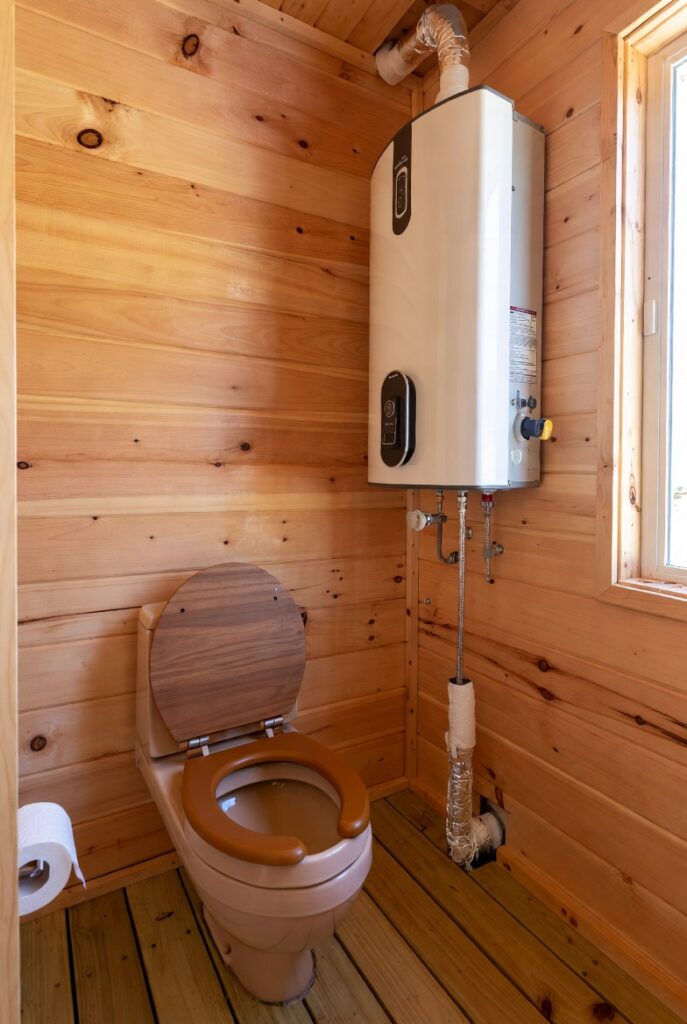
The most electrically expensive component in an Ontario off grid bathroom is not the toilet or the tap, it is the electric tankless water heater, which draws 1,500W continuously and consumes approximately 750Wh for a single 30-minute shower session, more than 75% of the entire daily January solar production from an 800W Tier 2 array. A property owner on Stone Road South in Guelph, Wellington County came to me in fall 2022 planning a year-round off-grid primary residence.
Her original bathroom specification: a standard flush toilet connected to a septic system, an electric 1,500W tankless hot water heater, and a 1/2 HP AC submersible well pump. Her daily bathroom electrical load from those three components: electric tankless 750Wh plus AC well pump 450Wh = 1,200Wh per day, plus a non-bathroom daily load of approximately 600Wh for a combined total of 1,800Wh, nearly double the daily production of a correctly sized Tier 3 system.
Together we redesigned the off grid bathroom. The electric tankless heater came out and a propane on-demand hot water heater replaced it, zero standby electrical load, approximately 40W for the igniter and gas valve during operation. The standard flush toilet came out and a composting toilet replaced it, zero water for toilet flushing, zero connection to the septic system for toilet waste, with grey water from the sink and shower continuing to drain to an approved system. The AC well pump remained but received a SoftStart Well to reduce startup surge from 2,800W to 900W. Daily bathroom electrical load after redesign: approximately 80Wh from the well pump’s running load.
I reviewed the completed system at commissioning in December 2022. Her Victron SmartShunt confirmed the actual daily bathroom electrical load was approximately 75 to 85Wh, essentially the 12V draw from the well pump pressure cycles throughout the day. The propane hot water heater consumed approximately 0.8 litres of propane per shower day. Her January logs showed the Battle Born heated LFP batteries in the unheated utility room never dropping below 38% SoC through the first Ontario winter. See our Ontario solar sizing guide before designing any off grid bathroom system.
The off grid bathroom electrical load: why the hot water heater is the biggest draw
| Off grid bathroom component | Standard approach | Daily load | Optimized approach | Daily load |
|---|---|---|---|---|
| Hot water | Electric tankless 1,500W | 750Wh | Propane on-demand | 15 to 30Wh |
| Water delivery | AC well pump 600W | 450Wh | 12V DC cistern pump | 80Wh |
| Toilet | Standard flush | 0Wh, 50L water | Composting toilet | 0Wh, 0L water |
| Total daily bathroom | ~1,200Wh + 150L water/day | ~80,100Wh + 90L water/day ✓ | ||
An 800W Tier 2 Ontario array produces approximately 960Wh on a clear January day, the standard off grid bathroom load of 1,200Wh per day exceeds the entire system’s daily production before a single light is turned on. The electric tankless heater draws 1,500W × 0.5 hours per day (30-minute shower) = 750Wh per day. The AC pump runs at 600W × 0.75 hours per day = 450Wh per day. Combined, the hot water and pump loads alone consume more than the full production of a correctly sized Tier 2 January array. Adding the remaining cabin loads to that 1,200Wh bathroom draw produces a daily deficit that no practically sized off-grid system can satisfy.
The optimized off grid bathroom redesign reduces the bathroom electrical demand from 1,200Wh to approximately 80 to 100Wh in three steps. Step 1: replace the electric tankless with a propane on-demand heater (saves 720 to 735Wh per day). Step 2: replace the AC well pump with a 12V DC cistern pump (saves 370Wh per day), or keep the AC pump with a SoftStart Well installed to reduce the startup surge from 2,800W to 900W and save the inverter upgrade cost without reducing running load.
Step 3: replace the standard flush toilet with a composting toilet, eliminating 40 to 50 litres per person per day of water demand and removing the toilet waste from the sewage system entirely. See our off grid water guide for the full pump surge calculation and cistern vs well decision.
Propane on-demand hot water: the correct answer for Ontario off-grid
Propane on-demand hot water draws approximately 30 to 60W for the igniter and gas valve during operation and zero watts on standby, it heats water only when a tap is opened. A standard 20 lb (9kg) propane cylinder contains approximately 7.5 litres of propane and runs approximately 7 to 10 shower days for two people. For year-round primary residence use, a permanently installed 120-litre or 200-litre propane tank with a TSSA-licensed gas fitter installation is the correct specification. For seasonal cottages, a portable 20 lb cylinder at the heater is acceptable without TSSA licensing under the portable appliance exemption, the same rule that applies to portable propane heaters.
Propane hot water consumption for two people showering daily: approximately 0.8 to 1.0 litre per day. Monthly propane cost at Ontario retail pricing of approximately $1.20 per litre: approximately $28 to $36 per month. Annual propane cost for hot water: approximately $336 to $432. An equivalent grid-connected 1,500W electric tankless would consume approximately 22,000Wh per month at approximately $3.30 to $4.40 per month at Ontario time-of-use rates, negligible on grid, but off-grid that same load consumes 67% of a 1,000Wh/day Tier 2 system’s entire January daily production. See our off grid heating guide for the full propane vs electric comparison for all off-grid thermal loads.
Pro Tip: When budgeting propane for an Ontario off grid bathroom, plan for three separate propane loads in the daily energy budget: hot water (approximately 0.8 to 1.0L per day), space heating (approximately 1 to 3L per day in January depending on insulation), and cooking (approximately 0.2 to 0.4L per day). A 200-litre propane tank serves approximately 45 to 60 days of combined off-grid propane use for a 2-person Ontario property in January. Size the tank for 90 days minimum to ensure supply through an extended cold period without requiring a delivery on a specific date. The propane delivery truck access window is shorter in deep winter, a property that cannot be reached by truck in January needs a propane reserve that bridges two scheduled delivery windows, not one.
The off grid bathroom toilet decision: composting, incinerating, and the grey water reality
The off grid bathroom toilet has three options in Ontario. Option 1: composting toilet, approximately $900 to $1,500 for a quality unit, zero water, no toilet waste connection to any sewage system. Grey water from sinks and showers still requires handling through a grey water system, holding tank, or approved drainage, the composting toilet eliminates only toilet waste (black water). In organized Ontario municipalities, a registered professional may still be required to design the grey water handling system.
In some unorganized territories, a composting toilet plus a grey water gravel pit may be accepted for seasonal or low-volume use, confirm with the local municipality before construction. Option 2: incinerating toilet, approximately $3,000 to $4,000, no water, no sewage connection for toilet waste, but requires approximately 1 to 2 kWh of electricity per cycle. Option 3: standard flush toilet, requires a full septic system for both toilet and grey water, approximately $15,000 to $25,000 for a field bed system depending on soil conditions.
A weekend cottage owner near Concession Road in Milton, Halton County installed a composting toilet in spring 2023 when the septic contractor quoted $22,000 for the holding tank and alternative treatment system his site required due to poor soil percolation. His daily cottage occupancy: two people for approximately 70 days per year, with water supplied by a 1,200-litre cistern filled before each visit. Grey water from the single sink and outdoor shower drained to a gravel pit approved by the local municipality for that seasonal volume.
His cistern water consumption dropped from approximately 120 litres per visit day (including toilet flushing) to approximately 70 litres per visit day, the 1,200-litre cistern now lasts approximately 17 visit days between fills versus the previous 10. For grey water handling options by Ontario municipality type, see our off grid appliances guide.
Ontario drain line frost protection: P-traps, exterior walls, and heat trace
Every P-trap (the U-shaped pipe under every sink, toilet, and shower drain) holds water permanently to block sewer gas from entering the building. Any P-trap in an unheated space, under an uninsulated cabin floor, against an exterior wall with less than R-10 insulation, or in an unheated utility room, will freeze and crack in a Wellington County January. A frozen P-trap results in a cracked drain line, sewer gas entry into the building, and water damage when the pipe thaws. Prevention: locate all P-traps within the heated building envelope. For any drain line that must pass through an unheated space or exterior wall, insulate to minimum R-10 and install heat trace cable rated for the expected minimum temperature.
The exterior wall drain line is the highest-risk frost point in a rural Ontario off grid bathroom installation. A drain line pressed against exterior sheathing inside a 2 × 4 wall with standard R-12 batt insulation receives approximately R-2 of effective insulation. At -30°C exterior temperature, that pipe will freeze. Correct specification: rigid foam insulation between the drain line and the exterior sheathing, pipe routed through the interior cavity away from the exterior face, and heat trace cable as a backup. No device protects a frozen drain line after the fact, physical frost protection at installation is the only solution. See our off grid cabin guide for the full four-season utility room specification including drain line routing.
NEC and CEC: Ontario compliance for off-grid plumbing and electrical systems
NEC 690 governs the solar PV system components that power the off grid bathroom electrical loads. The water pump circuit (whether DC from the battery bank or AC from the inverter output) must comply with NEC 690 DC load circuit requirements or NEC 240 branch circuit requirements for the AC output. The propane on-demand hot water heater’s igniter circuit, typically 30 to 60W at 12V DC or 120V AC, must be included in the daily load calculation and properly fused at the source. Contact the NFPA at nfpa.org for current NEC 690 requirements for DC and AC load circuits in off-grid residential installations.
CEC Section 64 governs solar PV installations in Ontario. The off grid bathroom electrical system, including the water pump circuit, the propane heater igniter circuit, and the battery bank heating element circuit for heated LFP batteries, must be identified in the ESA permit application for a permanent installation. The propane on-demand hot water heater gas line installation requires a TSSA-licensed gas fitter for any permanent gas line connection.
A composting toilet installation does not require a specific electrical permit if it has no electrical connections, some units include a small fan (approximately 5W) that must be wired to a fused circuit if permanently installed. Contact the Electrical Safety Authority Ontario at esasafe.com before beginning any permanent off grid bathroom electrical installation in Ontario.
The off grid bathroom verdict: the three decisions in the correct order
- Ontario off-grid property owner who has included electric tankless hot water in the bathroom specification: remove it and replace it with propane on-demand before commissioning. The Stone Road South Guelph result is definitive: 750Wh per day electric hot water load removed, replaced by approximately 15 to 30Wh per day propane igniter load, battery bank SoC improved from projected daily deficit to 38% minimum SoC through January on the same array. The Victron SmartShunt will confirm the actual daily off grid bathroom electrical load after commissioning, verify the hot water igniter and pump loads are within the daily budget before the first Ontario winter cycle.
- Ontario off-grid cottage or cabin owner whose septic system cost is prohibitive: evaluate a composting toilet before committing to a full septic field bed. The Concession Road Milton result: $22,000 septic system cost avoided by composting toilet plus an approved grey water pit. Grey water from sinks and showers still requires approved handling, the composting toilet eliminates toilet waste only. Confirm the specific grey water requirements with the local municipality before designing the system. The cistern water saving from eliminating flush water, approximately 40 to 50 litres per person per day, extended the 1,200L cistern from 10 to 17 days per fill, a 70% improvement in refill interval for the same occupancy pattern.
- Ontario off-grid property owner whose off grid bathroom drain lines pass through unheated spaces: inspect and insulate before the first winter. A cracked P-trap from a single freeze event requires drain line replacement and wall repair. Heat trace cable installed during rough-in costs approximately $80 to $150 per linear metre and provides reliable frost protection for any drain line that cannot be relocated to the heated building envelope. The Battle Born heated LFP batteries protect the battery bank from the same -20°C Ontario temperature that threatens drain lines, both require pre-winter frost protection as a design requirement, not an afterthought.
Frequently Asked Questions
Q: What type of toilet is best for an off-grid property in Ontario?
A: A composting toilet is the correct choice for most Ontario off-grid properties where a full septic system is cost-prohibitive or impractical. It eliminates toilet waste (black water), saves approximately 40 to 50 litres per person per day of water, and removes the toilet component from the sewage treatment requirement. Grey water from sinks and showers still requires an approved handling system, a grey water system, holding tank, or approved drainage depending on the municipality. Confirm the specific grey water requirements with the local municipal office before finalizing the off grid bathroom design. For seasonal cottages with low water volumes, a composting toilet plus an approved grey water pit may be the most cost-effective complete solution.
Q: Can I use an electric tankless water heater in an off-grid bathroom in Ontario?
A: Not recommended for any Ontario off grid bathroom with a Tier 1, Tier 2, or Tier 3 solar system. A 1,500W electric tankless running 30 minutes per day consumes 750Wh, more than 75% of the entire clear January day production from an 800W Tier 2 array. The Stone Road South Guelph result: standard flush plus electric tankless plus AC pump = 1,200Wh per day in bathroom loads alone, exceeding a Tier 2 system’s entire daily production before any other load was considered.
Propane on-demand hot water replaces the 750Wh per day electric load with approximately 15 to 30Wh per day for the igniter and gas valve, consuming approximately 0.8 to 1.0 litre of propane per day for two people at approximately $28 to $36 per month.
Q: How do I prevent my bathroom drain lines from freezing in an Ontario winter?
A: Locate all P-traps within the heated building envelope where possible. For any drain line that must pass through an unheated space or exterior wall, insulate to minimum R-10 effective insulation and install heat trace cable as a backup. The highest-risk point in a rural Ontario off grid bathroom is the drain line pressed against exterior sheathing inside a standard 2 × 4 wall, that pipe receives approximately R-2 of effective insulation, which is insufficient at -30°C.
Correct the routing at rough-in by placing rigid foam between the drain line and the exterior sheathing and routing the pipe through the interior wall cavity. Heat trace cable at approximately $80 to $150 per linear metre installed during rough-in is far less expensive than drain line replacement and wall repair after a single freeze event.
This build is engineered within the 48V DC Safety Ceiling. Diagnostic logic is based on 20+ years of technical service experience. All structural and electrical installations must be verified by a Licensed Professional and comply with your Local AHJ.
About the Author
Robert Bertrand spent 20 years as a service advisor in the automotive industry (Lexus and Nissan), where precision diagnostics, wiring integrity, and documentation standards were non-negotiable. He brings that same technical discipline to GridFree Guide, where he researches, tests, and documents off-grid solar systems for Ontario conditions. Based in Rockwood, Ontario, every article is built on verified specifications, manufacturer data, and the real-world climate constraints of Canadian off-grid living.
As an Amazon Associate I earn from qualifying purchases. This site also contains affiliate links to other products and services. GridFree Guide earns a small commission at no extra cost to you.