
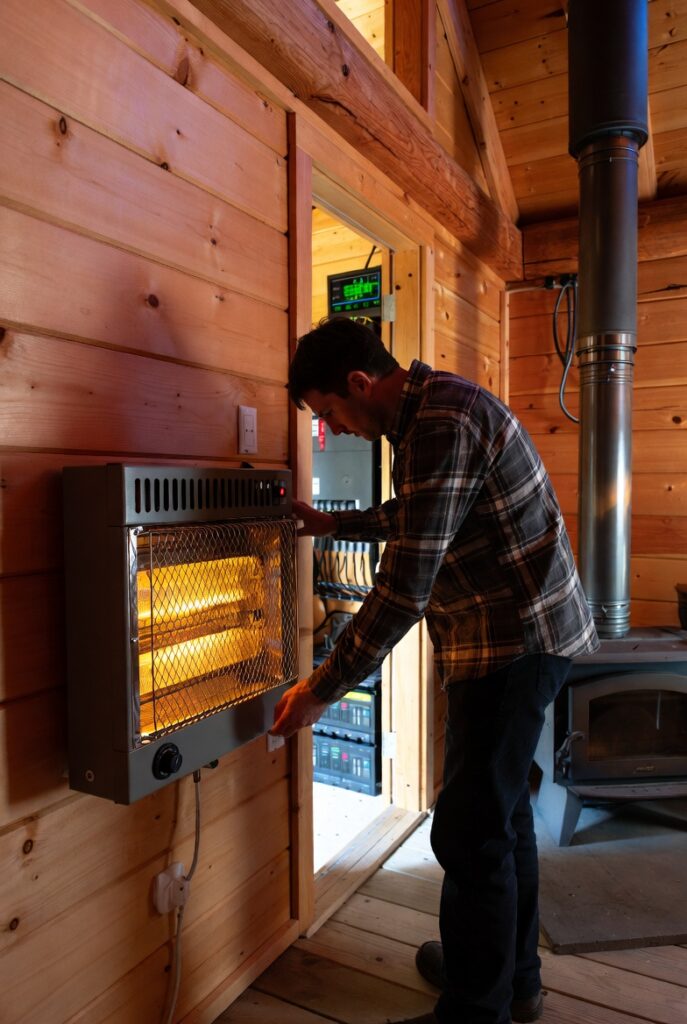
The most expensive off grid heating mistake in Ontario is attempting to run electric baseboard heaters from a solar battery bank, a 1,500W baseboard heater running 8 hours per night consumes 12,000Wh, which is 12.5 times more than the approximately 960Wh an 800W Tier 3 solar array produces on a clear January day. A property owner on Stone Road East in Guelph, Wellington County contacted me in winter 2022 planning a year-round off-grid primary residence. His preliminary system design included four 1,500W electric baseboard heaters for the main living space plus 500W of electric radiant floor heat in the bathroom. Total electric heating load at full operation: approximately 6,500W, or approximately 65,000Wh per 10-hour cold January night from heating alone.
I ran the array sizing calculation. His heating load alone required 65,000Wh ÷ 1.2Wh per watt per clear January day = 54,166W minimum array. With the 25% safety margin: approximately 67,700W of panels, or 677 individual 100W panels. The battery bank to cover a 3-day gray streak at that load required approximately 243,750Ah of LFP capacity at 12V. The full electric off grid heating system cost estimate: approximately $400,000 to $600,000 in solar and battery equipment alone. His total construction budget for the entire property was $220,000.
Together we redesigned the off grid heating approach. The electric heat came out entirely. A propane high-efficiency furnace, a propane tankless water heater, and a wood stove backup replaced all the electrical heating loads. His remaining electrical load after substitution: approximately 900Wh per day. His revised solar system: an 800W array and 400Ah LFP battery bank at 24V. His Battle Born heated LFP batteries kept the bank above 0C in the unheated utility room through two Ontario winters. Total system cost with propane appliances: approximately $11,500 versus the original electric heating scenario. See our Ontario solar sizing guide before designing any off grid heating system.
The off grid heating load problem: why electric baseboard fails the January math
| Heating method | Daily electrical load | Array required (January) | Ontario verdict |
|---|---|---|---|
| Electric baseboard (1 × 1,500W, 8h) | 12,000Wh | 12,500W | System killer. Never specify. ✗ |
| Propane radiant or furnace | 30 to 80W (blower only) | Existing Tier 2 to 3 array | Gold standard. ✓ |
| Wood stove | 0Wh | Zero additional array | Correct primary or backup. ✓ |
| Mini-split heat pump (shoulder season) | 2,000 to 4,000Wh | Tier 3+ only | Shoulder season only. ✓ |
A 1,500W baseboard heater running 8 hours per night consumes 12,000Wh, the equivalent of the entire daily production of an 800W Tier 3 Ontario array on a clear January day, multiplied by 12.5. Running two baseboards produces 24,000Wh of demand. The minimum array to power one 1,500W baseboard 8 hours per January day: 12,000 ÷ 1.2Wh per watt × 1.25 safety margin = 12,500W. At current Ontario installed costs, a 12,500W off-grid array with a proportionally sized battery bank costs approximately $40,000 to $60,000 for the solar system alone, before a single room is heated.
The economics do not improve at larger system scale. Heat requires BTUs, and generating BTUs from electricity costs 60 to 150 times more per BTU than propane at comparable off grid heating system costs. A propane furnace running 80% AFUE efficiency delivers the same BTUs from approximately $0.03 of propane fuel that would require $2.00 to $5.00 worth of solar-generated electricity. Electricity in Ontario off-grid systems is the correct energy carrier for information, light, refrigeration, and electronics, not for the thousands of BTUs required to maintain a 20C interior through a Wellington County January at -25C. The Stone Road East Guelph calculation confirms this without ambiguity: the correct off grid heating answer for Ontario is propane.
The off grid heating solution: propane, wood, and the mini-split exception
Propane radiant or forced-air off grid heating carries approximately 30 to 80W of electrical load for the furnace blower motor and thermostat, approximately 240 to 640Wh per day, within the electrical budget of any Tier 2 or Tier 3 system. A permanently installed propane furnace or radiant heater requires a TSSA-licensed gas fitter for all gas line connections under the Ontario TSSA Act. A portable propane heater using a 20 lb cylinder without a permanent gas line typically does not require TSSA licensing but must comply with manufacturer indoor use and ventilation specifications.
Wood stoves carry 0Wh of electrical load and output 15,000 to 50,000 BTU per hour depending on stove size and wood species, WETT-certified installation is required by most Ontario home insurers.
A year-round off-grid property owner near Campbellville Road in Milton, Halton County built his off grid heating system around propane radiant heat in fall 2022. His setup: a propane radiant tube heater in the workshop and a propane forced-air furnace in the main living space, with a wood stove backup rated at 30,000 BTU. His solar system handled all electrical loads: DC compressor fridge, LED lighting, Starlink, laptop charging, and the furnace blower motor at approximately 80W.
Total electrical load including the blower: approximately 980Wh per day. His 800W array of Renogy 100W monocrystalline panels and 200Ah LFP bank at 24V ran every electrical load through two Ontario winters without generator supplementation. His Victron SmartShunt January logs confirmed the bank never fell below 45% SoC after any gray streak. His propane bill averaged approximately $380 per Ontario winter season, approximately $0.52 per day for all space heat in a Wellington County winter.
Pro Tip: When sizing the solar system for a propane-heated off-grid property, include the furnace blower motor in the daily load audit as a separate line item, not a rounding error. A 80W blower cycling 8 hours per day during the heating season draws 640Wh, approximately 65% of the daily production from a single 100W panel on a clear January day. Run the SmartShunt for 7 days in January after commissioning and look for the repeating current spikes in the consumption graph that correspond to each furnace cycle. The spike height (amps) × blower run time per day = the actual blower contribution to daily load, which may differ from the nameplate due to the blower motor ramp-up draw. Confirm the actual blower load before finalising the battery bank sizing for the heating season.
The four Ontario heating options compared
The four Ontario off grid heating options in order of recommendation. Option 1: propane forced-air furnace or radiant heater, correct for any Ontario off-grid primary residence. Zero electrical load for heat generation; 30 to 80W electrical for blower and thermostat; TSSA-licensed gas fitter required for permanent gas line installation. Option 2: wood stove, correct as primary or backup for any off-grid property with accessible firewood; 0Wh electrical load; 15,000 to 50,000 BTU per hour; WETT-certified installation required by most Ontario insurers.
Option 3: mini-split heat pump, correct as a Tier 3+ supplement for shoulder seasons only; COP drops sharply below -15C on standard units, making January reliability uncertain as a sole heat source. Option 4: electric baseboard, system killer at every Ontario solar tier; never specify.
The hybrid approach combines all three viable options: propane handles primary heat demand, wood stove provides backup independence from propane supply, and a Tier 3 solar system handles all electrical loads after propane substitution. The Campbellville Road Milton result: 980Wh/day electrical load after propane substitution, 800W array, 200Ah LFP 24V, two Ontario winters without generator, $380/season propane average. See our off grid appliances guide for the five-category load audit that separates electrical loads from propane loads before sizing and our off grid cabin guide for the full Tier 1 through Tier 3 four-season specification.
The heated battery requirement: keeping the bank above 0°C without heating the cabin
Standard LFP battery chemistry stops accepting charge at or below 0C, the BMS disconnects the charging circuit to prevent lithium plating damage to the cells. If the battery utility room drops to -10C overnight, panels produce current in the morning that the BMS rejects for hours until the cells warm above 0C. This is a common off grid heating season failure mode: the propane furnace heats the cabin correctly, but the battery utility room is in an unheated attached shed and the bank cannot charge on the first clear day after a cold gray streak.
The Battle Born heated LFP batteries include internal heating elements that draw approximately 10 to 30W to warm the cells above 0C before charge acceptance begins.
The correct protocol: install the battery bank in the warmest accessible location, ideally a utility closet sharing a wall with the heated living space. If the bank must be in an unheated enclosure, specify heated LFP for any enclosure that reaches 0C or below during October through April. The battery heating draw of approximately 100 to 300Wh per cold night is a predictable and manageable thermal protection load, far less costly than a bank that cannot charge through the coldest off grid heating months.
The Stone Road East Guelph system confirmed two full Ontario winters of reliable charge acceptance in the unheated utility room with heated LFP. See our solar battery storage guide for the full heated vs standard LFP comparison.
NEC, CEC, and TSSA: Ontario compliance for off-grid heating systems
NEC 690 governs the solar PV system components for any off grid heating installation. The propane or wood heating appliances themselves are not governed by NEC 690, NEC 690 covers the panel array wiring, charge controller, battery bank, and inverter output. For an off grid heating system with a propane furnace, the furnace blower motor circuit connects to the inverter output and must comply with NEC 240 branch circuit requirements for the motor load and circuit protection. Contact the NFPA at nfpa.org for current NEC 690 requirements for the solar components and NEC 240 requirements for the furnace blower circuit.
CEC Section 64 governs solar PV installations in Ontario and requires an ESA permit for the permanent solar electrical system. The propane appliances in an off grid heating system are governed by the TSSA (Technical Standards and Safety Authority), a permanently installed propane furnace or radiant heater requires a TSSA-licensed gas fitter for all gas line connections including the run from the propane tank to the appliance.
Portable propane appliances using a 20 lb cylinder without a permanent gas line typically do not require TSSA licensing but must comply with manufacturer indoor use and ventilation specifications. A wood stove installation must comply with Ontario Building Code clearances and WETT certification requirements. Contact the Electrical Safety Authority Ontario at esasafe.com for ESA permit requirements and the TSSA at tssa.org for propane appliance installation standards in Ontario.
The off grid heating verdict: which approach survives an Ontario winter
- Ontario property owner planning a year-round off-grid primary residence who has electric baseboard heat in the load calculation: remove it now. The Stone Road East Guelph result is definitive, a full electric heating load requires $400,000 to $600,000 in solar and battery equipment against a $220,000 total property budget. Replace the electric heating load with a propane high-efficiency furnace or radiant heater and a wood stove backup. The solar system handles all remaining electrical loads. Total system cost drops from economically impossible to approximately $10,000 to $17,000 for a complete year-round off-grid primary residence. File the TSSA permit for the propane installation and the ESA permit for the solar system before any permanent installation begins.
- Ontario off-grid property owner with a propane or wood off grid heating system who is sizing the solar array for the remaining electrical loads: include the furnace blower in the load audit. The Campbellville Road Milton result confirms that 980Wh/day including the 80W blower is manageable on an 800W array with a 200Ah LFP bank through two Ontario winters. Use the Victron SmartShunt to confirm the actual blower draw in the first week of commissioning, the furnace cycling shows up as repeating current spikes in the consumption graph. Add the confirmed blower Wh to the daily load budget before finalising the battery bank sizing for the heating season.
- Ontario off-grid property owner whose battery bank is in an unheated space and who is experiencing charge rejection on cold January mornings: the bank is dropping below 0C overnight. The BMS is protecting the cells by disconnecting the charging circuit, this is correct behaviour, not a fault. Specify Battle Born heated LFP batteries for any off grid heating system enclosure that drops below 0C during October through April. The heating element draws approximately 100 to 300Wh per cold night, which is a manageable thermal protection load that prevents the far more costly consequence: a bank that cannot recharge during the coldest months of every Ontario winter.
Frequently Asked Questions
Q: Can you heat an off-grid cabin in Ontario with solar power?
A: Technically possible but economically indefensible for Ontario winters. A single 1,500W electric baseboard heater running 8 hours per night requires a 12,500W solar array and approximately $40,000 to $60,000 in solar equipment just to power that one heater. A full off grid heating load for a modestly sized cabin can require $400,000 to $600,000 in solar and battery equipment, as the Stone Road East Guelph calculation confirmed. The correct Ontario off grid heating approach is propane for primary heat generation and wood stove as backup, with solar handling all remaining electrical loads, typically 600 to 1,200Wh/day after propane substitution.
Q: What is the best heating system for an off-grid property in Ontario?
A: A propane high-efficiency furnace or radiant heater is the correct primary off grid heating system for Ontario. The furnace blower motor draws approximately 30 to 80W electrically, the only electrical load from the heating system itself. A wood stove rated at 15,000 to 50,000 BTU per hour is the correct backup, providing complete independence from both the propane supply and the solar system during extended cold gray streaks. The Campbellville Road Milton result confirms the combination: propane + wood stove backup + 800W solar for all electrical loads, two Ontario winters, bank never below 45% SoC, $380 per season in propane for all space heat.
Q: Why do my solar batteries stop charging in cold Ontario winters?
A: The battery bank drops below 0C and the battery management system disconnects the charging circuit to prevent lithium plating damage. This is correct BMS behaviour, not a fault. The solution is to either relocate the battery bank to a warmer location, a utility closet sharing a wall with the heated living space maintains temperatures above 0C without any additional heating, or specify heated LFP batteries for any off grid heating system enclosure that drops below 0C during the October through April period. The Battle Born heated LFP internal heating element draws approximately 10 to 30W to warm the cells, consuming approximately 100 to 300Wh per cold night as a thermal protection load.
This build is engineered within the 48V DC Safety Ceiling. Diagnostic logic is based on 20+ years of technical service experience. All structural and electrical installations must be verified by a Licensed Professional and comply with your Local AHJ.
This article contains affiliate links. If you purchase through these links, I earn a small commission at no extra cost to you.