
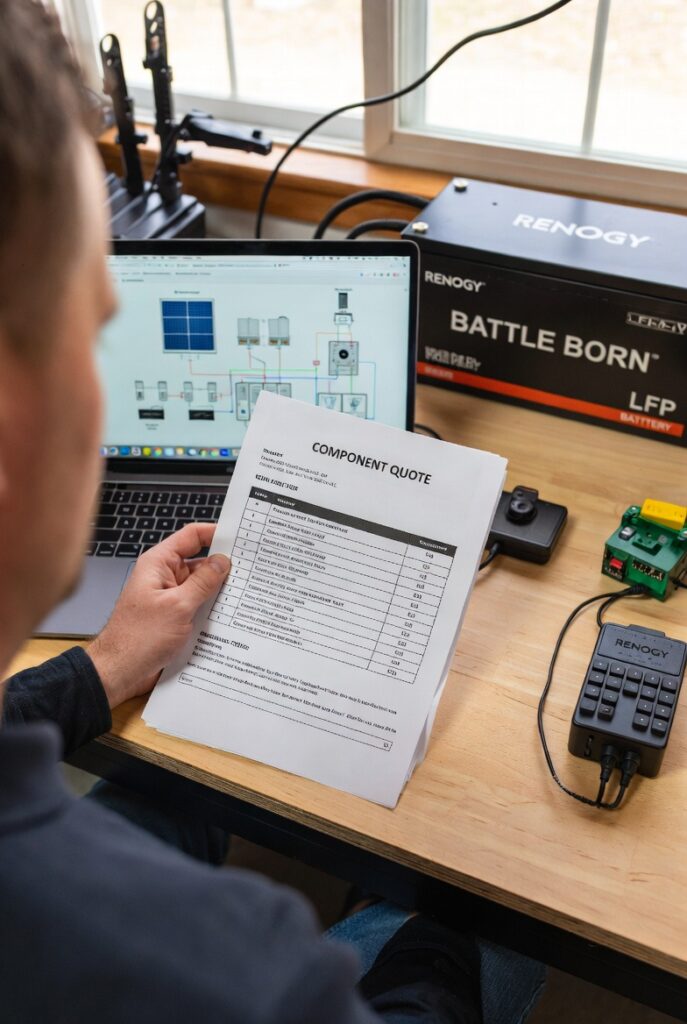
The solar panel cost question Ontario buyers ask first is usually the wrong question, because the panels themselves are typically only 20 to 25% of the total system invoice, and the battery bank is the component that drives 40 to 50% of the total cost. In spring 2023, a homeowner on Gordon Street in Guelph, Wellington County priced his first off-grid solar system and received three contractor quotes ranging from $6,500 to $11,000 for a Tier 2 system. To understand the component costs, he broke down the Tier 2 specification: 400W panels, 200Ah LFP battery bank at 24V, 1,500W/3,000W surge inverter, charge controller, and SmartShunt. The DIY component cost was approximately $3,200 at current Ontario retail pricing.
He built the system himself over two weekends in June 2023. His total cost: approximately $3,200 in components plus approximately $450 for the ESA permit and inspection, for a total of approximately $3,650 installed. The lowest professional quote had been $6,500 for the same specification, a $2,850 saving from understanding what each component actually costs and assembling it himself. Approximately $1,400 of his $3,200 component cost was the 200Ah LFP battery bank, 44% of the total component budget.
I reviewed his completed installation at the commissioning check in July 2023. His Victron SmartShunt confirmed the first full charge cycle matched the design specification within 3%. The system has operated for two Ontario winters without issue. Understanding the actual solar panel cost breakdown, what drives the invoice and what constitutes fair value, is the difference between a $3,650 self-build and a $6,500 professional quote for identical components. See our Ontario solar sizing guide before pricing any solar panel cost scenario.
The solar panel cost breakdown: why the battery bank drives 40% of the invoice
| Component | % of system cost | Tier 2 example cost | Ontario note |
|---|---|---|---|
| Battery bank (LFP) | 40 to 50% | $1,800 to $2,200 | Largest single item, spec this first |
| Solar panels | 20 to 25% | $320 to $480 (400W) | Lowest cost per watt in the system |
| Inverter (PSW) | 15 to 20% | $250 to $500 | PSW only, never MSW |
| Charge controller (MPPT) | 5 to 10% | $80 to $180 | MPPT recovers 15-30% more than PWM |
| Monitoring + wiring | 5 to 8% | $200 to $320 | SmartShunt is mandatory, not optional |
| ESA permit + inspection | Fixed | $300 to $600 | Required before any permanent wiring |
A 400W array of four Renogy 100W monocrystalline panels costs approximately $320 to $480, the smallest single cost item in a correctly specified solar power system. A 200Ah LFP battery bank at 24V costs approximately $1,800 to $2,200. The battery bank costs 4 to 5 times more than the panels in a Tier 2 system. The correct solar panel cost planning sequence starts with the battery bank: choose the chemistry, calculate the 3-day gray streak reserve for the daily load, size the bank, then price the remaining components in order of decreasing cost.
A correctly specified Ontario off-grid system requires a battery bank sized for the 3-day gray streak reserve at 80% LFP DoD. For a 50Ah/day load, that requires 187.5Ah of rated LFP capacity at approximately $1,700 to $2,100 at current Ontario retail pricing. The 400W panel array for the same system costs approximately $400 to $500. The battery bank costs 4 to 5 times more than the panels, and the battery specification, LFP vs AGM, 12V vs 24V, total rated capacity, determines more of the total solar panel cost than all other component decisions combined. See our solar battery storage guide for the full sizing formula and chemistry comparison.
The three solar panel cost false economies: where buyers lose money trying to save it
False economy 1: AGM batteries instead of LFP. A 200Ah AGM bank costs approximately $500, versus approximately $1,900 for the 200Ah LFP equivalent, an apparent $1,400 upfront saving. The AGM provides only 100Ah usable at 50% DoD; the LFP provides 160Ah usable at 80% DoD. A Stone Road West Guelph homeowner chose 200Ah AGM in spring 2022 to reduce his solar panel cost. The bank suffered 35 to 40% capacity loss from sulfation within 18 months of use that included January gray streaks pushing it below 50% DoD.
He replaced it with a Battle Born 100Ah LFP battery at approximately $950. His total 2-year cost: $500 AGM plus $950 replacement equals $1,450, $500 more than if he had bought LFP from the start.
False economy 2: MSW inverter instead of PSW. The Waterloo Avenue Guelph result from the solar inverter types article: an $80 saving on a modified sine wave inverter produced a $600 CPAP machine replacement in two nights from waveform distortion damage. The $80 saving generated a $520 net loss. False economy 3: undersized array. A $200 saving from a smaller panel array produces approximately $135 to $225 in annual generator fuel cost when the January 1.5 PSH production cannot recharge the bank, the saving disappears in the first Ontario winter.
The total lifetime solar panel cost is the only number that matters. The Gordon Street Guelph result confirms the LFP calculation: $1,400 for 200Ah at 24V at system build, no replacement at year 2, system producing correctly at year 3. The AGM alternative over the same period: $500 plus $950 replacement at 18 months equals $1,450, already $50 more in two years with further replacements ahead. See our solar inverter types guide for the full MSW vs PSW specification comparison.
Pro Tip: Before finalising any Ontario solar panel cost budget, run the 20-year total cost calculation for the battery bank option you are considering. LFP at $1,900 for 200Ah 24V, rated 3,000 to 5,000 cycles, at one cycle per day lasts approximately 8 to 13 years. Over 20 years you need one replacement, for a 20-year battery cost of approximately $3,800. AGM at $500 for 200Ah, rated 500 to 800 cycles at proper 50% DoD, lasts approximately 1.5 to 2.5 years. Over 20 years you need 8 to 13 replacement sets, for a 20-year battery cost of approximately $4,000 to $6,500. The AGM “saving” of $1,400 at year 0 inverts to a $200 to $2,700 lifetime cost increase by year 20. Run this calculation before buying any battery bank, and use the SmartShunt to confirm actual cycle behaviour in the field once the system is commissioned.
The Ontario tier cost table: DIY vs professional quote comparison
Tier 1 weekend retreat: DIY approximately $1,900 installed including ESA permit and inspection, professional quote approximately $3,500 to $5,000 for the same specification. Tier 2 comfortable cottage: DIY approximately $3,650 installed including ESA, professional quote approximately $6,500 to $12,000. Tier 3 four-season primary: DIY approximately $7,000 to $12,000 installed including ESA permit and propane system components, professional quote approximately $15,000 to $25,000 or more. The DIY vs professional gap widens with system size because labour cost is a higher percentage of professional quotes at larger system scales, a Tier 3 professional installation may include design fees, extended warranty, and commissioning support that add $3,000 to $5,000 beyond component and installation labour costs.
The Gordon Street Guelph result defines the Tier 2 DIY savings: $3,650 total installed versus a $6,500 lowest professional quote for identical components, a $2,850 saving that required two weekends of installation work and the confidence to file and manage the ESA permit. The professional quote covers design, procurement, installation labour, and workmanship warranty. DIY requires the property owner to perform installation, file the ESA permit, and take responsibility for commissioning and troubleshooting. For a property owner comfortable with electrical work and DC systems, the saving justifies the effort. See our solar power system integration guide for the full commissioning sequence and SmartShunt confirmation protocol.
The Hydro One alternative: why off-grid is often cheaper than grid connection
For rural Wellington and Halton County properties, the solar panel cost comparison must include the Hydro One alternative. A rural service extension for a property 400 metres from the nearest active service pole costs approximately $20,000 to $47,000, and the property owner owns none of the resulting infrastructure. A correctly specified Tier 2 off-grid system costs approximately $3,650 DIY or $6,500 to $12,000 professionally installed, and the property owner owns it outright. The Woodlawn Road North Guelph result from the off grid ontario article: $1,800 installed DIY versus a $47,000 Hydro One service extension quote for the same unserviced property.
Monthly delivery charges continue accumulating after the grid connection fee is paid. At $60 per month in Hydro One delivery charges, a 20-year connection adds $14,400 in charges to the $47,000 connection cost, for a 20-year total of approximately $61,400. A $3,700 Tier 2 DIY off-grid system with one LFP battery replacement at year 10 (approximately $2,000) totals approximately $5,700 over the same 20 years. The solar panel cost question for rural Ontario is not solar versus nothing, it is solar cost versus Hydro One total cost.
For most rural Wellington and Halton County properties where the grid connection quote exceeds $10,000, the off-grid system wins the 20-year comparison before the first solar panel is mounted. See our off grid ontario guide for the full connection cost analysis by property type.
NEC and CEC: Ontario requirements and their impact on total system cost
NEC 690 governs solar PV installations. A permanently installed solar power system must comply with NEC 690 requirements for panel array wiring, DC overcurrent protection, charge controller installation, battery storage, and inverter output wiring. The ESA permit and inspection add approximately $300 to $600 to the total Ontario solar panel cost and are a mandatory component of every permanent installation, not an optional budget line that can be skipped to reduce the quote. NEC 690 requirements for overcurrent protection, disconnecting means, and rapid shutdown on occupied structures must all be included in every system cost estimate from the start. Contact the NFPA at nfpa.org for current NEC 690 requirements that affect the total solar panel cost.
CEC Section 64 governs solar PV installations in Ontario. An ESA permit is required for any permanent solar power system installation in Ontario, filed before wiring begins. The permit adds approximately $300 to $600 to the total installed solar panel cost and must be included in any budget calculation, a DIY system installed without a permit is an uninsured installation, and the cost of a fire or electrical incident without insurance coverage vastly exceeds the permit fee. The permit confirms the installation meets the Ontario Electrical Safety Code and protects the property owner’s home insurance coverage. Contact the Electrical Safety Authority Ontario at esasafe.com for current permit fees before finalising any solar panel cost budget.
The solar panel cost verdict: Ontario Tier 1 to Tier 3 real numbers
- Ontario property owner pricing a first solar system who wants to know what solar panels cost: the correct question is what the complete system costs at the chosen tier. Tier 1 weekend retreat: approximately $1,900 DIY or $3,500 to $5,000 professional. Tier 2 comfortable cottage: approximately $3,650 DIY or $6,500 to $12,000 professional. Tier 3 four-season primary: approximately $7,000 to $12,000 DIY or $15,000 to $25,000 or more professional. In every tier, the battery bank is 40 to 50% of the component cost. Specify the battery bank first, chemistry, capacity, voltage, then price the panels and inverter. The panels are the smallest cost item in the invoice.
- Ontario rural property owner comparing solar panel cost to a Hydro One rural connection quote: compare the 20-year total cost, not the upfront price. A $47,000 Hydro One connection plus $14,400 in 20-year delivery charges equals $61,400 for infrastructure the property owner does not own. A $3,650 Tier 2 DIY solar system plus one battery replacement at year 10 equals approximately $5,700 for infrastructure the property owner owns outright. Use the Victron SmartShunt to track battery health in real time, the SoC at a known load starts declining as the battery approaches end of cycle life, giving advance notice of the replacement before it becomes an emergency.
- Ontario property owner who received a solar system quote and wants to verify whether it represents fair value: break the quote into its component costs using the tier pricing above. A Tier 2 professional quote of $6,500 to $12,000 is within market range. A quote below $6,000 for a Tier 2 specification may indicate AGM batteries instead of LFP, an MSW inverter, or an undersized array, ask the installer to specify the exact battery chemistry, inverter type, and array wattage before signing. The three false economy substitutions each reduce the upfront quote while increasing the lifetime solar panel cost. Require the quote to specify LFP, PSW, and January-floor array sizing before comparing it to the DIY component prices above.
Frequently Asked Questions
Q: How much does a solar panel system cost in Ontario?
A: A complete Ontario off-grid solar panel system costs approximately $1,900 DIY for a Tier 1 weekend retreat (200W panels, 100Ah LFP, 600W PSW inverter, ESA permit), approximately $3,650 DIY for a Tier 2 comfortable cottage (400W panels, 200Ah LFP 24V, 1,500W/3,000W surge inverter, ESA permit), and approximately $7,000 to $12,000 DIY for a Tier 3 four-season primary residence (600 to 1,200W panels, 400 to 600Ah LFP, PSW inverter-charger, propane system). Professional quotes run approximately 2 to 3 times the DIY component cost at Tier 1 and Tier 2. The Gordon Street Guelph confirmed result: $3,650 DIY versus a $6,500 lowest professional quote for identical Tier 2 components, a $2,850 saving from understanding the actual solar panel cost breakdown.
Q: Why is the battery bank the most expensive part of a solar system?
A: The battery bank must be sized for the 3-day Ontario gray streak reserve at 80% LFP DoD, typically 1.5 to 4 times the daily load in rated Ah capacity. At approximately $9 to $11 CAD per Ah of LFP capacity at current Ontario retail pricing, a correctly sized battery bank for a 50Ah/day load costs $1,700 to $2,100 for the battery alone. The 400W panel array for the same system costs $400 to $500.
The battery bank costs 4 to 5 times more than the panels because storing energy for 3 gray days requires significantly more materials than harvesting energy from the panels on clear days. This ratio holds across all three tiers: battery bank is always 40 to 50% of the total solar panel cost regardless of system size.
Q: Is it cheaper to go off-grid or connect to Hydro One in rural Ontario?
A: For rural Ontario properties where the Hydro One connection quote exceeds approximately $10,000, off-grid solar is almost always cheaper over a 20-year horizon. A $3,650 DIY Tier 2 off-grid system costs approximately $5,700 over 20 years including one LFP battery replacement. A $47,000 Hydro One rural connection plus $14,400 in 20-year delivery charges costs approximately $61,400 over the same period for infrastructure the property owner does not own. The Woodlawn Road North Guelph result: $1,800 installed off-grid versus $47,000 Hydro One connection quote. The total solar panel cost comparison is not solar versus nothing, it is solar versus Hydro One total cost of ownership including the ongoing delivery charge that continues regardless of energy consumption.
This build is engineered within the 48V DC Safety Ceiling. Diagnostic logic is based on 20+ years of technical service experience. All structural and electrical installations must be verified by a Licensed Professional and comply with your Local AHJ.
About the Author
Robert Bertrand spent 20 years as a service advisor in the automotive industry (Lexus and Nissan), where precision diagnostics, wiring integrity, and documentation standards were non-negotiable. He brings that same technical discipline to GridFree Guide, where he researches, tests, and documents off-grid solar systems for Ontario conditions. Based in Rockwood, Ontario, every article is built on verified specifications, manufacturer data, and the real-world climate constraints of Canadian off-grid living.
As an Amazon Associate I earn from qualifying purchases. This site also contains affiliate links to other products and services. GridFree Guide earns a small commission at no extra cost to you.