
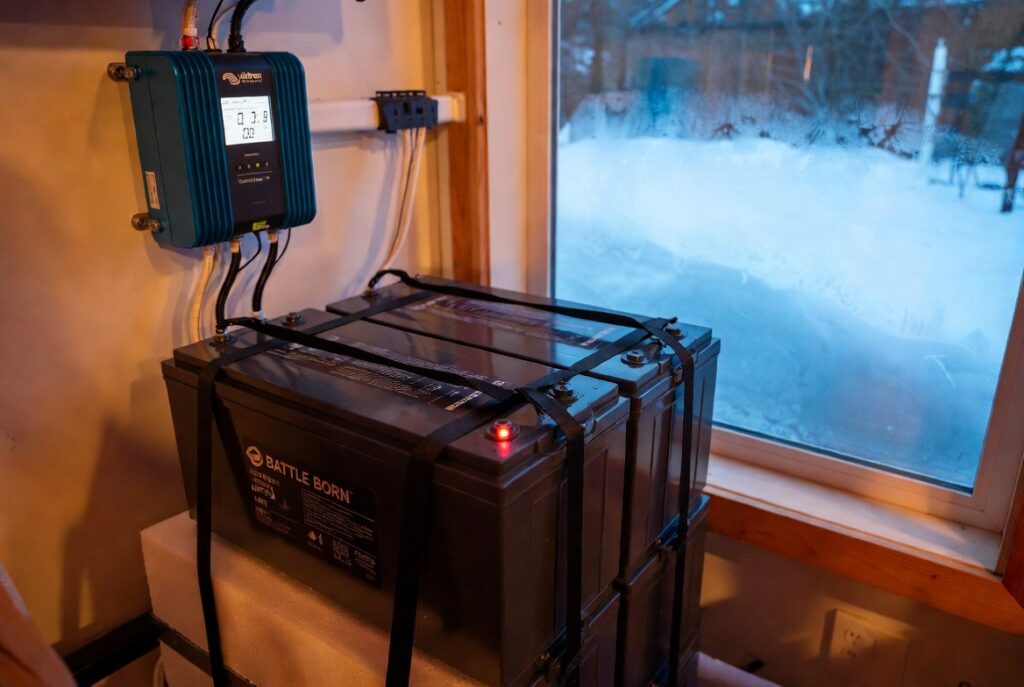
LiFePO4 cold charging fails at 0C because the BMS blocks all current to prevent irreversible lithium plating. In Ontario, that cutoff costs cabin owners days of lost solar harvest every January. The array produces power on clear winter mornings, but the battery bank accepts zero amps. Understanding why the BMS engages this cutoff is the first step toward solving the problem.
The issue affects every standard LFP battery without an internal heater. At minus 15C, the electrolyte inside the cells becomes too viscous for safe ion transfer. A charge controller showing 30A available means nothing when the BMS refuses to open the gate. Owners who size their arrays for Ontario winter often lose that harvest to a chemical limit no gauge shows.
This guide covers the full LiFePO4 cold charging diagnostic for Ontario seasonal and year-round properties. For a broader overview of system sizing, start with the solar sizing guide. For battery selection and cold weather protection, refer to the Solar Battery Guide.
Why LiFePO4 Cold Charging Fails at 0C
When temperatures drop to 0C, the BMS in your LiFePO4 bank blocks all charging current. This is not a malfunction. It is the primary safety feature that prevents lithium plating on the graphite anode. Below 0C, lithium ions cannot move fast enough through the viscous electrolyte to intercalate safely into the anode structure.
A standard 100Ah 12V LFP battery holds 1,200Wh at full charge. When exposed to minus 5C or colder, forced charging causes metallic lithium to plate directly on the anode surface. That plating is permanent and reduces capacity with every occurrence. Heated LFP batteries solve this with an internal pad that warms the cells above 0C before the charge gate opens.
| Feature | Standard LFP | Heated LFP (Battle Born) |
|---|---|---|
| Charge Cutoff | 0C | minus 20C (with heater) |
| Discharge Cutoff | minus 20C | minus 20C |
| BMS Behavior | Blocks charging at 0C | Diverts current to heater |
| Heater Mechanism | None | Internal heating pad, auto-activate |
The flat voltage curve of LFP cells makes LiFePO4 cold charging failures especially hard to diagnose. A cell at 0C reads nearly the same voltage as one at 20C. Without a terminal-mounted temperature sensor, the only visible symptom is zero charging amps on a sunny day.
The Lithium Plating Risk That Destroys Your Bank
Lithium plating occurs when ions forced into a cold cell cannot intercalate into the graphite anode. Instead, metallic lithium deposits on the anode surface in a thin layer. Each plating event is irreversible and can reduce capacity by up to 10 percent. Repeated plating creates dendrites that can eventually puncture the cell separator and cause an internal short.
The BMS cutoff exists specifically to prevent this damage. It is not blocking your power to be cautious. It is preventing a $3,800 bank from suffering permanent capacity loss that no amount of cycling or reconditioning can reverse. Every LiFePO4 cold charging system in Ontario needs either heated batteries or external heating to eliminate this risk entirely.
The Goderich Diagnosis
A cabin owner near Goderich in Huron County ran a 400Ah 12V standard LFP bank with an 800W solar array. After three days of heavy cloud cover, a clear January morning brought full sun to the panels. The charge controller showed 30A available at minus 15C ambient. The SmartShunt showed 0.0A flowing into the bank.
The BMS had engaged its low-temperature cutoff because cell cores sat at minus 8C. The owner lost three consecutive days of clear winter sun totaling 7.2kWh of potential harvest. By day three the bank had dropped to 15 percent SoC from overnight furnace fan and LED loads. The system sat 48 hours from a complete blackout during the coldest week of the year.
This is the same problem as a diesel engine that refuses to start because gelled fuel blocks the lines. The engine is sound, the starter works, but the fuel cannot flow. The owner added external heating pads and rigid foam insulation at a cost of $280. That $280 fix protected a $3,800 battery bank from permanent lithium plating damage.
The Heated Battery Solution for LiFePO4 Cold Charging
Battle Born 100Ah Heated LFP batteries have an internal heating pad that activates automatically at 0C. The heater draws approximately 12W from the existing bank charge for 30 to 60 minutes. Once the cells reach plus 2C, the heater shuts off and the charge gate opens. The entire LiFePO4 cold charging problem disappears without any owner intervention.
The energy cost of each heating cycle is minimal at roughly 9Wh per event. Over a full Ontario winter, the cumulative heating draw is less than 2 percent of total bank capacity. For more on how cycling depth affects long-term battery health, see the LiFePO4 charge cycle guide.
The Stratford Protocol
A property owner near Stratford in Perth County installed a 200Ah 12V Battle Born Heated LFP bank. The 600W array powered a year-round cottage with LED lighting, a furnace fan, and Starlink internet. External temperatures dropped to minus 18C during a December cold snap. The charge controller registered 22A available on the first clear morning.
The internal heater activated automatically and drew 12W for approximately 45 minutes. The cells warmed from minus 6C to plus 2C without any owner intervention. The charge gate opened and the bank began accepting the full 22A. By noon the bank had recovered from 55 percent to 92 percent SoC, following the storage voltage standard protocol.
This is the difference between a diesel truck with a block heater and one left cold in the lot. Both trucks have the same engine, but only the heated one starts on the first try. The heated battery added $150 per unit compared to the standard version. That $150 premium eliminated every minute of lost LiFePO4 cold charging harvest across four Ontario winter months.
Temperature Monitoring for Winter Battery Systems
A remote temperature sensor bolted directly to the battery terminal post is mandatory for any Ontario LiFePO4 cold charging installation. Ambient air temperature does not represent cell core temperature accurately. The Victron SmartShunt includes a temperature sensor input that feeds cell data to the Cerbo GX and VRM portal.
The Victron MPPT 100/50 also accepts a remote temperature sensor and reduces charge current automatically. This prevents any charging attempt when cells are below 0C, even if the BMS has not yet engaged its cutoff. For more on managing LiFePO4 cold charging through the off-season, see the LiFePO4 self-discharge guide.
Code Compliance for LiFePO4 Cold Charging Installations
NEC Article 480 requires battery installations with heated enclosures to include disconnect devices, overcurrent protection, and temperature monitoring provisions. Heating elements within battery enclosures must be listed for the application and installed with proper clearance from combustibles. Compliance is verified through the NFPA (National Fire Protection Association) code cycle and local inspection authorities.
CEC Section 64 governs Ontario-specific standards for battery room temperature control and heated enclosure installations. The section mandates ventilation requirements, minimum clearance distances, and temperature monitoring for any battery system operating below 0C. All Ontario installations must be inspected by the ESA (Electrical Safety Authority) before commissioning.
Pro Tip: The $150 heated battery premium is less than 4 percent of a $3,800 bank cost. That upgrade eliminates every LiFePO4 cold charging failure for the life of the battery.
- Install Battle Born Heated LFP batteries for automatic cold weather protection. The heater activates at 0C and warms cells in 30 to 60 minutes.
- Bolt a remote temperature sensor to the battery terminal post. Monitor through the SmartShunt and Cerbo GX via the VRM portal.
- Comply with NEC Article 480 and CEC Section 64 for heated enclosure installation, and schedule an ESA inspection before commissioning.
Frequently Asked Questions
Can I charge a LiFePO4 battery at minus 10C with a slow charge rate?
No. LiFePO4 cold charging at any rate below 0C risks lithium plating on the anode. The damage is irreversible regardless of charge speed. Warm the cells above 0C with a heated battery or external heating pad before applying any charge current.
How long does the internal heater take to warm a frozen battery?
The Battle Born Heated LFP internal heater warms cells from minus 6C to plus 2C in 30 to 45 minutes. The heater draws approximately 12W during the cycle. Once cells reach safe temperature, the heater shuts off and charging begins automatically.
Will insulation alone protect my LFP bank through an Ontario winter?
Insulation slows heat loss but cannot generate heat on its own. During a multi-day cold snap at minus 20C, insulation alone will not keep cells above 0C. Combine rigid foam insulation with either a heated battery or a thermostat-controlled heating pad for reliable LiFePO4 cold charging protection.
This build is engineered within the 48V DC Safety Ceiling. Diagnostic logic is based on 20+ years of technical service experience. All structural and electrical installations must be verified by a Licensed Professional and comply with your Local AHJ.
About the Author
Robert Bertrand spent 20 years as a service advisor in the automotive industry (Lexus and Nissan), where precision diagnostics, wiring integrity, and documentation standards were non-negotiable. He brings that same technical discipline to GridFree Guide, where he researches, tests, and documents off-grid solar systems for Ontario conditions. Based in Rockwood, Ontario, every article is built on verified specifications, manufacturer data, and the real-world climate constraints of Canadian off-grid living.
As an Amazon Associate I earn from qualifying purchases. This site also contains affiliate links to other products and services. GridFree Guide earns a small commission at no extra cost to you.