
The lifepo4 storage voltage you set before leaving your Ontario cottage for winter determines spring outcomes. Most seasonal owners get this wrong in one of two directions. They store at 100 percent SoC and cause cell stress, or they leave the bank unmonitored and allow deep discharge. Both failures are preventable with a 30-minute winterization protocol.
This article covers the winterization protocol used across Grey County and Northumberland County Ontario installations. The protocol takes 30 minutes before departure. It protects a $900 to $4,000 battery bank through six months of Ontario winter. For sizing context, see our solar battery guide and our how much solar power do I actually need guide.
| State of Charge | 12V System Voltage | 24V System Voltage | Action Required |
|---|---|---|---|
| 100% (Full) | 13.6V to 14.4V | 27.2V to 28.8V | Discharge for storage , do not store here |
| 50-60% (Storage target) | 13.15V to 13.2V | 26.3V to 26.4V | Optimal winterization target |
| 20% (Low) | 12.8V to 12.9V | 25.6V to 25.8V | Charge slightly before storage |
| 0% (Deep discharge) | Below 12.0V | Below 24.0V | Emergency recovery , BMS may lock out |
Why lifepo4 storage voltage determines whether your bank survives winter
LFP cells prefer 50 to 60 percent SoC for long-term storage. High voltage stress at 100 percent SoC causes accelerated calendar aging. The degradation process is called electrolyte oxidation at the positive electrode. The effect compounds over months and cannot be reversed through cycling.
The chemistry behind the storage voltage target is well established. At 100 percent SoC, the positive electrode is under maximum lithium extraction stress. At 50 to 60 percent SoC, the cell chemistry is balanced and electrochemical activity is minimal. For the scientific detail on calendar aging rates, see Battery University on lithium battery storage.
The lifepo4 storage voltage also affects cycle life over the bank’s full service period. A bank stored at 100 percent SoC for six months per year accumulates extra calendar aging. On a 10-year bank lifespan, that adds up to 20 percent of cycle life consumed during storage seasons. See our LiFePO4 charge cycles guide for the full cycle life math.
Calculating your lifepo4 storage voltage target for Ontario conditions
The correct lifepo4 storage voltage targets are system-specific. For a 12V system, the target is 13.15V to 13.2V. For a 24V system, the target is 26.3V to 26.4V. For a 48V system, the target is 52.6V to 52.8V.
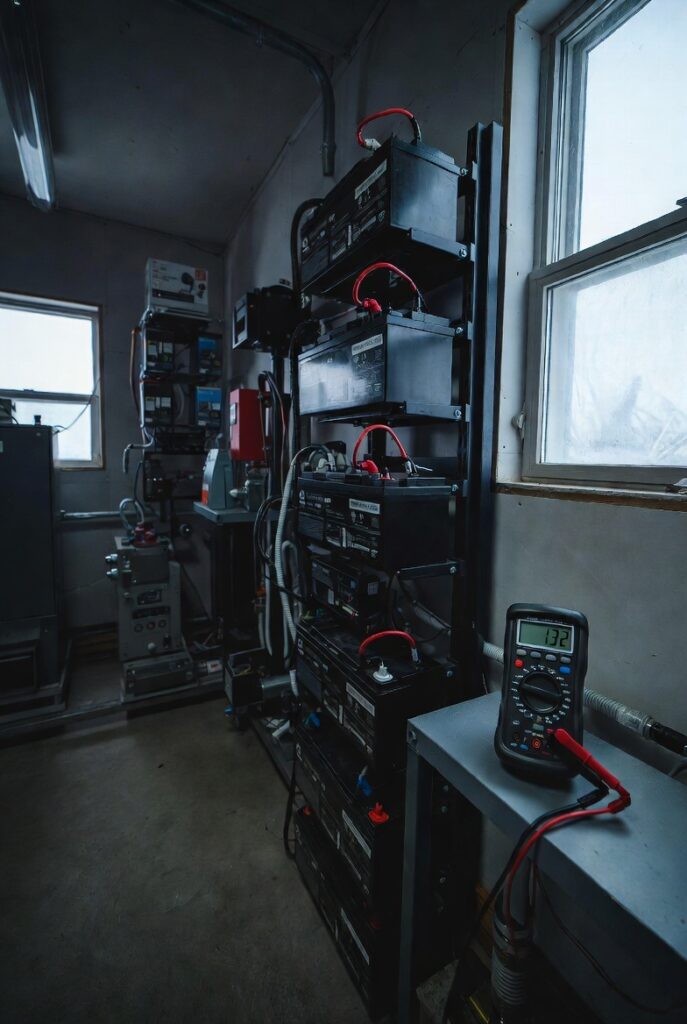
Verify the lifepo4 storage voltage at the battery terminals using a calibrated multimeter, not the BMS display. The BMS display can drift from actual cell voltage after the bank rests for 24 hours. A terminal measurement with the bank at rest for 2 hours gives the most accurate reading.
The Victron SmartShunt logs terminal voltage continuously and provides Bluetooth access from outside the cabin. Many Ontario cottage owners check the SmartShunt app from the driveway to confirm storage voltage without reopening the equipment room. See our LFP battery Ontario guide for the full commissioning and storage framework.
Parasitic loads and the invisible drain that kills stored banks
A single 0.1W indicator LED draws 43Wh over six months of storage. An inverter in standby draws 5 to 25W depending on the model. That translates to 2,160 to 10,800Wh over six months. A typical off-grid system in standby can drain a 200Ah bank within 4 to 8 weeks.
The only reliable solution is physical disconnection at the master fuse or main battery switch. Turning off the inverter is not sufficient if the inverter draws standby current from the DC side. The charge controller sleep mode still draws 0.5 to 2W on most models. A physically pulled fuse eliminates every parasitic path simultaneously.
Walk the property before locking up and confirm every DC breaker is pulled or switched off. Check the charge controller, the inverter, any active monitoring equipment, and any 12V outlets. See our LFP self-discharge guide for the full parasitic load audit procedure.
The Grey County 100 percent SoC failure
Near Owen Sound in Grey County, a cabin owner stored his 400Ah LFP bank at 100 percent SoC in October. He believed a full charge would protect the bank through winter. The cabin equipment room hits minus 25C in the Niagara Escarpment winters. He disconnected the solar array but left the bank at 14.4V with the inverter in standby.
The combination of sustained high lifepo4 storage voltage and cold ambient caused the BMS to enter a permanent protection state. By April, the bank showed 0V at the terminals and would not respond to any charge input. The unexpected consequence was that the BMS had correctly detected a fault and locked itself out permanently. The fault was cell voltage imbalance, not the temperature.
Storing a battery at 100 percent SoC is like storing a vehicle with the suspension springs fully compressed. The spring steel fatigues faster under sustained stress than at rest. His 400Ah bank cost $3,800 to replace. Setting the lifepo4 storage voltage correctly at 13.2V before departure would have cost 30 minutes and saved the entire bank.
Cold storage facts every Ontario seasonal owner must know
LFP cells can be stored safely in sub-zero temperatures. The hard rule is no charging below 0C, which causes lithium plating and permanent cell damage. Any active charge source must be disconnected or protected by a temperature-sensing BMS during Ontario winter storage.
The distinction between storage temperature and charging temperature is critical. Storing a bank at minus 25C for six months causes no damage to a properly disconnected LFP bank. Charging that same bank at minus 25C causes immediate and irreversible lithium plating. Ontario cottage owners who leave a small solar panel connected without a temperature-sensing BMS risk charging frozen cells in February.
The Battle Born Heated LFP battery handles this automatically through internal heating pads. The heating circuit activates before charging when cell temperature is below 0C. For the spring wake-up sequence after proper storage, see our LiFePO4 break-in guide.
The Northumberland County correct protocol
A cottage owner near Cobourg in Northumberland County followed the full winterization protocol before leaving in October 2024. He discharged his 200Ah LFP bank to 55 percent SoC using household loads over two days. He verified the lifepo4 storage voltage at 13.18V using a calibrated multimeter at the battery terminals. He then pulled the master fuse, disconnected the solar array, and locked up the property.
When he returned in late April, the bank was sitting at 13.07V. That represents approximately 48 percent SoC after 6 months of self-discharge. The unexpected consequence was how clean the spring startup was. After a 0.05C wake-up charge, the Victron SmartShunt showed cell drift of only 0.01V across all cells.
A proper storage protocol is the battery equivalent of a seasonal vehicle storage service. Right fuel level, right tire pressure, right battery tender voltage, all done before storage in sequence. His bank returned to full service with zero capacity loss after 6 months of Ontario winter. The 30 minutes he spent on the correct lifepo4 storage voltage was the cheapest maintenance he ever performed.
The spring wake-up after correct lifepo4 storage voltage maintenance
After 4 to 6 months of correct storage, the bank needs a structured wake-up before returning to full service. The 0.05C wake-up charge rate means 5A for a 100Ah bank and 10A for a 200Ah bank. Run this rate for 3 hours before increasing to the normal charge current.
Immediate full charge rate after 6 months risks cell imbalance and localized heating. The 3-hour slow charge lets all cells equilibrate before higher current is applied. The SmartShunt SoC reference requires a manual reset after storage. This recalibrates the 100 percent baseline from the new resting point.
A healthy spring return shows even cell balance and a steady voltage rise during the wake-up charge. Cell drift exceeding 0.05V after the wake-up charge means a 12-hour float charge is needed before returning to service. The float charge procedure follows the same steps as the initial break-in top-balance from our LiFePO4 break-in guide.
NEC Article 690 governs battery disconnection and overcurrent protection requirements including seasonal storage protocols. Battery circuit protection per NEC 690.9 applies to all permanent installations. The physical disconnect requirement during storage periods falls under NEC 690.15. Current standards are published at nfpa.org.
CEC Section 64 governs solar PV installations in Ontario including battery storage requirements. Permanent battery installations require an ESA permit before energizing and must comply with Section 64 disconnect requirements. Seasonal cottage installations follow the same permit and disconnect standards as year-round installations. The Electrical Safety Authority publishes current Ontario compliance guidelines at esasafe.com.
Pro Tip: The lifepo4 storage voltage check takes 90 seconds with a multimeter. Set the bank to 50-60 percent SoC and verify the terminal voltage. Pull the master fuse and photograph the meter reading before you lock up. That photo is your warranty documentation and your spring reference point.
- For the Ontario seasonal cottage owner leaving for winter: Set the lifepo4 storage voltage to 13.2V before departure. Pull the master fuse and photograph the terminal voltage. Those three steps protect the bank through winter at zero cost.
- For the homeowner managing a long absence: The 50-60 percent SoC rule applies to any absence over 30 days. A bank left at 100 percent SoC accumulates measurable calendar aging. The Grey County case cost $3,800. The storage protocol costs 30 minutes.
- For the owner returning in spring: Run the 0.05C wake-up charge for 3 hours before returning to full charge rate. Verify cell balance on the SmartShunt before connecting any loads. A 3-hour wake-up charge is the cheapest insurance against post-storage cell stress.
Frequently asked questions
Q: What is the correct lifepo4 storage voltage for a 12V system?
A: The correct lifepo4 storage voltage for a 12V system is 13.15V to 13.2V, representing 50-60 percent SoC. This is the chemical resting point where cell degradation is slowest during long-term storage. Verify with a multimeter at the battery terminals, not the BMS display. The BMS display can read incorrectly when the bank has been at rest for more than 24 hours.
Q: Can I leave my LiFePO4 battery in a cold Ontario cabin over winter?
A: Yes, LFP cells can be stored safely in sub-zero temperatures. The hard rule is that they must not be charged below 0C, which causes lithium plating and permanent damage. Disconnect any active solar input or charge source before departure. A heated LFP unit with internal heating pads handles this automatically if a charge source remains connected.
Q: How do I wake up a LiFePO4 battery after 6 months of winter storage?
A: Run a slow 0.05C charge rate for 3 hours before returning to full charge current. For a 100Ah bank, that means 5A maximum for the first 3 hours. Verify cell balance on the SmartShunt before connecting any loads. If cell drift exceeds 0.05V after the wake-up charge, run a 12-hour float charge to top-balance before returning to service.
This build is engineered within the 48V DC Safety Ceiling. Diagnostic logic is based on 20+ years of technical service experience. All structural and electrical installations must be verified by a Licensed Professional and comply with your Local AHJ.
This article contains affiliate links. If you purchase through these links, I earn a small commission at no extra cost to you.
About the Author
Robert Bertrand spent 20 years as a service advisor in the automotive industry (Lexus and Nissan), where precision diagnostics, wiring integrity, and documentation standards were non-negotiable. He brings that same technical discipline to GridFree Guide, where he researches, tests, and documents off-grid solar systems for Ontario conditions. Based in Rockwood, Ontario, every article is built on verified specifications, manufacturer data, and the real-world climate constraints of Canadian off-grid living.
As an Amazon Associate I earn from qualifying purchases. This site also contains affiliate links to other products and services. GridFree Guide earns a small commission at no extra cost to you.