
The Plug-In Reality and Can You Really Use Balcony Solar Panels in Ontario?
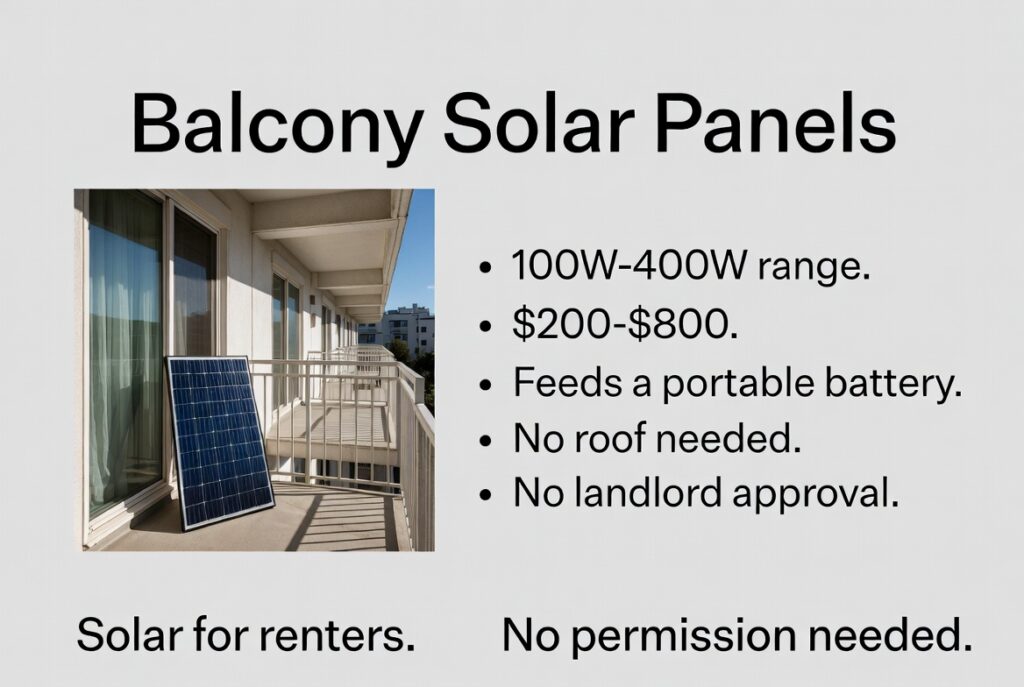
Balcony solar panels work for Ontario renters and condo owners when you feed the power into a portable battery instead of backfeeding into the wall because the battery path is legal, portable, and requires zero permits. The key is using DC from the panels to charge a portable power station. This setup requires no permits, no grid connections, and no landlord approval. The panels are portable personal property like a BBQ or a patio chair.
Plugging a micro-inverter directly into a wall outlet is illegal in Ontario. It backfeeds power into your building’s electrical system without ESA approval. Non-CSA certified devices void tenant insurance and can cause electrical fires. The Electrical Safety Authority (ESA) requires a permit for any device that feeds electricity back into the building’s wiring. A portable power station avoids this entirely because it is not connected to the building’s electrical system. For the complete panel selection guide, see our solar panel guide. For the full beginner overview, see our beginner solar guide.
The Rockwood Renter’s Win
A tenant in Rockwood installed two Renogy 200W flexible panels on the inside of his south-facing glass balcony railing. He secured them with industrial UV-rated zip ties. No drilling. No holes. No landlord approval needed because the panels are portable and removable. He fed the DC output directly into an Anker SOLIX C1000 power station sitting inside his apartment.
Mounting the panels on the inside of the glass railing complied with his condo’s aesthetic bylaws while still capturing 85 percent of the available south-facing sun. The two 200W panels produced approximately 1,500Wh per day during summer at 3.75 PSH effective. He ran his home office (laptop, monitor, router, desk lamp) and TV every evening from the stored power. His monthly Hydro One bill dropped by an average of $25.
Installing balcony solar panels is like adding a portable fuel tank to your car. If you use a certified jerry can (a portable power station) to store fuel and pour it in when needed, you are safe and legal. But if you try to hot-wire a second fuel line directly into the fuel rail while the engine is running, you are asking for a fire. The portable power station is the jerry can. The wall outlet backfeed is the hot-wired fuel line.
Condo Board Rules and How to Mount Without Drilling
Most Ontario condo boards have aesthetic bylaws that restrict visible exterior modifications. Mounting panels on the inside of a glass railing is compliant because the panels face inward and are not visible from the street. UV-rated zip ties, industrial velcro, and clamp mounts avoid drilling. All components are portable and removable, which means they are not “permanent modifications” under most condo bylaws.
Check your specific condo declaration before installing balcony solar panels. Some buildings restrict any balcony items above the railing height. Others restrict electrical devices on balconies entirely. The safest approach is to read the declaration first and confirm that portable, non-permanent items are permitted on your balcony. For the complete safety compliance guide, see our solar safety guide.
Choosing Your Balcony Solar Panels Setup and the Three Tier Comparison
| Setup | Wattage | Cost | Legal Status (Ontario) | Best For |
|---|---|---|---|---|
| The Hobbyist | 100W to 200W | $200 to $400 | Legal (Portable) | Phone, Laptop, LED Lights |
| The Power Saver | 400W to 600W | $600 to $1,200 | Legal (via Power Station) | Home Office, TV, Small Fridge |
| The Grid-Tie | 800W+ | $1,500+ | Requires ESA Permit | Full Bill Offset (Rare) |
The Hobbyist tier uses a single 100W to 200W panel and a small power bank. It charges phones, laptops, and LED lights. ROI is 18 to 24 months on a $200 to $400 investment. This tier requires zero technical knowledge and sets up in 30 minutes.
The Power Saver tier uses two Renogy 200W flexible panels feeding an Anker SOLIX C1000. This is the sweet spot for apartment renters who want meaningful savings. ROI is 24 months on a $600 to $1,200 investment at $25 per month savings. The 1,056Wh battery stores enough energy to run a home office and entertainment system every evening.
The Grid-Tie tier requires ESA permits, CSA-certified equipment, and building management approval. Most Ontario condos will not approve this tier. For 99 percent of renters, the Power Saver tier is the correct answer. The balcony solar panels ROI math uses the 75 percent reality rule because balcony mounting angles are rarely optimal. For the complete output calculation, see our rated power output guide.
The Milton Grid-Tie Trap and Why Backfeeding Is Illegal in Ontario
A condo owner in Milton bought an 800W plug-in solar kit from an overseas seller for $800. The kit included panels, a micro-inverter, and a standard household plug designed to backfeed power directly into a wall outlet. He installed the panels on his balcony railing and plugged the micro-inverter into his living room outlet. He did not check whether the micro-inverter was CSA certified for the Canadian market.
On a sunny Saturday, the micro-inverter pushed power back into a circuit already loaded with a portable AC unit. The combined load tripped the breaker. The condo’s smart meter flagged the reverse power flow to building management. He received a formal warning and an order to remove the “unauthorized electrical modification” within 14 days.
He discovered his tenant insurance would not cover any electrical fire caused by non-CSA approved backfeeding devices. His $800 investment became a total liability. The legal path using balcony solar panels with a portable power station would have cost the same $800 to $900 and produced the same daily energy without any risk to his insurance, his condo standing, or his electrical panel. The difference between legal and illegal balcony solar in Ontario is not the panels. It is where the power goes after the panels.
Frequently Asked Questions
Q: Do I need my landlord’s permission for balcony solar panels?
A: Not if the setup is portable and does not require drilling holes or permanent modifications to the balcony. Panels secured with zip ties or clamps and connected to a portable power station are personal property like a BBQ or potted plant. Check your specific lease and condo declaration for any restrictions on balcony use.
Q: How much money can balcony solar panels save in Ontario?
A: A 400W setup producing 1,500Wh per day during summer months saves approximately $20 to $30 per month on a typical Ontario apartment electricity bill. Annual savings are $120 to $180 because winter production drops to 30 to 40 percent of summer output. A $600 setup pays for itself in approximately 24 months and saves $120 to $180 per year thereafter.
Q: Is it legal to plug solar panels into a wall outlet in Ontario?
A: No, backfeeding power into a wall outlet without ESA approval and CSA-certified equipment is an unauthorized electrical modification in Ontario. Non-CSA micro-inverters void your tenant or condo insurance and can result in formal warnings from building management. The legal alternative is feeding panel output into a portable power station which is not connected to the building’s electrical system.
NEC Article 690 covers PV system installation requirements and Article 705 covers interconnection standards for any system feeding power into building wiring. Any grid-connected solar installation must comply with applicable interconnection standards and be installed by a licensed electrician. Current standards are published at nfpa.org.
CEC Section 64 governs solar installation requirements in Ontario including interconnection, grounding, and permit requirements for any system connected to building wiring. Portable power stations not connected to building wiring do not require ESA permits. The Electrical Safety Authority (ESA) provides current compliance guidelines at esasafe.com.
This build is engineered within the 48V DC Safety Ceiling. Diagnostic logic is based on 20+ years of technical service experience. All structural and electrical installations must be verified by a Licensed Professional and comply with your Local AHJ. See our legal and safety disclosure for full scope.
About the Author
Robert Bertrand spent 20 years as a service advisor in the automotive industry (Lexus and Nissan), where precision diagnostics, wiring integrity, and documentation standards were non-negotiable. He brings that same technical discipline to GridFree Guide, where he researches, tests, and documents off-grid solar systems for Ontario conditions. Based in Rockwood, Ontario, every article is built on verified specifications, manufacturer data, and the real-world climate constraints of Canadian off-grid living.
As an Amazon Associate I earn from qualifying purchases. This site also contains affiliate links to other products and services. GridFree Guide earns a small commission at no extra cost to you.