
12V vs 24V vs 48V Solar System and Why Voltage Is the First Decision in Any Build
Deciding between a 12v vs 24v vs 48v solar system is the first and most important choice in any solar build because it determines every component that follows. System voltage determines wire gauge, charge controller selection, inverter type, and expansion path. Higher voltage means lower current for the same wattage. Lower current means thinner wire, less voltage drop, and lower cost at every connection point in the system.
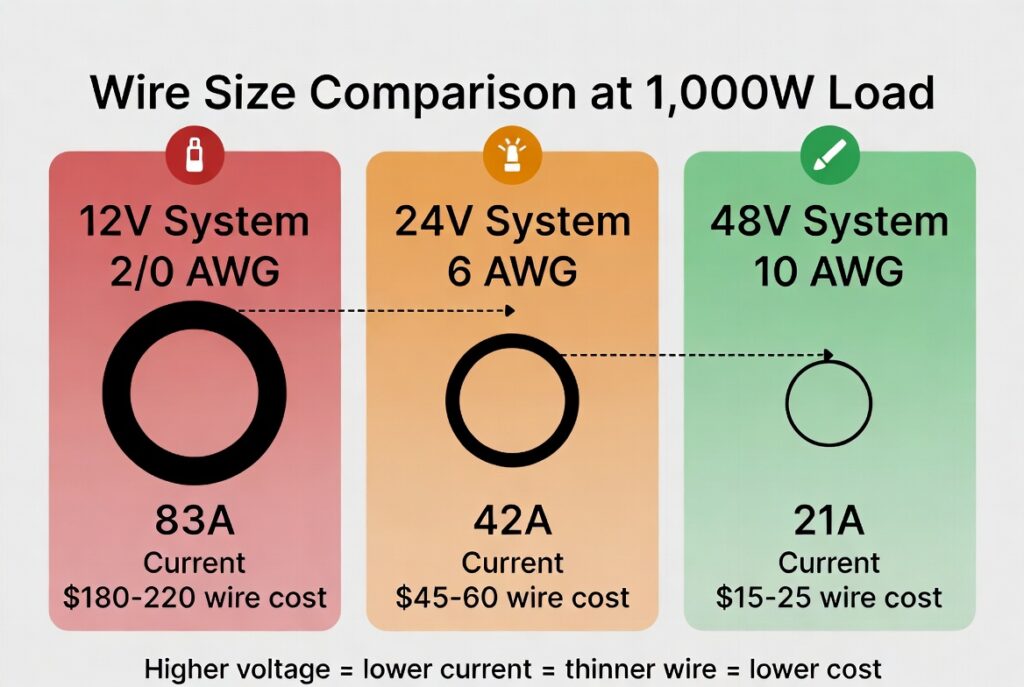
The math is simple. A 1,000W load at 12V draws 83A and requires 2/0 AWG copper cable. The same 1,000W load at 24V draws 42A and requires 6 AWG. At 48V, it draws 21A and requires 10 AWG. The wire gets thinner, cheaper, and easier to handle as voltage increases. The voltage drop decreases proportionally. The heat generated at every terminal and busbar connection decreases with it.
Most beginners default to 12V because RV accessories run on 12V and the entry-level components seem cheaper. The wire cost on anything beyond a 15-foot run erases that savings immediately. For Ontario cottage and cabin builds with 30 to 100 foot cable runs, 48V is not optional. It is the only way to make the wiring math work without spending more on copper than on panels. For a broader overview, see our solar generator Ontario guide.
The Wire Cost Comparison and Why Higher Voltage Saves Money
The table below compares wire cost for the same 1,000W load across all three system voltages on a 15-foot cable run. The cost difference between 12V and 48V is 10 to 1. On longer runs, the gap widens further because thicker wire costs more per foot and the run requires more feet of it.
| System Voltage | Current at 1,000W | Required Wire Gauge | Wire Cost (15-foot run) |
|---|---|---|---|
| 12V | 83A | 2/0 AWG | $180 to $220 CAD |
| 24V | 42A | 6 AWG | $45 to $60 CAD |
| 48V | 21A | 10 AWG | $15 to $25 CAD |
On a 60-foot run, the 12V wire cost climbs to approximately $800 CAD. The 48V wire cost for the same run stays under $100 using standard 10 AWG solar cable. That $700 savings on wire alone often exceeds the price difference between a 12V inverter and a 48V inverter-charger. For the full wire gauge chart by distance, see our wire gauge solar panels guide.
12V vs 24V vs 48V Solar System Characteristics and What Each Voltage Handles
A 12V system is best for builds under 400W with cable runs under 15 feet. Most portable devices and RV accessories including 12V fridges, fans, and lights run on 12V natively without a DC-DC converter. The trade-off is the highest current draw for any given wattage, which means the thickest wire, the most voltage drop, and the hottest connections. The maximum practical system size at 12V is 400W to 800W before wire costs and voltage drop make it impractical.
A 24V system halves the current versus 12V for the same wattage. This halves the voltage drop on the same wire and cuts wire costs by more than half. The sweet spot is 400W to 1,500W systems in small cabins, large vans, and medium off-grid builds. Fewer accessories run natively on 24V, but the efficiency gain on every conductor in the system more than compensates.
A 48V system is the professional standard for permanent installations. It carries one quarter the current of a 12V system for the same wattage, which means the thinnest wire, the least voltage drop, and the coolest connections. Most modern inverter-chargers including the Victron MultiPlus-II are designed for 48V. Systems above 2,000W require 48V. The 12v vs 24v vs 48v solar system decision at this level is not a preference. It is a requirement.
How to Build a 48V Battery Bank from 12V Batteries
Wire four identical 12V batteries in series by connecting the positive terminal of one battery to the negative terminal of the next in a chain. Each battery adds its voltage. Four Battle Born 100Ah LFP batteries at 12.8V each produce 51.2V nominal in series. The total capacity remains 100Ah but the voltage quadruples. This gives you a 48V battery bank from four standard 12V building blocks.
All four batteries must be the same brand, capacity, chemistry, age, and state of charge. Never mix old and new batteries in a series string. A weaker battery in a series chain limits the entire bank to its reduced capacity and ages faster under the imbalance. For long-term battery health, see our solar battery lifespan guide.
The Muskoka Distance Victory
A client in Muskoka was mounting his solar panels on a rock outcrop approximately 60 feet from his battery shed. He originally wanted a 12V system because he found an inexpensive 12V inverter. He had not calculated the wire cost for moving 1,000W of power 60 feet at 12V. The 83A current draw at 12V requires 2/0 AWG copper cable to stay under the 3 percent voltage drop threshold on a 60-foot run.
The 2/0 AWG copper cable for a 60-foot run with return would cost approximately $800 CAD for wire alone. That $800 wire cost was more than the inverter he was trying to save money on. We pivoted to a 48V system, which dropped the current from 83A to 21A. The 21A current allowed standard 10 AWG solar cable at under $100 for the same 60-foot run. The wire cost savings alone were $700.
He was trying to buy a cheap engine but did not realize the fuel line to feed it would cost more than the engine itself. Switching to 48V was like upgrading from a carbureted system to modern fuel injection. The delivery system became smaller, cheaper, and more efficient. The 12v vs 24v vs 48v solar system decision saved him $700 on wire and delivered more power to the battery with less loss.
The Rockwood 12V Workshop Regret
A DIYer in Rockwood built a 12V battery bank to power his entire workshop. He had three 2,000W inverters all pulling from the same 12V busbar. At full draw, the combined load was 6,000W. At 12V, that is 500A flowing through the busbar and wiring.
The busbars became hot enough to melt their plastic insulation covers. Every time he turned on a power saw, the voltage sag was so severe that his LED lights dimmed and his computer rebooted from the momentary dip. The 12V wiring was carrying 500A continuously through connections rated for 250A. The resistance at every bolt and terminal was generating heat that accumulated over hours of shop use.
He was trying to tow a fifth-wheel trailer with a go-kart engine. The battery bank had the energy storage, but the 12V system did not have the voltage to move that energy without overheating every conductor in the path. He scrapped the 12V inverters and rewired the entire workshop to 48V. At 48V, the same 6,000W load draws 125A instead of 500A. The busbars run cool and the voltage sag disappeared completely.
12V vs 24V vs 48V Solar System Verdict and Which Voltage Fits Your Ontario Build
This 12v vs 24v vs 48v solar system verdict splits into three profiles based on system size, cable run distance, and load type.
- Van, RV, and weekend camper owners with systems under 400W and cable runs under 15 feet should choose 12V. Most RV accessories including 12V fridges, fans, and lights run natively on 12V. No DC-DC converter needed. Keep cable runs short and use 10 AWG or thicker wire for battery-to-inverter connections. For seasonal builds, see our off-grid cabin guide.
- Small cabin and large van owners with 400W to 1,500W systems should choose 24V. It halves the current versus 12V, which reduces voltage drop and wire cost on every run. Good for cable runs up to 30 feet without excessive wire gauge. Use a Victron MPPT 100/50 which auto-detects 12V, 24V, or 48V battery banks.
- Full-time off-grid homes, workshops, and cottage builds with systems above 1,000W or cable runs over 30 feet should choose 48V. Use a Victron MultiPlus-II inverter-charger. Wire four Battle Born 100Ah LFP batteries in series for 51.2V nominal. Use a Victron Lynx Distributor for centralized busbar and fuse management. For 48V overcurrent protection, see our solar system fusing guide.
Frequently Asked Questions
Q: Can I mix voltages in the same system?
A: No. Your battery bank, charge controller, and inverter must all be designed for the same system voltage. Connecting a 12V battery bank to a 48V inverter will damage or destroy the inverter. Always verify voltage compatibility on every component before purchasing.
Q: How do I make 48V from 12V batteries?
A: Wire four identical 12V batteries in series by connecting the positive terminal of one battery to the negative terminal of the next in a chain. The voltages add, so four batteries at 12.8V each produce 51.2V nominal. All four batteries must be the same brand, capacity, chemistry, and age to prevent imbalance.
Q: Are 48V systems more dangerous than 12V?
A: Yes. 48V has enough electrical potential to sustain an arc across a gap, which 12V generally cannot. Always use insulated tools and wear eye protection when working on 48V connections. Proper DC-rated fuses and breakers are mandatory at 48V because the arc energy is significantly higher than at 12V.
NEC Article 690 covers photovoltaic system conductor sizing including voltage classifications, ampacity requirements, and voltage drop calculations for 12V, 24V, and 48V DC systems. All conductors must be sized to handle the maximum system current without exceeding ampacity ratings. Current standards are published at nfpa.org.
CEC Section 64 governs DC system voltage classifications and conductor requirements for solar installations in Ontario. All systems must use properly rated overcurrent protection devices matched to the system voltage. The Electrical Safety Authority (ESA) provides current compliance guidelines and DC wiring safety resources at esasafe.com.
This build is engineered within the 48V DC Safety Ceiling. Diagnostic logic is based on 20+ years of technical service experience. All structural and electrical installations must be verified by a Licensed Professional and comply with your Local AHJ. See our legal and safety disclosure for full scope.
About the Author
Robert Bertrand spent 20 years as a service advisor in the automotive industry (Lexus and Nissan), where precision diagnostics, wiring integrity, and documentation standards were non-negotiable. He brings that same technical discipline to GridFree Guide, where he researches, tests, and documents off-grid solar systems for Ontario conditions. Based in Rockwood, Ontario, every article is built on verified specifications, manufacturer data, and the real-world climate constraints of Canadian off-grid living.
As an Amazon Associate I earn from qualifying purchases. This site also contains affiliate links to other products and services. GridFree Guide earns a small commission at no extra cost to you.