
Wire Gauge Solar Panels Need and Why Voltage Drop Is the Hidden Efficiency Killer
Selecting the correct wire gauge solar panels require is a balance between safety and efficiency because every foot of undersized wire throws away power as heat. DC solar systems operating at 12V to 48V are far more sensitive to voltage drop than household AC at 120V. A 3 percent drop at 12V is only 0.36V. Thin wire on a long run loses that fraction of a volt easily, and the power it represents converts to heat inside the wire insulation instead of charge in the battery.
The industry standard is a maximum 3 percent voltage drop from panels to charge controller. That means at least 97 percent of the power generated at the panel must arrive at the controller. As the distance between panels and controller increases, the wire thickness must increase to keep resistance low. A 400W array on a 40-foot run of undersized wire can deliver only 320W to the controller. That 80W loss is invisible unless you measure the actual input at the controller display.
Higher system voltage solves the problem without thicker wire. Doubling the system voltage from 12V to 24V halves the current for the same wattage. Half the current means half the voltage drop on the same wire. This article covers the wire gauge solar panels chart by distance and system voltage, the 3 percent rule, and why the 48V approach saves money on every long run. For a broader look at Ontario solar, see our solar generator Ontario guide.
The 3 Percent Voltage Drop Rule and Why Distance Determines Wire Thickness
The 3 percent rule is straightforward. At least 97 percent of panel power must reach the controller. Every foot of wire adds resistance. The longer the run, the more resistance accumulates. The more resistance, the more voltage the wire drops. The only way to reduce resistance on a given run length is to increase the wire cross-section, which means going to a thicker gauge.
Higher system voltage provides a second solution. At 12V, a 400W array draws approximately 33A. At 48V, the same 400W array draws approximately 8.3A. That is one quarter the current on the same wire. Lower current means proportionally lower voltage drop. A 100-foot run at 12V requires 1 AWG copper. The same run at 48V uses 10 AWG. The wire cost difference is 70 percent or more. For Ontario cottage builds with long panel-to-controller distances, wiring panels in series to raise voltage is the most cost-effective solution.
Wire Gauge Solar Panels Chart by Distance and System Voltage
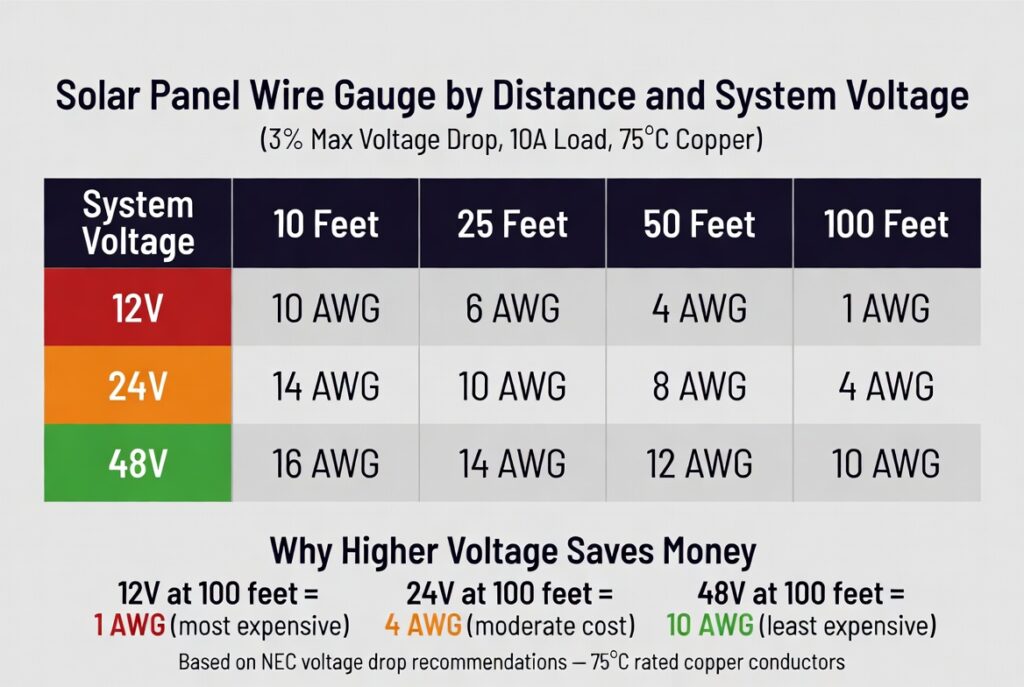
The table below shows the correct wire gauge for a 10A current load at three system voltages across four distances. All gauges are sized to stay under the 3 percent voltage drop threshold using standard 75 degrees C rated copper conductors.
| System Voltage | 10 Feet | 25 Feet | 50 Feet | 100 Feet |
|---|---|---|---|---|
| 12V | 10 AWG | 6 AWG | 4 AWG | 1 AWG |
| 24V | 14 AWG | 10 AWG | 8 AWG | 4 AWG |
| 48V | 16 AWG | 14 AWG | 12 AWG | 10 AWG |
The 48V row demonstrates why series wiring panels to increase voltage saves money on long runs. At 48V, a 100-foot run uses 10 AWG solar cable, which is affordable and easy to handle. At 12V, the same 100-foot run requires 1 AWG, which costs 5 times as much and is difficult to bend around corners. The wire gauge solar panels need scales directly with both current and distance.
MC4 Connector Quality and Why a Loose Joint Wastes More Power Than Bad Wire
A corroded or loose MC4 connection creates more resistance than 20 feet of undersized wire. The resistance concentrates at a single point instead of distributing across a cable length. This causes localized heating that can melt the connector housing and damage the panel junction box. A loose MC4 joint does not show on the controller display as a voltage drop error because the controller only sees the net result.
Use quality MC4 branch connectors rated for the current in your system. Inspect all MC4 joints annually for oxidation, heat discoloration, and loose fit. Replace any connector that shows browning or melting on the housing. A $5 connector replacement prevents a $500 panel junction box failure. For overcurrent protection on every conductor, see our solar system fusing guide.
The Muskoka Cottage Wire Upgrade Success
A client at a cottage near Muskoka had his solar panels mounted on a shed approximately 40 feet from his battery bank in the basement. He was using standard 10 AWG solar cable for the entire run. His 400W panel array was connected to a Victron MPPT 100/50 charge controller. He was frustrated that the controller display never showed more than 320W input even in full direct sun.
The problem was not the panels or the controller. The 10 AWG wire on a 40-foot run at 12V was dropping over 8 percent of the voltage before it reached the controller. That 8 percent loss translated to 80W of the 400W array output being converted to heat inside the wire instead of reaching the battery. After swapping to 4 AWG copper, the controller input jumped from 320W to 385W instantly.
Upgrading the wire was like swapping a clogged fuel filter for a high-flow unit. The engine was fine the entire time. The delivery system was restricting the flow. By spending $80 on thicker wire, he recovered 65W of power. That is the equivalent of adding a free Renogy 100W panel to his roof without buying one.
The Rockwood Hot Wire Hazard
A DIYer in Rockwood ran 30 amps of solar current through a 50-foot length of 14 AWG extension cord wire he had in his garage. He used it because it was available and he did not want to buy new cable. The wire was rated for 15A at 75 degrees C. He was pushing double the rated ampacity through the conductor.
The voltage drop was so severe that his Victron MPPT 100/30 would not enter bulk charge mode. The controller saw the incoming voltage as too low to begin charging. Additionally, the wire became physically hot to the touch along its entire 50-foot length. The resistance was converting solar energy into heat inside the wall of his camper rather than into battery charge.
He was trying to push a fire hose volume of water through a garden hose. The friction creates heat, and in a wooden camper wall, heat is the first step toward a fire. Replacing the 14 AWG wire with properly sized 6 AWG copper eliminated the heat and restored full charge controller operation. The correct wire gauge solar panels need depends on both the current and the distance, not just what wire is available in the garage. For more on charge speeds, see our solar panel charge time guide.
Wire Gauge Solar Panels Verdict and Which Gauge Fits Your Ontario Build
This wire gauge solar panels verdict splits into three profiles based on your cable run distance and system voltage.
- Van and RV owners with short cable runs under 15 feet should use standard 10 AWG solar cable. It handles up to 400W of panels at 12V on short runs. Keep runs short and direct. This is the simplest and cheapest wire gauge solar panels setup for mobile installations.
- Ground-mount and shed-mount owners with 25 to 50 foot runs need 6 AWG to 4 AWG at 12V to stay under the 3 percent drop. Alternatively, wire panels in series to increase system voltage to 24V or 48V and use 10 AWG to 8 AWG instead. The wire cost savings from higher voltage often pay for the series wiring effort within the first installation.
- Long-run cottage and cabin builders with 50 to 100+ foot runs should wire panels in series to 48V. At 48V, a 100-foot run uses 10 AWG, which is affordable and easy to handle. At 12V, the same run requires 1 AWG, which is expensive and difficult to bend. The 48V approach cuts wire cost by 70 percent or more on long runs and delivers nearly 99 percent of panel output to the controller.
Frequently Asked Questions
Q: Does wire color matter for solar?
A: Electrically no, but for safety and code compliance yes. Use red for positive and black for negative to prevent reverse polarity mistakes that can destroy the charge controller. Consistent color coding also makes troubleshooting faster during an outage when you are working by flashlight.
Q: Can I use aluminum wire for solar panel runs?
A: Copper is strongly recommended because it has lower resistance per foot than aluminum. If you use aluminum, increase the wire gauge by two sizes to match copper’s performance. Aluminum also requires special connectors to prevent galvanic corrosion at the connection points.
Q: Is welding cable acceptable for solar wiring?
A: Yes. Welding cable uses pure copper stranding and is highly flexible, making it excellent for battery and controller connections. It is not UV-rated for outdoor use, so run it through conduit or protect it from direct sun exposure. For outdoor panel runs, use UV-rated solar cable instead.
NEC Article 690 covers photovoltaic system conductor sizing including voltage drop limits and ampacity requirements for solar panel wiring. Conductors must be sized to limit voltage drop to 3 percent or less between panels and controller. Current standards are published at nfpa.org.
CEC Section 64 governs photovoltaic conductor sizing and voltage drop requirements in Ontario. All solar wiring must comply with ESA guidelines for conductor ampacity and maximum voltage drop. The Electrical Safety Authority (ESA) provides current compliance guidelines and safe wiring resources at esasafe.com.
This build is engineered within the 48V DC Safety Ceiling. Diagnostic logic is based on 20+ years of technical service experience. All structural and electrical installations must be verified by a Licensed Professional and comply with your Local AHJ. See our legal and safety disclosure for full scope.
About the Author
Robert Bertrand spent 20 years as a service advisor in the automotive industry (Lexus and Nissan), where precision diagnostics, wiring integrity, and documentation standards were non-negotiable. He brings that same technical discipline to GridFree Guide, where he researches, tests, and documents off-grid solar systems for Ontario conditions. Based in Rockwood, Ontario, every article is built on verified specifications, manufacturer data, and the real-world climate constraints of Canadian off-grid living.
As an Amazon Associate I earn from qualifying purchases. This site also contains affiliate links to other products and services. GridFree Guide earns a small commission at no extra cost to you.