
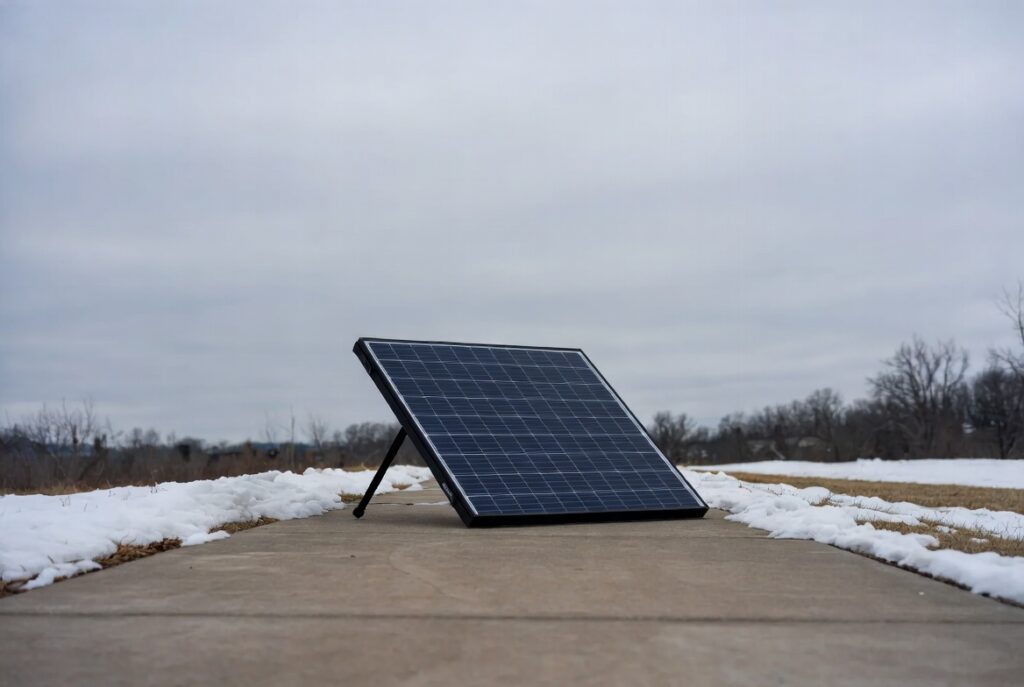
Bluetti solar panels sit in the mid-range of Ontario’s off-grid market. They cost more than Renogy but avoid the lock-in that defines EcoFlow. They use mono PERC cells with 22 to 23.4 percent efficiency, matching or beating most budget options. At $1.40 to $1.80 per watt, the premium buys fit and finish, not extra output.
The defining advantage of Bluetti solar panels is MC4 connector compatibility. Unlike EcoFlow’s proprietary XT60 ports, Bluetti panels connect to any charge controller out of the box. That means your panel investment survives a system upgrade. You never pay for adapters or rewiring when you outgrow a power station.
This review covers the 200W portable and 350W rigid panels tested through Ontario winters and summer heat. If you are comparing Bluetti solar panels to the best solar panels for Ontario, the answer depends on your setup.
| Spec | Bluetti 200W Portable | Bluetti 350W Rigid | Renogy 100W Rigid |
|---|---|---|---|
| Cell type | Mono PERC | Mono PERC | P-type mono PERC |
| Efficiency | 23.4 percent | 22 percent | 21.4 percent |
| Connector | MC4 standard | MC4 standard | MC4 standard |
| Cost per watt | $1.40 to $1.80 | $1.40 to $1.80 | $1.05 to $1.20 |
| February output (1.5 PSH) | ~246 Wh/day | ~525 Wh/day | ~127 Wh/day |
| August output (5.5 PSH) | ~880 Wh/day | ~1,540 Wh/day | ~450 to 500 Wh/day |
| Construction | Foldable, kickstand | Tempered glass, aluminum | Tempered glass, aluminum |
Where Bluetti solar panels sit in the Ontario market
Bluetti solar panels cost $1.40 to $1.80 per watt at current Ontario pricing. That places them above Renogy solar panels at $1.05 to $1.20 and below EcoFlow solar panels at $1.80 to $2.20. The cell technology is the same mono PERC architecture across all three brands. The price difference comes from build quality, packaging, and connector design.
If you already own a Bluetti station, these panels integrate cleanly via MC4. If building from scratch on a budget, Renogy delivers more watts per dollar. Bluetti solar panels earn their place for owners who want mid-range quality with no proprietary compromise. The value proposition is real, but it is conditional on your starting point.
The MC4 advantage over proprietary connectors
Bluetti solar panels use industry-standard MC4 connectors on both the 200W portable and 350W rigid models. That means they connect to any Victron, Morningstar, or Outback charge controller without adapters. A Victron MPPT 100/50 accepts Bluetti panels directly. No rewiring, no adapter cables, no wasted money.
EcoFlow’s XT60 connector forces owners to buy MC4 adapters when they leave the ecosystem. That adds $30 to $50 per panel in adapter costs plus a new failure point at every connection. Bluetti solar panels avoid that problem entirely. The MC4 standard is the quiet advantage that protects your investment long term.
The 200W portable panel and 23.4 percent efficiency
The Bluetti 200W portable uses mono PERC cells at 23.4 percent efficiency. That is the highest cell efficiency in the entry-level portable class. Understanding solar panel efficiency at the cell level explains the output gap per square metre. The foldable design with integrated kickstand deploys in under two minutes.
On clear February days at 1.5 PSH angled at 55 degrees, the 200W portable delivered 246 Wh. In July at 5.5 PSH, output reaches approximately 880 Wh per day. The higher efficiency means a smaller physical footprint per watt. If portability and compactness are priorities, this panel justifies the cost over Renogy.
The 350W rigid panel production from Bluetti solar panels
The Bluetti 350W rigid panel uses mono PERC cells at 22 percent efficiency with tempered glass and an aluminum frame. It is built for permanent roof or ground-mount installation in Ontario conditions. Two panels produced 3,080 Wh daily in August at 5.5 PSH. That covers lights, phone charging, a mini fridge, and a fan at a seasonal cottage.
February drops each panel to approximately 525 Wh per day at 1.5 PSH. That is enough for maintenance charging and basic LED lighting. It will not sustain continuous loads through multi-day grey streaks. Two Bluetti 350W panels cost approximately $1,200 for 700W total, delivering solid seasonal output at the mid-range price point.
The Grey County ice storm deployment
During a 36-hour outage in Grey County, I deployed a single Bluetti 200W portable panel on my cleared walkway. I angled it at 55 degrees to catch the low February sun. The MC4 connectors plugged directly into the Bluetti Elite 200 V2 station without adapters. I needed the fridge circuit running until grid power returned.
On the first clear day at 1.5 PSH, the Victron SmartShunt logged 246 Wh from the single panel. That kept the fridge compressor cycles covered through the overnight hours. The 23.4 percent cell efficiency captured weak winter sun more effectively per square metre than a comparable Renogy. The MC4 connectors required no special cables or configuration.
The system worked reliably for a single-appliance emergency backup. However, the $549 panel plus $1,299 station totalled $1,848 for 200W of solar input. Two Renogy 100W Monocrystalline Panels plus a Victron MPPT 100/30 and 100Ah LFP deliver the same output for approximately $1,100. The $748 premium bought build quality and convenience, not more energy.
The Haldimand County cottage transition
In Haldimand County, a cottage owner installed two Bluetti 350W rigid panels on a south-facing roof for summer weekend use. The panels fed a Bluetti AC200L station through the first season. August output averaged 3,080 Wh daily from the two-panel array at 5.5 PSH. That covered all weekend loads comfortably without supplemental charging.
The following year, the owner expanded to a full Victron system with an MPPT 100/50 for year-round use. The Bluetti 350W panels connected directly via their standard MC4 connectors. No adapters were needed and no rewiring was required. The transition took less than an hour of cable work.
The $1,200 spent on two Bluetti panels was not wasted when the owner left the ecosystem. Every dollar transferred to the new Victron system. The MC4 compatibility meant zero lost investment on the panel side. That clean transition is the genuine advantage Bluetti solar panels hold over EcoFlow in the Ontario market.
CEC and NEC code requirements for Bluetti installations
The Canadian Electrical Code Section 64 governs all photovoltaic installations in Ontario. Even a portable Bluetti panel deployment requires awareness of grounding and overcurrent protection standards. The Electrical Safety Authority at esasafe.com administers Ontario’s inspection and permitting process. Permanent 350W rigid installations need the same ESA permits as any other panel brand.
NEC Article 690 covers DC wiring, fusing, and disconnect requirements on the American side. NFPA standards at nfpa.org provide the fire safety framework many Ontario builders reference. The MC4 connector standard does not change any code compliance requirements. All Bluetti solar panels installations must meet the same electrical standards as Renogy or EcoFlow systems.
Pro Tip: Before choosing between Bluetti and Renogy, ask whether you plan to upgrade your charge controller within two years. If the answer is yes, both brands use MC4 and transfer cleanly. Choose Renogy for more watts per dollar. Choose Bluetti only if you already own a Bluetti station and want matched build quality.
Bluetti solar panels verdict: mid-range value with no lock-in
- Bluetti station owners wanting matching panels: Bluetti solar panels integrate cleanly with AC200L, AC300, and EP500 via MC4. The build quality feels premium and the connectors are reliable. If you are staying inside the Bluetti product line, these are the correct match.
- Builders who might upgrade later: Bluetti solar panels retain full value when transitioning to a Victron or standalone system. The MC4 connectors transfer without adapters. This is the key advantage over EcoFlow at a similar price point.
- Budget-focused builders starting from scratch: Skip Bluetti and buy Renogy. You get more wattage per dollar with the same MC4 compatibility. The Renogy 100W rigid plus a Victron MPPT 100/50 delivers the best value in Ontario.
Frequently asked questions
Q: Are Bluetti solar panels worth the extra cost over Renogy?
A: Only if you value the higher build quality and already own a Bluetti station. Otherwise, Renogy delivers more watts per dollar with identical MC4 connectors. The difference is in packaging and fit, not in energy output.
Q: Can Bluetti panels work with Victron charge controllers?
A: Yes. Standard MC4 connectors work with any Victron charge controller natively. No adapters are needed and no firmware restrictions apply. The panels were designed to be universal, not locked into one brand.
Q: How much power does a Bluetti 350W panel produce in Ontario winter?
A: Approximately 525 Wh per day at 1.5 PSH in February. That is enough for maintenance charging and basic LED lighting. It will not sustain continuous loads through multi-day grey streaks without supplemental charging.
This build is engineered within the 48V DC Safety Ceiling. Diagnostic logic is based on 20+ years of technical service experience. All structural and electrical installations must be verified by a Licensed Professional and comply with your Local AHJ. See our legal and safety disclosure for full scope.
About the Author
Robert Bertrand spent 20 years as a service advisor in the automotive industry (Lexus and Nissan), where precision diagnostics, wiring integrity, and documentation standards were non-negotiable. He brings that same technical discipline to GridFree Guide, where he researches, tests, and documents off-grid solar systems for Ontario conditions. Based in Rockwood, Ontario, every article is built on verified specifications, manufacturer data, and the real-world climate constraints of Canadian off-grid living.
As an Amazon Associate I earn from qualifying purchases. This site also contains affiliate links to other products and services. GridFree Guide earns a small commission at no extra cost to you.