
The solar energy bill Ontario misunderstanding that left a Grey County homeowner with a $160 monthly Hydro One bill after installing a $20,000 10kW grid-tied system was not a solar system failure but a bill analysis failure: the system correctly eliminated the $60 monthly commodity charge, but the $85 delivery charge, $28 Global Adjustment, and $37 in HST and fixed charges continued unchanged because those components are tied to grid connection status, not electricity consumption. The Hydro One bill has four distinct components, and a grid-tied solar system reduces only one of them. Understanding this distinction before sizing a grid-tied system is the difference between a realistic payback calculation and a genuine surprise.
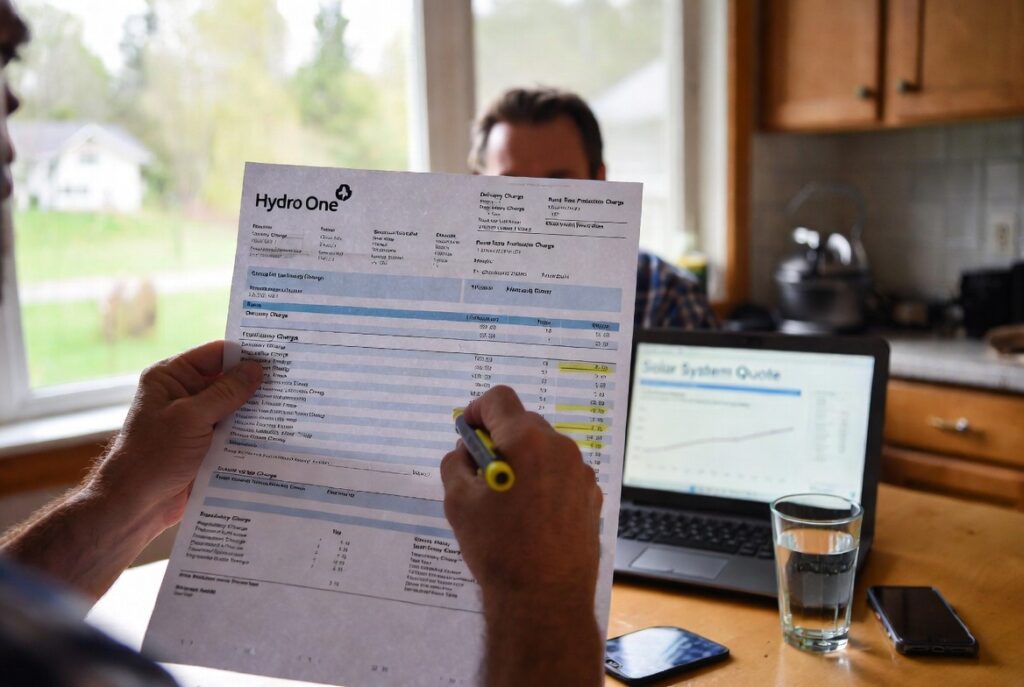
The Northumberland County owner who sat down with a $220 Hydro One bill and a highlighter spent 20 minutes marking which charges solar would reduce and which it would not. The commodity charge was $68. Every other line , $89 delivery, $28 Global Adjustment, $10 fixed service charge, $3 Debt Retirement , stayed regardless of solar production. The reducible portion was $68 out of $220. That solar energy bill Ontario analysis changed a $10,000 grid-tied investment decision into an off-grid investment that eliminated the entire $220 bill permanently.
The correct solar energy bill Ontario calculation is not total bill divided by system cost. It is commodity-only savings divided by system cost. For most rural Ontario properties that difference is the gap between a 12 to 28-year payback and a 4 to 8-year payback. Twenty minutes with a Hydro One statement and a highlighter is the most valuable solar analysis an Ontario homeowner can do before signing a contract. See our Ontario solar sizing guide before any solar energy bill Ontario system design.
The solar energy bill Ontario commodity charge: the only line item solar directly reduces
| Bill component | Typical amount (rural $220 bill) | Solar reduces this? | Off-grid eliminates this? |
|---|---|---|---|
| Commodity charge | $68 (31%) | Yes , directly | Yes |
| Delivery charge | $89 (40%) | No | Yes |
| Global Adjustment | $28 (13%) | Partially (scales with consumption) | Yes |
| Ontario Electricity Rebate | -$22 (credit) | Reduced when consumption drops | Eliminated |
| HST | $29 (13%) | Partially (on commodity portion) | Yes |
| Fixed service + DRC | $13 (6%) | No | Yes |
The solar energy bill Ontario commodity charge is the actual cost of electricity consumed at Time-of-Use rates ranging from approximately $0.087 per kWh off-peak to $0.130 per kWh on-peak. When solar panels are generating power, the home draws from them rather than the grid, and the commodity charge falls proportionally. This is the only line item solar production directly offsets. For a typical 1,000 kWh per month rural Ontario account, the commodity charge represents approximately 25 to 35 percent of the total bill , meaning it is typically $55 to $77 on a $220 total bill.
The commodity fraction matters for the ROI calculation because it sets the ceiling for grid-tied solar savings. A system that produces enough electricity to eliminate the commodity charge entirely still leaves 65 to 75 percent of the bill unchanged. When salespeople quote solar savings as a percentage of the total bill, they are using the wrong denominator. The correct savings figure is the commodity portion only, not the total. See our Ontario grid-tied solar guide for the complete grid-tied sizing and savings calculation.
The Grey County result: $20,000 grid-tied system reduced a $280 bill to $160, not zero
A Grey County homeowner had a $280 per month Hydro One rural residential account. The bill breakdown was approximately: commodity $60, delivery $85, Global Adjustment $28, Ontario Electricity Rebate minus $15, HST $37, Debt Retirement $3, fixed monthly charge $12. In late 2023, the homeowner installed a 10kW grid-tied solar array with an expected annual production of approximately 10,000kWh. At the TOU off-peak rate of approximately $0.087 per kWh, the estimated annual commodity savings were approximately $870. The homeowner expected a bill close to zero.
After installation the monthly bill dropped from $280 to approximately $160. The solar system eliminated the commodity portion of the bill , approximately $60 per month , but the $85 delivery charge, $28 Global Adjustment, $37 in HST calculated on the delivery and regulatory components, and $15 in fixed charges all remained unchanged. These components add up to approximately $165 per month regardless of how much solar the system produces. The homeowner was saving money, but the bill was not eliminated and would never be eliminated by adding more panels.
The solar energy bill Ontario payback calculation for this system: $60 per month in commodity savings equals $720 per year against a $20,000 system cost , a simple payback of approximately 27.8 years before maintenance and inverter replacement. The Grey County homeowner had calculated payback against the $280 total bill, which would have produced a 5.9-year payback estimate. The correct commodity-only calculation produced 27.8 years. The difference was the delivery charge and regulatory fees that solar cannot touch.
The solar energy bill Ontario delivery charge: why $80 to $120 per month persists after solar
The solar energy bill Ontario delivery charge covers Hydro One’s cost of owning, maintaining, and operating the poles, wires, transformers, and meters that deliver electricity to the property. It includes a fixed distribution charge of approximately $8 to $15 per month plus a variable transmission charge of approximately $0.013 per kWh. Rural Ontario properties with long service lines typically pay $80 to $120 per month in total delivery charges. This charge exists as long as the meter is connected to the grid , reducing consumption to zero by producing all electricity from solar does not eliminate or reduce the delivery charge.
The only way to eliminate the delivery charge is to physically disconnect from the grid and go off-grid. Net metering credits offset the commodity charge but not delivery. A grid-tied system that produces more than it consumes in a month earns net metering credits , but those credits apply against the commodity rate, leaving the delivery charge, Global Adjustment, fixed charges, and HST on non-commodity components unchanged. For a rural Ontario property paying $89 per month in delivery charges, that is $1,068 per year in permanent grid costs that no amount of solar panels can reduce while the meter remains connected.
Regulatory charges: Global Adjustment, Ontario Electricity Rebate, and Debt Retirement explained
The Global Adjustment (GA) is a variable monthly charge covering the cost of Ontario’s contracted electricity supply, including nuclear, wind, and solar generation contracts. It typically ranges from approximately $0.02 to $0.08 per kWh and shifts monthly based on the OEB’s settled costs. The Ontario Electricity Rebate (OER) is a government credit of approximately 11.7 percent applied to the pre-tax subtotal, reducing the bill. The Debt Retirement Charge (DRC) is a legacy fee from Ontario Hydro’s historical debt at approximately $0.003 per kWh, currently scheduled to end. These three components scale slightly with consumption but are largely tied to grid connection status.
The HST interaction with solar is worth understanding. Solar reduces the commodity charge, and that reduction also eliminates the 13 percent HST on the saved commodity amount , approximately $7.80 in HST savings for every $60 in commodity savings. However, HST continues to apply to delivery charges, the Global Adjustment, and fixed connection fees regardless of solar production. The net result is that a $60/month commodity reduction produces approximately $67.80/month in total bill reduction ($60 commodity plus $7.80 HST), not $60 flat.
Why the ROI calculation is often wrong: total bill versus commodity-only savings
The correct ROI calculation for a grid-tied Ontario solar system uses the commodity-only savings as the denominator, not the total monthly bill. If monthly commodity is $68 and solar reduces it by 90 percent ($61.20 per month), annual savings are approximately $734. Against a $10,000 system cost, simple payback is approximately 13.6 years before maintenance and inverter replacement at year 10. The total bill was $220 per month , if someone calculated ROI against $220, the payback estimate would be approximately 3.8 years. The gap between 3.8 years and 13.6 years is the delivery charge and regulatory fees.
The off-grid alternative genuinely produces the lower payback because it eliminates the entire bill , commodity, delivery, regulatory, HST, and fixed connection fees all go to zero permanently. At $220 per month total elimination, a $10,000 off-grid investment has a 3.8-year payback. This is the solar energy bill Ontario calculation that shifted the Northumberland County decision from grid-tied to off-grid. See our Ontario solar payback guide for the complete ROI calculation framework.
The Northumberland County decision: $68 reducible versus $130 fixed changed a $10,000 investment
A Northumberland County owner received a $220 Hydro One bill and sat down to read each line for the first time. The bill showed: commodity $68, delivery $89, Global Adjustment $28, Ontario Electricity Rebate minus $22, HST $29, Debt Retirement $3, fixed service charge $10. The owner had been considering a $10,000 grid-tied solar kit after seeing solar advertisements quoting a 5-year payback. The advertised payback was calculated against the $220 total bill , not the $68 commodity portion.
Working through the bill with a highlighter, the owner marked commodity $68 as the only line solar would directly reduce. Every other charge , $89 delivery, $28 Global Adjustment, $10 fixed service charge, $3 Debt Retirement , remained regardless of solar production. The Ontario Electricity Rebate credit of $22 would also be reduced as consumption dropped, netting out part of the commodity savings. Net reducible by grid-tied solar: approximately $68 per month. Grid-connection fixed costs: approximately $130 per month. At $68 per month in savings, the $10,000 grid-tied system payback was approximately 12.2 years.
The delivery charge of $89 per month is $1,068 per year , a permanent cost of grid connection that would continue for the life of the property regardless of how many panels were installed. The owner redirected the $10,000 budget from a grid-tied kit to an off-grid system: Cerbo GX, SmartShunt, MPPT 100/50, and a Renogy panel array. Going off-grid eliminated the entire $220 monthly bill permanently. The solar energy bill Ontario analysis that took 20 minutes with a highlighter changed a 12.2-year payback into a 3.8-year payback.
NEC and CEC: Ontario permit requirements for grid-tied and off-grid solar installations
Grid-tied solar installations in Ontario require an ESA permit under CEC Section 64 before installation begins. The permit covers the AC inverter connection to the utility grid, net metering meter installation, and all associated wiring. Hydro One also requires a separate Net Metering Application and Connection Agreement before a grid-tied system can export power. The ESA permit and the Hydro One agreement are separate processes , both must be completed before the system can legally operate. Contact the NFPA at nfpa.org for current NEC requirements applicable to Ontario grid-tied solar installations.
Off-grid solar installations also require an ESA permit under CEC Section 64 for any permanently wired components. An off-grid system that includes a permanent inverter, fixed battery bank, and hardwired AC distribution requires a full ESA permit regardless of the absence of a utility connection. The permit inspection confirms that the installation meets the Ontario Electrical Safety Code for standalone solar power systems. A system that disconnects from Hydro One must also formally notify Hydro One and have the grid meter removed or sealed. Contact the Electrical Safety Authority Ontario at esasafe.com before beginning any solar energy bill Ontario off-grid transition.
Pro Tip: Before getting a solar quote, spend 10 minutes with your most recent Hydro One bill. Find the commodity charge line and write it down. Find the delivery charge line and write it down. Divide the commodity charge by the total bill , that percentage is the maximum fraction of your bill that grid-tied solar can reduce. If the commodity is 30 percent of the total and the delivery is 40 percent, grid-tied solar can reduce your bill by at most 30 percent regardless of how large the system is. The Northumberland County owner found that their commodity was $68 out of $220 total (31 percent). That single calculation changed the entire investment decision.
The solar energy bill Ontario verdict: calculate ROI against commodity only, not the total bill
- Ontario homeowner considering grid-tied solar: calculate the commodity-only portion of the bill before getting quotes. If monthly commodity is $60 to $80, the grid-tied payback at $10,000 system cost is 10 to 14 years. If the delivery charge is $80 to $100 per month, compare that to the full off-grid alternative before deciding. The Grey County result: a $20,000 system reduced a $280 bill to $160 because the $85 delivery charge and $37 in regulatory/HST continued unchanged. The correct solar energy bill Ontario payback was 27.8 years, not the 5-year estimate calculated against the total bill.
- Ontario rural property owner with a monthly Hydro One bill over $200: highlight the bill line by line before making any decision. Mark commodity as the only line grid-tied solar reduces directly. Mark delivery, Global Adjustment, and fixed charges as lines only off-grid eliminates. Calculate payback for both scenarios. The Northumberland County result: $68 commodity reducible versus $130 fixed produced a 12.2-year grid-tied payback versus a 3.8-year off-grid payback on the same $10,000 budget. A Cerbo GX and SmartShunt-based off-grid system eliminated the entire bill.
- Ontario owner already on grid-tied solar with a persistent $100-plus monthly bill: the remaining bill cannot be reduced by adding more panels. The delivery charge, Global Adjustment, fixed service charge, and their associated HST will continue regardless of array size. The only path to a zero monthly bill is disconnecting from the grid entirely. Before committing to that decision, review the solar energy bill Ontario comparison: total off-grid system cost divided by total current monthly bill versus total grid-tied cost divided by commodity-only monthly savings. The off-grid math is usually better than it looks from inside a grid-tied system.
Frequently Asked Questions
Q: Why is my Hydro One bill still high after installing solar panels in Ontario?
A: A grid-tied solar system in Ontario reduces only the commodity charge , the actual cost of kWh consumed , which typically represents 25 to 35 percent of a rural Hydro One bill. The delivery charge, Global Adjustment, fixed service charges, Debt Retirement Charge, and the HST calculated on non-commodity components all continue unchanged regardless of how much solar the system produces. The Grey County result confirmed this precisely: a 10kW system eliminated $60 per month in commodity charges but left $165 per month in delivery and regulatory charges untouched, reducing a $280 bill to $160 rather than near zero.
To eliminate the delivery and regulatory charges, the property must disconnect from the grid entirely and go off-grid. Adding more solar panels to a grid-tied system cannot reduce those components.
Q: What portion of my Ontario electricity bill does solar actually reduce?
A: Grid-tied solar in Ontario directly reduces only the commodity charge, which is typically 25 to 35 percent of the total Hydro One bill for rural Ontario residential accounts. On a $220 monthly bill the commodity portion is approximately $68. That is the maximum annual savings a grid-tied system can achieve , approximately $816 per year before accounting for net metering credits on excess production. The delivery charge at approximately $89 per month for rural properties, the Global Adjustment, and fixed connection charges make up the remaining 65 to 75 percent of the bill and are not reduced by solar production. Understanding this solar energy bill Ontario split is essential for an accurate payback calculation.
Using the total bill as the savings denominator produces payback estimates 3 to 7 times shorter than the commodity-only calculation.
Q: Is it better to go off-grid or grid-tied in Ontario to reduce electricity costs?
A: The correct answer depends on the delivery charge. For urban and suburban Ontario properties with delivery charges below $40 per month, grid-tied solar usually produces the better financial outcome because the fixed off-grid system costs are harder to recoup against a lower total bill. For rural Ontario properties with delivery charges of $80 to $120 per month, off-grid solar typically produces a faster payback because it eliminates the entire monthly bill rather than just the commodity portion. The Northumberland County calculation showed a 12.2-year payback for grid-tied versus a 3.8-year payback for off-grid, both on the same $10,000 budget.
The solar energy bill Ontario analysis starts with one question: is the delivery charge closer to $40 or closer to $100?
This build is engineered within the 48V DC Safety Ceiling. Diagnostic logic is based on 20+ years of technical service experience. All structural and electrical installations must be verified by a Licensed Professional and comply with your Local AHJ. See our legal and safety disclosure for full scope.
About the Author
Robert Bertrand spent 20 years as a service advisor in the automotive industry (Lexus and Nissan), where precision diagnostics, wiring integrity, and documentation standards were non-negotiable. He brings that same technical discipline to GridFree Guide, where he researches, tests, and documents off-grid solar systems for Ontario conditions. Based in Rockwood, Ontario, every article is built on verified specifications, manufacturer data, and the real-world climate constraints of Canadian off-grid living.
As an Amazon Associate I earn from qualifying purchases. This site also contains affiliate links to other products and services. GridFree Guide earns a small commission at no extra cost to you.