
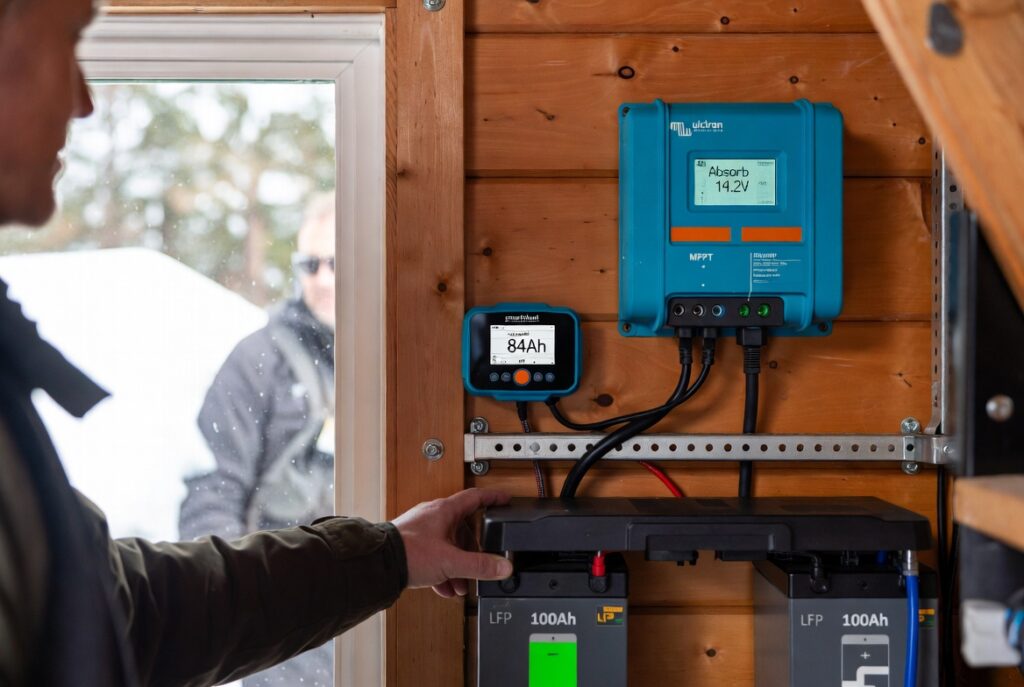
The battery balancing Ontario failure that leaves Parry Sound cabin owners staring at 84Ah on a 100Ah SmartShunt in May is not a failed cell or a warranty claim but three months of unequal cold-temperature self-discharge. The BMS now terminates the charge cycle the moment that one cell hits 3.65V, leaving the remaining cells at approximately 90 percent SoC and the bank reading full on voltage while functionally short of capacity. Battery balancing Ontario matters because LFP cells are not perfectly matched from the factory. Each cell has a slightly different internal capacity from manufacturing variance. Over time and temperature cycling, those differences produce measurable drift in individual cell voltages at full charge.
The Prince Edward County owner whose 200Ah parallel LFP bank drifted to consistent 184Ah charge termination after 6 months of cycling had a bank that looked healthy on total voltage but had a single cell in battery B triggering the BMS high-voltage cutoff 30 minutes before the rest of the cells reached full charge. Installing an active balancer across the two parallel battery terminals restored the bank to 198Ah after 4 cycles. The Parry Sound owner whose 100Ah Battle Born LFP bank showed 84Ah after winter storage recovered 96Ah after 3 days of extended absorb hold. The passive BMS balancers completed their work with sustained absorb voltage, not hardware replacement.
Both results share the same root cause and the same fix: the BMS needs sustained time at the absorb voltage to complete passive cell equalization. Cutting absorb short , either through an aggressive absorb timer or by allowing early float transition , prevents the balancers from finishing. The battery balancing Ontario top-balance protocol is not complicated, but it requires patience and an understanding of what the SmartShunt tail current reading is telling you. See our Ontario solar sizing guide before any battery balancing Ontario bank specification.
The battery balancing Ontario definition: cell drift, the BMS voltage cutoff, and why the bank reads full but isn’t
| Condition | SmartShunt reading | MPPT behaviour | Root cause |
|---|---|---|---|
| New balanced bank | 99 to 100Ah from 100Ah | Absorb completes normally, tail current drops to 2A | Cells matched at factory |
| Mild drift (5%) | 93 to 95Ah from 100Ah | Early float transition, absorb under 60 min | One cell 0.15V ahead of others |
| Ontario winter drift (10 to 15%) | 84 to 88Ah from 100Ah | Very early float, absorb under 45 min | 3-month cold storage imbalance |
| Cell failure (>20%) | Below 80Ah, plateau after 3 top-balance cycles | Absorb terminates immediately at bulk voltage | Physical cell damage, not drift |
Each LFP cell inside a 12V battery is a separate 3.2V nominal cell wired in series , 4 cells produce the 12.8V nominal bank voltage. Manufacturing variance gives each cell a slightly different internal capacity. When one cell reaches 3.65V full charge voltage before the others, the BMS terminates the entire charge cycle to protect that fastest cell. The remaining cells may be at only 90 percent SoC. The bank reads full on voltage but is functionally short of rated capacity. Cell drift is a normal characteristic of all lithium cell chemistry and is not a defect. New banks have minimal drift. Drift accumulates over years of cycling and temperature exposure.
Ontario cold storage at minus 15 to minus 20 degrees C over 3 months is one of the fastest battery balancing Ontario drift accelerators. A bank commissioned at 99Ah in April may terminate at 84Ah the following May after winter storage at minus 18 degrees C. The bank has not lost that capacity permanently , it has lost access to it because the BMS is stopping charge early to protect the fastest-drifting cell. The top-balancing protocol restores access to that capacity by giving the BMS passive balancers enough sustained absorb time to equalize all cells. See our Ontario LiFePO4 battery guide for the complete LFP cell chemistry and cycle life reference.
The battery balancing Ontario winter problem: why Ontario cold storage accelerates cell drift
Self-discharge rates vary across cells by age and temperature. A healthy young cell may self-discharge at approximately 0.5 percent per month at cold temperatures. An older cell or a cell with minor internal resistance differences may self-discharge at approximately 1 percent per month at the same temperature. Over a 3-month Ontario winter at minus 15 to minus 20 degrees C, that 0.5 percent per month difference accumulates to a 1.5 percent imbalance across the bank. The BMS must now correct this imbalance at the next absorb cycle before all cells can reach full charge simultaneously.
The spring power-up sequence for an Ontario off-grid cabin exposes the winter drift immediately. The first charge cycle terminates early. The MPPT 100/50 transitions to float within 30 to 45 minutes of reaching bulk voltage. The SmartShunt shows Ah significantly below the previous spring baseline. The bank is not failing , it is starting the season with accumulated winter drift that the BMS passive balancers need sustained absorb voltage to correct. Running the top-balance protocol for 2 to 3 full cycles in the first week of spring operation recovers the lost capacity before the high-production months begin.
Passive balancing versus active balancing: how the BMS corrects cell drift
Passive balancing uses the BMS resistive dissipation circuit to bleed excess charge from the highest cell as heat during the absorb stage. Dissipation current is typically 50 to 200 milliamps. On a 100Ah bank with 5 percent cell drift, passive balancing at 100 milliamps takes many hours of sustained absorb hold to complete equalization. This is precisely why cutting absorb short , by setting an overly aggressive absorb timer or allowing early float transition , prevents the passive balancers from finishing. The bank enters each subsequent charge cycle with the same uncorrected drift.
Active balancing moves charge from the highest cell to the lowest cell rather than dissipating it as heat. Transfer current is typically 1 to 5A, which is 10 to 50 times faster than passive balancing dissipation. Active balancing is most valuable in parallel banks where one battery has drifted relative to another, as the Prince Edward County result confirmed. It adds approximately $20 to $80 in hardware cost and some wiring complexity, but corrects significant drift in 4 to 6 cycles rather than the 3 to 4 weeks passive balancing alone might require for a heavily drifted parallel bank. See our Ontario BMS battery protection guide for the full BMS protection logic reference.
The top-balancing protocol: extended absorb hold, tail current confirmation, and cycle count
The top-balancing protocol starts in VictronConnect. Set the MPPT absorb voltage to 14.2V and extend the absorb timer to 4 to 6 hours , well beyond the default setting that allows early float transition. The extended timer prevents the MPPT from dropping to float before the BMS passive balancers have completed equalization. Run the bank through a full discharge to 20 percent SoC, then a full charge to 100 percent SoC. Hold absorb until the SmartShunt tail current drops below 1A. That is the completion signal , all cells have reached equilibrium at the absorb voltage.
Most Ontario winter drift corrects within 2 to 3 full top-balance cycles. The SmartShunt capacity reading after each cycle is the progress tracker.
A bank recovering from 84Ah to 88Ah to 93Ah across 3 cycles is responding correctly to the battery balancing Ontario protocol. A bank that does not show meaningful improvement after 3 full cycles has a cell with physical damage rather than drift. The SmartShunt capacity plateau after 3 cycles is the signal to investigate individual cell voltages with a multimeter during absorb , a cell stuck well below 3.65V while the others complete charge indicates a failed cell rather than drift. See our Ontario battery charging guide for the complete bulk, absorb, and float stage reference.
The Parry Sound spring recovery: 84Ah to 96Ah in three cycles, zero parts
Last May, I powered up my off-grid camp in Parry Sound after a 3-month winter storage at minus 18 degrees C. My Battle Born 100Ah LFP bank was commissioned at 99Ah the previous April. The first charge cycle of the season showed the SmartShunt terminating at 84Ah. The second full cycle showed 81Ah. Both cycles had the MPPT transitioning to float within 45 minutes of bulk completion, well before the tail current reached 2A. One cell was hitting the 3.65V high-voltage cutoff while the others were still at 90 percent SoC.
The diagnostic was straightforward once I understood what the early float transition meant. The Cerbo GX absorb timer was set to 1 hour , long enough on a balanced bank but not nearly long enough for a bank with 3 months of cold storage drift. I extended the absorb timer to 6 hours in VictronConnect and ran 3 full charge cycles over 3 consecutive days, discharging to approximately 20 percent SoC each evening before the morning recharge. The first extended cycle showed SmartShunt termination at 88Ah , the extra absorb time had allowed partial equalization. The second cycle reached 93Ah.
By the third cycle the MPPT stayed in absorb for the full 6 hours before the SmartShunt tail current finally dropped below 1A. That tail current drop confirmed that all cells had reached equilibrium at 14.2V absorb voltage. The SmartShunt confirmed 96Ah on cycle 3 , 12Ah more than the 84Ah the bank showed on arrival. No cells were damaged. No warranty claim was needed. No parts were replaced. Three days of extended absorb cycles and patience recovered 96 percent of the commissioning capacity from a bank I had briefly considered returning.
The Prince Edward County parallel drift: active balancer restores 200Ah bank to 198Ah
In spring 2023, a Prince Edward County owner built a 200Ah LFP bank from two Battle Born 100Ah batteries wired in parallel. The SmartShunt commissioned at 198Ah. After 6 months of daily cycling, the SmartShunt showed consistent charge termination at 184Ah rather than the expected 198Ah. The Cerbo GX VRM history showed the bank had been charging to progressively lower daily peak SoC since approximately month 3 of operation , the imbalance had been developing gradually rather than appearing suddenly.
Investigating the two batteries individually by temporarily disconnecting each string during a charge cycle revealed the source. Battery A consistently charged to 100Ah per cycle. Battery B consistently terminated at approximately 84Ah per cycle , battery B had a cell reaching the 3.65V high-voltage cutoff approximately 30 minutes before battery A cells. The BMS on battery B was terminating its own charge early, and the shared positive bus then prevented battery A from completing absorb fully because the combined bus voltage was already dropping toward float. The battery B cell drift was compounding across both strings.
An external active balancer installed across the two parallel battery positive terminals moved charge from battery A’s higher cells to battery B’s lower cells during absorb. After 4 full cycles with the active balancer in circuit, both batteries terminated at consistent capacity. The SmartShunt confirmed 198Ah on cycle 5 , the battery balancing Ontario active equalization restored the bank to within 1 percent of its commissioning baseline. Total hardware cost: approximately $45 for the active balancer. Total parts replacement: zero. The original two batteries are still in service.
NEC and CEC: Ontario permit requirements for LFP battery installations
Any permanently wired LFP battery installation in Ontario requires an ESA permit under CEC Section 64 before installation begins. The permit covers the battery bank wiring, BMS connections, overcurrent protection, and any active balancer circuits that are permanently wired into the DC distribution. Routine maintenance , including the top-balancing protocol described in this guide , does not require a permit, as it involves only charge parameter adjustments in VictronConnect rather than any wiring modification. Contact the NFPA at nfpa.org for current NEC requirements applicable to Ontario LFP battery installations.
CEC Section 64 requires the ESA permit before permanent wiring work begins. Adding an external active balancer with permanent wiring to the battery bank terminals constitutes a modification to the existing installation and requires a permit update before the work begins. A plug-connected active balancer used temporarily for a top-balance cycle does not require a permit update. Verifying the distinction with the ESA before proceeding prevents an unpermitted modification from being discovered at a future inspection. Contact the Electrical Safety Authority Ontario at esasafe.com before beginning any permanent wiring change to a battery bank installation.
Pro Tip: Add a SmartShunt spring capacity baseline check to your April maintenance visit. After the first 3 charge cycles of the season, record the SmartShunt displayed Ah capacity and compare it to the previous April baseline. A reduction of 5 percent or less is normal annual LFP degradation. A reduction of 10 to 15 percent after winter storage is Ontario cold-storage cell drift , run the top-balance protocol before concluding the battery is failing. The Parry Sound result confirmed: 84Ah in May became 96Ah after 3 extended absorb cycles. The baseline comparison is the tool that tells you whether you have a drift problem or a failure problem before you spend money on the wrong solution.
The battery balancing Ontario verdict: top-balance every spring, add an active balancer for parallel banks
- Ontario owner whose SmartShunt shows reduced capacity after winter storage: run the top-balance protocol before assuming cell failure. Set the MPPT absorb timer to 4 to 6 hours in VictronConnect. Run 3 full discharge and recharge cycles. Track SmartShunt capacity after each cycle. If capacity recovers progressively across 3 cycles, the bank had drift, not damage. The Parry Sound result: 84Ah recovered to 96Ah over 3 cycles with zero parts cost and 3 days of patience.
- Ontario owner with a parallel LFP bank showing progressive capacity reduction over months: check whether one battery is terminating charge earlier than the other. Disconnect each string individually during a full charge cycle and record the Ah each terminates at on the SmartShunt. If one battery terminates significantly earlier than the other, add an external active balancer across the parallel battery positive terminals. The Prince Edward County result: 184Ah restored to 198Ah after 4 cycles with an approximately $45 active balancer.
- Ontario owner planning winter storage: run a full top-balance cycle before closing the cabin for winter. A balanced bank entering cold storage drifts less than an imbalanced one because the cells start from equal states of charge. Set the MPPT absorb timer to 4 to 6 hours for the pre-storage cycle and confirm the SmartShunt tail current drops below 1A before storing. Store the bank at 50 percent SoC to minimize self-discharge over the winter months. A pre-storage top-balance reduces the spring recovery from 3 cycles to 1 cycle in most cases.
Frequently Asked Questions
Q: Why does my LFP battery show less capacity after Ontario winter storage?
A: The most common battery balancing Ontario cause of spring capacity reduction is cell drift from unequal cold-temperature self-discharge over the winter months.
Each LFP cell self-discharges at a slightly different rate. Over 3 months at minus 15 to minus 20 degrees C, one cell can drift 1 to 2 percent ahead of the others. When the spring charge cycle begins, the BMS terminates charge the moment the fastest-drifting cell reaches 3.65V , even though the other cells are only at 90 percent SoC. The SmartShunt reads 84 to 88Ah on a 100Ah bank, which looks like capacity loss but is actually the BMS protecting the lead cell. The battery balancing Ontario top-balance protocol, extended absorb at 14.2V for 4 to 6 hours per cycle over 3 cycles, allows the BMS passive balancers to restore full access to the bank capacity.
The Parry Sound result confirmed: 84Ah recovered to 96Ah in 3 cycles with no parts replacement.
The Parry Sound result confirmed this: The Parry Sound result confirmed this: 84Ah recovered to 96Ah in 3 cycles with no parts replacement.
Q: How do I top-balance my LFP battery bank in Ontario?
A: Open VictronConnect and extend the MPPT absorb timer to 4 to 6 hours. Set the absorb voltage to 14.2V for a 12V LFP bank. Run the bank through a full discharge to approximately 20 percent SoC, then a full recharge to 100 percent SoC, and hold at absorb voltage until the SmartShunt tail current drops below 1A. That tail current reading below 1A confirms all cells have reached equilibrium and the BMS passive balancers have completed their work.
Run 2 to 3 full cycles of this protocol. The SmartShunt capacity should increase after each cycle if the bank had drift rather than cell failure.
A bank showing no improvement after 3 full top-balance cycles likely has cell damage rather than drift.
Use a multimeter to check individual cell voltages during absorb and look for a cell not reaching 3.65V while the others complete charge.
Q: What is the difference between passive and active balancing for Ontario off-grid systems?
A: Passive balancing uses a resistor circuit inside the BMS to dissipate excess charge from the highest cell as heat during absorb. Dissipation current is typically 50 to 200 milliamps , slow but sufficient for minor drift in a single battery bank. Active balancing uses a separate circuit to move charge from the highest cell to the lowest cell.
Transfer current is typically 1 to 5A, which is 10 to 50 times faster than passive. For Ontario off-grid systems, passive balancing handles the annual spring top-balance protocol on a single battery bank. Active balancing is most valuable for parallel banks where one battery has drifted significantly relative to the other , the Prince Edward County result confirmed that an approximately $45 active balancer restored a 200Ah parallel bank from 184Ah to 198Ah in 4 cycles.
This build is engineered within the 48V DC Safety Ceiling. Diagnostic logic is based on 20+ years of technical service experience. All structural and electrical installations must be verified by a Licensed Professional and comply with your Local AHJ. See our legal and safety disclosure for full scope.
About the Author
Robert Bertrand spent 20 years as a service advisor in the automotive industry (Lexus and Nissan), where precision diagnostics, wiring integrity, and documentation standards were non-negotiable. He brings that same technical discipline to GridFree Guide, where he researches, tests, and documents off-grid solar systems for Ontario conditions. Based in Rockwood, Ontario, every article is built on verified specifications, manufacturer data, and the real-world climate constraints of Canadian off-grid living.
As an Amazon Associate I earn from qualifying purchases. This site also contains affiliate links to other products and services. GridFree Guide earns a small commission at no extra cost to you.