
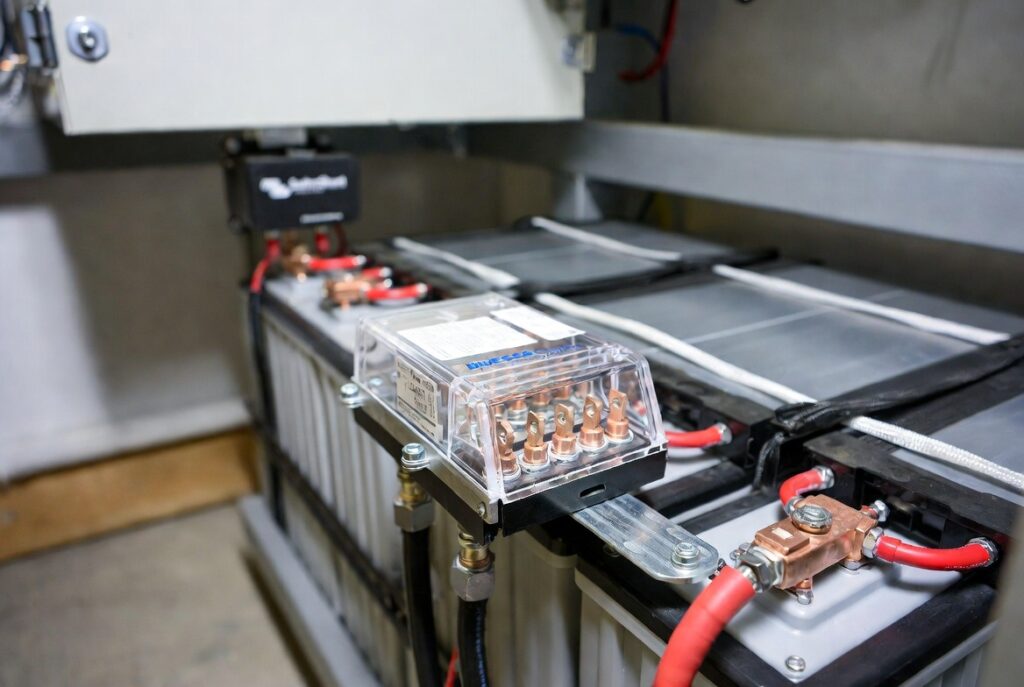
The solar fuse Ontario call that arrives after an ANL fuse failure is never from an owner who chose the wrong fuse deliberately , it is always from an owner who chose the cheaper option without knowing that a standard ANL fuse is rated for AC interrupting capacity, and an LFP battery delivering DC short-circuit current can flow through a melting ANL fuse body long enough to char cable insulation before the element finally clears.
A Hastings County owner discovered this in October 2023 when their 300A ANL fuse melted without fully interrupting the fault. The correct solar fuse Ontario specification for the battery-to-inverter positive circuit is the Class T fuse. The Class T uses a silver sand fill that quenches the DC arc in milliseconds, the same physics that make a DC fault more difficult to interrupt than an AC fault.
The SmartShunt is the diagnostic instrument that identifies a blown solar fuse Ontario before any physical inspection. If the MPPT 100/50 shows positive production on its display but the SmartShunt shows 0.0A input, the fuse is between them and it has failed open circuit. The MPPT is producing current but that current cannot reach the bank because the fuse has interrupted the circuit. This diagnostic pattern appears in cause 6 of the solar-fault-Ontario diagnostic sequence and takes less than 2 minutes to confirm.
The solar fuse Ontario placement rule compounds the fuse type error with a second error that occurs in approximately 30 percent of first-time Ontario installations. NEC 690.9 requires the main fuse within 18 inches of the battery positive terminal. The conductor between the battery terminal and the fuse carries the full battery short-circuit potential without any overcurrent protection. Every inch of that unprotected conductor is an arc risk if a fault occurs at any point along its length. See our Ontario solar sizing guide before selecting any solar fuse Ontario for a new installation.
The solar fuse Ontario Class T requirement: why the ANL fuse fails where the Class T succeeds
| Fuse type | Application | DC interrupting capacity | Cost (approx) |
|---|---|---|---|
| Blue Sea 600A Class T | Battery-to-inverter positive circuit | Rated DC, silver sand fill, arc quench in milliseconds | $40 to $50 |
| ANL fuse (300A typical) | Lower-current DC or AC circuits only | AC-rated only; plastic body melts under LFP DC fault | $5 to $15 |
| MIDI fuse (30A to 60A) | MPPT-to-battery charging circuit | Acceptable for lower-current MPPT output circuit | $5 to $10 |
The solar fuse Ontario Class T is the only correct fuse for the battery-to-inverter positive circuit in any Ontario LFP off-grid system. An LFP battery at full charge can deliver thousands of amperes into a short circuit, and the only fuse rated to interrupt that current cleanly is the Class T. A standard ANL fuse is rated for AC interrupting capacity. Under a DC fault from an LFP bank, the ANL fuse element may partially bridge rather than clear, allowing fault current to continue flowing through a melting plastic housing. The MultiPlus-II battery-to-inverter circuit requires a Class T fuse at the battery positive terminal.
In Hastings County, an owner installed a 300A ANL fuse on their MultiPlus-II circuit to save approximately $32 over the Class T.
When a fault occurred, the ANL fuse body melted without fully interrupting the circuit. The plastic housing softened, the fuse element partially bridged the gap, and fault current continued long enough to char the cable insulation. The owner replaced the ANL with a Blue Sea 600A Class T. The $32 saving cost approximately $200 in cable replacement and 6 hours of rewiring. The Class T is not a premium upgrade over the ANL for the same function , it is a different fuse for a different fault physics requirement. See our Ontario battery inverter guide for the full circuit specification.
The Hastings County ANL failure: what happens when the wrong fuse meets an LFP short circuit
The Hastings County owner had built a complete Tier 2 off-grid system in fall 2022: MultiPlus-II, MPPT 100/50, 200Ah LFP bank, and Cerbo GX. The budget pressure at the end of the build led to one substitution , a $8 ANL fuse in place of the $40 Class T at the battery positive terminal. The system ran without fault for 13 months. In October 2023, a loose battery lug on the positive bus bar made intermittent contact with the steel enclosure wall during a vibration event from a portable generator running in the adjacent utility room. The ANL fuse saw the fault current and attempted to clear.
The ANL fuse element partially melted rather than cleanly separating. The DC arc sustained itself across the partially bridged element because the ANL housing provides no arc-quenching medium , there is no silver sand, no interrupting fill, and no physical mechanism to extinguish a DC arc once it starts. The fault current continued for approximately 400 milliseconds before the element fully separated. In that 400 milliseconds, approximately 8 inches of 2/0 AWG cable insulation charred and the enclosure interior showed carbon scoring. The MultiPlus-II was undamaged because the fault occurred at a current level below the inverter’s own internal protection threshold.
The replacement was a Blue Sea 600A Class T fuse installed within 12 inches of the battery positive terminal. The Class T silver sand fill quenches the DC arc in under 10 milliseconds by embedding the arc channel in a non-conductive medium that prevents the ionised plasma from sustaining conductance. The owner’s comment: “I saved $32 and spent $200 to fix what happened. The Class T was the right fuse from day one.” The solar fuse Ontario lesson from Hastings County is not that ANL fuses always fail , it is that they fail without warning and without clean interruption when a genuine LFP DC fault current occurs.
The blown fuse diagnostic: MPPT shows production, SmartShunt shows zero
The blown solar fuse Ontario diagnostic has a single, unmistakeable pattern: the MPPT display shows watts being produced and the SmartShunt shows 0.0A input simultaneously. The fuse is between them. Current flows from the battery positive terminal, through the fuse, through the MPPT and inverter circuits, through all DC loads, and returns through the SmartShunt on the battery negative terminal. When the fuse is open circuit, no current completes that path regardless of what the MPPT claims to be producing. The MPPT production display reports attempted output, not delivered output.
Confirming the diagnosis takes less than 2 minutes. Check the SmartShunt reading first, then check the MPPT display. If both show the pattern described, inspect the Class T fuse visually and check both terminal lugs for grey-white oxidation on the copper surface. A visually intact fuse with oxidised terminals may still be an open circuit , clean the terminals with a wire brush and recheck. If the fuse element is visibly separated or the housing shows any heat damage, replace it. A replacement Blue Sea 600A Class T costs approximately $30 to $50 and the swap takes approximately 5 minutes. See our Ontario solar fault guide for the complete 7-cause diagnostic sequence this fits into.
The solar fuse Ontario 18-inch placement rule: NEC 690.9 and the Grey County arc incident
A Grey County owner built their off-grid system with the correct Class T fuse but mounted the fuse holder 36 inches from the battery positive terminal because the enclosure layout made that position more convenient. The 36-inch conductor between the battery terminal and the fuse ran along the inside wall of the enclosure unprotected. In spring 2024, a loose battery lug on the positive terminal contacted the metal enclosure wall at approximately 18 inches from the terminal , within the unprotected segment. The battery delivered full short-circuit current through the 18-inch unprotected conductor before the fuse at 36 inches could respond. The conductor arced, charred the enclosure wall, and tripped the main breaker in the adjacent cabin panel.
The Class T fuse at 36 inches never saw the fault because the fault occurred on the unprotected conductor between the terminal and the fuse.
NEC 690.9 requires the fuse within 18 inches precisely because this conductor segment is unprotected. The rewire moved the Class T fuse holder to within 12 inches of the battery positive terminal. The SmartShunt confirmed correct system operation after the rewire and no further arc events occurred in the 12 months since. The owner’s comment: “Two feet of wire nearly burned the cabin down. Moving the fuse 24 inches saved everything.” Every Ontario solar fuse Ontario installation that places the fuse at the distribution panel rather than at the battery has a wrong placement regardless of the fuse type installed.
Fuse sizing: battery-to-inverter versus MPPT-to-battery circuits
The solar fuse Ontario sizing rule has two separate circuits. The battery-to-inverter positive circuit uses the Blue Sea 600A Class T fuse at the battery positive terminal within 18 inches. The 600A rating accommodates the MultiPlus-II maximum continuous draw and the LFP bank’s fault current potential. The MPPT-to-battery charging circuit uses a MIDI fuse rated between 30A and 60A depending on the MPPT output rating: the MPPT 100/50 has a maximum output of 50A, so a 60A MIDI fuse on the MPPT positive output conductor is the correct specification. These two circuits have different fault current potentials and require different fuse types.
The MPPT-to-battery circuit fault current is limited by the MPPT controller’s own output design , it cannot deliver more than 50A regardless of how large the battery bank is or how much the panels are producing.
An ANL fuse is acceptable on the MPPT-to-battery circuit because the fault current potential is within the ANL’s AC-rated interrupting capacity at these lower current levels. This is the one circuit where an ANL fuse is correct. The distinction matters: ANL acceptable on MPPT circuit, Class T mandatory on battery-to-inverter circuit. Placing a Class T on the MPPT circuit provides more protection than required; placing an ANL on the battery-to-inverter circuit provides inadequate protection. See our Ontario Victron solar guide for the complete wiring specification.
NEC and CEC: Ontario permit requirements for solar overcurrent protection
NEC 690.9 governs all solar fuse Ontario overcurrent protection requirements for permanently wired off-grid installations. All DC conductors from the battery positive terminal must have overcurrent protection within 18 inches of the terminal per NEC 690.9(A). The fuse must be rated for the DC voltage and fault current of the circuit , not simply the continuous current rating. An unrated or AC-rated fuse at a DC circuit does not satisfy NEC 690.9 regardless of its amperage rating. Contact the NFPA at nfpa.org for current NEC 690 requirements applicable to Ontario off-grid solar systems.
CEC Section 64 governs all permanent Ontario electrical installations and requires an ESA permit before installation begins. The ESA inspector will verify that overcurrent devices are correctly rated for DC voltage, correctly sized for the conductor ampacity, and correctly positioned within 18 inches of the battery terminal per NEC 690.9. An installation that fails the fuse placement check requires rewiring before the permit can be closed. Contact the Electrical Safety Authority Ontario at esasafe.com before beginning any permanently wired solar fuse Ontario installation.
Pro Tip: Before closing up any Ontario battery enclosure, measure the distance from the battery positive terminal to the fuse holder. If it exceeds 18 inches, the installation does not comply with NEC 690.9 regardless of the fuse type installed. A tape measure and 5 minutes of rewiring before the enclosure is sealed saves the ESA inspection failure and the rewire cost after the permit inspection. The Grey County result confirms: 36 inches looks fine until a fault occurs at 18 inches. Mount the fuse holder on the battery enclosure itself, not on the distribution panel wall across the room.
The solar fuse Ontario verdict: Class T within 18 inches, MIDI for the MPPT circuit, SmartShunt confirms
- New Ontario off-grid installation: install a Blue Sea 600A Class T fuse within 18 inches of the battery positive terminal for the battery-to-inverter circuit. Mount the fuse holder on the battery enclosure side of the cable run. Install a 60A MIDI fuse on the MPPT 100/50 positive output conductor. The Grey County result confirms: 36 inches is too far; 12 inches is correct. The Hastings County result confirms: 300A ANL is the wrong fuse type; 600A Class T is the correct fuse type. Both errors are equally preventable and both carry equally serious consequences.
- Ontario owner who suspects a blown solar fuse Ontario: MPPT shows production, SmartShunt shows 0.0A input , the fuse is between them. Inspect the Class T fuse visually and check both terminal lugs for grey-white oxidation. Replace if the fuse element is visibly separated or the housing shows heat damage. The fix takes 5 minutes and costs approximately $30 to $50 for the replacement fuse. If the fuse is intact and terminals are clean, the fault is in a different part of the circuit , see the complete 7-cause diagnostic sequence at solar-fault-Ontario-standard.
- Ontario owner with an existing ANL fuse on the battery-to-inverter circuit: replace it with a Class T before the first fault event. The Hastings County result demonstrates that an ANL fuse body can melt without fully interrupting DC fault current from an LFP bank. The $32 cost difference is not a premium , it is the correct fuse for the correct fault physics. Replace the ANL fuse at the next scheduled maintenance visit and verify the replacement is within 18 inches of the battery positive terminal per NEC 690.9.
Frequently Asked Questions
Q: What fuse do I need for an off-grid solar system in Ontario?
A: The solar fuse Ontario specification depends on which circuit you are protecting. For the battery-to-inverter positive circuit (the MultiPlus-II main circuit), use a Blue Sea 600A Class T fuse rated for DC voltage. The Class T uses a silver sand fill to quench the DC arc in milliseconds and is the only fuse rated for the fault current an LFP battery can deliver. For the MPPT-to-battery charging circuit, use a MIDI fuse rated between 30A and 60A depending on your MPPT output rating , the MPPT 100/50 uses a 60A MIDI. Both fuses must be installed within 18 inches of their respective positive terminal connections per NEC 690.9.
The Hastings County result confirms the cost of substituting an ANL for the Class T on the battery-to-inverter circuit.
Q: Why does my MPPT show production but my battery is not charging in Ontario?
A: If your MPPT shows positive watts on its display but your SmartShunt shows 0.0A input simultaneously, you have a blown solar fuse Ontario on the circuit between them. The fuse has failed open circuit and no current is completing the path from the MPPT to the battery regardless of what the MPPT display reports. Inspect the Class T fuse visually and check both terminal lugs for oxidation. If the fuse element is visibly separated or the housing shows heat damage, replace the fuse (approximately $30 to $50, 5 minutes to swap). If the fuse is physically intact, clean the terminal lugs with a wire brush and recheck.
If the pattern persists after fuse inspection, proceed to the next cause in the solar-fault-Ontario diagnostic sequence.
Q: How close to the battery does a solar fuse need to be in Ontario?
A: NEC 690.9 requires the main solar fuse Ontario within 18 inches of the battery positive terminal. The conductor between the battery terminal and the fuse carries full battery short-circuit potential with no overcurrent device in the path.
Every inch beyond 18 is additional unprotected conductor that will carry full fault current to any fault point along its length before the fuse can respond. The Grey County arc incident confirmed this at 18 inches: fault occurred at 18 inches from the terminal on the unprotected conductor, fuse was at 36 inches, and could not respond to a fault within its own unprotected lead. Mount the fuse holder at 12 inches or less for the minimum unprotected exposure.
This build is engineered within the 48V DC Safety Ceiling. Diagnostic logic is based on 20+ years of technical service experience. All structural and electrical installations must be verified by a Licensed Professional and comply with your Local AHJ. See our legal and safety disclosure for full scope.
About the Author
Robert Bertrand spent 20 years as a service advisor in the automotive industry (Lexus and Nissan), where precision diagnostics, wiring integrity, and documentation standards were non-negotiable. He brings that same technical discipline to GridFree Guide, where he researches, tests, and documents off-grid solar systems for Ontario conditions. Based in Rockwood, Ontario, every article is built on verified specifications, manufacturer data, and the real-world climate constraints of Canadian off-grid living.
As an Amazon Associate I earn from qualifying purchases. This site also contains affiliate links to other products and services. GridFree Guide earns a small commission at no extra cost to you.