
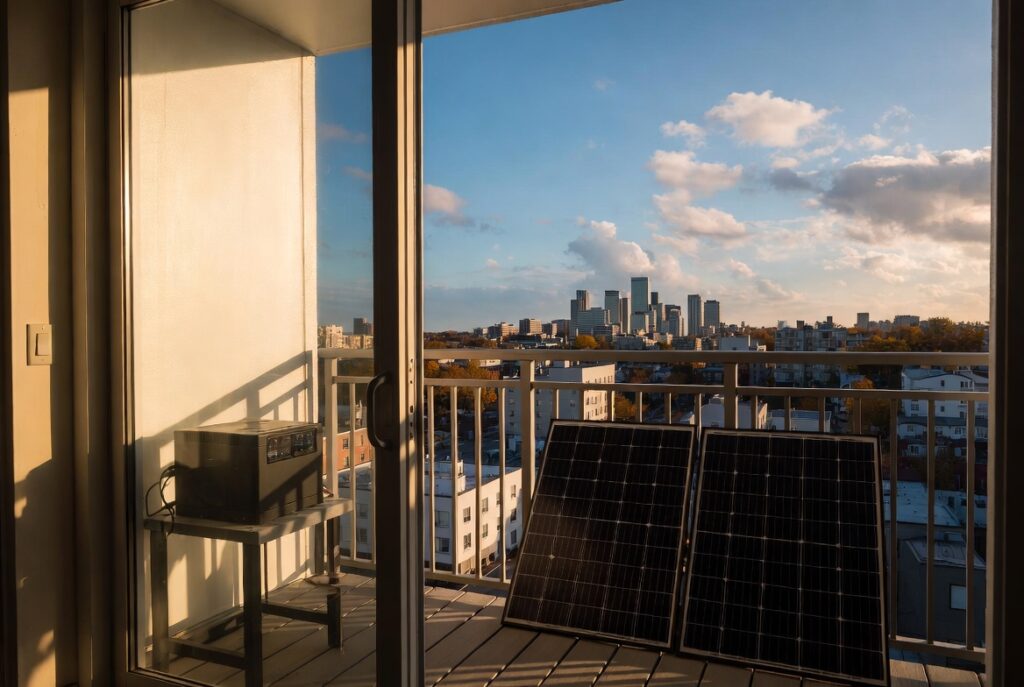
The solar worth it Ontario question for renters comes down to one diagnostic: south-facing access. A Hamilton apartment renter propped two 100W panels against her balcony railing in October 2024. Her measured savings hit $62 per month on Ontario TOU rates. The system paid back in under 3 years.
When I evaluate whether solar worth it Ontario math works for a renter, I skip the marketing numbers entirely. In my 20 years of diagnostics, the real question is whether orientation and load profile beat the lease term. A north-facing apartment kills the math before it starts.
The Solar Worth It Ontario Renter Constraints
Ontario renters face three hard limits that eliminate permanent solar installations. No drilling into the building envelope means no roof mounts. No grid-tied net metering means the property owner must apply for the meter connection. No whole-home backup means stoves and baseboard heat exceed portable capacity.
| Constraint | Why It Applies | Portable System Result |
|---|---|---|
| No permanent mounting | Lease breach and deposit risk | Panels propped on railing or ground stand |
| No grid-tied net metering | Owner must apply and own the meter | Offsets self-consumption only |
| No whole-home backup | Stove and AC draw exceeds capacity | Covers lighting, electronics, emergency backup |
| Investment must be portable | Renter moves every 2 to 4 years | Fits in two bags and moves with the renter |
The portable spec clears all three constraints simultaneously. It connects to loads via standard power strips and extension cords. It moves from one Ontario rental address to the next with zero cost. The one factor that eliminates portable solar is building orientation.
A north-facing or west-facing apartment with no south-facing surface cannot generate sufficient production for any portable system. When I evaluate a renter setup, I check the satellite view on Google Maps before recommending any investment. South-facing access is the single pass-fail gate in the solar worth it Ontario diagnostic. See our Ontario Solar Sizing Guide for the full tier progression.
The Correct Renter Spec: 400W Array and 100Ah Heated LFP
The correct Ontario renter specification starts with two to four Renogy 100W panels on a balcony railing or ground stand. A 100Ah Battle Born heated LFP bank is mandatory for storage below 0C. The Victron MPPT 100/30 and SmartShunt complete the setup at $1,800 to $2,200.
A student renter in Guelph propped two Renogy 100W panels against a south-facing wall in fall 2023. His daily electronics load was approximately 190Wh from a gaming laptop and workstation. The basement utility room dropped below 0C during January cold snaps. A standard LFP bank would have blocked charging at those temperatures.
The SmartShunt confirmed the system covered the full 190Wh load on clear January days. On overcast days it produced approximately 80Wh and kept the bank above 50 percent SoC. When he graduated in April 2024, the system packed into two duffel bags in 25 minutes. See our Ontario Cabin Solar Guide for the next tier.
What the Solar Worth It Ontario Portable Spec Covers
The portable solar spec offsets lighting, electronics, and emergency backup completely for Ontario renters with south-facing access. A 400W system at 5.5 summer peak sun hours produces approximately 2,200Wh per day. That far exceeds the 190Wh daily electronics baseline and covers a fridge at 540Wh during production hours.
Portability is the strongest renter advantage in the solar worth it Ontario calculation. The Hamilton renter broke down her panels, bank, and controller into two carry bags in 20 minutes. The system arrived at the new balcony and produced within 2 hours of moving day. When she eventually buys a home, the same components become the emergency backup specification with zero waste.
This portability factor separates renter solar from homeowner solar entirely. A $15,000 roof-mounted system stays with the building when you leave. A $2,000 portable system follows you to every address for its 10 year lifespan. That distinction changes the solar worth it Ontario payback from a property investment into a personal asset.
The Solar Worth It Ontario ROI Math
Ontario on-peak hydro rates reached approximately 20.3 cents per kWh in 2026. A 400W system at January 1.5 peak sun hours produces approximately 600Wh daily.
At summer 5.5 PSH the same system produces approximately 2,200Wh. Combined annual savings run $100 to $160 depending on TOU timing. System cost is approximately $1,800 to $2,200.
The Hamilton renter’s measured $62 per month produces a 2.5 to 3 year payback. Her system generated during the on-peak window when she was home. That timing eliminated the most expensive grid draw and compressed the payback dramatically.
The financial case improves when including asset resale at 60 to 70 cents on the dollar. Emergency backup during Ontario ice storms adds real solar worth it Ontario value beyond electricity savings. Zero reinstallation cost at the next address means the investment follows the renter. See our Ontario Battery Generator Guide for full backup value math.
The Ontario Winter Production Reality
In my experience with Ontario solar production, winter underperformance surprises most renters. January at 1.5 peak sun hours produces one quarter of July output. The solar worth it Ontario math must account for this seasonal gap.
The Guelph system confirmed the winter floor at 270Wh on clear January days. Overcast days dropped to approximately 80Wh. The 100Ah heated LFP bank stored surplus from clear days to bridge overcast gaps.
Without a heated LFP bank, charging stops entirely below 0C. This is the single most common renter system failure in Ontario winter. A standard LFP bank in an unheated basement or garage locks out from October through April.
NEC and CEC: Ontario Permit Requirements
A portable solar system without hardwired connections does not require an ESA permit in Ontario. Connecting panels to a portable battery via MC4 connectors and discharging via standard outlets equals operating a portable generator. No permanent wiring modification occurs. Contact the National Fire Protection Association for current NEC requirements on portable backup.
CEC Section 64 governs all permanent Ontario electrical installations. An Ontario renter who connects any component to the building electrical panel requires an ESA permit and landlord consent. The correct solar worth it Ontario approach stays within standard power strip connections. Contact the Electrical Safety Authority before any permanently wired Ontario solar work.
Pro Tip: Before signing a new Ontario lease, check balcony orientation on Google Maps satellite view. A south-facing balcony adds approximately $744 per year of solar value. That equals roughly $60 per month in the solar worth it Ontario rent comparison.
The Comparison Table
| Component | Specification | Cost | Role |
|---|---|---|---|
| Renogy 100W Panels (x2-4) | 100W each, MC4 connectors | $120 each | Solar production |
| Battle Born Heated LFP | 100Ah, 12V, internal heater | $925 | Storage below 0C |
| Victron MPPT 100/30 | 30A, Bluetooth monitoring | $185 | Charge control |
| Victron SmartShunt | 500A, Bluetooth monitoring | $140 | Bank monitoring |
| Wiring and connectors | 10AWG, MC4, fuse holder | $80 | System wiring |
Frequently Asked Questions
Can Ontario renters install solar panels without landlord permission?
Yes, if the setup is entirely portable with no drilling or permanent mounting. Panels propped on a balcony railing require no landlord permission. No component touches the building wiring or electrical panel.
What is the payback period for a portable renter solar system?
The electricity-only payback runs 11 to 22 years at average Ontario rates. The Hamilton renter’s measured $62 per month produced a 2.5 to 3 year payback. TOU-timed production during on-peak hours accelerates the math.
What can a portable solar system power in an Ontario apartment?
A 400W system covers LED lighting, laptops, phone charging, and a CPAP machine. It cannot power stoves, baseboard heaters, central AC, or electric dryers. The 190Wh daily electronics baseline is fully covered year-round.
Is portable solar worth it without a south-facing surface?
No. A north-facing apartment without south-facing access cannot generate sufficient production. The solar worth it Ontario answer is always yes for south-facing and always no without it.
- Ontario apartment renter with south-facing balcony: build the 400W portable spec at $1,800 to $2,200 and recover the cost in under 3 years at measured TOU savings.
- Ontario renter in a basement suite with south-facing yard: prop two panels against the exterior wall and cover the full 190Wh electronics load year-round.
- Ontario renter without south-facing access: the solar worth it Ontario answer is no at any price point.
Master Tech Advisory: When I evaluate a renter solar system, I check SmartShunt data first. If daily production falls below the daily load, the system is undersized or the orientation is wrong. A healthy 400W system on a south-facing Ontario balcony shows 250Wh minimum on clear January days. If the reading drops below 150Wh on a clear day, add a third 100W panel.
About the Author
Robert Bertrand spent 20 years as a service advisor in the automotive industry (Lexus and Nissan), where precision diagnostics, wiring integrity, and documentation standards were non-negotiable. He brings that same technical discipline to GridFree Guide, where he researches, tests, and documents off-grid solar systems for Ontario conditions. Based in Rockwood, Ontario, every article is built on verified specifications, manufacturer data, and the real-world climate constraints of Canadian off-grid living.
As an Amazon Associate I earn from qualifying purchases. This site also contains affiliate links to other products and services. GridFree Guide earns a small commission at no extra cost to you.