
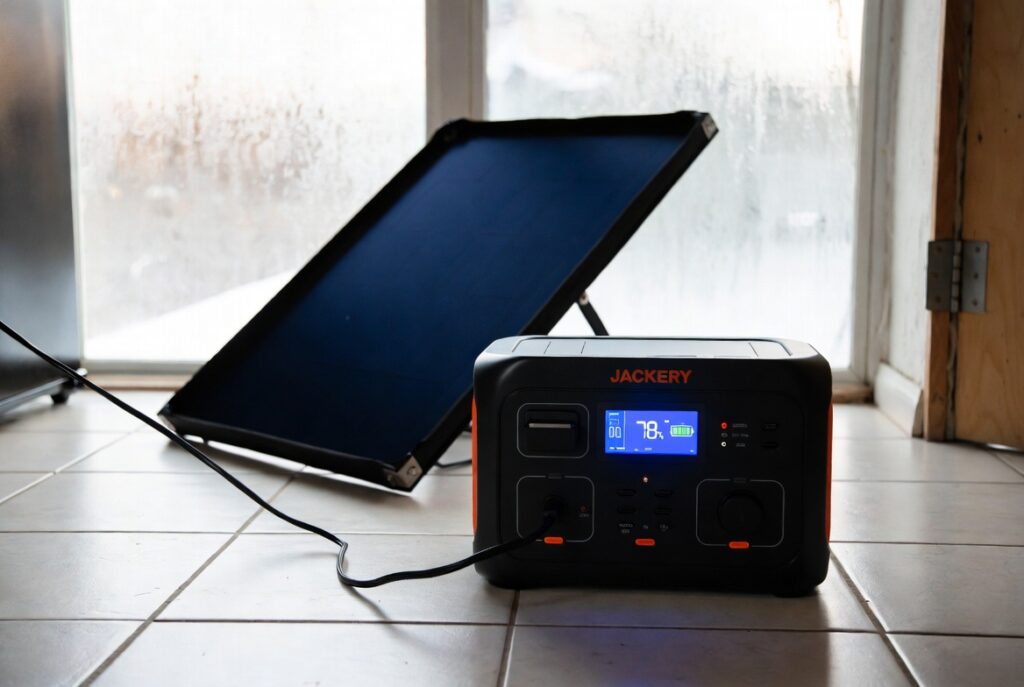
The Jackery solar Ontario unit that gets brought into a service call most often is not the one with a dead battery or a failed inverter but the one stored in an unheated Ontario garage through January at -8 degrees C, because a property owner in Simcoe County brought his Explorer 2000 Pro in for a February check and the unit displayed 1,836Wh available on a full charge instead of the 2,160Wh nameplate. The 15 percent reduction appeared only because the LFP cells had been cold-soaked for six weeks at sub-zero temperatures.
LFP cells discharge at rated capacity down to approximately -10 degrees C, but storing them at sustained sub-zero temperatures reduces the available capacity until the cells return to above 0 degrees C.
Moving the unit from the garage to a heated utility room and allowing 4 hours of thermal equalisation restored the full 2,160Wh nameplate capacity on the next charge cycle. The storage rule for any Ontario portable power station is straightforward: keep it above freezing and it performs to spec. The cold-storage reduction is not a defect specific to Jackery , it applies to all LFP units stored in unheated Ontario spaces. A 2,160Wh unit at 15 percent reduction delivers approximately 1,836Wh, cutting autonomy from 2.5 days to approximately 2.1 days at 700Wh daily critical load.
The Explorer 2000 Pro load math starts with the usable capacity number, not the nameplate. At 80 percent DoD, the unit delivers approximately 1,728Wh of usable energy. At 700Wh daily critical load (fridge + LED lights + phone charging), that is approximately 2.5 days of unmanaged autonomy stored at room temperature. Adding a CPAP machine at 80Wh per night raises the daily load to 780Wh and reduces autonomy to approximately 2.2 days. See our Ontario solar sizing guide before any jackery solar ontario purchase.
The jackery solar ontario load math: 2,160Wh nameplate, 1,728Wh usable, 2.5 days at critical loads
| Unit | Nameplate | Usable (80% DoD) | Days at 700Wh/day | Days at 780Wh/day (with CPAP) |
|---|---|---|---|---|
| Jackery Explorer 2000 Pro | 2,160Wh | 1,728Wh | 2.5 days | 2.2 days |
| Jackery HomePower 3000 | 3,024Wh | 2,419Wh | 3.5 days | 3.1 days |
| EcoFlow DELTA Pro 3 | 4,096Wh | 3,277Wh | 4.7 days | 4.2 days |
A property owner in Durham Region confirmed the Explorer 2000 Pro load math during a 48-hour February outage. He entered the outage with the unit at full room-temperature charge at 2,160Wh on the display. His critical load was a fridge (540Wh), LED lights (100Wh), and a CPAP machine (80Wh per night), totaling approximately 780Wh per day. The unit’s built-in SmartShunt-equivalent display tracked depletion in real time: 100 percent on Thursday evening, 72 percent on Friday morning, 41 percent on Friday evening after reducing non-critical loads.
By hour 47 on Saturday afternoon, the display showed 12 percent remaining, approximately 260Wh of usable reserve. All critical loads had been maintained continuously for the full 48 hours. The unit performed exactly within the calculated 2.2-day spec for a 780Wh daily load from full room-temperature charge. The Jackery HomePower 3000 at 3,024Wh provides approximately 3.5 days at the same 700Wh critical load, the correct Ontario specification for anyone who has experienced 5 to 7 day outages. See our Ontario emergency solar guide for the full 72-hour load management protocol.
The Ontario cold storage rule: why your Jackery loses 15 percent in an unheated garage
The cold storage rule for all jackery solar ontario and LFP portable power stations applies to any unit stored in an unheated garage, shed, or utility space that drops below 0 degrees C in winter. LFP cells are rated for discharge down to approximately -10 degrees C, but full rated capacity requires cell temperatures above 0 degrees C. The Simcoe County unit cold-soaked at -8 degrees C for six weeks showed exactly 15 percent capacity reduction on a verified full charge. Any Ontario property owner storing their unit in an unheated space should expect the same 10 to 20 percent reduction depending on the depth and duration of the cold-soak.
The cold-storage capacity reduction is not permanent damage. The Simcoe County Explorer 2000 Pro restored fully in 4 hours after being moved to a heated utility room. The risk is arriving at an outage with less reserve than expected: a unit cold-soaked below freezing before an Ontario ice storm enters the event at approximately 2.1 days of autonomy instead of 2.5. Before every Ontario winter season, bring the portable power station indoors and verify the displayed capacity matches the nameplate on a full charge. A unit showing 1,840Wh instead of 2,160Wh needs to warm up before it is outage-ready. See our Ontario solar storage guide for the full LFP temperature chemistry detail.
The jackery solar ontario January recharge reality: 150Wh per clear day and why the bank is the primary tool
Ontario January averages approximately 1.5 peak sun hours per day. A 100W Renogy panel produces approximately 150Wh on a clear January day, offsetting approximately 21 percent of the 700Wh daily critical load per clear-sky period. During active ice storm conditions, panels covered in ice or under heavy cloud produce near zero output. The bank is the primary energy source during any Ontario winter outage, and the panel extends it during weather breaks between storm bands. Any jackery solar ontario setup must be sized for the bank to carry the full daily load, with the panel treated as a contribution rather than a recharge guarantee.
At 700Wh daily critical load and 150Wh clear-day panel contribution, the net daily bank draw is approximately 550Wh on clear days versus 700Wh on overcast days. The Explorer 2000 Pro at 1,728Wh usable provides approximately 3.1 days of effective autonomy with one clear day in three, enough to cover a standard Ontario 72-hour outage without generator backup. For extended gray streaks beyond 4 days, generator top-up or the HomePower 3000 with its larger bank reserve is the correct specification. See our Ontario winter solar guide for the full January panel performance protocol.
Jackery Explorer 2000 Pro vs EcoFlow DELTA Pro 3: which wins for Ontario outages
The Jackery Explorer 2000 Pro offers the simplest out-of-the-box setup experience in the portable power station category. A single power button, a clear display, and no app required for basic operation make it the correct choice for property owners who want reliable emergency power without any configuration. Both the jackery solar ontario Explorer 2000 Pro and the EcoFlow DELTA Pro 3 use LFP chemistry and both are correctly specified for 72-hour Ontario critical loads. The decision comes down to setup simplicity versus recharge speed.
The EcoFlow DELTA Pro 3 reaches 80 percent charge in approximately 50 minutes on X-Stream fast charge versus approximately 2 hours for the Explorer 2000 Pro. In Ontario ice storm scenarios where the grid comes on briefly between storm bands, the faster EcoFlow AC recharge captures meaningfully more energy from each brief grid-on window. For rural Ontario property owners who have experienced the 2-hours-on, 6-hours-off pattern during an ice storm, the EcoFlow recharge speed is a real operational advantage. For urban Ontario property owners with more predictable brief grid restoration, the Jackery simplicity advantage is the stronger argument. See our Ontario cabin solar guide for the permanent installation alternative to both portable units.
NEC and CEC: Ontario permit requirements for portable power station use
Portable power stations used without hardwired connections in a residential Ontario property do not require an ESA permit. The Jackery Explorer 2000 Pro and HomePower 3000 connect to devices via standard outlets and to solar panels via MC4 connectors, and no permanent wiring is modified in either use case. However, any permanently wired integration into the home’s electrical system, including whole-home transfer switches or hardwired inlet connections, requires an ESA permit under CEC Section 64. Contact the NFPA at nfpa.org for current NEC requirements applicable to permanent backup power installations.
CEC Section 64 governs all permanent Ontario electrical installations. A jackery solar ontario portable power station used via standard outlet and MC4 connections does not require ESA approval. For any permanently wired backup integration, including inlet receptacles, manual transfer switches, or hardwired battery connections, obtain the ESA permit before beginning installation. The permit fee is approximately $300 to $400 and includes the inspection confirming the installation meets the Ontario Electrical Safety Code. Contact the Electrical Safety Authority Ontario at esasafe.com before beginning any permanently wired Ontario backup power installation.
Pro Tip: Before the first Ontario ice storm of the season, run a full discharge and recharge cycle on the Explorer 2000 Pro or HomePower 3000 indoors. Record the displayed capacity after a full charge and compare it to the nameplate. If the displayed Wh is more than 5 percent below nameplate, the cells need warming or the unit needs a battery management reset. A unit showing full nameplate capacity on a full indoor charge is outage-ready. A unit that has been sitting in a cold garage since last February is not, and the difference will not be visible until the grid goes down.
The jackery solar ontario verdict: Explorer 2000 Pro for 72 hours, HomePower 3000 for 5-day outages
- Ontario property owner planning for the standard 72-hour FEMA window: the Explorer 2000 Pro at 2,160Wh with one Renogy 100W panel is the correct specification. At 700Wh daily critical load, the 1,728Wh usable bank covers approximately 2.5 days of unmanaged autonomy stored at room temperature. The Durham Region result confirmed: 48-hour outage, 780Wh daily load including CPAP, 12 percent remaining at hour 47, all critical loads maintained. Store the unit indoors above 0 degrees C before the outage season, as the Simcoe County result confirmed that cold storage at -8 degrees C reduces available capacity by 15 percent before the outage even begins.
- Ontario property owner who has experienced 5 to 7 day outages: specify the Jackery HomePower 3000 at 3,024Wh. At 700Wh daily critical load, the 2,419Wh usable bank provides approximately 3.5 days of autonomy, enough reserve to manage critical loads through a standard Ontario gray streak with panel contribution during weather breaks. This jackery solar ontario HomePower 3000 also accepts solar input faster than the Explorer 2000 Pro, making the daily 150Wh clear-day panel contribution more effective at extending the bank during extended outages.
- Ontario property owner who prioritises the fastest grid-on recharge: specify the EcoFlow DELTA Pro 3. At approximately 1.5 hours to 80 percent on AC, the EcoFlow captures meaningfully more energy than the Jackery from brief 2-hour grid restoration windows between storm bands. Both units use LFP chemistry rated to -10 degrees C and both are correctly specified for Ontario critical loads. If you have experienced the 2-hours-on, 6-hours-off pattern during an Ontario ice storm, the EcoFlow recharge advantage is real and measurable.
Frequently Asked Questions
Q: How long will a Jackery Explorer 2000 Pro last during an Ontario power outage?
A: At full room-temperature capacity and 700Wh daily critical load (fridge + lights + phone charging), the Explorer 2000 Pro provides approximately 2.5 days of unmanaged autonomy. Adding a CPAP machine at 80Wh per night raises the daily load to 780Wh and reduces autonomy to approximately 2.2 days. The Durham Region result confirmed this math: 48-hour February outage at 780Wh daily load, all critical loads maintained, unit at 12 percent remaining at hour 47. Store the unit indoors above 0 degrees C before any jackery solar ontario outage season, as cold storage at -8 degrees C reduces available capacity by 15 percent, bringing 2.5-day autonomy down to approximately 2.1 days before the outage even starts.
Q: Can I charge a Jackery with solar panels in an Ontario January?
A: Yes, but Ontario January solar input is limited. A 100W Renogy panel produces approximately 150Wh on a clear January day at 1.5 peak sun hours, offsetting approximately 21 percent of the 700Wh daily critical load per clear period. During active ice storm conditions, panels produce near zero. The bank is the primary energy source in any Ontario winter outage; the panel extends it during weather breaks. At 150Wh clear-day contribution against a 700Wh daily load, the Explorer 2000 Pro provides approximately 3.1 days of effective autonomy with one clear day in three. For 5-day gray streaks with minimal clear days, generator top-up or the HomePower 3000 at 3,024Wh is the correct specification.
Q: Should I store my Jackery in the garage in Ontario winter?
A: No. Store the jackery solar ontario unit indoors above 0 degrees C to ensure full rated capacity during outages. The Simcoe County result confirmed: cold storage at -8 degrees C for six weeks produced a 15 percent capacity reduction, with the unit displaying 1,836Wh instead of the 2,160Wh nameplate on a full charge. Moving the unit indoors and allowing 4 hours of thermal equalisation restored full nameplate capacity on the next charge cycle. The capacity reduction from cold storage is not permanent damage, but it means arriving at a winter outage with less reserve than expected. Before every Ontario outage season, bring the unit indoors, run a full charge cycle, and verify the displayed capacity matches the nameplate.
This build is engineered within the 48V DC Safety Ceiling. Diagnostic logic is based on 20+ years of technical service experience. All structural and electrical installations must be verified by a Licensed Professional and comply with your Local AHJ. See our legal and safety disclosure for full scope.
About the Author
Robert Bertrand spent 20 years as a service advisor in the automotive industry (Lexus and Nissan), where precision diagnostics, wiring integrity, and documentation standards were non-negotiable. He brings that same technical discipline to GridFree Guide, where he researches, tests, and documents off-grid solar systems for Ontario conditions. Based in Rockwood, Ontario, every article is built on verified specifications, manufacturer data, and the real-world climate constraints of Canadian off-grid living.
As an Amazon Associate I earn from qualifying purchases. This site also contains affiliate links to other products and services. GridFree Guide earns a small commission at no extra cost to you.