
The emergency solar ontario failure that costs the most is not the one where the bank runs to zero on hour 48 but the one where the bank was never sized for the Ontario winter load in the first place, because a family in Durham Region discovered this during the January 2024 ice storm.
Their 54-hour outage tested every assumption they had made about how much power a fridge, a CPAP machine, and basic lighting actually consume across two and a half days of cold and dark. Their EcoFlow DELTA Pro 3 entered the outage at approximately 90 percent charge. The fridge drew approximately 540Wh per day in compressor cycles, the CPAP machine drew approximately 80Wh per night, and the LED lights drew approximately 100Wh per evening. The total daily critical load was approximately 720Wh.
The 2,000Wh bank provided approximately 2.5 days of unmanaged autonomy before the unit display showed a depletion warning.
They managed the load on day 2 by eliminating all non-critical draws and positioning the 100W Renogy panel in the south-facing window during the mid-day break between storm bands. The panel contributed approximately 120Wh on that partial-sun period. The SmartShunt-style display on the unit confirmed the bank recovered from 28 percent to 37 percent SoC during the 4-hour panel window. By managing loads and harvesting the available January sun during weather breaks, the family maintained continuous power for the full 54 hours without the unit ever reaching zero.
The emergency solar ontario lesson from Durham Region is that bank size determines survival duration and panel input extends it during weather breaks. At 720Wh daily critical load, a 1,000Wh bank provides approximately 1.1 days of unmanaged autonomy. A 2,000Wh bank provides approximately 2.5 days. For a 72-hour standard outage in Ontario, a 2,000Wh bank with one 100W panel and active load management covers the standard FEMA window without running dry. See our Ontario solar sizing guide before any emergency solar ontario purchase.
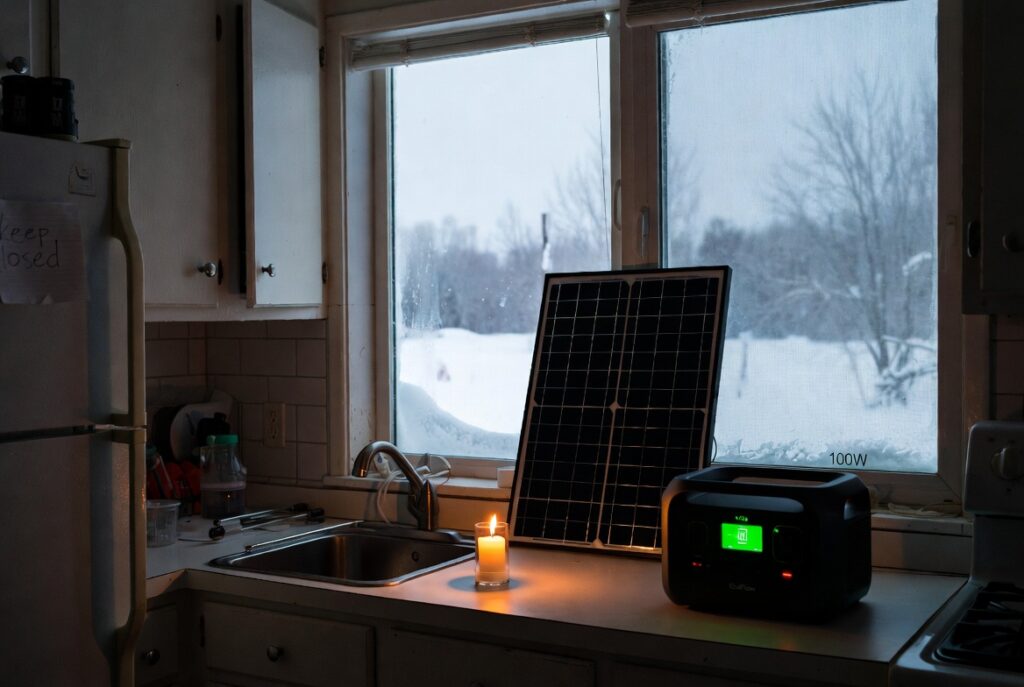
[Feature image: Ontario kitchen during power outage, candlelight on counter, EcoFlow portable power station glowing with charge indicator, 100W solar panel leaning against frost-covered window, refrigerator door closed with sticky note reading “keep closed,” photorealistic, 16:9]
Alt text: emergency solar Ontario
The emergency solar ontario critical load calculation: fridge, lights, CPAP, and phone
| Component | Recommended model | Why it works for Ontario |
|---|---|---|
| Primary generator | EcoFlow DELTA Pro 3 , 2,000Wh | 2.3 days at 700Wh daily load; LFP cells rated to -20 degrees C |
| Compact alternative | Anker SOLIX C1000 , 1,056Wh | 1.1 days unmanaged; fast recharge; correct for urban 72-hour outage |
| Solar input | Renogy 100W panel | 150Wh per clear January day; portable; offsets 21% of daily draw |
| Bank monitor | Victron SmartShunt | Real-time discharge tracking for load management decisions |
The critical load math for an Ontario emergency is straightforward. A standard fridge draws approximately 45W and runs for 12 hours of compressor cycles, totaling 540Wh per day. LED lighting at 20W for 5 hours adds 100Wh daily, and phone charging at 20W for 3 hours adds 60Wh. A CPAP machine draws approximately 10W for 8 hours, adding 80Wh per night for users who require it. The total critical load without a CPAP is approximately 700Wh per day; with a CPAP, it reaches approximately 780Wh. At 700Wh daily draw, a 2,000Wh bank (1,600Wh usable at 80 percent DoD) provides approximately 2.3 days of unmanaged autonomy.
Electric resistance heating is not a viable emergency solar ontario load. A single 1,500W baseboard heater would consume the entire 2,000Wh bank in approximately 80 minutes. Propane is the correct backup heating choice for Ontario homes during extended outages. The emergency solar ontario system covers the critical electrical loads , fridge, communication, medical devices, and minimal lighting , while propane handles heat. A 100-pound propane tank provides approximately 7 to 10 days of cooking and supplemental heat for a well-insulated Ontario home. See our Ontario battery generator guide for the hybrid backup specification.
The Ontario emergency spec: EcoFlow DELTA Pro 3 vs Anker SOLIX C1000
The EcoFlow DELTA Pro 3 at 2,000Wh is the correct specification for any Ontario property owner who has experienced or anticipates outages beyond 48 hours. At 700Wh daily critical load, the 1,600Wh usable bank provides approximately 2.3 days of unmanaged autonomy before the unit display shows a depletion warning. With load management and panel input during weather breaks, the 72-hour FEMA standard is achievable without the bank running dry. Both units use LFP cells, which maintain full performance down to approximately -20 degrees C , the correct chemistry for Ontario winter emergency storage where the generator may be kept in an unheated garage or utility space.
The Anker SOLIX C1000 at 1,056Wh is the correct specification for urban Ontario property owners planning for the standard 72-hour window with active load management. At 700Wh daily draw, the 845Wh usable bank provides approximately 1.1 days of unmanaged autonomy , requiring load management and panel input to reach the 72-hour mark. For rural Ontario property owners who have experienced 5 to 7 day ice storm outages, the Anker is insufficient without a second unit or permanent backup system. The Simcoe County 6-day outage confirms the limits of a 1,056Wh bank at fridge-priority loads: the 200W array was essential to extending the bank through all 144 hours. See our Ontario solar power outage guide for the full outage scenario analysis.
The emergency solar ontario January problem: 1.5 PSH and why the bank is the primary survival tool
Ontario January averages approximately 1.5 peak sun hours per day. A 100W panel harvests approximately 150Wh on a clear January day and near zero during active ice storm conditions when panels are covered in ice or under heavy cloud. The bank is the primary energy source during any Ontario winter outage , the panel extends it during weather breaks between storm bands. At 700Wh daily critical load, a 100W panel contributing 150Wh per clear-sky period offsets approximately 21 percent of the daily draw, adding approximately 0.3 days of effective autonomy per clear period to the bank reserve.
A property owner in rural Simcoe County used an Anker SOLIX C1000 paired with a 200W array through a 6-day = 144-hour freezing rain outage with a single mission: keep prescription medication refrigerated at exactly 4 degrees C. He eliminated every load except the fridge, reducing daily draw to approximately 540Wh. At that fridge-only load, the 845Wh usable bank provided approximately 1.6 days per full charge cycle, and the 200W array contributed approximately 300Wh on clear days, reducing the net daily discharge to approximately 240Wh when sun was available.
The LFP chemistry in the unit maintained normal discharge and recharge cycling throughout the sub-zero temperatures of the 6-day event without any cold-weather performance reduction. The SmartShunt-style unit display confirmed managed depletion and recharge cycles throughout all 144 hours. The medication stayed within the 2 to 8 degrees C pharmaceutical safety window for the full 6-day duration. His comment: “The fridge was the only thing plugged in for 6 days. Everything else could wait.” See our Ontario winter solar guide for the full January recharge protocol.
The 72-hour rule: FEMA standard and the Ontario ice storm reality
FEMA and Ontario Emergency Management recommend 72-hour self-sufficiency as the baseline standard. At 700Wh daily critical load, a 2,000Wh bank (1,600Wh usable at 80 percent DoD) provides approximately 2.3 days of unmanaged autonomy , close to the 72-hour window with active load management and panel input during weather breaks. For rural Ontario ice storm scenarios where repair crews face widespread damage across multiple counties, outages regularly extend to 5 to 7 days. The Simcoe County 6-day result confirms this is not an edge case , it is a realistic planning scenario for rural Ontario property owners.
Pro Tip: If you have a 1,000Wh bank, you have approximately one day of unmanaged critical-load power. To extend to 3 to 5 days, monitor the SmartShunt-style display from the moment the grid goes down and cut every non-essential load immediately. The fridge is the last load to cut. Medication and food safety are the non-negotiable outputs of any emergency solar ontario system. Write the load priority order on a card and tape it to the unit before the outage season begins: fridge first, CPAP second, lights third, phone charging fourth. Everything else waits for the grid.
NEC and CEC: Ontario permit requirements for emergency solar installations
Portable power stations under 2,000W used for emergency backup in a residential setting typically do not require an ESA permit when used without any hardwired connections. Any permanently wired backup system , including a whole-home transfer switch, permanently mounted panels, or a hardwired battery bank , requires an ESA permit under CEC Section 64. The distinction is straightforward: if the unit plugs into a standard outlet or connects directly to a device via cable, no permit is required. If any wiring is modified or added to the home’s electrical system, an ESA permit is required. Contact the NFPA at nfpa.org for current NEC 690 requirements applicable to permanent solar backup installations.
CEC Section 64 governs all permanent Ontario electrical installations. A portable emergency solar ontario system used without any hardwired connections does not require ESA approval. For any permanently wired backup system, obtain the ESA permit before beginning installation. The permit fee is approximately $300 to $400 and includes the ESA inspection that confirms the installation is safe for the home’s occupants. Contact the Electrical Safety Authority Ontario at esasafe.com before beginning any permanently wired Ontario emergency backup installation.
The emergency solar ontario verdict: 1,000Wh for 72 hours, 2,000Wh for 5 days, load management always
- Ontario property owner planning for the standard 72-hour FEMA window: the EcoFlow DELTA Pro 3 at 2,000Wh paired with one Renogy 100W panel is the correct specification. At 700Wh daily critical load, the 1,600Wh usable bank covers approximately 2.3 days of unmanaged autonomy. With load management and panel input during weather breaks, the standard 72-hour window is achievable without running dry. The Durham Region result confirms: 54-hour outage, 720Wh daily critical load, load management on day 2 with panel input through south-facing window, full 54 hours maintained on a single EcoFlow bank.
- Ontario rural property owner who has experienced or expects 5 to 7 day outages: the Anker SOLIX C1000 alone is insufficient for this duration. Either the EcoFlow DELTA Pro 3 at 2,000Wh with 200W of solar input, or a permanent Tier 1 cabin system, is required for 5-day critical-load autonomy in Ontario. The Simcoe County result confirms: 144-hour outage, Anker SOLIX C1000 with 200W array, fridge-only prioritization, LFP confirmed at sub-zero temperatures, medication within safety window for full 6 days. Without the 200W array and strict load management, the Anker bank would not have covered the 144 hours at fridge-only load. See our Ontario cabin solar guide for the permanent Tier 1 specification.
- Ontario property owner with a CPAP machine or refrigerated medication: size the bank for the medical device load before purchasing and write the load priority order before the outage season. A CPAP at 80Wh per night adds approximately 11 percent to the daily load. Refrigerated medication at 4 degrees C requires the fridge to be the last load cut in any load management scenario. The SmartShunt display confirms whether the bank has sufficient reserve to maintain the fridge load overnight without the unit shutting down. At 780Wh daily critical load with CPAP included, a 2,000Wh bank provides approximately 2.0 days of unmanaged autonomy , the correct starting point for any Ontario property owner with a non-negotiable medical load.
Frequently Asked Questions
Q: What size solar generator do I need for a 72-hour Ontario power outage?
A: For the standard 72-hour FEMA window at Ontario critical loads (fridge + lights + phone charging = approximately 700Wh daily), the EcoFlow DELTA Pro 3 at 2,000Wh is the correct specification. It provides approximately 2.3 days of unmanaged autonomy , close to 72 hours with active load management and panel input during weather breaks. The Anker SOLIX C1000 at 1,056Wh provides approximately 1.1 days of unmanaged autonomy and requires load management from the first hour.
For rural Ontario property owners who have experienced 5 to 7 day ice storm outages, the EcoFlow DELTA Pro 3 paired with a 200W array is the minimum specification. The Durham Region result confirmed the 2,000Wh bank with active management covers the standard outage window without running dry.
Q: Will a solar panel work during an Ontario ice storm?
A: During active ice storm conditions, panels covered in ice accumulation or under heavy cloud produce near-zero output. The bank is the primary emergency solar ontario energy source during the storm itself. The 100W Renogy panel contributes approximately 150Wh per clear January day during the breaks between storm bands , offsetting approximately 21 percent of the 700Wh daily critical load per clear period. At the 2-panel (200W) level, clear-day harvest reaches approximately 300Wh, reducing the net daily bank depletion to approximately 400Wh when sun is available. The panel extends the bank; it does not replace it during an active Ontario ice storm event.
Keep the panel positioned for the south-facing window from the moment the outage begins so it is ready to harvest the first weather break.
Q: Can I run a CPAP machine on an emergency solar generator in Ontario?
A: Yes. A CPAP machine draws approximately 10W for 8 hours per night, adding approximately 80Wh to the daily critical load. Most modern portable power stations including the EcoFlow DELTA Pro 3 and Anker SOLIX C1000 support CPAP operation with the correct DC adaptor , check the CPAP manufacturer’s specifications for compatible adaptors. At 780Wh daily total critical load (with CPAP), the EcoFlow DELTA Pro 3 at 2,000Wh provides approximately 2.0 days of unmanaged autonomy. For users where CPAP is non-negotiable, the bank size calculation must include the full 780Wh daily load rather than the 700Wh lights-only estimate.
The SmartShunt display confirms overnight fridge and CPAP combined drain rate and tells you exactly what the bank state will be at morning before the next panel harvest window.
This build is engineered within the 48V DC Safety Ceiling. Diagnostic logic is based on 20+ years of technical service experience. All structural and electrical installations must be verified by a Licensed Professional and comply with your Local AHJ. See our legal and safety disclosure for full scope.
About the Author
Robert Bertrand spent 20 years as a service advisor in the automotive industry (Lexus and Nissan), where precision diagnostics, wiring integrity, and documentation standards were non-negotiable. He brings that same technical discipline to GridFree Guide, where he researches, tests, and documents off-grid solar systems for Ontario conditions. Based in Rockwood, Ontario, every article is built on verified specifications, manufacturer data, and the real-world climate constraints of Canadian off-grid living.
As an Amazon Associate I earn from qualifying purchases. This site also contains affiliate links to other products and services. GridFree Guide earns a small commission at no extra cost to you.