
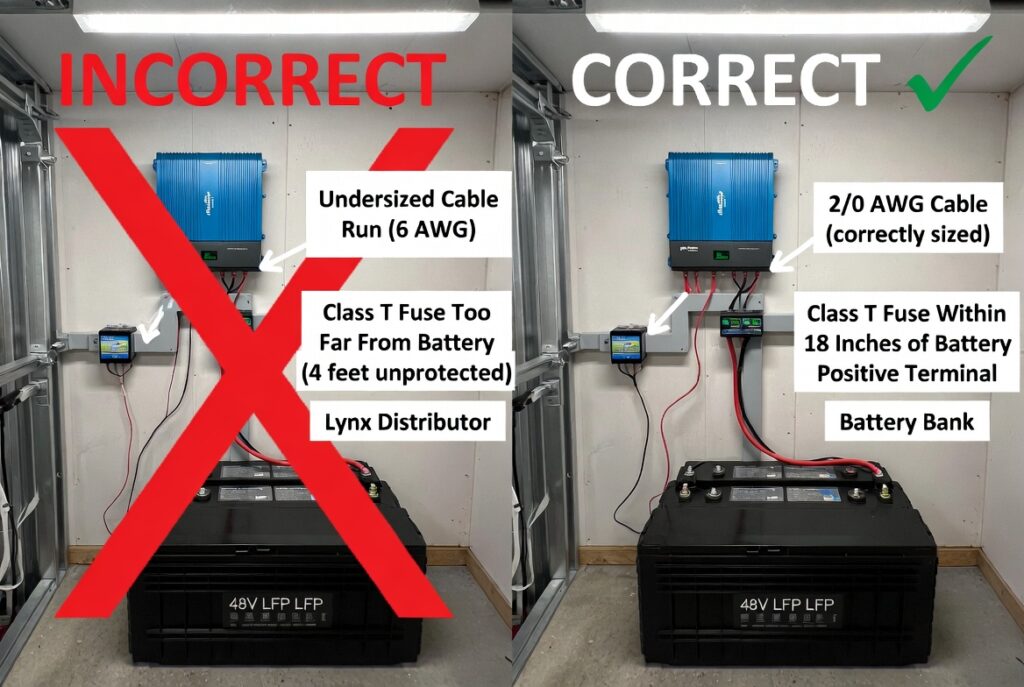
The solar wiring ontario failure that is hardest to diagnose is not the one that trips the BMS on the first day but the one that costs 15 percent of annual output for 18 months before the SmartShunt pattern confirms the source, because a property owner in Northumberland County made three solar wiring ontario mistakes simultaneously on his first build and his SmartShunt flagged all three within the first 24 hours of correct monitoring: a voltage dip under inverter load, a zero-output string after the first October frost, and a BMS protection trip during microwave use.
He had installed undersized DC battery cables, placed his Class T fuse at the inverter end instead of the battery terminal, and used generic MC4 extension cables mated to Renogy factory connectors. None of the three mistakes was visible during installation.
Each mistake produced a different SmartShunt symptom that pointed directly to the fault location. The voltage dip under load confirmed undersized cable. The string resistance anomaly confirmed the mixed-brand MC4 seal failure. The BMS trip log confirmed the unprotected cable fault path. The three fixes took one afternoon: 2/0 AWG replacement cable, Class T fuse moved to within 18 inches of the battery positive terminal, and matched Renogy-certified extension cables re-crimped and re-torqued to 3 Nm.
The solar wiring ontario lesson from Northumberland County is that the SmartShunt is the diagnostic instrument that turns invisible wiring errors into specific numbered anomalies. The seven-mistake checklist that follows covers every wiring error confirmed in Ontario off-grid service work, with the SmartShunt symptom for each and a link to the dedicated article covering the full technical detail. See our Ontario solar sizing guide before any solar wiring ontario installation.
The solar wiring ontario diagnostic checklist: 7 mistakes and the SmartShunt symptom for each
| # | Mistake | SmartShunt symptom | Fix | Full detail |
|---|---|---|---|---|
| 1 | Undersized DC cable | Voltage drop >3% under inverter load | Replace with 2/0 AWG, torque terminals | Battery Inverter guide |
| 2 | Class T fuse at inverter end | No warning , fire risk on fault | Move fuse to within 18 inches of battery positive | Battery Inverter guide |
| 3 | Mixed MC4 brands | String drops to zero after first frost | Replace with brand-matched connectors, re-torque 3 Nm | MC4 Connector guide |
| 4 | SmartShunt on inverter negative | SoC drifts from actual within 3-5 days | Move shunt to battery negative, recalibrate | Battery Inverter guide |
| 5 | Cold Voc not applied | Controller trips/fails first clear cold morning | Replace controller with correct cold Voc rating | Wire Gauge guide |
| 6 | MC4 collars hand-tightened | 8% decline month 12, 15% month 18 | Re-torque all collars to 3 Nm | MC4 Connector guide |
| 7 | Solder on MC4 pins | Panel drops to zero, intermittent on warm days | Ratchet re-crimp with WBHome crimper | Crimp guide |
Mistake 1 , Undersized DC cable. The correct size for a 48V 3,000W inverter is 2/0 AWG minimum for any run over 2 feet. Undersized cable causes voltage drop under load that the BMS reads as a low-cell-voltage fault , the inverter shuts down while the SmartShunt shows 90 percent SoC. The fix is 2/0 AWG replacement cable with all terminal connections torqued to manufacturer specification. See our battery inverter Ontario guide for the complete DC cable sizing calculation.
Mistake 2 , Class T fuse at the inverter end. The Class T fuse must be installed within 18 inches of the battery positive terminal per NEC 690.9. A fuse placed at the inverter end leaves the entire cable run from the battery to the fuse completely unprotected , any fault in that cable draws unlimited short-circuit current without any protection activating. This mistake produces no SmartShunt warning before the fault. Check fuse position visually and move it proactively before any fault occurs.
Mistake 3 , Mixed MC4 connector brands. Mixing a Stäubli or Renogy-certified male connector with a generic female voids the IP67 waterproof rating at that joint. The Northumberland County array lost one full string after the first October frost because the misaligned rubber glands admitted moisture during the freeze-thaw cycle. The SmartShunt confirmed zero output on that string within hours of the frost event. Fix: replace the non-matching half with a brand-matched MC4 connector, re-crimp with the WBHome ratchet crimper, and re-torque the locking collar to 3 Nm.
Mistake 4 , SmartShunt on the inverter negative instead of the battery negative. The SmartShunt must be the only connection on the battery negative terminal so that all current , solar charge, generator charge, inverter discharge, and DC loads , flows through it. A shunt on the inverter negative only measures inverter discharge current, missing the MPPT charge current entirely. The SoC calculation drifts from the actual bank state within 3 to 5 days of normal operation. Move the shunt to the battery negative terminal and reset the SoC calibration.
Mistake 5 , Cold Voc not applied to charge controller sizing. Ontario January panels produce higher voltage in cold conditions. The correct cold Voc multiplier is 1.08 at -10 degrees C. A panel with a STC Voc of 22.5V produces 24.3V cold Voc. Four panels in series: 4 times 24.3V equals 97.2V , the MPPT 100/30 and any charge controller must be rated for this voltage plus headroom. A controller sized for STC Voc only will trip its over-voltage protection or permanently fail on the first clear cold morning when the array reaches maximum cold Voc at sunrise.
Mistake 6 , MC4 locking collars hand-tightened only. Hand-tight reaches approximately 0.5 to 1 Nm , below the 2.5 Nm minimum required to compress the rubber gland and engage IP67. Moisture wicks in by capillary action and the SmartShunt shows a gradual output decline: typically 8 percent below baseline by month 12 and 15 percent by month 18. Fix: apply a torque screwdriver set to 3 Nm to every MC4 locking collar. The Huron County result confirmed full output restoration within 24 hours of re-torquing.
Mistake 7 , Solder on MC4 pins instead of ratchet crimp. Solder wicks into stranded wire by capillary action, creating a hard point where the wire transitions from flexible to rigid. Ontario wind-induced vibration concentrates fatigue stress at this hard point and fractures the wire within 3 to 7 years. The SmartShunt shows one panel dropping to zero output, often intermittent on warm days when the joint expands. Fix: cut the wire back to fresh copper past the solder zone, ratchet re-crimp with the WBHome crimper at full ratchet release, 25N pull-test, and re-seat the housing with the audible click.
The solar wiring ontario commissioning standard: check all 7 before first power-on
A property owner in Peterborough County applied the 7-point pre-commissioning checklist to their new Tier 2 build in fall 2023 before the first power-on. DC cable sized at 2/0 AWG with all terminal connections torqued to specification. Class T fuse installed within 18 inches of the battery positive terminal. All MC4 connections brand-matched with Renogy-certified extension cables confirmed. SmartShunt installed on the battery negative terminal and SoC calibration completed. Cold Voc calculated at 1.08 times STC Voc for each panel, charge controller input rating confirmed with voltage headroom.
All MC4 locking collars torqued to 3 Nm with a calibrated torque screwdriver. All field-assembled MC4 connections ratchet-crimped with the WBHome crimper and pull-tested at 25N. The pre-commissioning checklist took approximately 20 minutes for a 400W Tier 2 array. The SmartShunt was connected last and the commissioning-day baseline was recorded before any load was applied.
The first Ontario winter confirmed zero BMS trips, zero string anomalies, and zero resistance increase at any connection across all 7 months of heating season. The SmartShunt baseline established on commissioning day matched the production data through every month of that winter. His comment: “I read the checklist before I touched a wire. Best 20 minutes I spent on the build.” See our solar wire gauge Ontario guide for the cold Voc calculation that confirms controller input rating before commissioning.
NEC and CEC: Ontario permit requirements for off-grid solar wiring
NEC 690 covers all seven solar wiring Ontario mistakes under specific subsections. Mistake 1 (DC cable gauge) is governed by NEC 690.8 , DC conductors must be sized for 125 percent of maximum continuous current. Mistake 2 (fuse position) is governed by NEC 690.9 , overcurrent devices must be installed within 18 inches of the ungrounded conductor source. Mistakes 3, 6, and 7 (MC4 brand match, torque, and crimp method) are governed by NEC 110.14 , connections must use listed methods and materials. Mistake 4 (shunt position) is addressed by NEC 690.53.
Mistake 5 (cold Voc) is governed by NEC 690.7(A) , maximum system voltage must account for the lowest expected ambient temperature. Contact the NFPA at nfpa.org for current NEC 690 requirements.
CEC Section 64 governs Ontario electrical installations. All seven solar wiring Ontario mistakes would be flagged at an ESA inspection of a permanent off-grid solar installation. An ESA permit at $300 to $400 is required before any permanent solar wiring begins, and the ESA inspector will verify DC conductor sizing, overcurrent device placement, listed connector use, and maximum voltage compliance before issuing the permit certificate. Contact the Electrical Safety Authority Ontario at esasafe.com before beginning any permanent Ontario solar wiring installation.
Pro Tip: Keep a commissioning log for every Ontario solar array you build or service. Record the SmartShunt baseline readings , resting voltage, SoC percentage, and array output in watts per clear-sky PSH , on commissioning day. When the SmartShunt shows a deviation from baseline 6 or 18 months later, the commissioning log tells you exactly what “normal” looked like and how far the system has drifted. The Northumberland County property owner did not have a commissioning log, which is why the 15 percent output loss over 18 months went undiagnosed until the SmartShunt was installed and the baseline was established retroactively. The Peterborough County owner did , and zero anomalies through the entire first winter was confirmed against that day-one baseline.
The solar wiring ontario verdict: checklist, SmartShunt baseline, and zero-anomaly commissioning
- Ontario property owner who has not yet commissioned their system: apply all 7 checks before first power-on. The 20-minute pre-commissioning checklist prevents months of diagnostic work. Verify 2/0 AWG cable, Class T fuse within 18 inches of battery positive, brand-matched MC4 connectors, SmartShunt on battery negative, cold Voc calculation confirmed, all MC4 collars torqued to 3 Nm, all field crimps pull-tested. Record the SmartShunt commissioning baseline before any load is applied. The Peterborough County result: zero anomalies through the first full Ontario winter against a commissioning-day baseline.
- Ontario property owner with an existing system showing SmartShunt anomalies: match the symptom to the mistake and fix that mistake first before investigating other components. Voltage dip under load indicates mistake 1 (undersized cable). String drops to zero after frost indicates mistake 3 (mixed MC4 brands). SoC drifts from actual indicates mistake 4 (shunt position). Gradual 8 to 15 percent decline over 18 months indicates mistake 6 (undertorqued MC4 collars) or mistake 7 (soldered pins). Use the WBHome ratchet crimper for any MC4 pin repair. The Northumberland County result: all three mistakes identified and fixed in one afternoon from SmartShunt data alone.
- Ontario property owner who has not yet installed a SmartShunt: install it before the next Ontario winter. Mistakes 1, 3, 4, 6, and 7 all produce SmartShunt-readable symptoms that are completely invisible without monitoring. Mistake 2 (fuse position) requires a visual check , the SmartShunt cannot warn you before a fault on an unprotected cable. Mistake 5 (cold Voc) requires a voltage calculation before installation , the MPPT 100/30 will confirm the fault with a trip code on the first clear cold morning, but only if the array was already wired incorrectly. Five of seven mistakes are caught by the SmartShunt. The other two require a tape measure and a calculation. All seven are preventable.
Frequently Asked Questions
Q: What is the most common solar wiring mistake in Ontario off-grid systems?
A: Undersized DC battery cables are the most frequently diagnosed solar wiring ontario failure. A 48V 3,000W inverter draws 62.5A continuous current, requiring 2/0 AWG cable minimum for any run over 2 feet under the NEC 690 125 percent sizing rule. Installers who use 6 AWG cable , standard AC household wiring , produce a cable that is below the required ampacity rating. Under a 2,000W microwave load, the voltage drops from 52V to 44V or more, the BMS reads a low-cell fault, and the inverter shuts down while the SmartShunt still shows 90 percent SoC. The Northumberland County result confirmed this is diagnosable and fixable in one afternoon with the correct cable and properly torqued terminal connections.
Q: How does the SmartShunt help diagnose solar wiring mistakes in Ontario?
A: The SmartShunt provides continuous Coulomb-counting data , voltage, current, SoC, and time-to-empty , that converts invisible wiring errors into specific readable anomalies. A voltage drop of more than 3 percent under inverter load points to mistake 1 (undersized cable). A string resistance anomaly after an October frost points to mistake 3 (mixed MC4 brands). SoC readings drifting from the actual bank state within days point to mistake 4 (shunt on the wrong terminal). A gradual output decline tracking 8 percent by month 12 points to mistake 6 (undertorqued MC4 collars). The SmartShunt does not diagnose mistakes 2 (fuse position) or 5 (cold Voc) because those require visual inspection and voltage calculation rather than current data.
It catches five of the seven solar wiring ontario mistakes with its standard monitoring data. The SmartShunt is the commissioning instrument as much as it is the diagnostic instrument.
Q: What is the cold Voc multiplier for Ontario solar systems in January?
A: The correct cold Voc multiplier for Ontario January conditions is 1.08 at -10 degrees C. This means a panel with a STC Voc of 22.5V at standard test conditions produces approximately 24.3V in cold Ontario January conditions (22.5 times 1.08). Four such panels wired in series produce approximately 97.2V , the charge controller input must be rated above this voltage for reliable Ontario winter operation. A controller sized only for the STC Voc will trip its over-voltage protection or permanently fail on the first clear cold morning when the array reaches maximum cold Voc at sunrise. This is one of the two solar wiring ontario mistakes that the SmartShunt cannot warn you about in advance.
It requires a calculation before installation.
This build is engineered within the 48V DC Safety Ceiling. Diagnostic logic is based on 20+ years of technical service experience. All structural and electrical installations must be verified by a Licensed Professional and comply with your Local AHJ. See our legal and safety disclosure for full scope.
About the Author
Robert Bertrand spent 20 years as a service advisor in the automotive industry (Lexus and Nissan), where precision diagnostics, wiring integrity, and documentation standards were non-negotiable. He brings that same technical discipline to GridFree Guide, where he researches, tests, and documents off-grid solar systems for Ontario conditions. Based in Rockwood, Ontario, every article is built on verified specifications, manufacturer data, and the real-world climate constraints of Canadian off-grid living.
As an Amazon Associate I earn from qualifying purchases. This site also contains affiliate links to other products and services. GridFree Guide earns a small commission at no extra cost to you.