
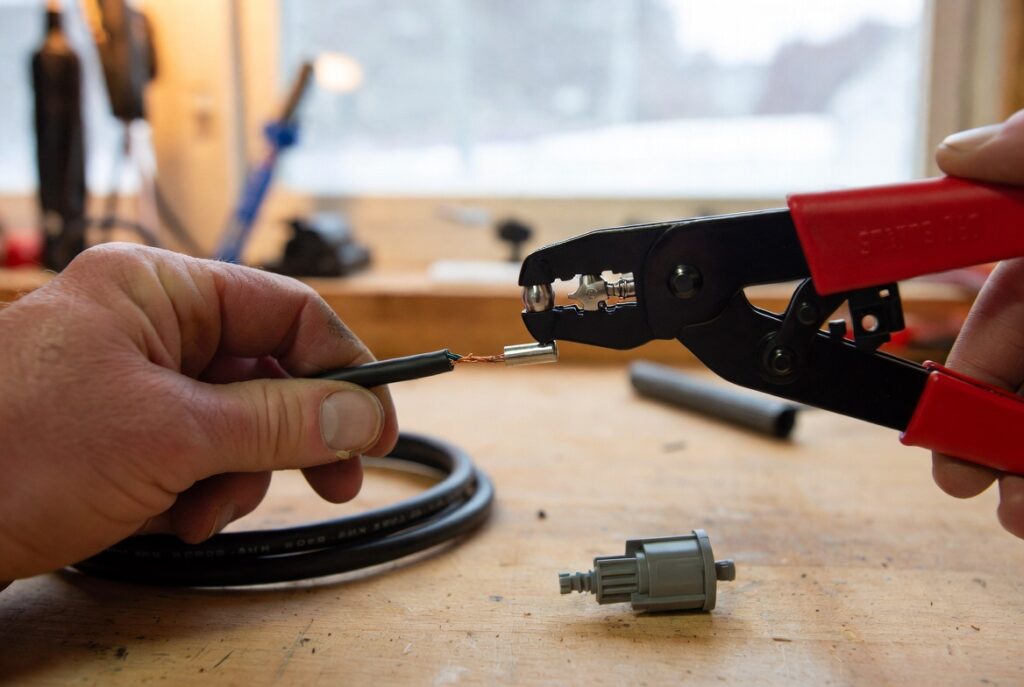
The crimp solar Ontario failure that shows up most reliably in off-grid service work is not a broken panel or a dead inverter but a high-resistance MC4 connection made with a standard hardware store pliers-type crimp tool, because a property owner in Grey Bruce County installed their 400W array with exactly this tool and their Victron SmartShunt showed a 15 percent drop in total array output after 18 months that appeared on clear days and overcast days alike, confirming the loss was in the connections rather than the panels.
A non-ratchet pliers-type tool applies inconsistent, non-measurable force to the MC4 pin. The resulting crimp leaves microscopic gaps in the pin-to-wire contact zone that are invisible to the eye but wide enough for moisture to enter and begin oxidising the copper strands over the following months.
The SmartShunt confirmed the source of the loss: all four connections on the two panels closest to the roof peak showed elevated resistance. The pins were disassembled and the wire pulled back , green corrosion was visible on the copper strands inside the pin barrel, and the pin faces showed heat discolouration from resistance-generated heat during current flow. The corroded wire was cut back to fresh copper, the pins were re-crimped with a WBHome ratchet crimper, and the SmartShunt confirmed full array output was restored on the same afternoon.
The crimp solar Ontario standard that prevents this outcome is built on one tool and four steps: strip the wire to the correct depth, crimp with a ratchet tool that cannot release until full mechanical pressure is applied, pull-test the crimped pin at 25N of axial force, and confirm the MC4 housing seats with an audible click. A ratchet crimp tool that does not release until the correct pressure is applied cannot produce an incomplete crimp. This is the entire argument for the ratchet over the pliers. See our Ontario solar sizing guide before any crimp solar Ontario wiring decision.
The crimp solar ontario standard: why ratchet crimp produces a gas-tight 25-year bond
| Connection method | Bond type | Ontario freeze-thaw | Vibration resistance | ESA approval |
|---|---|---|---|---|
| Ratchet crimp (WBHome) | Gas-tight mechanical | No degradation | Yes , deforms together | Yes , listed method |
| Non-ratchet pliers crimp | Partial, inconsistent | Moisture ingress over time | Marginal , gaps present | Risk , depends on result |
| Solder only | Metallurgical bond | Flux degrades, joint fails | No , hard-point fracture | No , not listed for MC4 |
| Crimp + solder seal (lug only) | Mechanical + moisture seal | Acceptable indoors | Yes , crimp carries load | Yes , when crimp is primary |
A ratchet crimp on an MC4 pin deforms the pin metal and the copper wire together under consistent, measured force. The ratchet mechanism cannot release until the jaws reach the correct crimp depth , the tool physically locks until the deformation is complete, making an undercrimp mechanically impossible. The resulting bond is gas-tight: all oxygen and moisture are excluded from the contact zone between the pin and the wire. The connection is rated for 30A continuous service and a 25-year outdoor lifespan in Ontario conditions. The IEC 60598 pull-test standard confirms a correct ratchet crimp: 25N of axial force , approximately the force of a firm handshake , produces zero movement at the pin-wire interface.
The WBHome ratchet crimper is the correct Tier 2 DIY tool for MC4 solar connections in Ontario. It has the correct jaw profiles for MC4 pin gauges and the ratchet-release mechanism that prevents premature jaw opening. Professional installers use hydraulic crimpers for even more consistent force across large arrays, but the WBHome ratchet produces specification-compliant crimps for all Ontario residential and rural off-grid array work. The non-ratchet pliers from the hardware store cannot produce a gas-tight crimp because the jaw pressure is entirely dependent on hand force, which varies with fatigue, pin orientation, and wire gauge. See our solar wire gauge Ontario guide for the PV cable gauge selection that determines the correct jaw profile.
Why solder fails on MC4 solar pins in Ontario conditions
The first solder failure mode on MC4 pins is capillary wicking. During soldering, molten solder flows by capillary action into the stranded wire bundle under the insulation jacket. When it solidifies, it creates a rigid zone where the wire should be flexible. At the boundary between the soldered rigid section and the unsupported flexible wire, vibration stress concentrates during Ontario wind events. Over 3 to 7 years of roof exposure, fatigue fractures the wire at this hard point. The fracture is inside the insulation and invisible until the output drop is detected on the SmartShunt.
The second solder failure mode is flux contamination and freeze-thaw degradation. Rosin flux is mildly acidic and hygroscopic , it absorbs moisture from the air and holds it at the solder joint under the insulation. In Ontario conditions where temperatures cycle from -30 degrees C to +35 degrees C multiple times per winter and spring, that trapped moisture freezes, expands, and progressively degrades the copper at the joint. An Ontario ESA inspection of a soldered MC4 connection will fail , only listed, rated crimp connections meet the approval standard. The correct crimp solar ontario method is a ratchet crimp that physically excludes moisture rather than trapping it. See our off-grid setup guide for the full Ontario array wiring context.
The hardware store pliers problem: inconsistent force and moisture ingress
The hardware store pliers-type crimp tool is the most common cause of field-assembled crimp solar ontario failures. A non-ratchet tool applies force through hand pressure alone , there is no mechanism that ensures the jaws reach the correct crimp depth. An operator with more or less hand strength, a slightly rotated pin, or a fatigued grip all produce different crimp depths. At the minimum, the result is a crimp that appears complete but leaves microscopic gaps that invite moisture. At the worst, the crimp is partially formed and the wire can be pulled out of the pin with modest force. The entire Grey Bruce output loss was caused by this tool on four connections.
The 15 percent output loss from the Grey Bruce installation developed over 18 months because moisture ingress and copper oxidation are gradual processes. The first clear day after installation would have shown near-normal output. By month 6, the resistance was measurable but not yet visible on the SmartShunt daily summary. By month 18, the SmartShunt was showing 15 percent below the commissioning baseline consistently on every irradiance level. The loss was not in the Renogy panels, the charge controller, or the battery bank , it was in four MC4 pins on two panels that had been crimped with the wrong tool.
The crimp solar ontario verification: strip, ratchet, pull-test, click
The 4-step crimp solar ontario verification protocol applied to every field-assembled MC4 connection. Step 1: strip the wire to the correct depth with a PV-rated wire stripper , approximately 6 to 8mm of exposed copper for MC4 pins, enough to fill the pin barrel without stray strands extending outside it. Step 2: seat the stripped wire in the pin barrel, position the pin in the correct jaw profile of the WBHome ratchet crimper, and squeeze until the ratchet releases , the tool will not release before the correct deformation depth is reached. Step 3: grip the wire and pull axially at 25N force. The pin must not move and the wire must not pull out.
Step 4: insert the crimped pin into the MC4 housing and push until the audible locking click confirms the pin is fully seated. A click that does not occur means the pin is not fully seated and the housing can be pulled open under normal service tension.
A property owner in Wellington County, Centre Wellington applied this 4-step protocol to every MC4 connection in his 400W array at commissioning in fall 2021. He pull-tested every pin before inserting the housing. Three Ontario winters of SmartShunt monitoring confirmed the result: array output per clear-sky PSH is within 2 percent of commissioning day output on identical conditions. Zero green corrosion on the two annual connection inspections. Zero high-resistance connections detected. His comment: “Three winters, same wattage. The ratchet crimper and the pull-test are the whole protocol.”
The Wellington County result is not exceptional , it is the expected outcome of correct crimp solar ontario technique applied consistently. The ratchet crimp tool costs approximately $30 to $40 and is a one-time purchase for the life of the array. The pull-test takes approximately 10 seconds per connection. The audible housing click takes no additional time. The four-step process applied to every field-assembled connection in a 400W array takes approximately 20 minutes. The alternative , diagnosing and repairing high-resistance connections after 18 months of degraded output , took the Grey Bruce property owner an afternoon plus the cost of replacement pins and fresh cable. See our MC4 connector Ontario guide for the full MC4 pin type and compatibility reference.
NEC and CEC: Ontario permit requirements for solar wiring connections
NEC 690 and NEC 110.14 govern solar wiring connections in Ontario. All field-assembled MC4 connections must use listed, rated crimp connections that comply with the connector manufacturer’s assembly instructions. NEC 110.14 specifically requires that connections be made using methods and materials identified as suitable for the application , solder-only connections on MC4 pins are not listed by MC4 connector manufacturers as an approved assembly method and do not comply. All conductors must be terminated using the correct method for their rated temperature, and the connection method must maintain that rating under 25-year outdoor service conditions in Ontario. Contact the NFPA at nfpa.org for current NEC 690 and NEC 110.14 requirements.
CEC Section 64 governs Ontario electrical installations. All solar array field-assembled connections , MC4 pin crimps, junction box terminations, and battery terminal lugs , must be performed under ESA permit by a licensed electrician or by a property owner under a homeowner permit for their primary residence. The ESA inspector will verify that MC4 connections are properly crimped using a listed ratchet crimp tool, not soldered, and that the crimp tool is appropriate for the conductor gauge. Contact the Electrical Safety Authority Ontario at esasafe.com before beginning any Ontario solar array wiring that requires field-assembled MC4 connections.
Pro Tip: Buy one additional set of MC4 pins for your array wire gauge when you order your crimp tool. Field repairs require cutting back degraded wire and re-crimping with fresh pins on fresh copper , having spare pins on the shelf means a repair during a gray streak event does not require a parts run before the fix. The WBHome ratchet crimper kit includes sample pins in multiple gauges. Confirm the correct gauge for your PV cable before purchasing spare pins , 10 AWG PV cable requires a different pin than 12 AWG PV cable and the two are not interchangeable in the housing.
The crimp solar ontario verdict: ratchet tool, 25N pull-test, and the one solder exception
- Ontario property owner who has already installed an array with a hardware store pliers-type crimp tool: test every field-assembled connection with the 25N pull-test before the next winter. Any pin that moves or any wire that pulls out must be re-crimped with a WBHome ratchet crimper on fresh copper. Cut the wire back past any discolouration, re-strip to 6 to 8mm, crimp, pull-test, and click the housing. The Grey Bruce result: full array output restored on the same afternoon after four connections were re-crimped. If the SmartShunt shows unexplained output loss below commissioning baseline on clear days, check the MC4 connections before replacing any other component.
- Ontario property owner building a new array: specify the WBHome ratchet crimper before ordering panels or wire, and apply the 4-step protocol to every field-assembled MC4 connection. The factory-crimped MC4 cables on Renogy panels are already correctly assembled , the crimp risk is only on connections you assemble in the field, including branch connectors, extension runs, and any custom-length array cables. The Wellington County result: three Ontario winters, zero resistance increase, same wattage as commissioning day. The ratchet crimp tool is a $40 investment that protects a $3,000 to $6,000 array for 25 years.
- Ontario property owner asking about the battery terminal lug exception: crimp the lug to full mechanical specification first, then apply solder as a secondary moisture seal only. Crimp the copper compression lug using the WBHome ratchet crimper or a hydraulic lug crimper to full mechanical specification. Then apply a small amount of solder to seal only the wire-entry opening of the lug barrel against moisture ingress in a high-humidity battery enclosure. This technique uses the solder as a secondary seal on top of the mechanical crimp , the crimp carries all the current load. It does not apply to MC4 solar connector pins, which must be crimped only and must never be soldered in any Ontario outdoor solar installation.
Frequently Asked Questions
Q: Can I solder MC4 solar connectors instead of crimping in Ontario?
A: No. Solder fails on MC4 solar connector pins under Ontario outdoor conditions through two mechanisms: capillary wicking creates a hard point at the solder-wire transition that fractures under vibration, and flux contamination traps moisture that freezes, expands, and degrades the joint during Ontario freeze-thaw cycling. An ESA inspection of a soldered MC4 connection will fail , only listed, rated crimp connections are approved for Ontario solar array MC4 pins. The correct crimp solar ontario method is a ratchet crimp that produces a gas-tight mechanical bond excluding all moisture from the contact zone.
The Grey Bruce result confirms what happens without it: 15 percent output loss after 18 months, green corrosion inside four pins, and a full afternoon’s work to cut back and re-crimp the affected connections.
Q: What crimp tool do I need for MC4 solar connectors?
A: The WBHome ratchet crimper is the correct Tier 2 DIY tool for MC4 solar connections in Ontario. It has the correct jaw profiles for MC4 pin gauges and the ratchet-release mechanism that prevents the jaws from opening before the correct crimp deformation depth is reached. This makes it physically impossible to produce an undercrimp , the tool locks until the job is done correctly. The WBHome kit costs approximately $30 to $40 and is a one-time purchase for the life of the array. Do not use a hardware store pliers-type crimp tool for MC4 solar pins , the Grey Bruce result confirms that inconsistent hand-force crimping leads to moisture ingress, copper corrosion, and measurable output loss within 18 months.
Q: How do I know if my MC4 crimp is correct?
A: Apply the 4-step crimp solar ontario verification to every field-assembled connection. Strip the wire to 6 to 8mm exposed copper with a PV-rated stripper. Crimp with the WBHome ratchet crimper until the ratchet releases. Pull the wire axially at 25N , approximately the force of a firm handshake , and confirm the pin does not move. Insert the pin into the MC4 housing and push until the audible locking click confirms full seating. If any connection fails the 25N pull-test, cut back the wire to fresh copper and re-crimp with a new pin. The Wellington County result confirms this protocol works: three Ontario winters of SmartShunt monitoring, zero resistance increase, same wattage as commissioning day across all MC4 connections.
This build is engineered within the 48V DC Safety Ceiling. Diagnostic logic is based on 20+ years of technical service experience. All structural and electrical installations must be verified by a Licensed Professional and comply with your Local AHJ. See our legal and safety disclosure for full scope.
About the Author
Robert Bertrand spent 20 years as a service advisor in the automotive industry (Lexus and Nissan), where precision diagnostics, wiring integrity, and documentation standards were non-negotiable. He brings that same technical discipline to GridFree Guide, where he researches, tests, and documents off-grid solar systems for Ontario conditions. Based in Rockwood, Ontario, every article is built on verified specifications, manufacturer data, and the real-world climate constraints of Canadian off-grid living.
As an Amazon Associate I earn from qualifying purchases. This site also contains affiliate links to other products and services. GridFree Guide earns a small commission at no extra cost to you.