
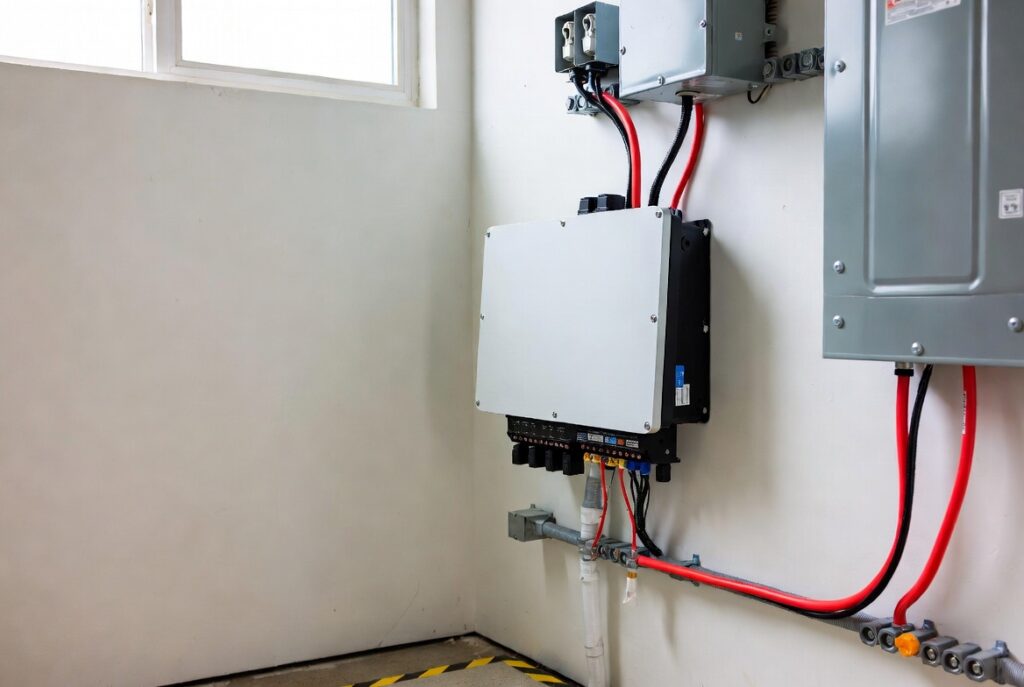
The most expensive string inverter ontario mistake is paying the micro inverter premium on an unshaded roof, because two neighbours in Guelph installed identical 8-panel Renogy 100W panel arrays on their clear south-facing roofs in the same month and after one full year of SmartShunt comparison data the harvest numbers were identical , one paid $600 for a string inverter, the other paid $1,400 for a micro inverter system, and neither system had a shading problem to solve. The micro inverter’s per-panel MPPT provided zero benefit on a roof where all panels received the same irradiance simultaneously. The string inverter ontario is the correct HRSP specification for any Ontario roof without consistent partial shading.
The string inverter wires all panels in series and runs the combined high-voltage DC power to a single central inverter unit inside the utility room. One MPPT tracks the maximum power point for the entire string. On an unshaded roof where all panels receive equal irradiance, this is exactly what the array needs , no per-panel tracking required, no individual inverters bolted to panel backs on the roof, and no distributed electronics exposed to Ontario winters. The $800 hardware difference on an unshaded roof is not a quality tradeoff. It is the price of per-panel MPPT on a roof where per-panel MPPT adds nothing.
The string inverter Ontario system still requires IESO interconnection approval for any HRSP grid-tied application. The inverter must appear on the IESO approved equipment list before the utility will approve the interconnection. This requirement applies equally to string inverters and micro inverters , the approval path is identical, and the hardware cost and service location are the only differences between the two architectures on a clear Ontario roof. See our Ontario solar sizing guide before any string inverter Ontario specification.
The string inverter ontario case: how it works and why it costs half the micro inverter price
| Inverter type | Hardware cost (8 panels) | MPPT | Service location | Ontario unshaded roof verdict |
|---|---|---|---|---|
| String inverter (plain) | ~$600 | One central MPPT | Utility room , indoors | Correct specification, identical harvest |
| String + power optimizers | ~$800-900 | Per-panel voltage, central MPPT | Utility room , indoors | Correct for occasional minor shading |
| Micro inverter system | ~$1,400 | Per-panel MPPT and inverter | Roof , outdoor, panel access required | Correct only when 2+ panels shade consistently |
A string inverter works by wiring all panels in series into a combined high-voltage DC string. That string runs on a single pair of cables to the central inverter unit in the utility room, where one MPPT circuit tracks the maximum power point for the entire array and converts the DC to grid-tied AC. On an unshaded Ontario roof, all panels receive equal irradiance at the same time throughout the day. The single MPPT handles all panels correctly because they are all operating at the same conditions. There is no scenario on an unshaded roof where per-panel tracking would improve the output.
The physical installation simplicity of the string inverter ontario architecture also reduces array wiring complexity. One DC positive and one DC negative cable run from the array string to the inverter input , no individual AC wiring drops from each panel to a trunk cable as required in micro inverter systems. All of the complexity , MPPT, DC-to-AC conversion, anti-islanding protection, and grid synchronisation , happens in the single indoor unit. When that unit needs service, the property owner or electrician accesses the utility room. No ladder, no roof, no weather window required. See our solar wire gauge Ontario guide for the string DC wiring sizing details.
The string inverter ontario serviceability advantage: utility room swap versus January roof access
A property owner in Erin Township, Centre Wellington ran a string inverter ontario system on a clear south-facing 8-panel array. In year 7 of operation, the inverter unit failed , a common failure mode for string inverter electronics after 7 to 10 years of continuous operation. He walked into the utility room, disconnected the failed unit, connected the replacement, and had the system back online before noon. Total time from failure diagnosis to recommissioning: under 2 hours. The replacement cost was the inverter unit only. No roof access, no weather check, no safety equipment required for the swap itself.
His neighbour experienced a micro inverter failure in the same month. The failed unit was bolted to the back of a roof panel in January. Accessing it required a licensed electrician, safety equipment, snow removal from the affected panel, panel lifting, and the replacement work itself. The total time from failure to recommissioning was 10 days , the electrician could not access the roof safely until a weather window opened. During those 10 days, the system was completely offline through a stretch that included a 4-day Ontario gray streak event. His comment: “I fixed mine before lunch. My neighbour was dark for 10 days waiting for someone to get on the roof.”
The string inverter ontario serviceability advantage is most significant in the October through March window when Ontario weather makes roof access difficult, time-consuming, and expensive. A string inverter failure in January is a 2-hour utility room job. A micro inverter failure in January is a weather-dependent roof access event that can extend system downtime by days or weeks depending on the electrician’s schedule and the weather. The Erin Township comparison is not an edge case , it is the realistic Ontario winter service scenario for both inverter architectures. See our micro inverter Ontario guide for the full shading comparison that determines which architecture is correct for a given roof.
The IESO approval requirement: what grid-tied Ontario inverters must have before HRSP interconnection
Any inverter used in an Ontario HRSP grid-tied installation must appear on the IESO approved equipment list for grid-tied solar before the local distribution company will approve the interconnection. The IESO maintains the list and updates it when new inverter models are certified. The property owner or installer verifies the specific inverter model number against the IESO list before applying for interconnection approval , the brand name is not sufficient, the exact model number must be on the list. Both string inverters and micro inverters must meet this requirement. The approval path is identical for both inverter types.
The IESO approval is a separate process from the ESA permit. The ESA permit covers the electrical installation , wiring, connections, disconnects, and the physical inspection. The IESO approval covers the grid interconnection , the utility agrees to allow the inverter to connect to their distribution system and export power under the net metering program. Both approvals must be in place before the system is commissioned for grid export. The combined process from ESA permit application to IESO interconnection approval typically takes 4 to 12 weeks. See our grid tied Ontario guide for the full HRSP approval sequence.
When to choose the string inverter and when to choose the micro inverter
The string inverter ontario decision is a shade audit decision first. On a clear day in late September between 10 AM and 4 PM, observe the roof where the array will be installed and watch whether any shadow crosses any panel during the full 6-hour window. September is the correct month because the sun angle is low enough to reveal tree and chimney shadows that do not appear in summer but persist through the entire October to February low-PSH period. If the panels are completely clear for the full window, specify the string inverter and save the $800 micro inverter premium. The Guelph SmartShunt comparison confirms the output will be identical.
If any shadow consistently crosses two or more panels for two or more hours per day from September through February, micro inverters are the correct specification for those panels , the Orangeville 19 percent annual harvest recovery from the micro inverter article confirms the return on the premium in that shading scenario. Power optimizers (SolarEdge system) are a middle path: per-panel voltage management with a central string inverter, costing more than a plain string but less than full micro inverters. For roofs with occasional minor shading that does not consistently hit two or more panels, power optimizers resolve most shading losses without placing individual inverters on the roof. See our micro inverter Ontario guide for the complete shading threshold analysis.
NEC and CEC: Ontario permit requirements for HRSP string inverter installations
NEC 690 and NEC 70 govern grid-tied solar installations in Ontario including string inverter ontario HRSP systems. Array wiring must be sized for 125 percent of Isc at the cold Voc design voltage for Ontario January conditions , at -10 degrees C, apply a 1.08 multiplier to the STC Voc before sizing the DC input wiring. All outdoor array wiring must use UV-resistant, sunlight-resistant rated cable. The string inverter must appear on the IESO approved equipment list and must include anti-islanding protection certified to UL 1741 or equivalent. Contact the NFPA at nfpa.org for current NEC 690 requirements for Ontario HRSP installations.
CEC Section 64 governs Ontario electrical installations. Any HRSP string inverter Ontario system requires an ESA permit at $300 to $400 before installation begins, IESO interconnection approval from the local distribution company, and installation by a licensed electrician. The IESO interconnection agreement must be signed with the utility before the grid export function is commissioned. An uninspected or unpermitted HRSP installation will not qualify for Ontario net metering credits. Contact the Electrical Safety Authority Ontario at esasafe.com before beginning any string inverter ontario HRSP installation.
Pro Tip: Before committing to either a string inverter or a micro inverter system for your Ontario HRSP installation, spend one September afternoon doing the shade audit. Set a reminder for a clear day between September 15 and 30, stand at the array location from 10 AM to 4 PM, and photograph the roof every hour on the hour. If any shadow appears on any panel across those six photos, you have a shading scenario to evaluate. If all six photos show a clear unshaded array, specify the string inverter ontario system and direct the $800 micro inverter premium savings toward additional battery storage. The Guelph SmartShunt data confirms the string inverter delivers identical annual harvest on any unshaded Ontario south-facing roof , the shade audit determines which roof yours is.
The string inverter ontario verdict: correct for clear roofs, wrong for shaded ones
- Ontario property owner with a clear south-facing roof and no shading: specify a string inverter from the IESO approved equipment list and save the $800 micro inverter premium. The Guelph SmartShunt comparison confirms the output is identical on an unshaded roof , one full year of data with zero measurable difference between the $600 string inverter and the $1,400 micro inverter on the same street with the same array. Direct the $800 savings toward additional battery storage or array expansion. Do the September shade audit first to confirm the roof qualifies.
- Ontario property owner who has experienced a string inverter failure: a utility room swap of the inverter unit typically restores the system in under 2 hours at the cost of the replacement unit only. The Erin Township result confirms this , year 7 failure, accessed the utility room, back online by noon. Ensure the ESA permit was obtained for the original installation before any replacement work begins, and confirm the replacement unit also appears on the IESO approved equipment list before reconnecting to the grid. If the original installation was done without an ESA permit, apply for an after-the-fact amendment through the ESA before recommissioning.
- Ontario property owner unsure whether their roof qualifies for a string inverter: do the September shade audit on a clear day between 10 AM and 4 PM and photograph the array every hour. If any shadow crosses two or more panels for two or more hours during that window, the string inverter ontario specification is not correct for that roof , see our micro inverter Ontario guide for the shading scenario specification. If the roof is completely clear across all six photos, the string inverter delivers identical harvest at half the micro inverter price. The shade audit takes one afternoon and determines which $800 decision is correct for the specific roof.
Frequently Asked Questions
Q: Is a string inverter better than a micro inverter for an Ontario solar system?
A: On any unshaded south-facing Ontario roof, the string inverter ontario delivers identical annual harvest at approximately half the hardware cost of a micro inverter system. The Guelph SmartShunt comparison confirms this with one full year of data showing no measurable output difference between a $600 string inverter and a $1,400 micro inverter on identical 8-panel arrays with no shading. The string inverter is also significantly easier to service , a utility room swap versus roof access in potentially winter conditions. The micro inverter is the correct choice only when consistent partial shading affects two or more panels for two or more hours per day, as confirmed by the Orangeville 19 percent annual harvest recovery from the micro inverter article.
Q: What is the IESO approved equipment list and why does my Ontario inverter need to be on it?
A: The IESO approved equipment list is maintained by the Independent Electricity System Operator and specifies which inverter models are certified for grid interconnection under the Ontario HRSP program. Any inverter connected to the Ontario distribution grid must appear on this list by specific model number before the local distribution company will approve the interconnection. The list ensures that all grid-tied inverters meet the anti-islanding, power quality, and safety standards required for safe parallel operation with the utility grid. Both string inverters and micro inverters must be on the list , neither type can be connected under HRSP without this certification. The IESO updates the list as new models are certified.
Q: How long does a string inverter last in Ontario and what happens when it fails?
A: Quality string inverter ontario units typically last 7 to 12 years in continuous operation. When a unit fails, a licensed electrician accesses the utility room, disconnects the failed unit, connects the replacement, and recommissions the system , typically in under 2 hours. The Erin Township year-7 failure was back online by noon on the day of diagnosis. The replacement cost is the inverter unit only, with no roof access, no weather dependency, and no safety equipment beyond standard electrical precautions. This is the key serviceability advantage over micro inverters, where a single unit failure requires roof access to the back of the affected panel , a weather-dependent event that can take days to schedule in Ontario January conditions.
This build is engineered within the 48V DC Safety Ceiling. Diagnostic logic is based on 20+ years of technical service experience. All structural and electrical installations must be verified by a Licensed Professional and comply with your Local AHJ. See our legal and safety disclosure for full scope.
About the Author
Robert Bertrand spent 20 years as a service advisor in the automotive industry (Lexus and Nissan), where precision diagnostics, wiring integrity, and documentation standards were non-negotiable. He brings that same technical discipline to GridFree Guide, where he researches, tests, and documents off-grid solar systems for Ontario conditions. Based in Rockwood, Ontario, every article is built on verified specifications, manufacturer data, and the real-world climate constraints of Canadian off-grid living.
As an Amazon Associate I earn from qualifying purchases. This site also contains affiliate links to other products and services. GridFree Guide earns a small commission at no extra cost to you.