
The most common solar heater ontario mistake is connecting a 1,500W electric space heater to an off-grid battery bank, because a property owner in Orangeville, Dufferin County did exactly this in October and his Victron SmartShunt showed the battery bank at 8 percent SoC every evening by 6 PM within the first week. This happened when a 12,000Wh daily heating load was added to a system sized for approximately 2,000Wh of daily household consumption. The 1,500W heater running 8 hours consumed 6 times the total daily energy budget of the entire Tier 2 system.
He had sized his Tier 2 system correctly for the standard loads: furnace blower, well pump with SoftStart, chest freezer, lights, and router totalling approximately 2,000Wh per day. His 200Ah Battle Born heated LFP bank provided approximately 4-day gray streak autonomy at that load. The 1,500W space heater multiplied his daily consumption by 7 before he had run it for a single full week.
His SmartShunt showed the situation exactly. The bank drew down at approximately 50A net deficit on a 24V system from the moment the heater came on at 4 PM. At that depletion rate, the 200Ah bank reached the 30 percent SoC generator trigger in approximately 3 to 4 hours. He was running the generator from 6 PM until 9 or 10 PM every night at approximately $6 to $8 per night, approximately $200 per month, to run a single space heater.
The fix was immediate: a propane wall heater for the living space and a 500W ceramic cube heater for the battery utility room only. The SmartShunt confirmed the bank returned to the 2,000Wh daily baseline within 24 hours. See our Ontario solar sizing guide before any solar heater ontario load calculation.
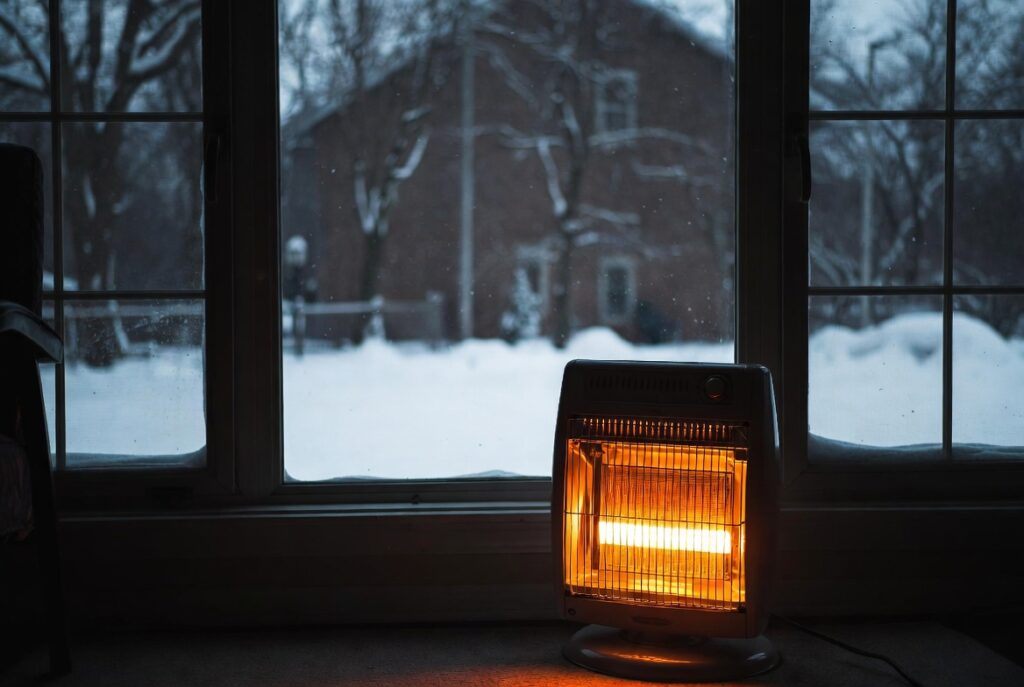
[Feature image: Ontario living room in winter, electric space heater glowing orange against a dark window with snow outside, no brand logos, photorealistic, 16:9]
Alt text: solar heater Ontario
The solar heater ontario math: why 1,500W resistance heating is incompatible with a Tier 2 bank
| Heating method | Daily energy | 4-day bank needed | Cost per month | Ontario verdict |
|---|---|---|---|---|
| 1,500W electric space heater (8h) | 12,000Wh | ~56,000Wh (30 cells) | ~$200 generator fuel | Incompatible with Tier 2 bank |
| 500W mini-split heat pump (8h) | 4,000Wh | ~24,000Wh (13 cells) | ~$40-60 generator supplement | Feasible with larger 400Ah 48V bank |
| Propane wall heater (no battery) | 0Wh from battery | No change to bank | ~$80-100 propane | Correct Ontario off-grid heating standard |
| 500W ceramic cube (battery room only, 4h) | 2,000Wh | Standard Tier 2 bank | Included in gray streak protocol | The only correct solar heater ontario application |
A 1,500W space heater running for 8 hours consumes 12,000Wh per day. The standard Tier 2 Ontario off-grid daily consumption is approximately 2,000Wh. The total daily load with the heater is approximately 14,000Wh. Over a 4-day Ontario gray streak, this totals 56,000Wh. To handle this load with 4-day autonomy, you need approximately 30 Battle Born cells at approximately $27,000 for the bank alone , before a single panel, wire, or inverter is purchased. An array of approximately 11,000W is additionally required to replenish 14,000Wh daily at 1.5 January PSH.
The bank sizing alone makes electric resistance heating unworkable for most Ontario solar heater ontario installations. Even in summer at 5.0 PSH, replenishing 14,000Wh per day requires approximately 3,300W of array capacity. No standard Tier 2 Ontario system is designed for either array size. Electric resistance heating is a feasible solar heater ontario load only for brief, targeted applications such as a battery utility room , not for continuous space heating of a living area. See our solar system planning ontario guide for the correct Tier 2 bank and array sizing process.
The Ontario heating alternatives: propane, mini-split, and wood stove compared
Propane wall heaters deliver heat without touching the battery bank at all. At approximately $0.15 to $0.20 per kWh equivalent at Ontario retail propane prices, a propane heater costs approximately $80 to $100 per month in peak winter to heat a 600-square-foot Ontario living space , versus the $200 per month in generator fuel the Orangeville property owner had been burning to run the electric heater. His 18,000 BTU propane wall heater eliminated the solar heater ontario drain the same day he installed it, and his bank returned to normal 4-day gray streak autonomy immediately. The propane heater requires a licensed TSSA gasfitter for installation and proper combustion air ventilation , it is not a DIY appliance.
A cold-climate mini-split heat pump draws approximately 300W to 500W to deliver the same BTU output as a 1,500W resistance heater, at a coefficient of performance of approximately 2.5 to 3.0. At 500W for 8 hours, the daily heating load drops to 4,000Wh rather than 12,000Wh , still double the standard Tier 2 daily consumption but potentially manageable with a 400Ah 48V bank and a 600W to 800W array on a well-insulated Ontario property.
A wood stove requires zero electricity, produces dry heat that reduces humidity in the living space, and eliminates the heating load entirely from the solar heater ontario system calculation. See our winter solar Ontario guide for the full Ontario winter energy context that makes these comparisons concrete.
The solar heater ontario legitimate use case: protecting the battery room at 500W
The one correct solar heater ontario application is a 200W to 500W ceramic cube heater in the unheated battery utility room, on a thermostat set to 5 degrees C.
The goal is not space heating. It is equipment protection. When an unheated Ontario garage drops to -15 degrees C from November through March, a standard LFP battery bank cannot accept any charging current , the BMS activates the charge protection circuit. The Battle Born heated LFP has an internal self-heating element that activates at approximately 2 degrees C, but that element draws energy from the bank to produce the heat. A 500W ceramic heater on a thermostat at 5 degrees C keeps the utility room warm enough that the self-heating element never activates.
That protection covers both bank capacity and energy reserves throughout the Ontario winter months.
A property owner in Halton Hills, Halton Region installed this exact setup for her fall 2024 Tier 2 build. The ceramic cube heater ran approximately 3 to 4 hours per day at 500W in the coldest months , consuming approximately 1,500 to 2,000Wh daily. The SmartShunt confirmed the bank never dropped below 7 degrees C cell temperature all winter. The BMS charge block never triggered. The Victron MultiPlus-II and the MPPT 100/30 operated at full rated efficiency through every January cold snap.
Her comment: “The heater uses less power than my fridge. The battery bank never got cold. That is the entire solar heater ontario strategy I needed.” The 2,000Wh daily heater load at maximum is included in the gray streak generator protocol as a standard load. The MultiPlus-II built-in charger at 50A bulk restores the combined household and heating load in a single 90-minute generator run, and the SmartShunt confirms the recovery on every run. See our solar battery heater ontario guide for the complete Battle Born heated LFP specification and the winter charging protocol.
The thermal mass opportunity: storing summer solar surplus as heat
The legitimate solar heater ontario opportunity for surplus energy is thermal mass charging in fall and spring. Ontario off-grid systems frequently produce more energy than the household consumes from May through October. That surplus currently goes to waste or to a grid export credit. A water heater tank on a dedicated AC circuit controlled through the MultiPlus-II can absorb hundreds of watt-hours of surplus energy per day as hot water, holding that heat for 12 to 24 hours. A heated concrete floor with thermal mass stores hours of heat energy for release after the sun goes down, reducing propane consumption on shoulder-season days when the house needs only mild supplemental heat.
In January at 1.5 PSH, there is rarely surplus solar energy to store as thermal mass. The MPPT 100/30 is running every available watt into the battery bank to maintain gray streak autonomy. The thermal mass strategy is a fall and spring technique , not a January solar heater ontario strategy. Run propane or wood for January heat. Run thermal mass charging in October and April when the panels produce more than the household consumes. This phased approach is the only solar heater ontario heating strategy that is both financially defensible and technically compatible with a standard Ontario Tier 2 system. See our off-grid setup guide for the MultiPlus-II surplus energy routing configuration.
NEC and CEC: Ontario permit requirements for off-grid solar and heating systems
NEC 690 and NEC 70 (NFPA 70, the National Electrical Code) govern off-grid solar installations in Ontario, including any permanently wired heating appliance connected to the off-grid AC output. A ceramic cube heater on a dedicated circuit through the MultiPlus-II AC output must be installed with circuit protection and wiring sized for 125 percent of the appliance’s rated current. A 500W ceramic cube heater at 120V draws approximately 4.2A , the circuit wiring must be rated for at least 5.25A, typically satisfied by standard 15A residential wiring. Contact the NFPA at nfpa.org for current NEC 690 and NEC 70 requirements for off-grid heating appliance installations in Ontario.
CEC Section 64 governs Ontario electrical installations. Any permanently wired heating appliance added to an existing off-grid solar system requires an ESA permit amendment covering the new circuit wiring, circuit protection, and connection to the inverter AC output. Propane appliances additionally require Technical Standards and Safety Authority (TSSA) approval and installation by a licensed TSSA gasfitter , propane appliance installation is not covered by the ESA permit. Contact the Electrical Safety Authority Ontario at esasafe.com for the ESA permit process and the TSSA at tssa.org for propane installation requirements in Ontario.
Pro Tip: Use surplus fall solar power to pre-charge thermal mass before the heating season begins. In October, an Ontario off-grid system regularly produces 3 to 4 PSH per day , often more than the household needs. Route that surplus through the MultiPlus-II to a dedicated water heater circuit on a timer. Pre-heating a 60-gallon water tank to 60 degrees C stores approximately 4,000Wh of heat energy that the household draws on over 12 to 18 hours without touching the battery bank. Over 30 October days, this thermal pre-charging displaces approximately 120,000Wh of propane or electric heating energy that would otherwise be needed in November. The SmartShunt confirms the surplus routing is not affecting battery bank SoC , if the bank hits 100 percent and the timer activates the water heater circuit, the surplus goes to hot water rather than being wasted.
The solar heater ontario verdict: propane for the house, ceramic cube for the battery room
- Ontario property owner who has already connected an electric space heater to an off-grid battery bank and is experiencing rapid bank depletion: disconnect the space heater immediately and run the SmartShunt diagnostic to confirm the bank is recovering to the 2,000Wh daily baseline. Install a propane wall heater for the living space , a licensed TSSA gasfitter handles installation. Add a 500W ceramic cube heater on a thermostat at 5 degrees C for the battery utility room if the room drops below 0 degrees C in winter. The Orangeville result: SmartShunt confirmed the 2,000Wh daily baseline restored within 24 hours. Generator runs dropped from every night to once every 4 days. No bank replacement, no new panels , just the correct heating appliance for each application.
- Ontario property owner planning a new build who wants electric heating: specify a cold-climate mini-split heat pump rather than resistance space heaters as the solar heater ontario strategy. A 500W mini-split running 8 hours draws 4,000Wh , twice the standard Tier 2 daily load but manageable with a 400Ah 48V Battle Born heated LFP bank and a 600W to 800W array on a well-insulated Ontario property. Include the mini-split load in the bank sizing calculation from day one. The SmartShunt from commissioning confirms whether the system is meeting the combined heating and household load through the first Ontario winter.
- Ontario property owner with a battery bank in an unheated garage or utility room: this is the correct solar heater ontario application and the only one that works with a standard Tier 2 system. Install a 200W to 500W ceramic cube heater on a thermostat at 5 degrees C in the battery room. The heater protects the MultiPlus-II, the MPPT 100/30, and the Battle Born bank from temperature-related performance loss through all four Ontario winter months. At 500W for 3 to 4 hours per day, the heater consumes 1,500 to 2,000Wh included in the standard gray streak generator protocol. The Halton Hills result: bank never below 7 degrees C, BMS charge block never triggered, heated LFP self-heating element barely needed.
Frequently Asked Questions
Q: How many solar panels do I need to run a 1,500W space heater in Ontario?
A: To run a 1,500W space heater for 8 hours daily in January at Ontario’s 1.5 peak sun hours, you need approximately 11,000W of panels , roughly 110 standard 100W panels. This is not a practical configuration for any Ontario residential off-grid property. The math breaks down as follows: 14,000Wh total daily consumption (12,000Wh heater plus 2,000Wh other loads) divided by 1.5 PSH times 0.85 system efficiency equals approximately 11,000W of required array capacity. Even in July at 5.0 PSH, the same calculation requires approximately 3,300W. The solar heater ontario answer for electric space heating is not more panels , it is propane or mini-split for the living space and a small ceramic cube for the battery room.
Q: What is the best way to heat an off-grid home in Ontario without a huge battery bank?
A: A propane wall heater is the most practical primary heat source for an Ontario off-grid home. It burns propane at approximately $0.15 to $0.20 per kWh equivalent and costs approximately $80 to $100 per month in peak winter , without consuming any battery bank capacity or requiring any additional solar array. A cold-climate mini-split heat pump is the electric alternative, drawing approximately 300W to 500W for the same BTU output as a 1,500W resistance heater. A wood stove is the most resilient option, requiring zero electricity.
For the battery utility room specifically, a 500W ceramic cube heater on a thermostat at 5 degrees C is the correct solar heater ontario application. It keeps the bank from freezing without meaningfully affecting daily energy consumption.
Q: Can I use a small electric heater to protect my solar battery bank from freezing in Ontario?
A: Yes , this is the only correct solar heater ontario application. A 200W to 500W ceramic cube heater on a thermostat set to 5 degrees C in the battery utility room keeps the Battle Born LFP bank above the BMS charge block temperature threshold through all Ontario winter months. At 500W for 3 to 4 hours per day, the heater consumes approximately 1,500 to 2,000Wh, the same as the total standard Tier 2 other-loads daily consumption.
This is included in the gray streak generator protocol as a standard load and does not require any change to the bank size or array. The Halton Hills result confirms this works: bank never below 7 degrees C all winter, BMS charge block never triggered, and the heated LFP self-heating element barely needed because the room stayed warm throughout.
This build is engineered within the 48V DC Safety Ceiling. Diagnostic logic is based on 20+ years of technical service experience. All structural and electrical installations must be verified by a Licensed Professional and comply with your Local AHJ. See our legal and safety disclosure for full scope.
About the Author
Robert Bertrand spent 20 years as a service advisor in the automotive industry (Lexus and Nissan), where precision diagnostics, wiring integrity, and documentation standards were non-negotiable. He brings that same technical discipline to GridFree Guide, where he researches, tests, and documents off-grid solar systems for Ontario conditions. Based in Rockwood, Ontario, every article is built on verified specifications, manufacturer data, and the real-world climate constraints of Canadian off-grid living.
As an Amazon Associate I earn from qualifying purchases. This site also contains affiliate links to other products and services. GridFree Guide earns a small commission at no extra cost to you.