
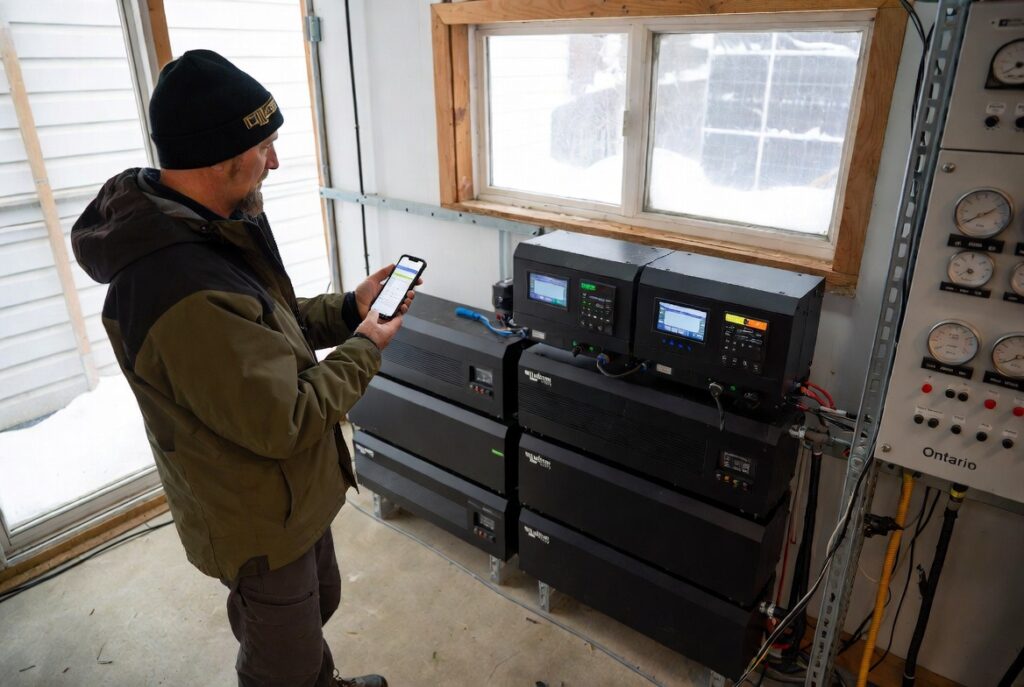
The most dangerous Ontario solar battery monitor mistake is using a voltmeter as a state of charge indicator, because a property owner in Rockwood, Wellington County spent the first winter of his off-grid system running his generator four hours per day based on a 12.8V reading on his 24V LFP bank, believing the bank was nearly depleted, until a Victron SmartShunt revealed that the bank was at 67 percent SoC and the 12.8V reading was a temporary voltage dip under furnace load that had nothing to do with the actual capacity remaining in the cells.
He had applied lead-acid logic to LFP chemistry. On a lead-acid battery, 12.8V at 12V nominal indicates a bank approaching 50 percent DoD. On an LFP battery, 12.8V under load is meaningless without knowing the discharge rate, the surface charge history, and the resting voltage after a 30-minute rest.
After the SmartShunt installation, the first week of data was clarifying. His bank cycled between 85 percent and 42 percent SoC through normal operation, never approaching the dangerous depletion he had feared. The voltage readings he had been watching ranged from 12.6V to 13.4V across that entire SoC range, a spread of less than 0.8V that told him almost nothing useful about remaining capacity. The SmartShunt confirmed he had approximately 14 more hours of autonomy at normal load every time the voltmeter had him reaching for the generator key. His bank was consuming approximately $40 per week in generator fuel it did not need.
The solar battery monitor problem was not his system. It was his instrument. A voltmeter measures electrical pressure across the terminals. LFP chemistry is so electrochemically stable that the pressure barely changes across 70 percent of the usable capacity range. The SmartShunt does not measure pressure , it counts every amp that enters and leaves the battery, integrates that count against the bank capacity, and reports the result as a percentage that means the same thing at 2 AM in January as it does at noon in July. See our Ontario solar sizing guide before specifying any solar battery monitor for an Ontario system.
The solar battery monitor problem: why LFP voltage tells you almost nothing about remaining capacity
| Monitoring method | How it works | LFP accuracy | Surface charge fooled? | Ontario verdict |
|---|---|---|---|---|
| Voltmeter only | Measures terminal pressure (V) | Poor , 0.3V across 70% SoC range | Yes , reads high after brief sun | Unreliable. Causes unnecessary generator runs. |
| MPPT display | Shows array voltage, not bank SoC | None , wrong metric entirely | Yes | Array health only. Not a solar battery monitor. |
| Victron SmartShunt | Counts every amp in and out (Coulomb) | Excellent , true SoC regardless of load | No , current-based, not voltage-based | Correct Ontario solar battery monitor standard. |
| BMS app (some units) | Reports individual cell voltages | Moderate , cell balance visible, SoC estimated | Partial | Useful supplement, not a replacement for SmartShunt. |
LFP batteries have a flat discharge curve. From 90 percent to 20 percent SoC, the resting voltage only changes from approximately 13.3V to 13.0V on a 12V nominal bank , less than 0.3V difference across 70 percent of the usable capacity. Under load, voltage drops further based on current draw, making voltage readings under load unreliable for SoC determination. Surface charge from a few minutes of morning sun pushes terminal voltage 0.2 to 0.5V above true resting voltage, creating false confidence in a bank that may be significantly depleted.
Lead-acid logic does not transfer to LFP chemistry. A lead-acid bank at 12.8V is genuinely at approximately 50 percent DoD and the voltage reading is meaningful. An LFP bank at 12.8V under a 6A furnace blower load could be anywhere from 85 percent to 30 percent SoC depending on discharge rate and recent charging history. The Rockwood property owner applied the lead-acid mental model to an LFP bank and ran $40 per week in unnecessary generator fuel through an entire Ontario winter.
The correct solar battery monitor for LFP chemistry is an instrument that counts amp-hours rather than one that measures voltage. See our solar battery heater guide for the winter battery bank standard that pairs with the SmartShunt for Ontario systems.
The solar battery monitor solution: how the SmartShunt counts amps and calculates time-to-empty
The Victron SmartShunt uses Coulomb counting to provide accurate state of charge. It measures the current flowing through the shunt resistor at 100ms intervals, integrates the current over time, and subtracts the accumulated amp-hours from the programmed bank capacity to produce a true SoC percentage. A bank that starts at 100 percent SoC and discharges 80Ah shows 60 percent SoC on a 200Ah bank regardless of what the voltage reads under load or at rest. The SmartShunt is not fooled by surface charge because it measures actual current flow rather than terminal pressure.
A property owner in Halton Hills, Halton Region had the SmartShunt installed from commissioning day on his fall 2024 Tier 2 build. During a February 2025 gray streak, the panels were producing approximately 1.5A to 2A on overcast days while the system drew approximately 43A. At 8 PM on day 3, the SmartShunt time-to-empty display showed 6.2 hours remaining at the current net deficit. He ran the generator for 90 minutes. The Victron MultiPlus-II built-in charger delivered 50A bulk to the Battle Born heated LFP bank, restoring it to 94 percent SoC in 90 minutes.
No anxiety. No guessing about whether the generator was needed. No waking at 2 AM to check a voltmeter. His comment: “I just looked at the number and made a decision. 6.2 hours is not a lot. Time to run the generator.” The SmartShunt also measures net amps in real time , when the MPPT delivers 2A from a weak February sun and the system draws 43A, the SmartShunt shows negative 41A net and calculates the exact time-to-empty at that specific deficit without any calculation on the property owner’s part. See our solar power outage guide for how the SmartShunt manages gray streak autonomy during Hydro One failures.
The SmartShunt calibration protocol: Peukert, tail current, and charged voltage for Battle Born LFP
Four settings in Victron Connect determine whether the SmartShunt solar battery monitor produces accurate readings or misleading ones. The first is battery capacity , enter the actual amp-hours of the bank (100Ah for one Battle Born cell, 200Ah for two wired in series or parallel). The second is the Peukert exponent , set this to 1.05 for Battle Born LFP, which accounts for slightly reduced capacity at high discharge rates and produces more accurate SoC readings when the furnace blower and well pump are cycling simultaneously. The third is charged voltage, set this to 0.2V below the Victron MPPT 100/30 absorption voltage to prevent premature 100 percent sync on partial charges.
The fourth and most critical setting is tail current , set to 4 percent of bank capacity. For a 100Ah bank that is 4A; for a 200Ah bank that is 8A. When the charge current tapers to this level after a full bulk and absorption cycle, the bank is genuinely saturated and the SmartShunt resets to 100 percent SoC. Setting tail current below 2 percent causes the shunt to sync to 100 percent before the bank is fully saturated. This overstates remaining capacity and compounds with every charge cycle.
The shunt must also be installed as the only connection to the battery negative terminal , any ground wire that bypasses the shunt produces incorrect SoC readings because current is flowing outside the measurement circuit. See our off-grid setup guide for the complete battery bank wiring sequence.
The gray streak net amp calculation: using time-to-empty to decide when to run the generator
The Ontario Tier 2 winter running load totals approximately 1,040W or approximately 43A on a 24V system: furnace blower (80W), well pump with SoftStart (870W running), chest freezer (45W average), LED lighting and router (45W combined). When February clouds reduce the MPPT output to 2A while the system draws 43A, the net deficit is 41A. At 41A net deficit from a 200Ah bank starting at 50 percent SoC with 100Ah remaining, the SmartShunt time-to-empty reads approximately 2.4 hours. That number is the generator run trigger. Without a solar battery monitor providing that number, the property owner either runs the generator too early and wastes fuel or runs it too late and over-discharges the bank.
The gray streak protocol with a correctly calibrated SmartShunt is straightforward. Check the time-to-empty reading at sunset each day of the gray streak. When the reading shows less than 6 hours remaining, start the generator and run it for 90 minutes. The MultiPlus-II built-in charger at 50A bulk restores approximately 2,400Wh on a 24V system in 90 minutes, pushing the bank from 30 percent back to approximately 90 percent SoC and buying 2 to 3 more days of autonomy before the next generator run.
The SmartShunt confirms the result on every run. The post-charge SoC reading removes all doubt about whether the generator run was sufficient. See our solar battery cost ontario guide for the complete Battle Born bank cost breakdown.
NEC and CEC: Ontario permit requirements for battery bank installations and shunt wiring
NEC 690 and NEC 70 (NFPA 70, the National Electrical Code) govern battery bank installations in Ontario, including the monitoring shunt and all associated wiring. The SmartShunt installs on the battery negative terminal and must be wired with conductors sized for the maximum continuous current of the battery bank. A 200Ah 24V bank with a 2,000W inverter draws approximately 42A continuous at 48V , the shunt conductors and the shunt itself must be rated for this current with appropriate fusing on the positive terminal. The shunt wiring is part of the ESA permit scope for the complete battery bank installation. Contact the NFPA at nfpa.org for current NEC 690 requirements for battery bank monitoring installations in Ontario.
CEC Section 64 governs electrical installations in Ontario. The SmartShunt installation is covered under the ESA permit for the permanent battery bank wiring at $300 to $400 before installation begins. Any additions to an existing battery bank installation, including the addition of a monitoring shunt after initial commissioning, require an amended ESA permit. A licensed electrician must complete the installation and schedule the ESA inspection. Contact the Electrical Safety Authority Ontario at esasafe.com before beginning any battery bank or solar battery monitor installation in Ontario.
Pro Tip: The most revealing SmartShunt test is to watch the SoC reading on the first clear morning after a multi-day gray streak. If the SoC reading jumps from 35 percent to 78 percent within 2 hours of sunrise, the bank is healthy and the SmartShunt calibration is correct. If the SoC reading barely moves despite high panel output, the tail current threshold may be set too low and the 100 percent sync reference point has drifted. Run a full charge cycle from below 20 percent SoC through bulk and absorption until the charge current tapers to 4 percent of bank capacity, confirm the SmartShunt syncs to 100 percent at that point, and the calibration is restored. The Rockwood property owner ran this re-sync cycle after installation and the SmartShunt has read accurately through two full Ontario winters since.
The solar battery monitor verdict: every Ontario off-grid system needs a SmartShunt from commissioning day
- Ontario property owner currently running an off-grid system on a voltmeter: install the Victron SmartShunt immediately. The calibration takes 15 minutes in Victron Connect. The first week of data will reveal exactly how much capacity has been left on the table and how many generator runs have been unnecessary. Configure Peukert to 1.05, tail current to 4 percent of bank capacity, and charged voltage to 0.2V below the MPPT absorption voltage. The Rockwood result: one SmartShunt installation revealed 67 percent SoC on a bank the owner believed was near-empty, saving $40 per week in fuel and eliminating unnecessary generator runs for the remaining winter.
- Ontario property owner specifying a new Tier 2 system: the SmartShunt is a mandatory commissioning component alongside the Battle Born heated LFP bank. Install it the same day. Configure all four settings correctly before the first charge cycle. From commissioning day forward, every gray streak autonomy decision is based on a measured number from the solar battery monitor rather than a voltage guess. The Halton Hills result: time-to-empty 6.2 hours at 8 PM on day 3 of a February gray streak, generator runs 90 minutes, bank returns to 94 percent SoC at 50A bulk through the MultiPlus-II built-in charger, no anxiety.
- Ontario property owner whose SmartShunt SoC readings are drifting or consistently showing 100 percent too quickly: check the tail current setting first. If it is set below 2 percent, the shunt syncs to 100 percent before the bank is genuinely saturated and the SoC reading overstates remaining capacity from that point forward. Set the tail current to 4 percent of bank capacity using Victron Connect. Discharge the bank below 20 percent SoC deliberately, then run a complete charge cycle through bulk and absorption to the tail current threshold. When the MPPT 100/30 charge current tapers to the tail current threshold and the SmartShunt syncs to 100 percent, the calibration is restored and the solar battery monitor will produce accurate SoC for the rest of the battery bank’s service life.
Frequently Asked Questions
Q: Why is my LFP battery voltage not dropping even though the state of charge is low?
A: LFP batteries have a flat discharge curve where voltage changes by less than 0.3V across 70 percent of the usable capacity range on a 12V nominal bank. A reading of 13.2V at rest could indicate 80 percent SoC, 50 percent SoC, or 25 percent SoC depending on load history, surface charge, and discharge rate. This is not a fault , it is an inherent property of LFP chemistry. The correct solar battery monitor for LFP is the Victron SmartShunt, which uses Coulomb counting to track actual amp-hours in and out of the bank rather than relying on the voltage reading that changes so little it tells you almost nothing about remaining capacity.
Q: How do I set up a Victron SmartShunt for a Battle Born LFP battery bank?
A: Configure four settings in Victron Connect. Set battery capacity to the actual Ah of your bank (100Ah for one Battle Born, 200Ah for two). Set the Peukert exponent to 1.05 for Battle Born LFP , this accounts for reduced capacity at high discharge rates and produces accurate SoC when the furnace and well pump cycle simultaneously. Set charged voltage to 0.2V below your MPPT 100/30 absorption voltage (for a 24V system at 28.8V absorption, set charged voltage to 28.6V). Set tail current to 4 percent of bank capacity (4A for 100Ah, 8A for 200Ah). These four settings, combined with correct shunt installation on the battery negative terminal as the only connection, produce accurate SoC through all Ontario conditions.
Q: What is the difference between a voltmeter and a Coulomb-counting solar battery monitor?
A: A voltmeter measures electrical pressure across the battery terminals. For LFP chemistry, this pressure is nearly constant across 70 percent of the usable capacity range, making voltage readings unreliable for state of charge determination. A Coulomb-counting solar battery monitor like the SmartShunt measures the actual electrical current flowing in and out of the battery at 100ms intervals, integrates that current over time against the programmed bank capacity, and reports a true SoC percentage. The Coulomb-counting method is not fooled by surface charge, load-induced voltage sag, or the flat LFP discharge curve. The Rockwood result illustrates the difference: the voltmeter said near-empty at 12.8V, the SmartShunt said 67 percent SoC, and the SmartShunt was correct.
This build is engineered within the 48V DC Safety Ceiling. Diagnostic logic is based on 20+ years of technical service experience. All structural and electrical installations must be verified by a Licensed Professional and comply with your Local AHJ. See our legal and safety disclosure for full scope.
About the Author
Robert Bertrand spent 20 years as a service advisor in the automotive industry (Lexus and Nissan), where precision diagnostics, wiring integrity, and documentation standards were non-negotiable. He brings that same technical discipline to GridFree Guide, where he researches, tests, and documents off-grid solar systems for Ontario conditions. Based in Rockwood, Ontario, every article is built on verified specifications, manufacturer data, and the real-world climate constraints of Canadian off-grid living.
As an Amazon Associate I earn from qualifying purchases. This site also contains affiliate links to other products and services. GridFree Guide earns a small commission at no extra cost to you.