
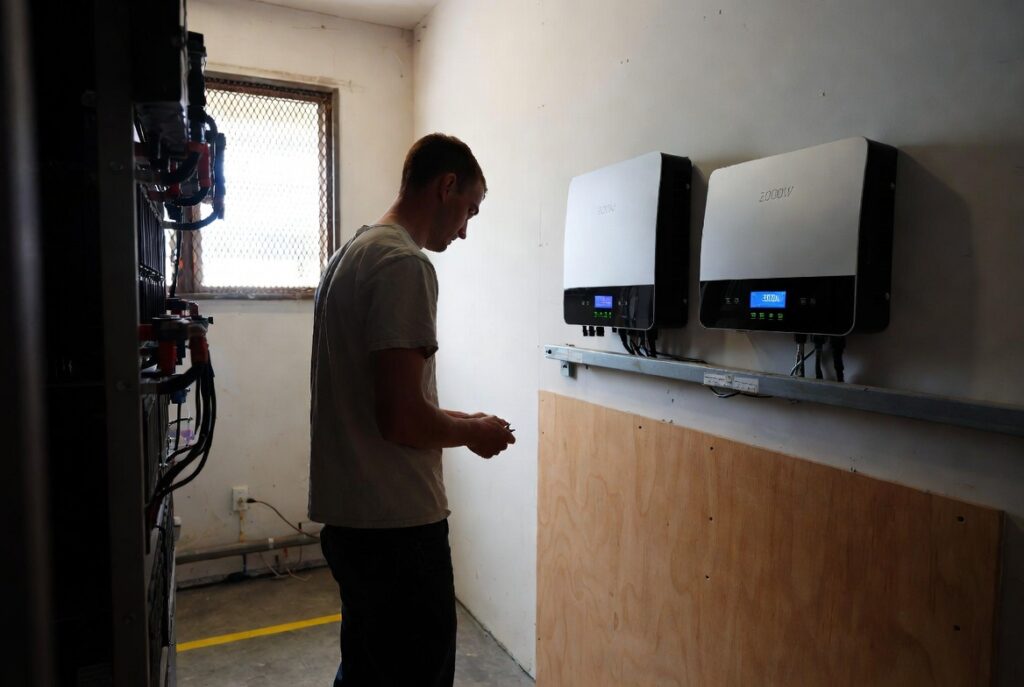
The most expensive inverter size ontario mistake is upsizing from 2,000W to 3,000W because a well pump trips the 2,000W unit, because a property owner in Erin Township, Centre Wellington spent $450 more on a 3,000W inverter for exactly this reason and then discovered that a $68 SoftStart Well would have fixed the 2,000W unit by dropping the pump startup surge from 2,800W to 900W, leaving him with a larger inverter drawing 25 to 35W of idle power every hour instead of the 15 to 20W his 2,000W unit would have drawn.
He had diagnosed the problem correctly. His 1/2 HP submersible well pump drew approximately 2,800W at startup, which exceeded the 2,000W inverter’s 140 percent surge threshold and tripped the protection circuit on every pump cycle.
The 3,000W inverter handled the surge without tripping.
But the fix introduced a new problem: a standby draw approximately 10 to 15W higher than the 2,000W unit he had replaced, running every hour of every day regardless of load. His Victron SmartShunt showed the idle draw difference immediately after commissioning. The 3,000W inverter consumed approximately 28W in standby with no loads connected, versus the approximately 17W his previous 2,000W inverter had drawn. Over a 4-day Ontario gray streak, that difference added approximately 672Wh of additional wasted capacity , roughly 35 percent of a single Battle Born heated LFP cell’s usable capacity, drawn from the bank before a single real load was powered.
I recommended the SoftStart Well after reviewing his SmartShunt data. Installed in 30 minutes in the pump electrical box, the SoftStart Well dropped the pump startup surge from approximately 2,800W to approximately 900W on the first cycle after installation. His 2,000W inverter would have handled that startup surge with 1,100W of comfortable margin. The inverter size Ontario decision had been answered incorrectly the first time because the pump surge was addressed with additional hardware cost instead of a soft-start controller. See our Ontario solar sizing guide before making any inverter size Ontario decision for a Tier 2 system.
The inverter size ontario decision: three load profiles mapped to three wattages
| Inverter size | Idle draw | 4-day gray streak waste | Correct for | Ontario verdict |
|---|---|---|---|---|
| 1,000W PSW | 10-12W | 960-1,152Wh | Shed electronics only | LED, laptop, phone, fan. No motors. |
| 2,000W PSW + SoftStart Well | 15-20W | 1,440-1,920Wh | Tier 2 standard household | Well pump, furnace, fridge, lighting. |
| 3,000W PSW | 25-35W | 2,400-3,360Wh | Workshop or large motors | Compressor, electric water heater, no soft-start option. |
The correct inverter size Ontario for a Tier 1 shed system is 1,000W. This profile covers LED lighting (30 to 60W), a laptop (45 to 65W), phone charging (10 to 25W), small fans (30 to 50W), and a router (15W) , a total running load of approximately 100 to 200W. At 10 to 12W idle draw, the 1,000W inverter wastes approximately 960 to 1,152Wh over a 4-day Ontario gray streak. This is the correct and only correct inverter size Ontario for electronics-only shed loads. It will not start a furnace blower, well pump, or chest freezer, and specifying anything larger than 1,000W for this load profile penalises battery autonomy every hour the system is running at idle.
The correct inverter size Ontario for a Tier 2 household system with a well pump and furnace is 2,000W with a SoftStart Well. The standard Tier 2 load profile totals approximately 1,040W running: furnace blower (80W), well pump with SoftStart at 870W running and 900W startup, chest freezer (45W average), LED lighting (30W), and router (15W). The 2,000W inverter handles the 900W startup with 1,100W of comfortable margin. Without the SoftStart Well installed, the 2,800W startup surge exceeds the inverter’s threshold and triggers the protection circuit on every pump cycle.
For properties with workshop air compressors drawing 1,500 to 2,500W at startup, electric water heaters with 4,500W resistance elements, or any large motor load that cannot accept a soft-start controller, the 3,000W inverter is the correct inverter size Ontario. See our off-grid inverter ontario guide for the PSW mandate that applies to all three wattage tiers.
The SoftStart Well test: why the $68 fix replaces the $450 inverter upgrade for most Ontario well pump systems
The 1/2 HP submersible well pump draws approximately 2,800W at startup without a soft-start controller. This 4-second inrush exceeds the 140 percent overload threshold of a 2,000W inverter and trips the protection circuit on every pump cycle. The SoftStart Well installs in the pump electrical box in approximately 30 minutes and reduces the startup surge to approximately 900W. The 2,000W inverter then handles the startup with 1,100W of comfortable margin. The upgrade from 2,000W to 3,000W to solve the pump trip costs $350 to $450 more in inverter cost alone, plus the idle draw penalty for every hour the system runs at standby. The SoftStart Well costs $68 and introduces no idle draw of its own.
The SoftStart Well does not help with resistive loads such as electric water heater elements or baseboard heaters. These loads draw their rated wattage from the first millisecond with no startup surge, so no soft-start controller can reduce them.
If the only reason for considering a 3,000W inverter size Ontario is a well pump or furnace motor, the SoftStart Well is the correct answer at $68. If the property genuinely runs a workshop air compressor or electric water heater, the 3,000W inverter is the justified inverter size Ontario for that load profile. The Victron SmartShunt confirms which case applies: measure the peak draw on the heaviest motor cycle before specifying the inverter wattage. See our well pump Ontario guide for the complete pump surge calculation.
The inverter size ontario idle draw penalty: why the 3,000W unit drains the bank when nothing is running
A 1,000W PSW inverter draws approximately 10 to 12W in standby with no loads connected. A 2,000W unit draws approximately 15 to 20W. A 3,000W unit draws approximately 25 to 35W. Over a 4-day Ontario gray streak, those idle draws consume 960 to 1,152Wh (1,000W), 1,440 to 1,920Wh (2,000W), and 2,400 to 3,360Wh (3,000W) respectively, before a single real load is powered. The difference between a correctly sized 2,000W and an over-sized 3,000W inverter over 4 days is approximately 960 to 1,440Wh of additional wasted capacity. A Battle Born heated LFP 100Ah cell has approximately 1,920Wh of usable capacity at 80 percent DoD.
The idle draw penalty from choosing the wrong inverter size ontario consumes the equivalent of one full cell’s capacity every 5 to 8 days of gray weather.
A property owner in Halton Hills, Halton Region, specified a 1,000W PSW inverter for his detached shed with a 170W peak load profile: LED lighting (45W), laptop (55W), phone charging (20W), router (15W), and small fan (35W). His SmartShunt confirmed 11W idle draw at standby. His neighbor’s shed carried the same load profile but had been over-specified with a 3,000W inverter, drawing approximately 28W in standby. Over a 7-day February gray streak, the 1,000W shed wasted approximately 1,848Wh in idle draw. The neighbor’s 3,000W shed wasted approximately 4,704Wh over the same 7 days. The SmartShunt data confirmed measurably higher battery autonomy in the correctly sized 1,000W system.
His comment: “I thought bigger was safer. The SmartShunt showed me that bigger just drains the bank faster when nothing is running.”
The Victron MultiPlus-II at 2,000VA: the correct Tier 2 inverter that replaces three devices
The Victron MultiPlus-II 2,000VA is the correct inverter size Ontario for Tier 2 builds. It combines the PSW inverter, an automatic transfer switch (less than 20ms), and a multi-stage battery charger (50A at 48V) in one box at approximately $660. Three separate devices for the same function , a standalone inverter ($480), an external transfer switch ($280), and an external battery charger ($220) , cost approximately $980 before wiring and labor. The MultiPlus-II is not only a cost saving. It eliminates manual wiring between three separate devices, provides a single ESA permit covering the complete installation, and integrates with the Victron ecosystem via VE.Bus for SmartShunt monitoring of idle draw, surge events, and gray streak autonomy.
The MultiPlus-II 2,000VA is the correct inverter size Ontario for any Tier 2 system that includes a generator as a backup charging source during gray streaks. The generator connects directly to the MultiPlus-II AC input. The built-in charger manages the bulk-absorb-float cycle at 50A automatically with no manual switching and no external charger required. On a 4-day Ontario gray streak where the bank drops below 40 percent SoC, connecting the generator to the MultiPlus-II AC input restores the bank to 95 percent in approximately 2 hours without any manual intervention. See our off grid setup guide for the complete MultiPlus-II commissioning sequence for Ontario Tier 2 systems.
NEC and CEC: Ontario permit requirements for permanent inverter installations
NEC 690 and NEC 70 (NFPA 70, the National Electrical Code) govern the installation of any permanent inverter in Ontario. The inverter AC output wiring must be sized for 125 percent of the inverter’s continuous output current and protected with an appropriately rated breaker in the AC distribution panel. The inverter DC input wiring must be sized for 125 percent of the maximum continuous DC current draw, protected with a Class T fuse at the battery positive terminal, and installed with an accessible DC disconnect switch. At 48V, the maximum continuous DC current for a 2,000W load is approximately 42A, requiring 2 AWG minimum on the DC input run.
Contact the NFPA at nfpa.org for current NEC 690 and NEC 70 requirements for inverter installations in off-grid systems.
CEC Section 64 governs electrical installations in Ontario. Any permanently wired inverter installation requires an ESA permit at $300 to $400 before installation begins. The permit covers the inverter, the DC disconnect, the battery bank wiring, and the AC distribution panel connections. A licensed electrician must complete the installation and schedule the ESA inspection. Operating a permanent inverter installation without an ESA permit invalidates the property insurance coverage for the electrical system. Contact the Electrical Safety Authority Ontario at esasafe.com before beginning any permanent inverter installation in Ontario.
Pro Tip: Before ordering a 3,000W inverter because a well pump trips the 2,000W unit, install the SoftStart Well first. It costs $68 and installs in 30 minutes. On the first pump cycle after installation, check the SmartShunt peak draw reading. If it shows approximately 900W, the 2,000W inverter is correctly specified and the 3,000W upgrade is unnecessary. The Erin Township property owner paid $450 more for a 3,000W inverter and gained 10 to 15W of additional idle draw penalty in every standby hour. The SoftStart Well would have resolved the same problem for $68 and preserved his battery autonomy.
The inverter size ontario verdict: 2,000W plus SoftStart Well for Tier 2, 1,000W for Tier 1, 3,000W for workshops only
- Ontario property owner whose 2,000W inverter is currently tripping on well pump startup: install the SoftStart Well before specifying a larger inverter. The SoftStart Well drops the 1/2 HP pump startup from 2,800W to 900W for $68, leaving the 2,000W inverter with 1,100W of surge margin. Confirm the fix with the Victron SmartShunt on the first pump cycle after installation. If the startup reads approximately 900W, the inverter size ontario decision is resolved without any hardware upgrade. The Erin Township result: $68 SoftStart Well resolved a problem that had cost $450 in unnecessary inverter upsizing and introduced a daily idle draw penalty of 672Wh over every 4-day gray streak.
- Ontario property owner specifying a new Tier 2 system with well pump and furnace: specify the Victron MultiPlus-II 2,000VA as the inverter size ontario standard. Add the SoftStart Well for the pump. The MultiPlus-II replaces three separate devices at $980 with one box at $660, provides less than 20ms generator transfer, and charges the Battle Born heated LFP bank at 50A bulk through its built-in charger. Confirm the inverter size ontario specification with the SmartShunt idle draw reading at commissioning , the 2,000W MultiPlus-II should show approximately 15 to 20W standby, not the 25 to 35W of the 3,000W unit.
- Ontario property owner with a workshop air compressor, electric water heater, or large motor loads that cannot accept a soft-start controller: the 3,000W inverter is the correct inverter size ontario specification for this load profile. Accept the 25 to 35W idle draw penalty as the cost of running loads that genuinely require it. Size the Battle Born heated LFP bank to include the additional 960 to 1,440Wh of idle draw waste over a 4-day gray streak versus the 2,000W alternative. Use the SmartShunt to confirm the actual idle draw figure at commissioning and recalculate gray streak autonomy from measured data rather than the inverter specification sheet.
Frequently Asked Questions
Q: What size inverter do I need for an Ontario off-grid system with a well pump?
A: For most Ontario Tier 2 systems with a 1/2 HP submersible well pump, the correct inverter size ontario is 2,000W combined with a SoftStart Well. The SoftStart Well reduces the pump startup surge from approximately 2,800W to approximately 900W, allowing the 2,000W inverter to handle the pump with 1,100W of comfortable margin. Without the SoftStart Well, the 2,800W startup trips the 2,000W inverter on every pump cycle and a 3,000W inverter is required. The SoftStart Well costs $68 and installs in 30 minutes. The 3,000W inverter costs $350 to $450 more and introduces a 10 to 15W idle draw penalty that compounds over every gray streak day.
Q: Why does my 2,000W inverter trip when the well pump starts?
A: The 1/2 HP submersible well pump draws approximately 2,800W at startup without a soft-start controller. This 4-second inrush surge exceeds the 140 percent overload threshold of a 2,000W inverter and triggers the protection circuit on every pump cycle. The correct solution is installing a SoftStart Well in the pump electrical box, which reduces the startup surge to approximately 900W and allows the 2,000W inverter to handle the pump correctly. Confirm the fix with a Victron SmartShunt on the first pump cycle after installation , the peak reading should drop from approximately 2,800W to approximately 900W.
Q: Is a 3,000W inverter better than a 2,000W inverter for an Ontario Tier 2 system?
A: Not for standard Ontario Tier 2 systems with a well pump and furnace blower. A 3,000W inverter draws approximately 25 to 35W in standby versus 15 to 20W for a 2,000W unit, wasting an additional 960 to 1,440Wh over every 4-day Ontario gray streak in idle draw alone. For most Tier 2 systems where the only oversized load is a well pump startup surge, the SoftStart Well resolves the surge problem for $68 without the idle draw penalty. The 3,000W inverter size ontario is only justified for workshop compressors, electric water heaters, or large motor loads that cannot use a soft-start controller.
This build is engineered within the 48V DC Safety Ceiling. Diagnostic logic is based on 20+ years of technical service experience. All structural and electrical installations must be verified by a Licensed Professional and comply with your Local AHJ. See our legal and safety disclosure for full scope.
This article contains affiliate links. If you purchase through these links, I earn a small commission at no extra cost to you.