
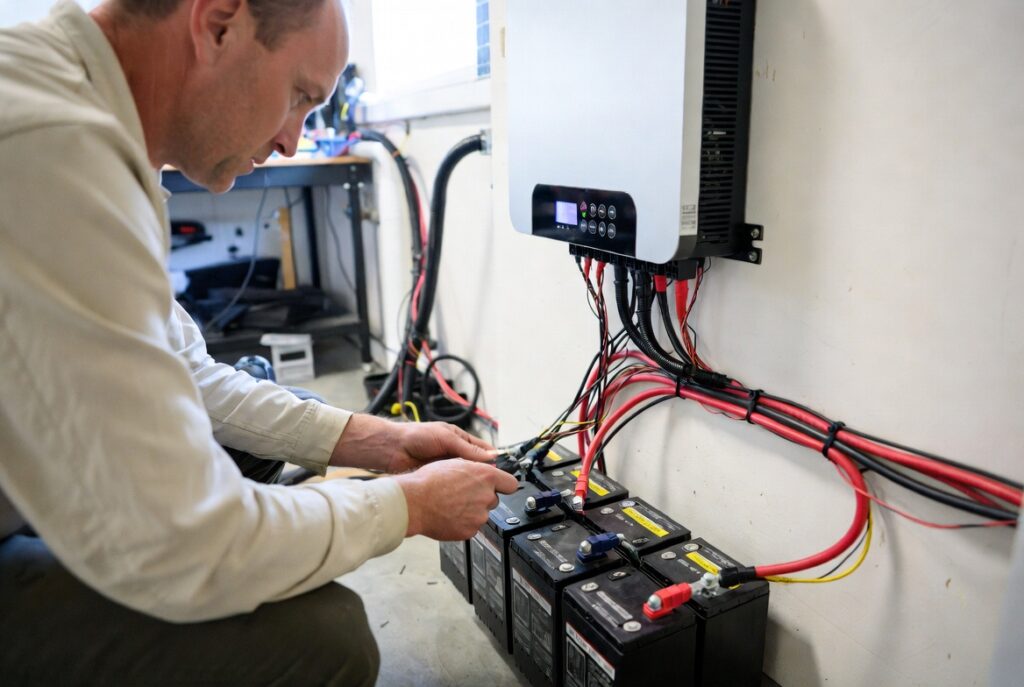
The most expensive off grid inverter mistake in Ontario is choosing a modified sine wave unit to save $180 on a Tier 2 system, because the harmonic distortion from a modified sine wave off grid inverter destroyed the furnace control board of a property owner in Fergus, Centre Wellington within 6 weeks of commissioning, and the $340 board replacement plus the cost of an emergency HVAC technician visit added up to more than three times the cost of the PSW upgrade he had avoided.
He had built a solid Tier 2 system in fall 2023 , 400W array, 200Ah Battle Born heated LFP, Victron MPPT 100/30. He chose a 2,000W MSW inverter at $220 versus the 2,000W PSW at $400. The furnace ran without visible problems for the first six weeks. Then the control board failed mid-January at -18 degrees C.
The HVAC technician confirmed harmonic distortion from the MSW off grid inverter as the cause. Modern furnace controllers use variable frequency drives sensitive to waveform quality. His MSW inverter produced approximately 8 to 12 percent total harmonic distortion versus less than 3 percent for a PSW unit. The board replacement cost $340. The emergency service call during a January cold snap added $180. Total cost of saving $180 on the inverter: $520 in repairs and one cold night.
I replaced his MSW off grid inverter with a 2,000W PSW unit that same week. His Victron SmartShunt confirmed clean battery draw on every appliance cycle from that point forward. The furnace controller has run without fault through two full Ontario winters since. The rule is now absolute in every system I specify: PSW only, no exceptions, regardless of what the load list looks like on paper. See our Ontario solar sizing guide before specifying any off grid inverter for a Tier 2 system.
The off grid inverter PSW mandate: why modified sine wave destroys Ontario furnace controllers
| Inverter type | THD | Well pump startup (1/2 HP) | Gray streak recovery | Ontario verdict |
|---|---|---|---|---|
| MSW 2,000W | 8-12% | 2,800W trips inverter | Manual generator only | Never. Destroys furnace boards. |
| PSW 2,000W + SoftStart Well | <3% | 900W, 1,100W margin | Manual generator | Correct for Tier 1 and Tier 2 with SoftStart. |
| PSW 3,000W | <3% | 2,800W handled | Manual generator | Only justified for large loads , overcost for standard Tier 2. |
| MultiPlus-II 2,000VA | <3% | 900W with SoftStart | Auto transfer, built-in charger | Ontario Tier 2 standard. One box replaces three devices. |
Modern furnace controllers use variable frequency drives that are sensitive to waveform quality. MSW produces 8 to 12 percent total harmonic distortion; PSW produces less than 3 percent. The loads that fail silently from MSW distortion include furnace control boards (the most common Ontario failure), CPAP humidifiers, variable speed well pump drives, laser printers, and certain battery chargers. The loads that tolerate MSW are incandescent bulbs, resistive heating elements, and simple universal motor tools. The problem is that you cannot know which of your loads will fail until it fails, typically at -18 degrees C in January when a service call costs three times the normal rate.
The Ontario winter amplifies the MSW risk beyond a simple cost comparison. A furnace control board failure in a Wellington County cabin in January is not an inconvenience. It is a pipe-freezing, safety-threatening event that demands an emergency service call regardless of weather, road conditions, or time of day. The Fergus result confirms the math: $180 saved on the MSW off grid inverter, $520 in repairs, one cold night without heat, and a property owner who will never spec MSW again. See our solar inverter ontario guide for the grid-tied inverter context and HRSP eligibility discussion.
The off grid inverter sizing standard: 2,000W vs 3,000W and the SoftStart Well decision
The 2,000W vs 3,000W decision tree is straightforward for Ontario Tier 2 systems. Does the system include a 1/2 HP or larger submersible well pump? If yes, the startup surge without a SoftStart Well reaches approximately 2,800W for 4 seconds, which exceeds the 140 percent overload threshold of a 2,000W inverter and causes a protection trip on every pump cycle. The fix is the SoftStart Well at approximately $68, installed in the pump electrical box in 30 minutes, which drops the startup surge to approximately 900W. The 2,000W off grid inverter then handles the pump with 1,100W of comfortable surge margin.
The cost comparison is direct: $68 SoftStart Well versus $400 to $500 upgrade to a 3,000W inverter for the same operational result.
Properties without a well pump, or properties with a correctly installed SoftStart Well, are correctly served by a 2,000W PSW off grid inverter for the standard Ontario Tier 2 load profile: furnace blower (80W), chest freezer (45W average), LED lighting (30W), well pump with SoftStart (900W startup, 870W running), and router (15W). Total running load: approximately 1,040W. The 2,000W inverter provides 960W of headroom for additional loads. Properties with electric water heaters, workshop compressors, or EV charging require a 3,000W or larger off grid inverter regardless of SoftStart. See our well pump ontario guide for the complete pump surge calculation and SoftStart sizing verification process.
The 48V system advantage: why voltage matters for cable sizing and efficiency
At 12V, a 2,000W load draws approximately 167A continuously from the battery bank. This current requires 4/0 AWG cable at $8 to $12 per foot and causes significant resistive heat loss in even a short battery-to-inverter run. At 48V, the same 2,000W load draws approximately 42A, which requires 2 AWG cable at $2 to $3 per foot. On a typical 10-foot battery-to-inverter run, the cable cost difference is approximately $60 to $90. The resistive loss reduction is approximately 75 percent, which means more of the battery bank energy reaches the loads rather than heating the cables and reducing effective range.
Every Ontario Tier 2 system with more than 200Ah of battery capacity should use a 48V off grid inverter as the standard specification. The Battle Born heated LFP 100Ah cells are configured in a 4S1P arrangement (four cells in series) to produce 48V from four 12V-nominal batteries. The Victron MPPT 100/30 supports 48V battery banks directly. The 48V specification reduces cable costs, reduces resistive losses, extends battery cycle life by reducing peak discharge current, and is fully compatible with the Victron MultiPlus-II as the terminal off grid inverter standard for Ontario Tier 2 builds.
The idle draw calculation: how your inverter drains the bank when nothing is running
A 2,000W PSW off grid inverter draws approximately 15 to 20W continuously in standby mode with no load connected. Over 24 hours, this idle draw consumes 360 to 480Wh from the battery bank with no productive work delivered. Over a 4-day Ontario gray streak, the inverter idle draw alone consumes 1,440 to 1,920Wh, which represents 75 to 100 percent of one Battle Born 100Ah cell’s usable capacity (approximately 1,920Wh at 80 percent DoD). This is not a rounding error in the gray streak calculation. It is a meaningful system drain that must be included in every off-grid battery sizing calculation from the first draft.
The mitigation strategy for off grid inverter idle draw in Ontario: use the inverter manual on/off switch to cut power during sleeping hours when no AC loads are running. Most Ontario Tier 2 cabins have no AC loads running from 11 PM to 6 AM except the furnace blower, which draws 80W and does not require the off grid inverter if wired directly to a DC source. Turning the inverter off for 7 hours per night eliminates approximately 105 to 140Wh of idle draw per night, saving approximately 420 to 560Wh over a 4-day gray streak.
The Victron SmartShunt captures the idle draw as a baseline in the system history, making precise gray streak autonomy calculations possible before the first real outage arrives.
The MultiPlus-II as the complete off grid inverter solution for Ontario Tier 2
A property owner in Halton Hills, Halton Region evaluated her Tier 2 off-grid cabin build in fall 2024. Her local installer quoted three separate devices: a standalone 3,000W PSW off grid inverter ($480), an external transfer switch ($280), and an external battery charger ($220), totalling $980 before wiring and labour. I recommended the Victron MultiPlus-II 2,000VA at $660 and the SoftStart Well at $68, a total of $728 for one box performing all three functions. The MultiPlus-II combines the PSW inverter, the automatic transfer switch (less than 20ms), and the multi-stage battery charger (50A bulk at 48V) in a single device with a single ESA permit covering the entire installation.
Installation completed in one day. The ESA permit and inspection were done the same week. The Victron SmartShunt went on the negative run between the Battle Born heated LFP bank and the system bus. On commissioning day, the SmartShunt confirmed the bank at 97 percent SoC after a full overnight charge cycle through the MultiPlus-II built-in charger from the temporary generator connection. The generator plugged directly into the MultiPlus-II AC input. No external charger. No manual switch. No separate transfer panel.
The first October gray streak arrived 3 weeks after commissioning. Four consecutive overcast days. The SmartShunt showed 38 percent SoC after day 3. The generator ran for 2 hours. The MultiPlus-II charged the bank to 95 percent at 50A bulk rate through the built-in charger with no manual switching and no visible interruption to any connected load. The transfer between battery and generator power happened in less than 20 milliseconds. No clock resets. Her comment: “I thought I was getting a budget build. I ended up with a better system than the full quote for $250 less.” See our off grid setup guide for the complete MultiPlus-II commissioning sequence for Ontario Tier 2 systems.
NEC and CEC: Ontario permit requirements for permanent inverter installations
NEC 690 and NEC 70 (NFPA 70, the National Electrical Code) govern the installation of any permanent off grid inverter in Ontario. The inverter AC output wiring must be sized for 125 percent of the inverter continuous output current and protected with an appropriately rated breaker in the AC distribution panel. The inverter DC input wiring must be sized for 125 percent of the maximum continuous DC current draw, protected with a Class T fuse at the battery positive terminal, and routed through an accessible DC disconnect switch. The pre-charge resistor protocol applies to all 48V inverter connections to prevent inrush current damage at commissioning.
Contact the NFPA at nfpa.org for current NEC 690 and NEC 70 requirements for off-grid inverter installations.
CEC Section 64 governs electrical installations in Ontario. Any permanently wired off grid inverter installation requires an ESA permit at $300 to $400 before installation begins. The permit covers the inverter, the DC disconnect, the battery bank wiring, the AC distribution panel connections, and the generator input wiring. A licensed electrician must complete the installation and schedule the ESA inspection. Operating a permanent off grid inverter installation without an ESA permit invalidates the property insurance coverage for the electrical system. Contact the Electrical Safety Authority Ontario at esasafe.com before beginning any permanent off grid inverter installation in Ontario.
Pro Tip: Before committing to a 3,000W inverter upgrade because of well pump trips, install the SoftStart Well ($68) first and watch the SmartShunt on the next pump cycle. The startup surge reading drops from approximately 2,800W to 900W in one commissioning cycle. The Fergus property owner spent $520 learning that MSW was wrong. The Halton Hills property owner spent $728 total and ended up with three devices in one box for $250 less than the standalone quote. Sequence matters: SoftStart Well first, then measure, then decide on inverter size.
The off grid inverter verdict: standalone PSW for Tier 1, MultiPlus-II for Tier 2 and above
- Ontario property owner building a Tier 1 shed system (lighting, phone charging, small appliances, no well pump, no furnace): a standalone 2,000W PSW off grid inverter at approximately $400 is the correct specification. PSW only , no MSW regardless of the load list or the budget pressure. The Fergus result confirms the cost of that $180 shortcut: $520 in repairs and a cold January night in Wellington County. Budget $68 for the SoftStart Well if any pump will ever be added to the system. Install a Victron SmartShunt to confirm the idle draw baseline and track gray streak autonomy accurately from commissioning day forward.
- Ontario property owner building a Tier 2 system with a well pump, furnace, and generator backup: the Victron MultiPlus-II 2,000VA is the correct off grid inverter. Add the SoftStart Well for the well pump. Connect the generator to the MultiPlus-II AC input for gray streak recovery charging. Specify the Battle Born heated LFP bank at 48V to minimise cable costs and maximise inverter efficiency. The Halton Hills result: $728 total for inverter plus SoftStart Well, one box replacing three devices at $980, 2-hour gray streak generator recovery confirmed by SmartShunt, less than 20ms transfer on every generator switch.
- Ontario property owner whose 2,000W inverter is currently tripping on well pump startup: install the SoftStart Well first before ordering a 3,000W replacement. The SoftStart Well costs $68 and resolves the 2,800W surge in 30 minutes of installation time. Confirm the fix with the SmartShunt on the first pump cycle after installation , the peak reading should drop from approximately 2,800W to approximately 900W. If the SmartShunt confirms 900W startup, the 2,000W off grid inverter is correctly specified and the 3,000W upgrade is unnecessary. The $68 SoftStart Well versus the $400 to $500 inverter upgrade is one of the clearest cost decisions in any Ontario Tier 2 system.
Frequently Asked Questions
Q: Do I need a pure sine wave inverter for an off-grid system in Ontario?
A: Yes, without exception. A pure sine wave off grid inverter is the only acceptable specification for any Ontario system that includes a furnace, CPAP machine, variable speed motor, or modern electronics. The modified sine wave (MSW) alternative produces 8 to 12 percent total harmonic distortion, which destroyed the furnace control board in Fergus, Centre Wellington within 6 weeks of commissioning at a total repair cost of $520. The PSW inverter costs approximately $150 to $180 more than the MSW equivalent. A single furnace board failure recovers that difference and then some at emergency January service rates.
Q: What size off grid inverter do I need for a well pump in Ontario?
A: For a standard 1/2 HP submersible well pump, a 2,000W PSW off grid inverter with the SoftStart Well installed is the correct specification for Ontario Tier 2 builds. The SoftStart Well reduces the pump startup surge from approximately 2,800W to approximately 900W, allowing the 2,000W inverter to handle the pump with 1,100W of comfortable surge margin. Without the SoftStart Well, the 2,800W startup surge trips the 2,000W inverter on every pump cycle and a 3,000W inverter is required. The SoftStart Well costs $68 and installs in 30 minutes , confirm the result with a Victron SmartShunt on the first pump cycle.
Q: What is the difference between a standalone inverter and the Victron MultiPlus-II for off-grid use?
A: A standalone 2,000W PSW off grid inverter converts battery power to AC power and does nothing else. Replicating the full Tier 2 system function requires three separate devices: the inverter ($480), an external transfer switch for generator backup ($280), and an external battery charger ($220), totalling approximately $980. The Victron MultiPlus-II 2,000VA performs all three functions in one box at approximately $660, transfers between battery and generator power in less than 20ms (invisible to all connected loads), and charges the battery bank through a built-in 50A multi-stage charger when the generator is connected. The Halton Hills result: $728 for MultiPlus-II plus SoftStart Well versus $980 for the three-device alternative , one box, $252 saved, and a better system.
This build is engineered within the 48V DC Safety Ceiling. Diagnostic logic is based on 20+ years of technical service experience. All structural and electrical installations must be verified by a Licensed Professional and comply with your Local AHJ. See our legal and safety disclosure for full scope.
About the Author
Robert Bertrand spent 20 years as a service advisor in the automotive industry (Lexus and Nissan), where precision diagnostics, wiring integrity, and documentation standards were non-negotiable. He brings that same technical discipline to GridFree Guide, where he researches, tests, and documents off-grid solar systems for Ontario conditions. Based in Rockwood, Ontario, every article is built on verified specifications, manufacturer data, and the real-world climate constraints of Canadian off-grid living.
As an Amazon Associate I earn from qualifying purchases. This site also contains affiliate links to other products and services. GridFree Guide earns a small commission at no extra cost to you.