
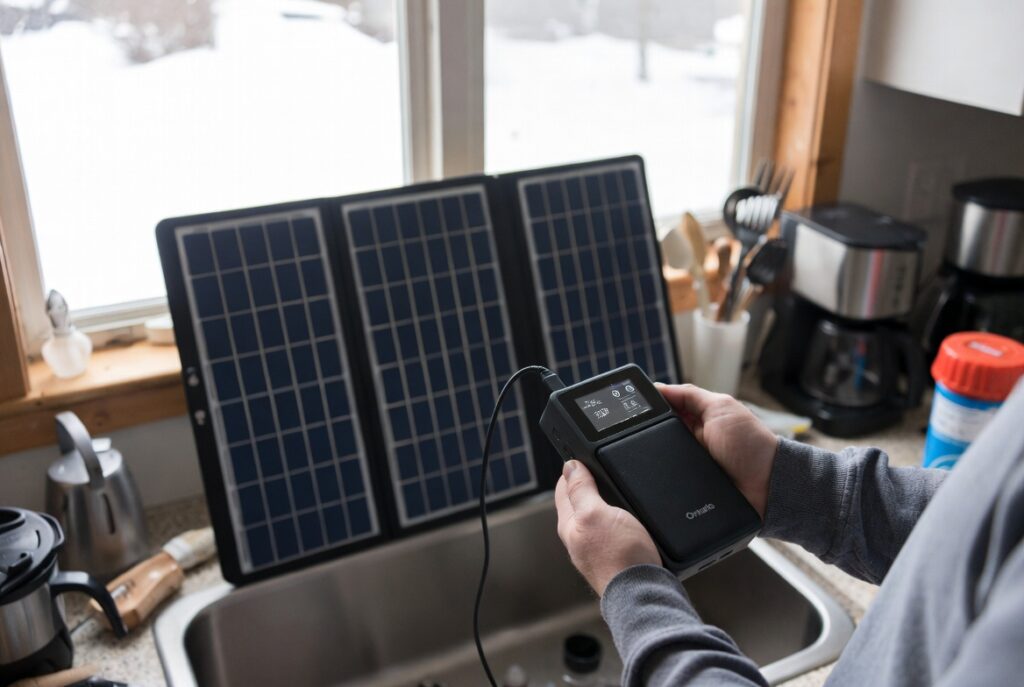
The most common Ontario solar power bank mistake is buying a 3,024Wh unit based on a YouTube review filmed in Arizona. The buyer stores it in an unheated garage. During a February ice storm, the unit shows 8% SoC because the LFP cells sat at -15°C since November. The BMS blocked all solar charging current for 14 weeks. The 400W folding array sat folded in a corner unused because even with a warm BMS, 510Wh per clear January day means 6 clear days to recharge from 0%.
A property owner on Wellington Street in Rockwood, Wellington County purchased a Jackery HomePower 3000 in September 2023 for whole-home backup. He stored the unit in his unheated attached garage, where ambient temperatures dropped to -12°C by late November. On February 8, 2024, the morning after a grid outage began, he opened the Jackery app and found the unit at 8% SoC.
The unit depleted partly through wifi standby draw over 22 weeks. The BMS blocked solar charging once the garage dropped below 0°C in late November. His 400W folding array was connected, but the Jackery app showed zero charging current. He carried the unit inside the heated house and waited 3 hours for the cells to warm above 5°C. The app showed charging resume at that point, but from 8% SoC and with the grid already down, solar alone would take approximately 6 clear days to reach 100%.
I reviewed his setup after the outage ended. The fix required no new hardware. His solar power bank protocol needed three changes: charge the unit to 100% from the grid outlet before October 15th each year, store it in the heated living space from October through April, and disable the wifi standby in the Jackery app settings to eliminate the parasitic drain. These three steps cost nothing and would have left him with a 100% charged unit at the start of the February outage. See our Ontario solar sizing guide before specifying any solar power bank system.
The solar power bank Ontario recharge reality: 510Wh per clear January day and why grid charging comes first
| Unit | Capacity | Ontario Jan. recharge (400W) | Clear days from 0% |
|---|---|---|---|
| EcoFlow DELTA Pro 3 | 3,600Wh | 510Wh = 14.2%/day | ~7 clear days |
| Jackery HomePower 3000 | 3,024Wh | 510Wh = 16.9%/day | ~6 clear days |
| Bluetti Elite 200 V2 | 2,048Wh | 510Wh = 24.9%/day | ~4 clear days |
| Manufacturer spec (US-based) | n/a | “Charges in 3 hours with 800W” | ~3 hours (Arizona, not Ontario) ✗ |
The solar power bank Ontario recharge reality: 400W portable array × 1.5 PSH × 0.85 efficiency = 510Wh per clear January day. This is the only correct figure for Ontario January solar power bank recharge planning. Manufacturer specs calculate recharge time at 4 to 6 PSH, the solar resource of Arizona or the US Southwest in summer. The Bluetti Elite 200 V2 at 2,048Wh recharges in approximately 4 clear days from 0%, making it the correct choice if solar recharge speed is the priority after a summer or fall outage.
For winter emergency backup, grid-charge the solar power bank in October. At 510Wh per clear January day, solar is a supplement, not a primary fuel source. A grey January streak produces approximately 215Wh per day from the same 400W array, pushing recharge times to 10 to 17 days on a fully depleted unit. For Ontario camping from April through October at 3 to 4 PSH, solar recharging works well. The correct winter framing: the solar power bank is a pre-charged fuel tank, topped up from the grid in October and held in reserve for the ice storm season. See our solar generator ontario guide for the full January recharge comparison.
The BMS cold lockout: why an unheated Ontario garage kills your emergency backup
The BMS cold lockout is the solar power bank failure mode specific to Ontario winters. A BMS protects LFP cells in EcoFlow, Bluetti, and Jackery units by blocking charging current when cell temperature drops below 0°C. This is correct behaviour, preventing lithium plating damage that would permanently reduce capacity. An unheated Wellington County garage drops to -10°C to -20°C by mid-November and stays below 0°C until mid-March, approximately 18 weeks during which the solar power bank refuses all charging current from any source. The solar panels produce current. The BMS rejects every ampere.
The warming protocol: bring the solar power bank from the unheated space to a heated interior (above 5°C) and allow 2 to 4 hours for the LFP cells to warm above the BMS charge inhibit threshold. The app will show charging current resuming once the cells are warm enough. In an active outage with no grid power, this 2 to 4-hour warming delay means the solar power bank is unavailable as emergency power for the first hours after discovery. Correct autumn storage prevents this outcome entirely. Store the solar power bank in the heated living space from October through April.
Pro Tip: Before October 15th every year, run through this three-step solar power bank Ontario winter prep. Step 1: plug into grid power and charge to 100% SoC, confirm the percentage in the app before unplugging. Step 2: open the app settings and disable wifi standby. At 8W continuous × 24h × 15 days = 2,880Wh, wifi standby alone fully depletes a Bluetti Elite 200 V2 from 100% before the first ice storm. Step 3: move the unit from any garage or outbuilding to the heated living space and leave it there until April. The Erin Street Fergus result: charged October 14th, wifi disabled, stored in heated home office. The unit arrived at the February 2024 outage at 91% SoC and provided 19.6 hours of runtime with zero preparation at the time of the event.
The solar power bank Ontario winter protocol: charge in October, store inside, disable wifi standby
The solar power bank Ontario winter protocol requires four steps that cost nothing. Step 1: charge the unit to 100% SoC from the grid outlet before October 15th. Step 2: disable wifi standby in the app settings. At 8W continuous × 24h × 15 days = 2,880Wh, wifi standby alone fully depletes a Bluetti Elite 200 V2 from 100% in standby. Step 3: store the unit in the heated living space (above 5°C at all times) from October through April.
Step 4: check the app monthly from November through April to confirm SoC is above 80%. A correctly maintained solar power bank loses approximately 1 to 2% per month through natural self-discharge without wifi drain, remaining above 85% SoC through a typical Ontario winter.
A property owner on Erin Street in Fergus, Centre Wellington, purchased a Bluetti Elite 200 V2 in October 2023. She followed the correct protocol: charged to 100% on October 14th, disabled wifi standby, stored in heated home office (above 18°C). Monthly SoC checks: November 97%, December 94%, January 91%. February 2024 ice storm: unit at 91% SoC = 1,865Wh available. Combined draw: laptop (45W) + LED lighting (30W) + phone charger (20W) = 95W. Runtime at 95W: 1,865Wh ÷ 95W = 19.6 hours, well beyond the 14-hour outage. Her comment: “I charged it once in October and forgot about it. When the power went out, it was ready.” See our solar backup power guide for the permanent MultiPlus-II hybrid specification.
The Ontario portable battery comparison: EcoFlow, Bluetti, and Jackery for Ontario use cases
The three major solar power bank Ontario units have distinct strengths. EcoFlow DELTA Pro 3 (3,600Wh, approximately 3,500 to 4,000 LFP cycles, approximately 30ms transfer): best for extended outages requiring maximum portable runtime, and best for sump pump loads via its 12V DC output, bypassing the inverter entirely. Bluetti Elite 200 V2 (2,048Wh, approximately 6,000 LFP cycles, approximately 20ms transfer): best for properties that cycle the battery regularly. At 6,000 cycles to 80% retention, this unit lasts approximately 16 years of daily cycling at 80% DoD.
Jackery HomePower 3000 (3,024Wh, approximately 3,000 to 4,000 LFP cycles): best balance of capacity and expandability for a family Ontario emergency kit. All three share the same Ontario winter limitation: store in heated interior from October through April, grid-charge to 100% before storm season, and disable wifi standby. For backup needs exceeding approximately 5,000Wh, the permanent Victron MultiPlus-II system with a Victron SmartShunt is more cost-effective at approximately $3,500 to $5,000 installed versus stacking portable units. See our solar battery ontario guide for permanent battery system specifications.
NEC and CEC: Ontario permit requirements for permanently wired portable battery systems
NEC and CEC do not govern portable solar power bank units that plug into standard household outlets. A portable EcoFlow, Bluetti, or Jackery unit that charges via a standard 120V AC outlet or via solar panels connected to the unit’s external solar input port does not require an ESA permit. These are self-contained consumer devices. However, any hardwired connection including a transfer switch that allows the solar power bank to feed the home’s electrical panel, a dedicated charging circuit, or any wiring that involves the electrical panel requires an ESA permit before installation begins. Contact the NFPA at nfpa.org for NEC guidance on portable energy storage systems in residential applications.
CEC Section 64 governs electrical installations in Ontario. A solar power bank connected to the home’s electrical system through any hardwired connection, including a transfer switch, dedicated circuit, or sub-panel connection, requires an ESA permit at $300 to $400 before any wiring work begins. A standalone portable solar power bank that plugs into a standard outlet and charges from a compatible solar panel via the unit’s external port does not require a permit.
For the permanent Victron MultiPlus-II hybrid system that some Ontario property owners add as a complement to their portable solar power bank, the ESA requires a permit before installation. Contact the Electrical Safety Authority Ontario at esasafe.com before beginning any permanently wired solar power bank installation in Ontario.
The solar power bank Ontario verdict: Bluetti for daily cycling, EcoFlow for maximum runtime, grid charge before storm season
- Ontario property owner who bought a solar power bank for ice storm backup and is concerned about winter readiness: check the unit’s SoC via app right now, if below 90% and stored in an unheated space, bring it inside and charge to 100% from the grid immediately. The Wellington Street Rockwood result: unheated garage, BMS locked out from November, 8% SoC at February outage start, 6 clear days needed for solar recovery. The three-step protocol (grid charge before October 15, disable wifi standby, heated storage) costs nothing and ensures 90%+ SoC at any ice storm. Choose EcoFlow DELTA Pro 3 for maximum runtime (3,600Wh) or Bluetti Elite 200 V2 for maximum cycle life (6,000 cycles).
- Ontario property owner selecting a solar power bank for the first time: match the unit to the primary use case before checking capacity. For extended winter outages: EcoFlow DELTA Pro 3 (3,600Wh, 7 clear January days from 0%, sump pump via 12V DC output). For regular daily cycling and longevity: Bluetti Elite 200 V2 (2,048Wh, 4 clear days from 0%, 6,000 LFP cycles). For family emergency backup with expandability: Jackery HomePower 3000 (3,024Wh, 6 clear days from 0%). All three require the same Ontario winter protocol: grid charge October 15, heated storage, wifi disabled, monthly app check.
- Ontario property owner whose solar power bank needs have grown to whole-home critical load backup: the permanent Victron MultiPlus-II system is more cost-effective above 5,000Wh and eliminates the October charging ritual entirely. The permanent system recharges from the grid at 3.9¢/kWh overnight, is always at or near 100% SoC before any outage, and transfers in less than 20ms, the Victron SmartShunt confirms SoC in real time. The Erin Street Fergus approach, a correctly maintained solar power bank for portable loads plus the permanent system for whole-home backup, is the complete Ontario solar power bank standard.
Frequently Asked Questions
Q: Can I rely on solar to recharge my power bank during an Ontario winter outage?
A: Not reliably in January. A 400W portable array produces approximately 510Wh per clear January day in Ontario (1.5 PSH × 400W × 0.85 efficiency). A fully depleted EcoFlow DELTA Pro 3 (3,600Wh) takes approximately 7 clear January days to reach 100% from solar alone. Gray streak days produce only approximately 215Wh, pushing recovery toward 17 days. Solar recharging works well as a supplement after a summer or fall outage and suits Ontario camping from April through October (3 to 4 PSH).
For winter ice storm backup, the correct strategy is to grid-charge the solar power bank to 100% before October 15th, disable wifi standby, and store it in the heated living space. Use solar recharging as a post-outage supplement after grid restoration.
Q: What is the best solar power bank for Ontario emergency backup in 2026?
A: The best solar power bank Ontario choice depends on the primary use case. For maximum runtime during extended outages: EcoFlow DELTA Pro 3 (3,600Wh, approximately 7 clear January days from 0%, sump pump capable via 12V DC output). For regular daily cycling and maximum LFP longevity: Bluetti Elite 200 V2 (2,048Wh, approximately 4 clear January days from 0%, 6,000 LFP cycles). For family emergency backup with expandability: Jackery HomePower 3000 (3,024Wh, approximately 6 clear January days from 0%).
All three units require the same Ontario winter protocol: grid charge to 100% before October 15th, store in heated interior space above 5°C, disable wifi standby. The Erin Street Fergus result demonstrates the correct approach: unit charged once in October, 91% SoC available at February outage, 19.6 hours of runtime from a single October charge.
Q: Do I need a permit for a solar power bank in Ontario?
A: A portable solar power bank that charges from a standard 120V outlet or from a compatible solar panel via the unit’s external port does not require an ESA permit. These are self-contained consumer devices. Any hardwired connection that involves the home’s electrical panel, including a transfer switch, dedicated charging circuit, or sub-panel connection, requires an ESA permit at $300 to $400 before work begins. The ESA requires this permit for home insurance coverage on any such hardwired installation. For the permanent Victron MultiPlus-II system that some property owners install as a complement to their portable solar power bank, the ESA mandates a permit. Contact esasafe.com before beginning any hardwired solar power bank installation in Ontario.
This build is engineered within the 48V DC Safety Ceiling. Diagnostic logic is based on 20+ years of technical service experience. All structural and electrical installations must be verified by a Licensed Professional and comply with your Local AHJ. See our legal and safety disclosure for full scope.
About the Author
Robert Bertrand spent 20 years as a service advisor in the automotive industry (Lexus and Nissan), where precision diagnostics, wiring integrity, and documentation standards were non-negotiable. He brings that same technical discipline to GridFree Guide, where he researches, tests, and documents off-grid solar systems for Ontario conditions. Based in Rockwood, Ontario, every article is built on verified specifications, manufacturer data, and the real-world climate constraints of Canadian off-grid living.
As an Amazon Associate I earn from qualifying purchases. This site also contains affiliate links to other products and services. GridFree Guide earns a small commission at no extra cost to you.