
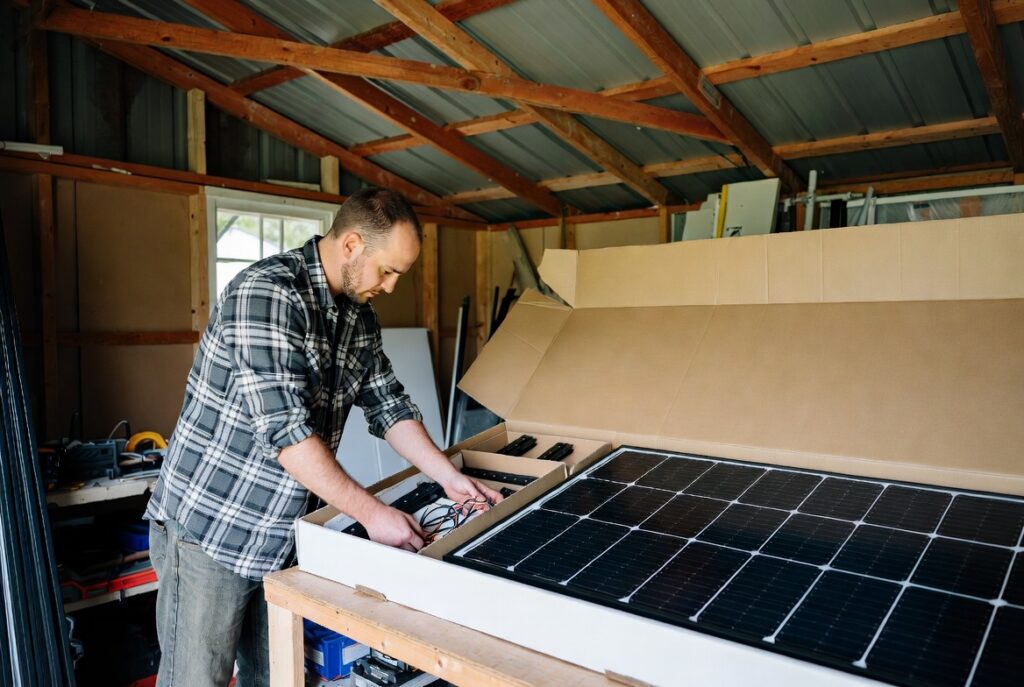
The most common Ontario solar panel kit mistake is buying the 100W kit at a big-box retailer, because that kit includes a PWM controller that clips the cold Voc boost every January morning and an AGM battery that sulfates permanently the first time it drops below 10.5V during a gray streak, and a property owner on Woolwich Street in Guelph, Wellington County bought exactly that kit in September 2022 for a small outbuilding, installed it correctly, and found the AGM battery permanently damaged by February 2023 after a 9-day January gray streak drained it to 10.2V and the PWM controller lacked the cold-weather harvesting capability to recover it on the following clear day.
The kit had cost approximately $180 at the time of purchase. The included 20Ah AGM battery reached 10.2V after 9 days of gray-streak production at approximately 15W average daily output from the dim January sun. The PWM controller’s inability to harvest the cold Voc boost meant the clear day following the gray streak delivered approximately 180Wh instead of the 510Wh a Victron MPPT 100/30 would have captured from the same panel on the same day.
I diagnosed the system in March 2023. The AGM battery’s resting voltage was 11.8V with no load, a confirmed sulfated cell condition. The panel was functional. The wiring was correct. The PWM controller was operating as designed, the problem was that its design was incompatible with Ontario January conditions. The correct Ontario solar panel kit specification required two changes: replace the PWM with a Victron MPPT 100/30 and replace the 20Ah AGM with a Battle Born heated LFP. The panel itself, a 100W mono PERC, was the correct Ontario specification. Only the controller and battery failed the January test.
The lesson from Woolwich Street is not that solar panel kits don’t work in Ontario, it is that the Ontario solar panel kit requires a different controller and battery than the kit ships with. The Renogy 100W Starter Kit is the correct base, its panel is mono PERC and correctly specified for Ontario low-light January conditions. The PWM controller and AGM battery that come with it are not. The upgrade cost is approximately $270 above the base kit price. The $180 lesson costs more. See our Ontario solar sizing guide before specifying any solar panel kit system.
The solar panel kit Ontario failure mode: how PWM clips cold Voc and AGM sulfates at 10.5V
| Component | Big-box kit (PWM + AGM) | Upgraded kit (MPPT + heated LFP) | Ontario January verdict |
|---|---|---|---|
| Controller | PWM, clips Voc to 13V, harvests ~49W at -22°C | MPPT 100/30, tracks 26.3V, harvests ~90W at -22°C | MPPT harvests 40 to 90% more ✓ |
| Battery | 20Ah AGM, sulfates permanently below 10.5V | 100Ah heated LFP, self-heats at 2°C, no sulfation | Heated LFP runs 3+ winters ✓ |
| Panel | 100W mono PERC, correct Ontario spec ✓ | 100W mono PERC, same panel ✓ | Keep the Renogy panel ✓ |
| Monitor | None included | Victron SmartShunt, confirms 127Wh clear January day | SmartShunt mandatory for diagnosis ✓ |
The most significant issue with a typical big-box solar panel kit is the PWM controller. A PWM controller connects the solar panel directly to the battery, so the panel operates at battery voltage, approximately 12.8V to 14.4V. At -22°C Ontario design temperature, a Renogy 100W panel’s Voc rises to approximately 26.3V (the cold temperature coefficient adds approximately 17%). A PWM controller clips this to 13V battery voltage, delivering approximately 49W from a 100W panel. An MPPT controller tracks the panel’s maximum power point at 26.3V, converts it to battery charging voltage, and delivers approximately 85 to 95W from the same panel on the same cold morning.
The standard 20Ah AGM battery in a typical big-box solar panel kit reaches 10.5V after approximately 2 to 3 days at a 30W load during a gray streak. Ontario January gray streaks average 3 to 5 consecutive low-production days, long enough to guarantee the AGM drops below 10.5V at least once per winter. One drop below 10.5V permanently sulfates an AGM battery. The combination of a PWM controller that cannot harvest the cold Voc recovery on the first clear day after a gray streak, and an AGM that sulfates on the first gray streak, is the confirmed big-box solar panel kit failure mode in Wellington County and Halton Hills every winter.
See our solar battery ontario guide for the full Ontario LFP vs AGM comparison.
The PWM vs MPPT cold weather comparison: why the Ontario January harvest gap is 40 to 90%
At 25°C STC, a 100W panel operating through a PWM controller delivers approximately 85 to 90W to the battery, close to the MPPT’s approximately 90 to 95W. The warm-season performance difference is small, and a big-box kit is genuinely adequate for summer camping use. At Ontario’s -22°C design temperature, the gap widens significantly: the panel’s Voc rises to 26.3V and the PWM clips it to 13V battery voltage, delivering approximately 49W. The Victron MPPT 100/30 tracks 26.3V and delivers approximately 85 to 95W. The cold-weather MPPT advantage of 40 to 90% is the Ontario-specific case that makes the controller upgrade mandatory for any solar panel kit intended for year-round use.
The Victron MPPT 100/30 accepts up to 100V input, which comfortably accommodates the Renogy 100W panel’s 26.3V cold Voc in both single-panel (26.3V) and 2S configurations (52.6V). The PWM controller included in most big-box kits is not rated for variable Voc tracking and cannot manage cold Voc safely in multi-panel configurations. Additionally, the MPPT 100/30 has a built-in LFP charging profile, set it correctly for the Battle Born heated LFP and the charging voltage, absorption, and float stages are handled automatically. See our solar panels ontario guide for the complete cold Voc calculation sequence.
Pro Tip: On commissioning day, check the Victron SmartShunt charging amps within the first 30 minutes of a clear morning. With a single Renogy 100W panel and MPPT 100/30 at approximately -8°C cell temperature, the SmartShunt should show approximately 6 to 8 amps at 14.2V charging voltage, approximately 85 to 115W harvested. If it shows 3 to 4 amps, the MPPT battery profile may still be set to AGM instead of LFP. Change the profile to LFP in the Victron Connect app and recheck. The Erin Township commissioning reading was 7.2 amps at 14.2V = 102W, confirming correct MPPT operation on the first clear January day at approximately -8°C.
The correct Ontario solar panel kit: Renogy 100W base with MPPT 100/30 and heated LFP substitution
The correct Ontario solar panel kit starts with the Renogy 100W Starter Kit as the base. The panel itself is correctly specified mono PERC for Ontario: high efficiency in low-light January conditions, south-facing ground or shed-roof mount, and correct cold Voc for 2S configuration at 52.6V, within the MPPT 100/30’s 100V limit. Two mandatory upgrades before first use: replace the included PWM controller with the Victron MPPT 100/30, and substitute the 20Ah AGM battery recommendation with a Battle Born heated LFP 100Ah. Add the Victron SmartShunt for commissioning confirmation.
A property owner in Erin Township, Wellington County purchased the Renogy 100W Starter Kit as the base solar panel kit in fall 2022 and made both upgrades before commissioning. His SmartShunt confirmed 127Wh from the single 100W panel on the first clear January day, correctly harvested by the MPPT at approximately -8°C cell temperature. The system operated through 3 consecutive Ontario winters without a single failure: no sulfated battery, no failed controller, no inverter trips.
His comment: “The MPPT and the heated battery were the only changes. The $180 version would have cost me more by spring.” Total upgraded kit cost at the time: approximately $450 to $550 including all four components. See our off grid costs guide for the complete Tier 1 to Tier 2 comparison.
The Ontario Tier 1 kit specification: 100W, MPPT, heated LFP, SmartShunt
The Ontario Tier 1 solar panel kit specification: Panel, Renogy 100W Starter Kit mono PERC, outperforms polycrystalline in Ontario’s low-light January conditions by approximately 10 to 15%. Controller, Victron MPPT 100/30, harvests cold Voc correctly, accepts up to 100V input, LFP charging profile built in. Battery, Battle Born heated LFP 100Ah, self-heating at 2°C, no sulfation risk, 3,000 to 4,000 cycle life versus 300 to 500 cycles for a typical AGM. Monitor, Victron SmartShunt, confirms charging amps and SoC in real time, the only reliable Ontario cold weather solar panel kit diagnostic. Total system cost: approximately $450 to $550 including all four components.
The Tier 1 solar panel kit is correctly scoped for detached sheds, workshops, outbuildings, and seasonal properties where the primary loads are LED lighting (approximately 25W), phone charging (approximately 15W), and a small radio or fan (approximately 8 to 15W), approximately 48 to 55W total. At 127Wh per clear January day from the single 100W panel and MPPT, the system provides approximately 2.3 to 2.6 hours of full-load operation from daily solar harvest, with the 100Ah LFP reserve covering evening and gray-day loads. For any load above approximately 100W continuous, chest freezer, furnace blower, power tools, the Tier 1 solar panel kit is undersized and the Tier 2 400W system is the correct specification.
NEC and CEC: Ontario permit requirements for permanently wired kit installations
NEC 690 governs permanent solar panel kit installations in Ontario. A permanently mounted solar panel on a shed or outbuilding roof, including the panel wiring, charge controller installation, and battery bank connections, constitutes a permanent electrical installation subject to NEC 690 requirements. Battery cable sizing must meet 125% of maximum continuous current. Class T fusing at the battery positive terminal is required for any LFP installation. A portable solar panel kit that is set up temporarily and taken down is not subject to NEC 690 permit requirements. Contact the NFPA at nfpa.org for current NEC 690 requirements for residential solar installations.
CEC Section 64 governs electrical installations in Ontario. A permanently installed solar panel kit, including the panel mounting, charge controller, and battery bank wiring in an outbuilding or shed, requires an ESA permit at $300 to $400 before installation begins. A portable solar panel kit that is not permanently wired to a structure does not require an ESA permit. The distinction is permanent versus temporary wiring, not the size of the system, a 100W solar panel kit permanently wired to a shed requires the same ESA permit as a 400W Tier 2 system. Contact the Electrical Safety Authority Ontario at esasafe.com before permanently installing any solar panel kit in Ontario.
The solar panel kit Ontario verdict: upgrade the controller and the battery, keep the Renogy panel
- Ontario property owner who bought a big-box solar panel kit and is experiencing battery problems: check the resting battery voltage with no load before replacing anything. If below 12.0V after a full day of sun, the AGM has likely sulfated, caused by the PWM controller clipping the cold Voc harvest and the AGM reaching 10.5V during a gray streak. Replace the AGM with a Battle Born heated LFP and replace the PWM with a Victron MPPT 100/30. The Woolwich Street Guelph result: panel was correct, wiring was correct, only the controller and battery needed replacing. Keep the Renogy panel.
- Ontario property owner specifying a new Tier 1 solar panel kit for a shed or outbuilding: start with the Renogy 100W Starter Kit base, make both upgrades before first use, and verify on commissioning day. Renogy 100W Starter Kit base, panel is correctly specified mono PERC. Replace the included PWM with Victron MPPT 100/30. Substitute Battle Born heated LFP 100Ah for the AGM recommendation. Add Victron SmartShunt, confirm 127Wh on first clear January day. The Erin Township result: 3 winters, zero failures, “the $180 version would have cost me more by spring.”
- Ontario property owner whose Tier 1 solar panel kit load has grown beyond LED lighting and phone charging: calculate the actual load before buying a second panel. A chest freezer adds approximately 40W continuous. A furnace blower adds 80W. A well pump adds 800W startup surge. Any of these loads requires the Tier 2 400W system, a second 100W panel will not bridge the gap. The Renogy 100W panel is the correct Tier 2 expansion panel, but the charge controller and battery bank must be resized for the larger system. See our off grid costs guide for the Tier 1 to Tier 2 upgrade path.
Frequently Asked Questions
Q: Why does my solar panel kit stop working in Ontario winter?
A: Two failure modes combine in Ontario January. First, the PWM controller included in most big-box solar panel kits connects the panel directly to the battery, clipping the cold Voc boost, at -22°C, a 100W panel’s Voc rises to approximately 26.3V but the PWM clips it to 13V battery voltage, delivering approximately 49W instead of the 85 to 95W an MPPT would harvest. Second, the included AGM battery sulfates permanently if it drops below 10.5V, which happens after approximately 2 to 3 days at a 30W load during an Ontario January gray streak (3 to 5 consecutive low-production days).
The Woolwich Street Guelph result confirmed both: 9-day gray streak, AGM to 10.2V, permanent sulfation, 11.8V resting voltage in March. Fix: replace the PWM with a Victron MPPT 100/30 and the AGM with a Battle Born heated LFP. Keep the Renogy 100W panel, it is the correct Ontario specification.
Q: Is the Renogy 100W Starter Kit good for Ontario?
A: The Renogy 100W Starter Kit panel is the correct Ontario specification, mono PERC, high efficiency in low-light January conditions, correct cold Voc for 2S configuration. The kit also includes mounting hardware and cables that are correctly specified. The two components that require upgrading for Ontario year-round use: replace the included PWM controller with a Victron MPPT 100/30 (approximately 40 to 90% more harvest on cold clear days), and substitute the AGM battery recommendation with a Battle Born heated LFP 100Ah (self-heating at 2°C, no sulfation risk, 10× the cycle life of an AGM).
With those two upgrades, the Renogy 100W Starter Kit forms the correct Ontario Tier 1 solar panel kit specification. The Erin Township result confirms it: 3 winters, zero failures, SmartShunt confirmed 127Wh on the first clear January day.
Q: Do I need a PWM or MPPT controller for my Ontario solar panel kit?
A: MPPT is mandatory for any Ontario solar panel kit intended for year-round or winter use. The core reason is cold Voc: at -22°C Ontario design temperature, a 100W mono PERC panel’s Voc rises to approximately 26.3V, approximately 17% higher than the 22.5V nameplate. A PWM controller clips this to 13V battery voltage (wasting the cold boost), while an MPPT controller tracks 26.3V and converts it efficiently to charging voltage, harvesting approximately 85 to 95W versus the PWM’s approximately 49W on the same cold clear morning. For summer-only or warm-season camping use, the PWM difference is small, approximately 5 to 15%. For Ontario January, the difference is the boundary between a functional solar panel kit and a sulfated AGM battery.
This build is engineered within the 48V DC Safety Ceiling. Diagnostic logic is based on 20+ years of technical service experience. All structural and electrical installations must be verified by a Licensed Professional and comply with your Local AHJ. See our legal and safety disclosure for full scope.
About the Author
Robert Bertrand spent 20 years as a service advisor in the automotive industry (Lexus and Nissan), where precision diagnostics, wiring integrity, and documentation standards were non-negotiable. He brings that same technical discipline to GridFree Guide, where he researches, tests, and documents off-grid solar systems for Ontario conditions. Based in Rockwood, Ontario, every article is built on verified specifications, manufacturer data, and the real-world climate constraints of Canadian off-grid living.
As an Amazon Associate I earn from qualifying purchases. This site also contains affiliate links to other products and services. GridFree Guide earns a small commission at no extra cost to you.