
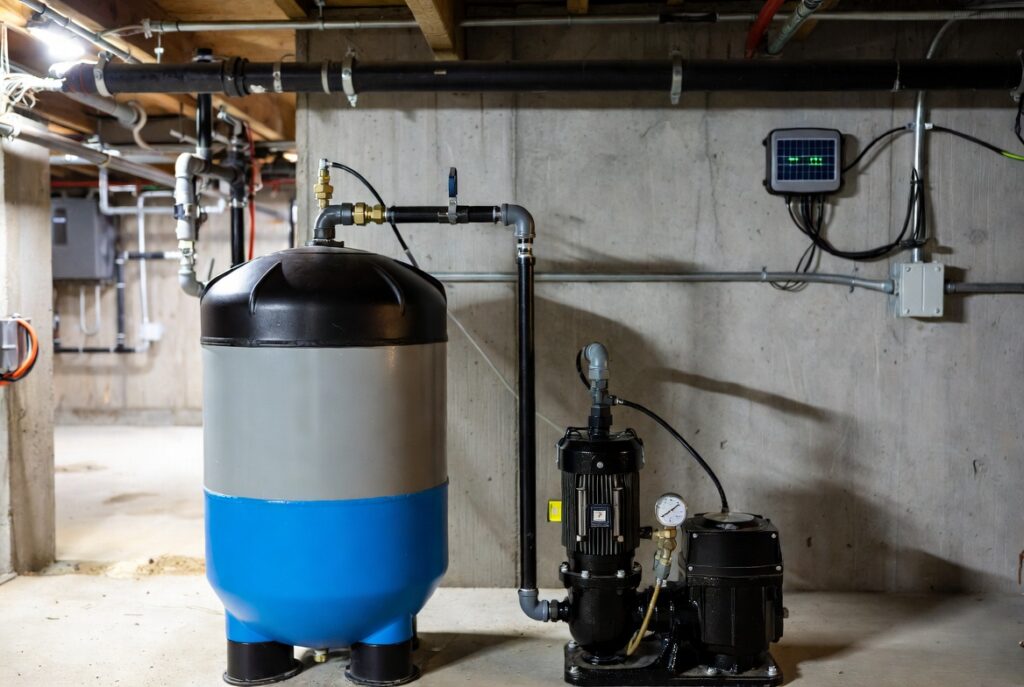
The most common off grid pump mistake is sizing the inverter to the well pump’s running watts. The nameplate on a 1/2 HP submersible well pump in a Wellington County drilled well reads 800 to 900W running. Without a [SoftStart Well](https://www.amazon.com/dp/B0FQ4G4Q7L?tag=gridfreegui0b-20), the startup surge reaches approximately 2,800W for the first 3 to 5 seconds of every pump cycle. A property owner on Speedside Road in Guelph discovered this when his brand-new 2,000W PSW inverter went into overload protection and shut down the cabin the first time his family tried to run the tap.
He had installed a correctly specified Tier 2 system: 400W mono PERC array, 200Ah Battle Born heated LFP, Victron MPPT 100/30, and a quality 2,000W PSW inverter. His [Victron SmartShunt](https://www.amazon.com/dp/B0856PHNLX?tag=gridfreegui0b-20) captured the event: the off grid pump startup drew a 2,800W peak for approximately 4 seconds before settling to 870W continuous running. The 2,000W inverter’s overload threshold at 140% equals 2,800W, exactly the pump’s startup surge.
I reviewed his SmartShunt history remotely. The 2,800W peak appeared consistently on every pump start, 11 trips in 3 days of occasional use. His first impulse was to upgrade the inverter to a 3,000W unit at approximately $450 cost. I recommended the SoftStart Well instead. This device installs in the pump’s electrical box in approximately 30 minutes. It electronically ramps the motor voltage over 3 to 5 seconds, preventing the instantaneous inrush current that causes the 2,800W surge.
He installed the SoftStart Well in 30 minutes. The SmartShunt confirmed the result on the first pump cycle: 900W startup peak for approximately 4 seconds, then 870W continuous running. The 2,000W inverter handled the 900W startup with 1,100W to spare, no overload, no shutdown. Total cost: $68 for the SoftStart Well. Total cost avoided: $450 inverter upgrade. The off grid pump surge problem had a $68 solution. See our [Ontario solar sizing guide](https://gridfreeguide.com/how-much-solar-power-do-i-actually-need-real-numbers-no-fluff/) before specifying any off grid pump system.
The off grid pump surge trap: why the 800W nameplate hides the 2,800W startup that trips the inverter
| Pump type | Running watts | Startup surge (no SoftStart) | With SoftStart Well |
|---|---|---|---|
| 1/2 HP well pump (submersible) | 800 to 900W | ~2,800W (trips 2,000W inverter) | ~900W ✓, 2,000W inverter safe |
| 1/3 HP sump pump | 400 to 500W | ~1,200 to 1,500W | Not required, 2,000W handles it |
| Grey water pump | 200 to 400W | ~600 to 900W | Not required, 2,000W handles it |
| SoftStart Well cost | $65 to $80 | vs $400 to $500 inverter upgrade | 6 to 7× cost savings ✓ |
Induction motors (well pumps) require 3 to 5 times their running watts to overcome inertia and magnetic flux at startup. A 1/2 HP well pump running at 870W requires approximately 2,800W for the first 3 to 5 seconds of each pump cycle, 3.2 times the running watts. This is the locked rotor current: the motor’s resistance is lowest when the shaft is stationary, causing maximum current draw. A 2,000W inverter with 4,000W surge rating can handle surge peaks only for fractions of a second. A 4-second 2,800W pump startup exceeds the sustained overload threshold and activates the inverter’s protection circuit.
The [Victron SmartShunt](https://www.amazon.com/dp/B0856PHNLX?tag=gridfreegui0b-20) is the only tool that reveals this surge in real time. Without a SmartShunt, inverter overload trips look like a system fault or battery problem. The property owner cannot distinguish between a surge issue and a configuration error. With the SmartShunt, the peak watt reading at the moment of the trip appears in history: 2,800W for 4 seconds, confirming the surge source and pointing directly to the SoftStart Well as the fix. The Speedside Road SmartShunt history showed 11 identical 2,800W spikes over 3 days, every one a pump start, every one a trip. See our [solar inverter ontario guide](https://gridfreeguide.com/solar-inverter-ontario-standard/) for the inverter sizing sequence that the SoftStart Well makes possible at Tier 2.
The off grid pump SoftStart standard: $68 drops the 2,800W surge to 900W and saves a $450 inverter upgrade
The [SoftStart Well](https://www.amazon.com/dp/B0FQ4G4Q7L?tag=gridfreegui0b-20) installs in the well pump’s electrical box in approximately 30 minutes. It sits between the pressure switch and the pump motor, electronically ramping voltage over 3 to 5 seconds and preventing the instantaneous inrush current. The result: 2,800W startup surge drops to approximately 900W, within the 2,000W PSW inverter’s continuous rating. The Speedside Road result: $68 SoftStart Well, 30 minutes of installation, SmartShunt confirmed 900W startup from the first cycle. Cost comparison: $68 SoftStart versus $400 to $500 inverter upgrade, a 6 to 7 times cost ratio for the same operational result. The SoftStart Well also extends pump motor life by eliminating the mechanical shock of instantaneous full-voltage startup.
A property owner in Erin Township, Wellington County specified the SoftStart Well from day one. His SmartShunt confirmed 900W startup on the first pump cycle. The 2,000W inverter recorded zero overload events through the first winter. He also installed an 80-gallon pressure tank rather than the standard 20-gallon, reducing pump cycling from approximately 12 times per hour to approximately 3 times per hour. Each pump start at 900W times 4 seconds equals 1Wh from the bank. At 12 starts per hour versus 3 starts per hour, the larger tank directly extends battery cycle life.
His comment: “The SoftStart is the first thing I’d tell anyone to buy before they touch a well pump.” See our well pump ontario guide for the complete drilled well system specification.
Pro Tip: Verify the SoftStart Well is working correctly on the first pump cycle after installation by checking the SmartShunt peak watt reading. With the system at rest, turn on a tap to trigger the pressure switch, then watch the SmartShunt peak watt reading during the 3 to 5 seconds of pump startup. The reading should peak at approximately 900W and then settle to 850 to 900W continuous running. If the SmartShunt still shows 2,000W or above during startup, the SoftStart Well is either wired incorrectly or has a fault. The Speedside Road confirmation reading was 897W peak, the SmartShunt captured the surge drop from 2,800W to 897W on the first cycle after installation, confirming the fix before the inverter had another chance to trip.
The Ontario pump type comparison: well pump, sump pump, pressure tank, and grey water load profiles
The Ontario off grid pump load profiles differ significantly by pump type. The 1/2 HP submersible well pump is the only pump that requires the SoftStart Well. Its 2,800W startup surge is the only off grid pump load that exceeds a 2,000W inverter’s sustained overload threshold. The 1/3 HP sump pump at approximately 400 to 500W running and approximately 1,200 to 1,500W startup is manageable by a 2,000W PSW inverter with 4,000W surge rating without a SoftStart device. The grey water pump at approximately 200 to 400W running and approximately 600 to 900W startup is handled easily by any Tier 2 inverter without additional startup assistance.
The [Battle Born heated LFP](https://www.amazon.com/dp/B092RKVC1D?tag=gridfreegui0b-20) bank absorbs the pump startup surge as a brief high-current draw through the [Victron SmartShunt](https://www.amazon.com/dp/B0856PHNLX?tag=gridfreegui0b-20). Without the SoftStart Well, each 2,800W startup draws approximately 233A from a 12V battery bank for 4 seconds. This high-current spike causes voltage sag on the battery terminals and contributes to accelerated cell degradation over time. With the SoftStart Well, the 900W startup draws approximately 75A at 12V, within the LFP bank’s comfortable operating range and causing negligible voltage sag. The SoftStart Well protects both the inverter and the battery bank simultaneously.
The sump pump spring load: why Ontario snowmelt can turn a 400W pump into a continuous system drain
The Ontario spring sump pump load is the seasonal off grid pump consideration that catches most property owners unprepared. During the March and April snowmelt period in Wellington County and Halton Hills, a sump pump can cycle every 2 to 5 minutes continuously during peak melt days. It runs at approximately 400W for approximately 40 to 60% of each hour. At 400W times 0.5 hours active per hour equals 200Wh per hour. Over a 12-hour peak melt day, that totals 2,400Wh. A 200Ah LFP bank (1,920Wh usable) cannot sustain this load on solar alone in March. A 400W array produces approximately 850Wh per day at approximately 2.5 PSH. Generator or grid backup may be required during peak melt days.
The correct off grid pump spring preparation starts with verifying the sump pump is a standard 1/3 HP unit (400 to 500W running). Confirm the 2,000W inverter handles the 1,200 to 1,500W startup surge using the SmartShunt history from an autumn test run. Calculate the spring melt daily load separately from the winter base load. If the sump pump cycling during peak melt exceeds 1,200Wh per day, plan for a second 100Ah LFP for spring reserve or generator integration during peak melt days. A correctly sized system with a [Victron MPPT 100/30](https://www.amazon.com/dp/B073ZJ3L13?tag=gridfreegui0b-20) and 400W array handles the sump pump load outside of peak melt days. See our [off grid setup guide](https://gridfreeguide.com/off-grid-setup-standard/) for the SmartShunt commissioning protocol before spring melt season.
NEC and CEC: Ontario permit requirements for permanent pump wiring in off-grid systems
NEC 690 and NEC 430 govern the wiring for any permanent off grid pump installation. The pump motor wiring must be sized for 125% of the motor’s full-load current. It must also be protected with a time-delay fuse or circuit breaker rated for the motor’s locked-rotor current, and installed with appropriate overcurrent protection in the disconnect box. The SoftStart Well installs in the pump control panel between the pressure switch and motor leads. All wiring connections must meet the manufacturer’s specification and comply with NEC 430 requirements for motor branch circuit conductors. Contact the NFPA at nfpa.org for current NEC requirements for motor branch circuits in residential off-grid applications.
CEC Section 64 governs electrical installations in Ontario. Any permanently wired off grid pump system requires ESA inspection as part of the overall off-grid electrical permit. This includes the well pump disconnect box, pressure switch wiring, SoftStart Well installation, and inverter sub-panel connections. The ESA permit at $300 to $400 covers the complete off-grid installation including the pump circuit wiring. A SoftStart Well installation performed without an ESA permit invalidates the property insurance coverage for the pump circuit. Contact the Electrical Safety Authority Ontario at esasafe.com before beginning any permanent off grid pump installation in Ontario.
The off grid pump verdict: SoftStart Well for the well pump, SmartShunt to confirm, larger pressure tank to reduce cycling
- Ontario property owner whose 2,000W inverter is tripping on well pump startup: the cause is the 2,800W startup surge, confirmed by the SmartShunt peak reading before any hardware replacement. The fix is the SoftStart Well at approximately $68, installed in the pump electrical box in 30 minutes. The Speedside Road Guelph result: 2,800W surge to 900W startup, inverter trips eliminated, $68 versus $450 inverter upgrade. Install the Victron SmartShunt to confirm the 900W startup peak on the first pump cycle after the SoftStart Well installation. If the SmartShunt peak is still above 2,000W, check the SoftStart Well wiring before ordering a new inverter.
- Ontario property owner specifying a new Tier 2 off-grid cabin with a drilled well: install the SoftStart Well before commissioning, specify an 80-gallon pressure tank, and verify both in the SmartShunt history on commissioning day. 2× Battle Born heated LFP 100Ah through a Victron MPPT 100/30 provides 1,920Wh usable, sufficient for 8.7 days of gray streak autonomy at 220Wh per day including the off grid pump load. The Erin Township result: SoftStart Well from day one, SmartShunt confirms 900W startup, zero overload events through the first winter, 80-gallon tank reduces cycling to 3 times per hour.
- Ontario property owner with a sump pump as the primary off grid pump concern: no SoftStart Well required, but plan the spring snowmelt load separately from the winter base load calculation. The 1/3 HP sump pump at 400 to 500W running and 1,200 to 1,500W startup is managed by a 2,000W PSW inverter without a SoftStart device. The critical Ontario planning item: confirm the SmartShunt startup peak from an autumn test before melt season, and calculate whether peak melt-day cycling (up to 2,400Wh) requires generator supplement or additional battery capacity. If daily sump pump load exceeds 1,200Wh during peak melt days in Wellington County and Halton Hills, plan for generator support on those specific days.
Frequently Asked Questions
Q: Why does my well pump keep tripping the inverter if the pump is only 800 watts?
A: The 800W nameplate on a 1/2 HP well pump is the running wattage, the continuous draw while the pump actively moves water. The startup surge reaches approximately 2,800W for the first 3 to 5 seconds of every pump cycle. Induction motors require 3 to 5 times their running current to overcome shaft inertia at startup. A 2,000W PSW inverter trips at 140% overload, which equals 2,800W, exactly the pump’s startup surge.
The SmartShunt confirms this: the Speedside Road Guelph system showed 11 identical 2,800W spikes in 3 days, every one a pump start, every one a trip. The fix is the SoftStart Well at approximately $68. It ramps the motor voltage electronically over 3 to 5 seconds, dropping the startup surge from 2,800W to approximately 900W, well within the 2,000W inverter’s operating range.
Q: What does the SoftStart Well actually do and is it worth $68?
A: The SoftStart Well installs between the pressure switch and the pump motor in the well pump’s electrical box. It electronically ramps the motor voltage over 3 to 5 seconds rather than applying full voltage instantaneously. This prevents the locked rotor current spike that causes the 2,800W startup surge. The result: startup surge drops from approximately 2,800W to approximately 900W, allowing a 2,000W PSW inverter to handle the well pump with 1,100W to spare.
At approximately $68, the SoftStart Well costs 6 to 7 times less than a 3,000W inverter upgrade ($400 to $500) needed to handle the un-softened 2,800W surge. It also extends pump motor life by eliminating the mechanical shock of instantaneous full-voltage startup. The Erin Township result: installed from day one, SmartShunt confirms 900W startup on every pump cycle, zero inverter overload events through the first winter.
Q: How do I size my off-grid battery bank for a well pump in Ontario?
A: Size the battery bank to the total daily load including the well pump running time, not the startup surge. A 1/2 HP well pump running at 870W typically operates for approximately 1 to 2 hours per day at normal household water use. It consumes approximately 870 to 1,740Wh per day from running time alone. Adding this to the base Tier 2 load (lighting, fridge, laptop, furnace blower = approximately 165Wh) gives a total daily load of approximately 1,000 to 1,900Wh.
A 200Ah Battle Born heated LFP bank (1,920Wh usable) handles the lower end of this range at 8.7 days autonomy. Properties with higher water use should consider 400Ah (3,840Wh usable) for reliable gray streak autonomy. Install the SoftStart Well before the battery bank. The reduced 900W startup eliminates the 233A spike that would otherwise stress the LFP cells on every pump start.
This build is engineered within the 48V DC Safety Ceiling. Diagnostic logic is based on 20+ years of technical service experience. All structural and electrical installations must be verified by a Licensed Professional and comply with your Local AHJ. See our legal and safety disclosure for full scope.
About the Author
Robert Bertrand spent 20 years as a service advisor in the automotive industry (Lexus and Nissan), where precision diagnostics, wiring integrity, and documentation standards were non-negotiable. He brings that same technical discipline to GridFree Guide, where he researches, tests, and documents off-grid solar systems for Ontario conditions. Based in Rockwood, Ontario, every article is built on verified specifications, manufacturer data, and the real-world climate constraints of Canadian off-grid living.
As an Amazon Associate I earn from qualifying purchases. This site also contains affiliate links to other products and services. GridFree Guide earns a small commission at no extra cost to you.