
The most expensive Ontario off grid insulation mistake is building a cabin with R-12 walls and then trying to heat it with a 1,500W electric heater, because a 1,500W heater running 16 hours a day draws 24,000Wh daily, and sustaining that load through a 4-day January gray streak requires approximately 96,000Wh of battery storage, which at current LFP prices represents approximately $40,000 in batteries just for the heating load while the lights, fridge, water pump, and every other load sit at zero.
A property owner on Eramosa Road in Guelph, Wellington County built a 900-square-foot off-grid cabin in 2020 with R-12 batt insulation in 2×4 walls and R-20 in the attic. The cabin was cold. She added a 1,500W electric space heater to supplement her propane furnace during January cold snaps.
Her Victron SmartShunt showed the battery bank hitting 20% SoC by midnight on the coldest nights. The generator ran 4 to 5 hours per night to recover the bank from the 1,500W heater drain. Over a full Ontario heating season (approximately 1,100 hours of generator runtime), her annual propane bill for generator fuel alone was approximately $4,200. The insulation was not a comfort problem, it was a $4,200-per-year mechanical failure.
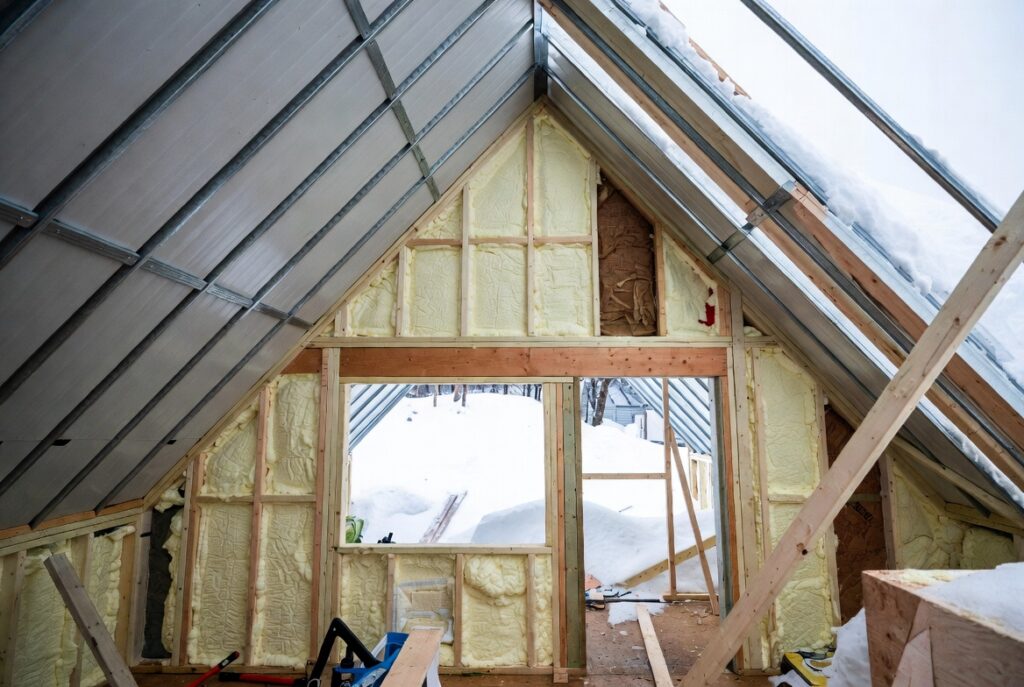
She hired a spray foam contractor in spring 2023. Rim joists received 2-inch closed-cell spray foam. Exterior walls received R-5 continuous rigid foam board on the outside. The attic was blown in to R-60. Total cost: $4,800. The following January, the SmartShunt confirmed the off grid insulation upgrade had eliminated all supplemental electric heat, furnace blower draws 80W, daily heating electrical load is 1,920Wh, generator runtime is zero, annual propane savings are $4,200. Payback: approximately 14 months. See our Ontario solar sizing guide before specifying any off grid insulation system.
The off grid insulation electric heat trap: why 1,500W of supplemental heating destroys a Tier 2 system in January
| Insulation level | Heating load (Ontario January) | Electrical heating load | Ontario verdict |
|---|---|---|---|
| R-12 walls, R-20 attic (“Camp”) | ~12,000 BTU/hr | 1,500W supplement = 24,000Wh/day | $40,000 batteries for heat alone ✗ |
| R-16 effective, R-30 attic | ~8,000 BTU/hr | Still requires generator support | Marginal improvement ⚠️ |
| R-24 effective, R-60 attic (Fortress) | ~4,000 BTU/hr | 80W furnace blower = 1,920Wh/day | Solar-only operation possible ✓ |
| Generator propane savings | n/a | $4,200/year eliminated | $4,800 upgrade pays back in 14 months ✓ |
Electric heating is mechanically impossible for any practical off-grid system. A 1,500W heater running 16 hours a day draws 24,000Wh daily. Gray streak autonomy for heat alone across a 4-day Ontario January gray streak requires approximately 96,000Wh, and that covers only the heater, with zero capacity for lights, water pump, fridge, or any other load. At current LFP costs, 96,000Wh of battery storage represents approximately $40,000. The correct off grid insulation strategy: propane combustion provides the heat (dense energy, no electricity required), and the electrical system powers only the 60 to 80W furnace blower motor.
The Eramosa Road Guelph system confirmed this precisely. With R-12 walls and a 1,500W electric heater supplementing the propane furnace, the SmartShunt showed the 200Ah LFP bank (2,400Wh usable) being consumed by the heater at 1,500W, exhausting the bank in approximately 1.6 hours of heater operation at full load. The generator had to run to prevent the bank from hitting the low-voltage cutoff. The 4-5 hours of nightly generator runtime was not a solar system failure, it was a building envelope failure that the solar system was absorbing. See our off grid heating guide for the propane furnace specification that pairs with a correctly insulated off-grid cabin.
The thermal bridging problem: why R-20 batts in a 2×6 wall deliver R-16, not R-20
Thermal bridging explains why nominal R-values overstate actual wall performance. Wood studs at 16-inch centres conduct heat at approximately R-1.25 per inch, far less insulating than the R-3.7 per inch of mineral wool or fiberglass batts. Because studs make up approximately 15 to 20% of the wall area, they conduct significantly more heat per square inch than the adjacent insulation. The result: a 2×6 wall with R-20 batts has an effective R-value of approximately R-16, a 20% thermal performance gap from the nominal value. This gap matters for off grid insulation planning because it means the wall is losing approximately 25% more heat than the R-20 spec suggests.
Adding R-5 continuous rigid foam board on the exterior surface wraps both studs and insulation, eliminating the thermal bridge and improving the effective R-value to approximately R-21. The rim joist demonstrates thermal bridging at its most costly: the continuous band of 2-inch lumber at foundation level is exposed to outdoor temperatures on all sides and can represent 15 to 20% of total building heat loss through a very small surface area. Two inches of closed-cell spray foam (R-13) applied to the interior face of the rim joist stops both the thermal bridge and the air infiltration that accompanies it. This is the highest-priority off grid insulation repair in any Ontario cabin built before 2005.
Pro Tip: The three off grid insulation upgrades ranked by payback speed for an existing Ontario cabin: (1) rim joist spray foam, approximately $400 for a 900-square-foot cabin, eliminates 15 to 20% of total heat loss, typically pays back in 6 to 12 months through reduced generator propane; (2) attic blown-in from R-20 to R-60, approximately $800 to $1,200, highest-value-per-dollar thermal improvement available, pays back in 12 to 24 months; (3) exterior R-5 rigid foam on walls, approximately $2,000 to $3,000 for walls alone, longer payback but eliminates thermal bridging and protects the wall assembly from moisture. Do these in order. The Eramosa Road $4,800 total included all three, and the $4,200/year generator savings paid the full investment back in 14 months.
The air sealing audit: why R-value is useless if wind blows through the outlets
Air sealing is the off grid insulation component that nominal R-values cannot capture. A 2×6 wall with R-20 batts and R-5 exterior rigid foam has an effective R-value of approximately R-21, but only if the insulation is surrounded by still air. Wind-driven infiltration through unsealed electrical outlet boxes, plumbing penetrations, and ceiling light fixtures bypasses the insulation entirely and carries heat out of the building at a rate no R-value calculation accounts for. Acoustic sealant behind each electrical outlet and switch box adds approximately 2 to 3 hours of labour to a cabin retrofit and can eliminate the single largest source of uncontrolled air leakage in an older Ontario cabin.
The vapour barrier is the air sealing component that affects both thermal performance and long-term structural integrity. In Ontario, the vapour barrier belongs on the warm side of the insulation (inside the stud cavity, behind the drywall). Any penetration through the vapour barrier, electrical boxes, plumbing, ceiling fixtures, must be sealed with acoustic sealant or vapour-barrier tape. A cabin with R-21 effective off grid insulation and a properly sealed vapour barrier will outperform a cabin with R-24 nominal walls and unsealed penetrations, because the air infiltration in the unsealed cabin carries far more energy loss than the R-3 nominal difference suggests. See our off grid living guide for the complete Ontario winter off-grid system standard.
The off grid insulation Fortress standard: R-24 effective walls, R-60 attic, spray foam rim joists
The Ontario off grid insulation Fortress standard: R-24 effective walls, R-60 blown-in attic, closed-cell spray foam on all rim joists, and low-E argon double-pane windows. The wall R-24 effective target can be achieved with 2×6 framing plus R-20 mineral wool batts (R-16 effective after thermal bridging) plus R-5 continuous rigid foam board on the exterior, improving to approximately R-21 effective, or with 2×6 framing plus 2-inch closed-cell spray foam cavity fill. The R-60 attic is the highest-impact single improvement in any existing Ontario cabin because heat rises and the ceiling is where most thermal energy escapes through a 43°C interior-to-exterior differential in January.
A property owner near Elora in Centre Wellington, Wellington County completed a new off-grid cabin build in fall 2023, specifying the Fortress off grid insulation standard from the design phase: R-24 effective walls, R-60 blown-in attic, spray foam rim joists, low-E argon double-pane windows. First January: the 80W propane furnace blower was the only heating electrical load. Daily heating electrical load: 1,920Wh. Her Victron SmartShunt confirmed the bank never dropped below 65% SoC through any January day or the 3-day gray streak.
Generator runtime: zero. Annual propane cost: approximately $420 for heat fuel, no generator propane. Her 200W Renogy mono PERC array through a Victron MPPT 100/30 paired with a Battle Born heated LFP bank handled the full winter. Her comment: “The insulation is the battery. Every R-value is a kilowatt-hour I didn’t have to store.” See our solar battery ontario guide for battery sizing after the insulation load is correctly calculated.
NEC and CEC: Ontario permit requirements for permanent building envelope improvements
NEC and CEC do not govern building envelope insulation directly, insulation is covered by the Ontario Building Code (OBC), specifically Part 9 and Supplementary Standards SB-12 for energy efficiency. However, spray foam insulation applied near electrical panels or around electrical wiring in a wall cavity must not cover or restrict access to electrical connections. The spray foam contractor must coordinate with the licensed electrician to ensure all electrical connections remain accessible after spray foam application. Contact the NFPA at nfpa.org for NEC fire safety requirements related to spray foam insulation and electrical clearances.
CEC Section 64 and the Ontario Building Code govern electrical installations within insulated structures. Any changes to the building envelope that affect the location or accessibility of the electrical panel, service entrance, or branch circuit wiring require notification to the local building department. A building permit is required for any off grid insulation upgrade that alters the fire separation rating of the structure or covers previously uninspected electrical work. Contact the Electrical Safety Authority Ontario at esasafe.com before beginning any insulation retrofit that involves the electrical system in an Ontario off grid insulation project.
The off grid insulation verdict: insulate first, then size the solar system to the remaining load
- Ontario property owner running a 1,500W electric heater in an off-grid cabin to supplement a propane furnace: check the SmartShunt SoC at midnight on the coldest night before purchasing any additional batteries. If the bank is at 20% SoC by midnight, the building envelope is the failure, not the battery bank size. Get quotes for rim joist spray foam, R-5 exterior rigid foam on the walls, and R-60 attic blown-in before adding a single kilowatt-hour of battery capacity. The Eramosa Road Guelph result: $4,800 insulation investment, $4,200/year in generator propane eliminated, 14-month payback, zero electric heat the following winter. Confirm the load reduction with a Victron SmartShunt, the midnight SoC reading should be above 70% after the insulation upgrade.
- Ontario property owner planning a new off-grid build: specify R-24 effective walls, R-60 attic, spray foam rim joists, and low-E argon double-pane windows before calculating the solar system size. The Elora Centre Wellington result: a 200W array with 2× Renogy 100W mono PERC panels and a Battle Born heated LFP 100Ah through a Victron MPPT 100/30 powered a fully insulated 900-square-foot Ontario cabin through the entire winter with zero generator runtime. The insulation is the battery, every R-value is a kilowatt-hour that does not need to be stored.
- Ontario property owner with an existing cabin at R-12 to R-16 effective walls who wants to improve without a full exterior renovation: target the three highest-impact off grid insulation improvements in order of payback speed. First: rim joist 2-inch closed-cell spray foam, approximately $400 for a 900-square-foot cabin, stops 15 to 20% of total heat loss. Second: attic upgrade from R-20 to R-60 blown-in, approximately $800 to $1,200, highest value-per-dollar thermal improvement available. Third: acoustic sealant on all electrical outlet boxes and plumbing penetrations, approximately $50 in materials plus 3 hours of labour. These three improvements alone can reduce the heating load by 40 to 50% without touching the exterior walls, and each pays for itself in reduced generator propane within 12 to 24 months.
Frequently Asked Questions
Q: Does insulation reduce the size of solar system I need for an off-grid cabin in Ontario?
A: Yes, significantly. The Eramosa Road Guelph comparison is the clearest example: before off grid insulation upgrade (R-12 walls, R-20 attic), the heating electrical load was 24,000Wh per day from a 1,500W supplement heater running 16 hours, requiring generator support for approximately 1,100 hours per heating season ($4,200/year in propane). After the R-24/R-60 Fortress upgrade ($4,800), the heating electrical load dropped to 1,920Wh per day from an 80W furnace blower, a 92% reduction.
A solar system sized for 1,920Wh per day (200W array) is approximately $3,500 to $5,000 in components. A solar system sized for 24,000Wh per day (effectively impossible) would exceed $40,000 in batteries alone. Off grid insulation is not an optional comfort upgrade, it is the prerequisite for solar-only winter operation.
Q: What is the best insulation standard for an off-grid Ontario cabin?
A: The Fortress standard: R-24 effective walls, R-60 blown-in attic, 2-inch closed-cell spray foam on all rim joists, and low-E argon double-pane windows. The wall R-24 effective target is achieved with 2×6 framing plus R-20 mineral wool batts (R-16 effective after thermal bridging at 16-inch stud spacing) plus R-5 continuous rigid foam board on the exterior (improving to R-21 effective). The R-60 attic is the highest single-improvement value in an Ontario off grid insulation project, the attic upgrade from R-20 to R-60 costs approximately $800 to $1,200 for a 900-square-foot cabin and reduces ceiling heat loss by approximately 67%.
The rim joist spray foam typically costs approximately $400 and stops 15 to 20% of total heat loss in an older Ontario cabin.
Q: What is thermal bridging and why does it matter for off-grid insulation?
A: Thermal bridging occurs when a conductive material, such as a wood stud, creates a continuous heat path through the insulation layer. Wood studs at 16-inch centres in a 2×6 wall conduct heat at approximately R-1.25 per inch versus R-3.7 per inch for mineral wool batts. Because studs make up approximately 15 to 20% of the wall area, the effective R-value of a 2×6 wall with R-20 batts is approximately R-16, not R-20.
Applying R-5 continuous rigid foam board to the exterior of the wall wraps both the studs and the insulation, eliminating the thermal bridge and improving the effective R-value to approximately R-21. For off grid insulation planning, the difference between R-16 effective and R-21 effective is approximately 24% less heat loss through the walls, a direct reduction in the propane furnace runtime and the electrical load of the furnace blower.
This build is engineered within the 48V DC Safety Ceiling. Diagnostic logic is based on 20+ years of technical service experience. All structural and electrical installations must be verified by a Licensed Professional and comply with your Local AHJ. See our legal and safety disclosure for full scope.
About the Author
Robert Bertrand spent 20 years as a service advisor in the automotive industry (Lexus and Nissan), where precision diagnostics, wiring integrity, and documentation standards were non-negotiable. He brings that same technical discipline to GridFree Guide, where he researches, tests, and documents off-grid solar systems for Ontario conditions. Based in Rockwood, Ontario, every article is built on verified specifications, manufacturer data, and the real-world climate constraints of Canadian off-grid living.
As an Amazon Associate I earn from qualifying purchases. This site also contains affiliate links to other products and services. GridFree Guide earns a small commission at no extra cost to you.