
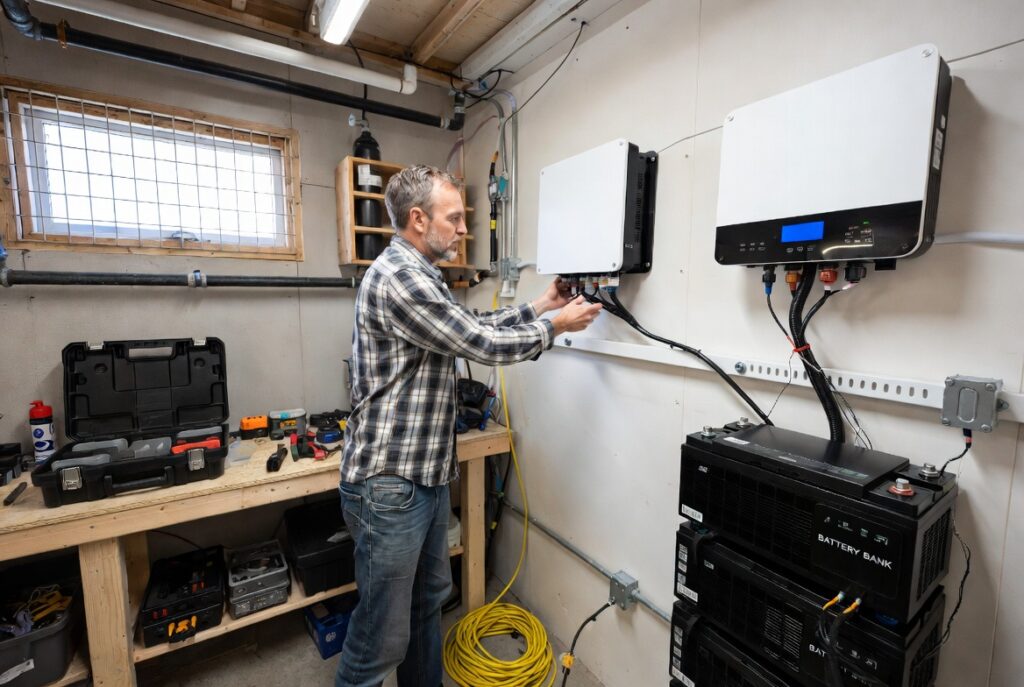
The most common solar inverter ontario mistake costs $80 at purchase and approximately $1,500 at repair: a property owner on Woolwich Street in Guelph, Wellington County chose a modified sine wave (MSW) inverter over a pure sine wave (PSW) unit to save $80 on a 2,000W inverter purchase in fall 2022, and by February 2023 the propane furnace blower motor had overheated and failed because MSW inverters produce a chopped square wave that causes approximately 15 to 20% more heat in inductive motor windings compared to the smooth sine wave that motors are designed to run on.
His furnace blower drew approximately 80W continuously through the inverter. On MSW power, the motor ran hotter than its PSW design specification. By mid-January the blower began humming audibly during startup, a sign of the motor struggling against waveform distortion.
The HVAC technician found scorched motor windings, thermal damage from months of running on MSW power. The motor replacement cost $1,480 in parts and labour. I reviewed his solar inverter ontario specification after the repair. His inverter’s waveform distortion (total harmonic distortion, THD) was approximately 28%, far above the approximately 3% or less THD of a quality PSW unit. The $80 MSW saving had cost 18.5 times its value in motor repairs.
I specified a replacement 2,000W PSW inverter and confirmed the propane furnace blower specification required less than 5% THD, a PSW requirement. His Victron SmartShunt confirmed the replacement system ran correctly: furnace blower drawing approximately 80W on startup, settling to 65W continuous, no error codes through the remainder of the winter. The solar inverter ontario PSW mandate is not a preference, it is determined by every inductive motor load in the system. See our Ontario solar sizing guide before specifying any solar inverter ontario.
The solar inverter ontario PSW mandate: why modified sine wave kills furnace blower motors in Ontario winter
| Specification | PSW (pure sine wave) | MSW (modified sine wave) | Ontario verdict |
|---|---|---|---|
| Total harmonic distortion | ~3% or less | ~25 to 30% | PSW only for inductive loads ✓ |
| Furnace blower motor | Runs at design temp | 15-20% more heat per cycle | MSW = scorched windings in 1-3 seasons ✗ |
| Well pump motor | Correct waveform | Premature bearing wear | PSW mandatory with SoftStart Well ✓ |
| PSW premium over MSW | Approximately $150-200 more | Base price | $150 vs $1,480 repair, obvious ✓ |
| Correct MSW use case | n/a | Resistive loads only | Incandescent lighting, heating elements only |
The PSW mandate for any Ontario solar inverter ontario system is driven by the inductive motor loads that every habitable property requires: propane furnace blower, well pump motor, refrigerator compressor, and chest freezer compressor. MSW inverters produce a chopped square wave approximation with THD of approximately 25 to 30%. This causes the motor’s magnetic flux to distort and generate approximately 15 to 20% more heat per operating cycle. At furnace blower duty hours in a Wellington County January (approximately 8 to 10 hours per day), 15% excess heat accelerates winding degradation and causes motor failure in 1 to 3 heating seasons.
The PSW premium over MSW is approximately $150 to $200 for a quality 2,000W unit. The Woolwich Street result: the MSW saving of $80 cost $1,480 in HVAC repair, an 18.5× ratio. For any solar inverter ontario system with a furnace blower, well pump, or compressor load, PSW is not a preference, it is the only correct specification. MSW inverters are appropriate only for purely resistive loads (incandescent lighting, heating elements) with no rotating magnetic components. See our solar battery ontario guide for the heated LFP specification that pairs with any Ontario PSW inverter in an unheated utility room.
The solar inverter ontario idle draw: why the 2,000W unit beats the 3,000W unit in a January gray streak
The idle draw difference is the silent solar inverter ontario cost that determines how much of the battery bank a larger inverter consumes doing nothing. A quality 2,000W PSW unit draws approximately 6 to 10W in idle mode (no load, powered on). A generic 3,000W unit draws approximately 20 to 30W idle. The 17W difference × 24 hours = 408Wh per day consumed before any load is connected. During a 4-day Ontario January gray streak: 408 × 4 = 1,632Wh of additional bank drain from the larger inverter’s idle draw alone. For a 200Ah 12V LFP bank (1,920Wh usable), that 1,632Wh represents 85% of the usable bank capacity consumed by idle draw over 4 days.
A property owner near Elora in Centre Wellington, Wellington County specified a correct PSW inverter from day one in spring 2023. Her 2,000W PSW quality unit confirmed an idle draw of approximately 8W on her SmartShunt. During a 4-day January gray streak, total idle draw: 8W × 96h = 768Wh. A comparable 3,000W generic unit at 25W idle: 25W × 96h = 2,400Wh over the same period.
The difference of 1,632Wh over 4 days equals 85% of a 200Ah 12V LFP bank’s usable capacity, energy the correctly specified 2,000W PSW system saved during the gray streak’s most critical period. Her comment: “The SmartShunt showed 8W idle all winter. I never once worried about the inverter draining the bank.” See our off grid costs guide for the full Tier 2 component cost comparison.
Pro Tip: Verify idle draw on the SmartShunt within the first 24 hours after commissioning, before the first gray streak. Power the inverter on with no loads connected and check the SmartShunt’s current reading, this is the inverter’s true idle draw under your specific conditions. Above 15W idle on a 2,000W unit is a sign of a budget unit with poor efficiency; below 10W confirms a quality specification. The Woolwich Street Guelph system’s 2,000W PSW replacement confirmed 4W idle on a clear October morning, 1,632Wh per 4-day gray streak better than the 25W generic 3,000W alternative. Record this baseline in the SmartShunt history so you can verify it hasn’t drifted after 12 months of operation.
Inverter sizing sequence: peak load calculation, SoftStart Well surge reduction, and the 20% margin rule
The inverter sizing sequence for any Ontario solar inverter ontario system. Step 1: calculate peak simultaneous load, every load that could run at the same time. For Tier 2 (DC fridge 60W + propane furnace blower 80W + laptop 45W + LED lighting 30W + well pump with SoftStart Well 900W): peak = 1,215W. Step 2: add 20% margin = 1,458W minimum continuous rating. Step 3: specify a 2,000W PSW with at least 4,000W surge rating. Step 4: verify the surge rating exceeds the largest single load startup, with the SoftStart Well, the well pump startup is 900W, well within the 4,000W surge rating.
The SoftStart Well is mandatory in any Ontario solar inverter ontario system with a drilled well. Without it, the 1/2 HP well pump startup surge reaches approximately 2,800W, exceeding the 2,000W PSW’s surge capacity and causing inverter trips on every pump start. With it, the 900W reduced startup is well within the 4,000W surge rating. The well pump startup is the single load that most commonly forces Ontario off-grid builders toward a 3,000W inverter when a 2,000W unit paired with the SoftStart Well is sufficient. See our well pump Ontario guide for the complete SoftStart Well specification.
When the Victron MultiPlus-II is the correct specification
The Victron MultiPlus-II is the solar inverter ontario specification for three scenarios: HRSP load displacement grid-tied installations, generator integration for Tier 3 off-grid primary residences, and any system requiring a combined inverter-charger-transfer switch in a single chassis. The MultiPlus-II is UL 1741 certified, required for HRSP grid-tied rebate eligibility. It provides inverter output, battery charging from grid or generator input, and automatic transfer switch function, switching loads between grid/generator and battery seamlessly in approximately 20 milliseconds.
For a standard Tier 2 off-grid cabin with no generator charger requirement and no grid connection, a quality 2,000W PSW inverter paired with a Victron MPPT 100/30 charge controller is the simpler and less expensive correct specification. The Victron MultiPlus-II adds approximately $600 to $900 over a quality 2,000W PSW unit, justified when generator integration or HRSP UL 1741 compliance is required, not required for a Tier 2 cabin using a manual generator start-stop protocol.
NEC and CEC: Ontario permit requirements for permanent solar inverter installations
NEC 690 governs the inverter installation in any solar inverter ontario system. The inverter must be rated for the system voltage, all AC output circuits must be appropriately fused and sized, and the inverter’s output must be connected through a sub-panel with a main breaker sized to the inverter’s maximum output current. For a 2,000W inverter at 120V: maximum output 16.7A, a 20A breaker on the sub-panel main is the correct minimum. All AC wiring from the inverter to loads must be rated for the load current and comply with NEC 690 requirements. Contact the NFPA at nfpa.org for current NEC 690 requirements for residential inverter installations.
CEC Section 64 governs electrical installations in Ontario. Any permanently installed solar inverter ontario in a habitable structure requires an ESA permit covering the inverter installation, AC output wiring, sub-panel, and all connected circuits. For HRSP-eligible grid-tied installations using the Victron MultiPlus-II, the ESA inspection is a program requirement, the rebate is not released without proof of ESA and LDC final inspection. Contact the Electrical Safety Authority Ontario at esasafe.com before beginning any permanent solar inverter ontario installation in Ontario.
The solar inverter ontario verdict: 2,000W PSW for Tier 2, MultiPlus-II for Tier 3 and HRSP
- Ontario property owner who installed an MSW inverter and is experiencing furnace blower problems: replace the inverter before the next heating season, do not wait for the motor to fail completely. Confirm the inverter type first. If MSW, replace with a quality 2,000W PSW unit before October. The Woolwich Street Guelph result: $80 MSW saving, $1,480 HVAC repair, plus one winter of degraded heating reliability. Install a Victron SmartShunt at commissioning to confirm the PSW replacement: 65W continuous furnace blower draw, no error codes, no humming, idle draw below 10W.
- Ontario property owner specifying a new solar inverter ontario system for a Tier 2 off-grid cabin: specify 2,000W PSW with 4,000W surge, SoftStart Well for the drilled well, and verify idle draw at commissioning. Pair it with a Victron MPPT 100/30 charge controller. The 2,000W PSW idle draw of approximately 8W versus a 3,000W generic at 25W saves 408Wh per day, 1,632Wh over a 4-day January gray streak. Verify idle draw on the SmartShunt after commissioning: above 15W idle on a 2,000W unit suggests a budget specification; below 10W confirms quality.
- Ontario property owner planning a Tier 3 primary residence, generator integration, or HRSP grid-tied system: specify the Victron MultiPlus-II for UL 1741 compliance and the integrated charger-inverter-transfer switch function. The Victron MultiPlus-II is UL 1741 certified for HRSP load displacement installations, provides 20ms automatic transfer switching between battery and generator, and integrates the battery charger, inverter, and transfer switch in a single ESA-inspectable chassis. The premium over a standard 2,000W PSW unit is justified by HRSP rebate eligibility ($1,000 per kW solar, $300 per kWh battery).
Frequently Asked Questions
Q: Do I need a pure sine wave inverter for off-grid solar in Ontario?
A: Yes, for any system with inductive motor loads. Propane furnace blowers, well pump motors, refrigerator compressors, and chest freezer compressors all require the smooth 60Hz sine wave (approximately 3% or less THD) that PSW inverters produce. MSW inverters produce a chopped square wave with approximately 25 to 30% THD that causes 15 to 20% more heat in motor windings per operating cycle. At Ontario January furnace blower duty hours (8 to 10 hours per day), this excess heat causes motor winding failure in 1 to 3 heating seasons. The Woolwich Street Guelph result: $80 MSW saving, $1,480 HVAC repair. PSW is the only correct specification for any Ontario off-grid system with a furnace or well pump.
Q: What size inverter do I need for an Ontario off-grid cabin?
A: Follow the four-step sizing sequence. Step 1: calculate peak simultaneous load (all loads that could run at once). Step 2: add 20% margin. Step 3: that is your minimum continuous watt rating, for a standard Tier 2 cabin with a DC fridge (60W), furnace blower (80W), laptop (45W), LED lighting (30W), and well pump with SoftStart Well (900W), peak = 1,215W with 20% margin = 1,458W, specify a 2,000W PSW.
Step 4: verify surge rating exceeds the largest single load startup, the SoftStart Well reduces the 1/2 HP well pump from a 2,800W startup surge to 900W, bringing it well within the 4,000W surge rating of the 2,000W PSW. Without the SoftStart Well, the same pump requires a 3,000W+ inverter.
Q: What is inverter idle draw and why does it matter in Ontario winter?
A: Inverter idle draw is the power consumed when the inverter is powered on but running no loads. A quality 2,000W PSW unit draws approximately 6 to 10W idle. A generic 3,000W unit draws approximately 20 to 30W idle. The 17W difference × 24 hours = 408Wh per day consumed before a single load turns on. Over a 4-day January gray streak, that 17W difference = 1,632Wh of additional bank drain from the oversized inverter’s idle draw alone, equal to 85% of a 200Ah 12V LFP bank’s usable capacity.
The Elora Centre Wellington SmartShunt result confirmed this: 8W idle on the correctly specified 2,000W PSW versus 25W idle on a 3,000W generic, saving 1,632Wh during the 4-day gray streak’s most critical period.
This build is engineered within the 48V DC Safety Ceiling. Diagnostic logic is based on 20+ years of technical service experience. All structural and electrical installations must be verified by a Licensed Professional and comply with your Local AHJ. See our legal and safety disclosure for full scope.
About the Author
Robert Bertrand spent 20 years as a service advisor in the automotive industry (Lexus and Nissan), where precision diagnostics, wiring integrity, and documentation standards were non-negotiable. He brings that same technical discipline to GridFree Guide, where he researches, tests, and documents off-grid solar systems for Ontario conditions. Based in Rockwood, Ontario, every article is built on verified specifications, manufacturer data, and the real-world climate constraints of Canadian off-grid living.
As an Amazon Associate I earn from qualifying purchases. This site also contains affiliate links to other products and services. GridFree Guide earns a small commission at no extra cost to you.