
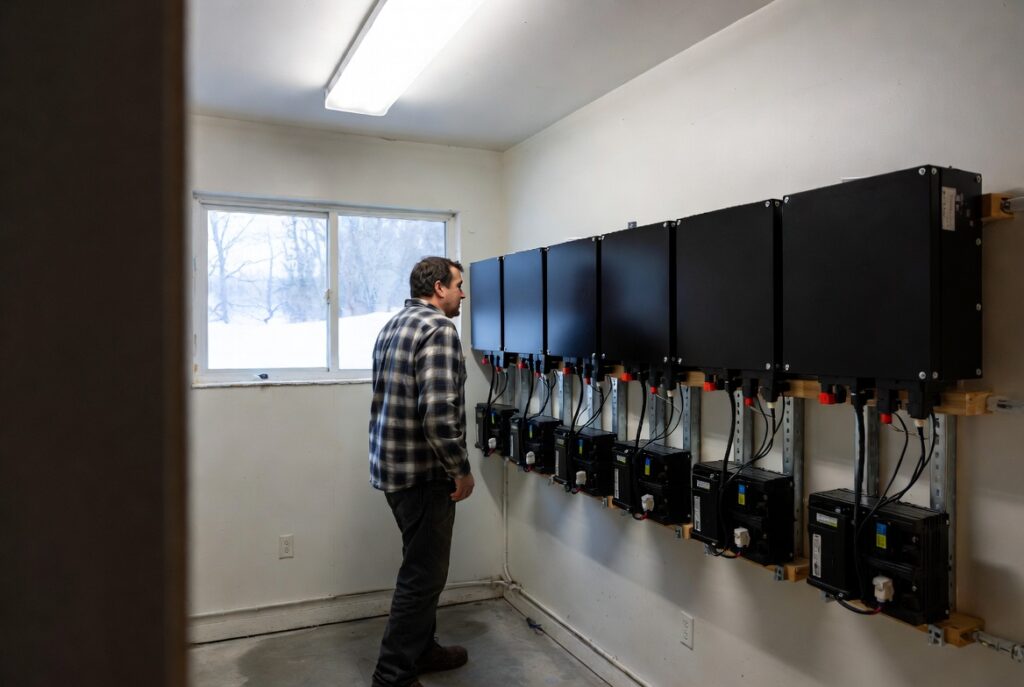
The most common solar battery ontario mistake is installing a standard LFP bank in an unheated utility room, then discovering in March that the Victron SmartShunt shows 0.0A of charging current on every bright January day, not because the panels stopped working, but because the utility room dropped to -5°C and the battery BMS correctly shut off all charging current at 0°C to prevent cold-charging damage.
A property owner on Kortright Road West in Guelph, Wellington County installed two standard Battle Born 100Ah LFP batteries in his unheated workshop utility room in fall 2022. His system included a 400W monocrystalline array, a Victron MPPT 100/30 charge controller, and a 2,000W PSW inverter. The utility room was uninsulated and unheated, tracking outdoor conditions closely through the winter.
In late November 2022, the utility room ambient temperature dropped below 0°C. The Battle Born standard LFP BMS correctly shut off all incoming charging current at 0°C as designed. His SmartShunt showed 0.0A charging current every sunny day from late November through early March. The panels were producing normal MPPT voltage, the charge controller was tracking correctly, but the BMS blocked every amp from entering the bank. The bank sat at approximately 10% SoC from November through March without receiving a single amp of charging current.
He contacted me in March when the bank was flat and the workshop had been without reliable power all winter. His SmartShunt history confirmed exactly what had happened: zero charging amps every day from November 28 through March 4, 96 days. The battery was not damaged by the cold storage, as LFP handles low SoC storage reasonably well. The practical failure was that his solar battery ontario system had been useless for 96 days, no heat, no well pump, no lights.
He replaced the standard LFP with two Battle Born heated LFP units and added 50mm of XPS foam insulation around the battery enclosure. The following winter, the SmartShunt confirmed daily charging through every clear January day. See our Ontario solar sizing guide before specifying any solar battery ontario bank.
The solar battery ontario cold cutoff: why standard LFP blocks all charging below 0°C in unheated Ontario spaces
| Specification | Standard LFP (Battle Born 100Ah) | Heated LFP (Battle Born heated) | Ontario verdict |
|---|---|---|---|
| Charging cutoff temp | 0°C (BMS blocks charging) | Self-heats at 2°C before charging | Heated is mandatory in unheated spaces ✓ |
| Discharge temp range | -20°C to 50°C | -20°C to 50°C | Both discharge in Ontario winter ✓ |
| Ontario unheated room | 0A charging Nov-Mar | Full charging year-round | Standard = 96 days wasted ✗ |
| XPS foam benefit | Slows cooling but BMS still trips | Reduces heating energy tax | Heated LFP + XPS = Ontario standard ✓ |
| Cost premium | Base price | Approximately $200 more per 100Ah | $200 vs 96 days of no power, obvious ✓ |
The 0°C charging cutoff is a fundamental safety feature of standard LFP batteries, not a defect. LFP cells cannot safely accept charging current at or below 0°C, forcing charge at sub-zero temperatures causes lithium plating on the anode that permanently damages cell capacity. The Battle Born standard LFP BMS correctly blocks all charging current when cell temperature reaches 0°C. An Ontario utility room that tracks outdoor ambient temperatures hits sub-zero conditions from approximately late November through mid-March, approximately 100 to 120 days of potential charging cutoff every year.
The practical consequence is that a standard LFP bank in an unheated Ontario space produces no energy for the system owner during the 3 worst months of the year. The panels produce normally (MPPT tracks correctly, voltage and current at controller input are normal), the charge controller attempts to charge, and the BMS blocks every amp from entering the bank. The SmartShunt shows this immediately: 0.0A input on a clear sunny day is the unmistakable signature of a cold-blocked standard LFP bank. See our solar battery bank guide for the sizing formula that determines how many amp-hours of heated LFP to specify for Ontario year-round use.
The solar battery ontario heated LFP standard: how self-heating solves the 0°C problem permanently
The Battle Born heated LFP solves the 0°C problem through a self-contained internal heating element. When the cell temperature drops to approximately 2°C, the heater activates automatically, using incoming solar current or drawing from the battery’s own stored capacity, to raise the cell temperature to approximately 5 to 7°C before allowing any charging current to flow. The Ontario result: the bank charges on every clear January day regardless of what the utility room ambient temperature reads. A property owner near Elora in Centre Wellington, Wellington County installed two Battle Born heated LFP 100Ah units in an unheated shed utility room with a 50mm XPS foam box around the batteries.
The first January: self-heating activates on cold mornings, SmartShunt shows positive charging current by approximately 8:30 AM on clear days, and the bank reaches 100% SoC by approximately 1:00 PM (400W array × 1.5 PSH × 0.85 efficiency = 510Wh, sufficient to fully recover a 200Ah bank from 40% SoC in one clear January day). Her comment after the first January: “It just works. I never had to think about it.” The heated LFP premium is approximately $200 over the standard unit.
For any solar battery ontario installation in an unheated Ontario space, this is the most cost-effective single upgrade in the entire system, $200 versus 96 days of no usable power. See our off grid setup guide for the correct battery installation sequence including the battery-first wiring rule.
Pro Tip: The SmartShunt history function is the post-winter audit tool that reveals whether the solar battery ontario bank was charging through the winter or cold-blocked. After commissioning any battery system in an unheated space, check the SmartShunt daily summary at the end of January. Look for any day from November through March showing zero or near-zero Wh harvested on a day when the previous and following days show normal production. A single zero-harvest day surrounded by normal days means the BMS cold cutoff tripped on that morning. Multiple consecutive zero-harvest days from late November onward means the standard LFP bank was blocked for the entire winter. The Kortright Road West Guelph result showed 96 consecutive zero-amp days, a pattern that would have been obvious from the first week had the owner checked the SmartShunt history in December.
The SmartShunt diagnostic: reading 0.0A on a bright January day
The SmartShunt provides the real-time diagnostic that confirms whether a solar battery ontario bank is charging or cold-blocked. The correct daily pattern on a clear January day: positive charging current beginning within 5 to 10 minutes after first morning sun for a heated LFP bank (allowing for the self-heating cycle). Current rises through bulk charge until the bank reaches absorption voltage, then tapers to float. The Elora Centre Wellington result: positive amps by 8:30 AM, absorption phase by 11:30 AM, float and 100% SoC by 1:00 PM, consistent with 510Wh daily production on the 400W array at 1.5 PSH.
The cold-blocked signature: SmartShunt shows 0.0A input current with the MPPT 100/30 showing normal panel voltage at its input terminals. This combination, normal panel voltage, zero charging amps, is the unambiguous SmartShunt indication of a BMS cold cutoff. The Kortright Road West Guelph system showed this signature every clear day from November 28 through March 4. The SmartShunt history function records hourly or daily summaries and reveals weeks of zero-amp patterns that would not be obvious from checking the system only occasionally. See our solar charge controller guide for the MPPT settings that optimize heated LFP charging in Ontario cold conditions.
The insulation tax reduction: XPS foam around the battery enclosure
The XPS foam insulation tip reduces the energy tax that the heated LFP self-heating cycle imposes on the bank. A 50mm XPS foam enclosure on all six sides of the battery bank slows heat loss from the cells to the surrounding unheated air. On a January morning at -5°C ambient, the self-heating cycle on an uninsulated heated LFP bank may run for 2 to 3 hours before cells reach charging temperature. The same bank in a 50mm XPS enclosure typically reaches charging temperature in 45 to 60 minutes, because the foam traps the heat the cells already generated from the previous day’s charging cycle.
The insulation does not eliminate the need for heated LFP. A standard LFP bank surrounded by 50mm XPS foam will still have its BMS block charging when the cells cool to 0°C, insulation slows the cooling rate but does not maintain above-zero temperatures in a -22°C Ontario utility room over a multi-day cold snap. The correct Ontario solar battery ontario specification for any unheated space: heated LFP inside a 50mm XPS foam enclosure. The Elora Centre Wellington result confirmed this combination: 8:30 AM charging start on cold mornings versus the 2 to 3 hour uninsulated baseline, approximately 1.5 to 2 hours of additional production captured each cold morning through the insulation upgrade.
NEC and CEC: Ontario permit requirements for permanent solar battery installations
NEC 690 governs the battery bank wiring in any solar battery ontario installation. The battery positive terminal requires a Class T or MEGA fuse rated to the inverter’s maximum continuous input current, all battery cables must be sized for the system’s peak current draw, and disconnect switches must be rated for the system DC voltage. The BMS provides internal cell-level protection but does not replace the external fuse and disconnect requirements under NEC 690. Contact the NFPA at nfpa.org for current NEC 690 requirements for residential solar battery system installations.
CEC Section 64 governs electrical installations in Ontario. Any permanently installed solar battery ontario system in a habitable structure requires an ESA permit covering the battery bank wiring, fusing, inverter connections, and all AC output circuits. The ESA inspector will verify that the battery bank is fused correctly, cables are sized to the maximum continuous current draw, and the installation is compliant with CEC Section 64 requirements. Contact the Electrical Safety Authority Ontario at esasafe.com before beginning any permanent solar battery ontario installation in Ontario.
The solar battery ontario verdict: heated LFP for unheated spaces, SmartShunt confirmed, XPS insulation reduces the tax
- Ontario property owner with a standard LFP bank in an unheated utility room experiencing zero charging amps in winter: check the SmartShunt history before replacing any hardware. If you see 0.0A input on clear sunny days from November through March, the BMS cold cutoff is active. Replace the standard LFP with the Battle Born heated LFP and add 50mm XPS foam around the battery enclosure. The Kortright Road West Guelph result: 96 days of zero charging on a standard bank, replaced with heated LFP, daily charging confirmed on the Victron SmartShunt the following winter. The standard LFP bank was not permanently damaged, it simply could not charge in an unheated space.
- Ontario property owner specifying a new solar battery ontario system for an unheated space: specify the Battle Born heated LFP from day one and build the XPS foam enclosure before commissioning. The $200 premium per 100Ah unit determines whether the bank charges through the 100 to 120 coldest days of the Ontario year. Add 50mm XPS foam on all six sides of the battery enclosure to reduce the self-heating energy tax from 2 to 3 hours to 45 to 60 minutes. Install the SmartShunt at commissioning and verify positive charging amps on the first cold clear January morning to confirm the heated LFP is functioning correctly.
- Ontario property owner with a heated utility room or basement considering whether standard LFP is acceptable: yes, for any installation where ambient temperature never drops below 0°C. A properly insulated and heated basement or utility room that maintains above-freezing temperatures year-round is a suitable environment for standard Battle Born 100Ah LFP. The heated LFP is required only when the ambient temperature in the battery enclosure will fall below 0°C at any point during the Ontario winter. The SmartShunt confirms the correct specification in either case, positive charging amps on a clear January day is the only verification that matters.
Frequently Asked Questions
Q: What solar battery is best for Ontario winters?
A: The Battle Born heated LFP is the correct solar battery ontario specification for any unheated space, garage, shed, outbuilding, or utility room that drops below 0°C from November through March. It activates its internal heating element at approximately 2°C, raises cell temperature to 5 to 7°C, and then charges normally on every clear January day. The Elora Centre Wellington result: positive charging current by 8:30 AM and 100% SoC by 1:00 PM on clear January days in an unheated shed. For heated spaces (insulated basement, heated garage, interior utility room) that maintain above-freezing temperatures year-round, the standard Battle Born 100Ah LFP is the correct and less expensive specification.
Q: Can I use a regular LFP battery in an unheated garage in Ontario?
A: No, standard LFP batteries will not accept a charge below 0°C. The BMS cold cutoff is a safety feature that prevents lithium plating damage from cold-temperature charging. In an unheated Ontario garage that drops below 0°C from late November through mid-March, a standard LFP bank will sit flat and uncharged for approximately 100 to 120 days per year. The SmartShunt will show 0.0A charging current on every sunny day during this period even when the panels are producing normally.
The Kortright Road West Guelph result: 96 consecutive days of zero charging. The fix is the Battle Born heated LFP, not insulation around a standard LFP bank, insulation slows the cooling rate but cannot maintain above-zero temperatures over a multi-day Ontario cold snap.
Q: How does a heated LFP battery work in cold weather?
A: The Battle Born heated LFP contains an internal heating element that activates automatically when cell temperature drops to approximately 2°C. The heater draws power from incoming solar current or from the battery’s own stored capacity to raise the cell temperature to approximately 5 to 7°C, the minimum temperature at which LFP chemistry safely accepts charging current. Once the cells reach operating temperature, the heater deactivates and normal charging proceeds.
Adding 50mm XPS foam insulation around the battery enclosure reduces the heating cycle from approximately 2 to 3 hours to approximately 45 to 60 minutes on a cold Ontario morning, because the foam traps heat from the previous day’s charging cycle. The SmartShunt confirms the heated LFP is working correctly: positive charging amps within 5 to 10 minutes of first morning sun, even at -22°C ambient.
This build is engineered within the 48V DC Safety Ceiling. Diagnostic logic is based on 20+ years of technical service experience. All structural and electrical installations must be verified by a Licensed Professional and comply with your Local AHJ. See our legal and safety disclosure for full scope.
About the Author
Robert Bertrand spent 20 years as a service advisor in the automotive industry (Lexus and Nissan), where precision diagnostics, wiring integrity, and documentation standards were non-negotiable. He brings that same technical discipline to GridFree Guide, where he researches, tests, and documents off-grid solar systems for Ontario conditions. Based in Rockwood, Ontario, every article is built on verified specifications, manufacturer data, and the real-world climate constraints of Canadian off-grid living.
As an Amazon Associate I earn from qualifying purchases. This site also contains affiliate links to other products and services. GridFree Guide earns a small commission at no extra cost to you.