
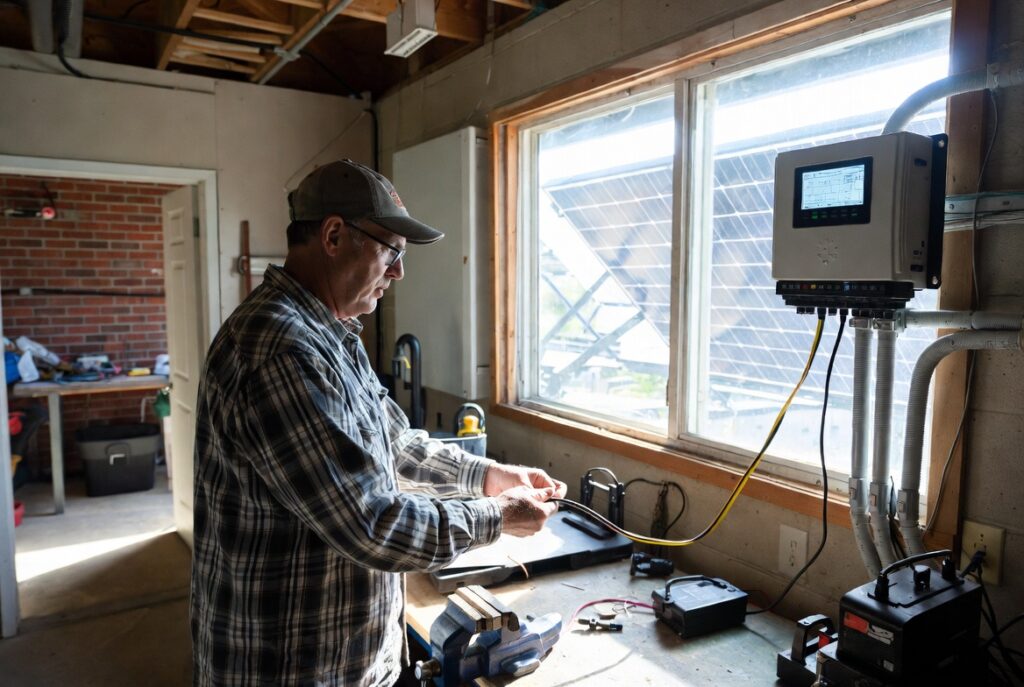
The most expensive first day of any Ontario off grid setup is the one where the property owner mounts the solar panels on the roof, plugs the MC4 connectors into the charge controller, and then connects the battery, because a Victron MPPT 100/30 with no battery reference voltage connected receives the full open-circuit panel voltage through its input terminals and attempts to regulate to a voltage reference that does not exist, causing MOSFET failure that arrives silently: the controller appears to power on, the display may briefly illuminate, and then nothing works, and the $340 component is dead before it charged a single watt-hour.
A property owner on Eramosa Road in Guelph, Wellington County installed a two-panel 200W off grid setup on his workshop in fall 2022. He mounted both 100W Renogy panels on the south-facing roof, ran the MC4 cables through the wall, and connected them to his new MPPT 100/30 before retrieving his 100Ah LFP battery from the garage. He assumed the controller would simply wait for the battery to be connected.
When he returned and connected the battery, his Victron SmartShunt showed zero charge activity and the controller display cycled through an error state. He contacted me the following morning. The MPPT 100/30 was non-functional. Without a battery reference voltage on its output terminals, the controller had attempted to regulate the panel’s 22.5V open-circuit voltage using internal logic that expects a battery load, and the resulting MOSFET stress damaged the regulation circuitry. The repair was not covered under warranty because the damage was caused by incorrect installation sequence. Cost: $340 for a replacement MPPT 100/30 and one lost day of installation time.
I supervised the reinstallation. Battery positive to controller output positive first, battery negative through the SmartShunt to controller output negative. The controller display read approximately 13.0V, confirming the battery reference voltage was present. Then the MC4 connectors were connected to the controller input. The controller immediately began MPPT tracking with the battery voltage as its reference, and the SmartShunt confirmed 185Wh harvested on the first clear afternoon at approximately 200W × 0.85 efficiency × 1.1h of direct sun. The entire off grid setup ran without issue from that point forward. See our Ontario solar sizing guide before planning any off grid setup component list.
Important Safety and Permit Note: Any permanently installed off-grid solar system in a habitable Ontario structure requires an ESA permit before any work begins. All electrical work, including array wiring, charge controller, battery bank, inverter, and AC output circuits, must comply with CEC Section 64 and be inspected by a licensed professional. Never attempt to install or modify the electrical system yourself. Contact esasafe.com before beginning any work. Proper ESA documentation is required for home insurance coverage on any habitable structure with a permanent off-grid electrical system.
The off grid setup battery-first rule: why connecting panels before the battery destroys the controller
| Step | Action | Why it matters | Ontario verdict |
|---|---|---|---|
| 1 | Battery to controller output | Controller needs voltage reference to configure regulation | Non-negotiable, always first ✓ |
| 2 | SmartShunt installed | Fuel gauge before any power flows | Commission before panels connect ✓ |
| 3 | Panels to controller input | MPPT tracking starts with battery reference present | Only after steps 1 and 2 ✓ |
| 4 | Pre-charge, then inverter | Eliminates arc that damages BMS and terminal lugs | $2 resistor prevents $300+ damage ✓ |
| 5 | AC distribution and sub-panel | Breakers and labelling per CEC Section 64 | ESA inspector checks this first ✓ |
| 6 | ESA inspection | Legal, inspected, insured from day one | Pull permit before step 1 ✓ |
The battery-first rule is non-negotiable in any Ontario off grid setup because of how MPPT charge controllers read voltage on startup. The Victron MPPT 100/30 reads the battery voltage connected to its output terminals and uses that value to configure its MPPT tracking algorithm and regulation target. Without a battery present, the controller receives the panel’s 22.5V open-circuit voltage through the output terminals with no load reference. The MOSFET circuitry attempts to regulate a voltage that does not exist and fails in under a second, partial MOSFET damage can produce intermittent faults that appear as inconsistent harvest or erratic charging for weeks before total failure.
The correct sequence takes 30 seconds longer than the wrong one. Battery positive to controller output positive, battery negative through the SmartShunt to controller output negative, confirm the display reads approximately 13.0V for a charged 12V LFP bank. Then and only then connect the panel MC4 connectors to the controller input. The controller reads the battery voltage, configures its MPPT tracking algorithm, and begins harvesting immediately. See our solar charge controller guide for the complete Victron MPPT 100/30 commissioning procedure including cold Voc pre-connection verification.
Cold Voc Ontario: why -22°C pushes your panel string past the controller’s safe input limit
Every Ontario off grid setup must complete the cold Voc calculation before connecting any panel series string. A Renogy 100W panel has an STC Voc of 22.5V measured at the standard test condition of 25°C. Ontario’s design temperature is -22°C, 47°C colder than the STC test condition. The Renogy 100W temperature coefficient is approximately -0.35% per degree Celsius, meaning the Voc increases as temperature drops. Cold Voc per panel: 22.5 × (1 + 0.0035 × 47) = approximately 26.2V. Always use the exact temperature coefficient from your specific panel datasheet, as values range from approximately -0.31% to -0.35% per degree Celsius across manufacturers.
For a 2-panel series string: 26.2 × 2 = 52.4V, within the MPPT 100/30’s 100V maximum input safely. For a 4-panel series string: 26.2 × 4 = 104.8V, this exceeds the 100V limit and risks destroying the controller on the coldest Ontario morning of the year.
A property owner near Elora in Centre Wellington, Wellington County followed the correct off grid setup sequence from the first day of planning in spring 2023. She calculated the cold Voc for her 2S panel configuration before ordering any hardware: 26.2V × 2 = 52.4V, confirmed within the MPPT 100/30’s 100V limit with a 47.6V margin. She pulled the ESA permit before purchasing components, specified 4/0 AWG tinned copper battery-to-inverter cables, and ran the underground array cable in 1.2m frost-depth conduit to protect against Ontario freeze-thaw cycles.
Her Battle Born heated LFP bank was connected to the controller output first, the SmartShunt was installed before any panel connection, and the MC4 connectors were plugged in last. The ESA inspector passed the system on the first visit without a single correction item.
Her SmartShunt confirmed 410Wh harvested on the first clear day after commissioning, a 400W array at 1.5 PSH × 0.85 MPPT efficiency = 510Wh theoretical, with approximately 80% yield on a partially hazy day. Her comment after the ESA inspection: “The inspector said it was the cleanest first-time residential installation he had seen all year.” The cold Voc calculation took 5 minutes before purchase. Skipping it and discovering the 4S string exceeds 100V at -22°C costs $340 in controller damage plus the time and delay of a replacement. See our solar power system guide for the full Ontario sizing sequence that pairs with this installation procedure.
The six-step Ontario off grid setup sequence: from site assessment to ESA inspection
The six-step Ontario off grid setup sequence. Step 1: Pull the ESA permit before any installation work begins, the permit application requires a system specification that forces the cold Voc calculation, wire sizing, and load circuit documentation before the first connection. Step 2: Mount the battery bank and connect the Battle Born heated LFP to the charge controller output terminals, battery first, always. Step 3: Install the Victron SmartShunt between the battery negative terminal and the system negative bus, fuel gauge before any power flows.
Step 4: Complete and confirm the cold Voc calculation, then connect the Renogy 100W panels through the MC4 connectors to the Victron MPPT 100/30 input. Step 5: Pre-charge resistor procedure, then inverter connected to battery bank. Step 6: AC sub-panel and distribution wiring per CEC Section 64, then ESA inspection.
The ESA permit is Step 1 because it is the step that makes the entire off grid setup legal, inspected, and insured from day one. An Ontario ESA inspection covers the complete installation: array wiring, charge controller, battery bank connections, inverter, sub-panel, and all AC output circuits. Most Ontario home insurers will not cover a habitable structure with uninspected permanent electrical work, a system installed without a permit is an uninsured electrical installation regardless of how correctly it was built.
The permit process typically takes 2 to 4 weeks; plan the off grid setup timeline around it, not around component delivery. See our off grid costs guide for the full component cost breakdown of a correctly specified Ontario off grid setup including ESA permit fees.
Pro Tip: The Elora Centre Wellington ESA inspection result, passed on first visit, no correction items, came from one preparation step that most first-time installers skip: request the inspector’s checklist from the ESA before installation begins, not after. The checklist documents exactly what the inspector will verify: wire ratings for each circuit, fuse sizing at each overcurrent point, disconnect locations, grounding electrode connection, and labelling requirements. Completing the installation against the checklist before the inspection arrives eliminates every correction item before it becomes one. The Elora off grid setup took 90 minutes longer to build because of the checklist. It saved 3 weeks of re-inspection scheduling.
Wire gauge, pre-charge, and the inverter connection protocol
Battery-to-inverter cable sizing determines whether the off grid setup runs safely under peak load. A 2,000W inverter at 12V draws 167A continuous at full load. A 2/0 AWG tinned copper cable handles approximately 200A for runs under 1 metre, the correct minimum for a 2,000W inverter in a compact utility room where the battery bank and inverter are side by side. For battery-to-inverter runs over 1 metre, the standard distance in most Ontario off grid setups where the bank and inverter are on opposite sides of the utility room, 4/0 AWG is the correct specification at approximately 230A continuous. A 3,000W inverter at 12V draws 250A continuous, requiring 4/0 AWG for any run length regardless of distance.
The pre-charge procedure protects the battery bank’s BMS and the inverter’s internal capacitors from inrush current at initial connection. A new inverter connected directly to a charged LFP bank produces a large arc at the terminal lugs as the inverter’s capacitors charge instantly from the bank. Connect a 25 to 50 ohm, 5W resistor in series with the inverter positive cable for 5 seconds before the direct connection, this charges the inverter capacitors gradually and eliminates the arc that would otherwise weld the terminal lugs or trip the BMS overcurrent protection.
Every off grid setup with a new inverter or a new battery bank requires this $2 step. Undersized battery-to-inverter cables generate resistive heat under load, insulation damage and fire risk that arrives gradually without warning.
NEC and CEC: Ontario permit requirements for permanent off-grid system installations
NEC 690 governs the complete solar PV installation for any Ontario off grid setup, the array wiring, charge controller connections, battery bank wiring, inverter connections, and all AC output circuits. Array wiring must be sized for 125% of the short circuit current. Each array string requires overcurrent protection. The battery bank positive terminal requires a Class T or MEGA fuse sized to the inverter’s maximum input current. All disconnect switches must be rated for the system voltage and accessible without moving equipment. Contact the NFPA at nfpa.org for current NEC 690 requirements for off-grid solar PV installations in residential applications.
CEC Section 64 governs electrical installations in Ontario. Any permanent off grid setup in a habitable Ontario structure requires an ESA permit before work begins. The permit covers the complete installation: array wiring and combiners, charge controller, battery bank and fusing, inverter, sub-panel, and all AC circuits. The ESA inspector will verify wire ratings, overcurrent protection, disconnect locations, grounding, and labelling against the permit drawings. Pulling the permit before work begins ensures the installation is documented from the first connection. Contact the Electrical Safety Authority Ontario at esasafe.com before beginning any permanent off grid setup installation in Ontario.
The off grid setup verdict: ESA permit first, battery first, cold Voc verified, SmartShunt commissioned
- Ontario property owner who has already completed an off grid setup and is experiencing controller or inverter failures: check the installation sequence before replacing any component. If panels were connected before the battery during any part of the installation, the MPPT controller may have been damaged at commissioning. The Eramosa Road Guelph result was immediate and total failure, but partial MOSFET damage can produce intermittent faults that appear as inconsistent harvest or erratic battery charging for weeks without a clear error code. Replace the controller, install a Victron MPPT 100/30, and follow the correct six-step sequence on reinstallation.
- Ontario property owner preparing for a new off grid setup: pull the ESA permit before purchasing any components and follow the six-step sequence in order without exception. Battery first, SmartShunt second, cold Voc verified before panel connection, pre-charge before inverter, AC distribution per CEC Section 64, ESA inspection last. The Elora Centre Wellington result confirms this sequence produces a system that passes ESA inspection on the first visit and is insured from day one. Specify 4/0 AWG tinned copper battery-to-inverter cables and 1.2m frost-depth conduit for any underground array runs in Ontario.
- Ontario property owner who has been told by a supplier that the ESA permit is optional for a “small” off grid setup: it is not optional. CEC Section 64 applies to all permanently installed electrical systems in habitable Ontario structures regardless of system size or wattage. A 200W off grid setup in a habitable structure requires a permit. A 2,000W off grid setup requires a permit. The permit is the document that makes the installation legal, inspected, and insurable, and the Victron SmartShunt is the instrument that confirms the system performs to specification after the inspector leaves.
Frequently Asked Questions
Q: What order do you connect an off-grid solar system?
A: Battery to charge controller output first, always. The controller needs a battery voltage reference on startup to configure its regulation target. Without a battery connected, the controller receives unregulated panel open-circuit voltage through its output terminals and the MOSFET circuitry fails. The correct six-step Ontario off grid setup sequence: (1) ESA permit, (2) battery to controller output, (3) SmartShunt installed, (4) cold Voc verified, (5) panels to controller input, (6) pre-charge resistor then inverter, AC distribution, ESA inspection. The Eramosa Road Guelph result, $340 controller failure on the first day, came from reversing steps 2 and 5. The sequence costs nothing extra and takes 30 seconds longer than the wrong order.
Q: Do I need an ESA permit for an off-grid solar system in Ontario?
A: Yes. CEC Section 64 requires an ESA permit for any permanently installed electrical system in a habitable Ontario structure, regardless of system size. A 200W off grid setup in a habitable structure requires a permit. A 2,000W system requires a permit. The permit application must document the array wiring, charge controller, battery bank and fusing, inverter, and all AC output circuits. Most Ontario home insurers require ESA documentation before issuing coverage on a habitable structure with a permanent off-grid electrical system. The ESA permit process typically takes 2 to 4 weeks, pull it before purchasing any components, not after installation is complete. Contact esasafe.com to begin the application.
Q: What is the cold Voc and why does it matter in Ontario?
A: Cold Voc is the open-circuit voltage of a solar panel at low ambient temperature. Panel Voc increases as temperature drops below the STC test condition of 25°C. A Renogy 100W panel at -22°C Ontario design temperature reaches approximately 26.2V, versus 22.5V at STC. A 2-panel series string reaches 52.4V at -22°C, within the Victron MPPT 100/30’s 100V maximum input safely. A 4-panel series string reaches 104.8V at -22°C, exceeding the 100V limit and risking controller damage on the coldest Ontario morning of the year.
The cold Voc calculation must be completed before ordering hardware, it determines whether a 2S or 4S configuration is safe with your specific controller, and the consequences of skipping it arrive without warning on a clear January day at full array Voc.
This build is engineered within the 48V DC Safety Ceiling. Diagnostic logic is based on 20+ years of technical service experience. All structural and electrical installations must be verified by a Licensed Professional and comply with your Local AHJ. See our legal and safety disclosure for full scope.
About the Author
Robert Bertrand spent 20 years as a service advisor in the automotive industry (Lexus and Nissan), where precision diagnostics, wiring integrity, and documentation standards were non-negotiable. He brings that same technical discipline to GridFree Guide, where he researches, tests, and documents off-grid solar systems for Ontario conditions. Based in Rockwood, Ontario, every article is built on verified specifications, manufacturer data, and the real-world climate constraints of Canadian off-grid living.
As an Amazon Associate I earn from qualifying purchases. This site also contains affiliate links to other products and services. GridFree Guide earns a small commission at no extra cost to you.