
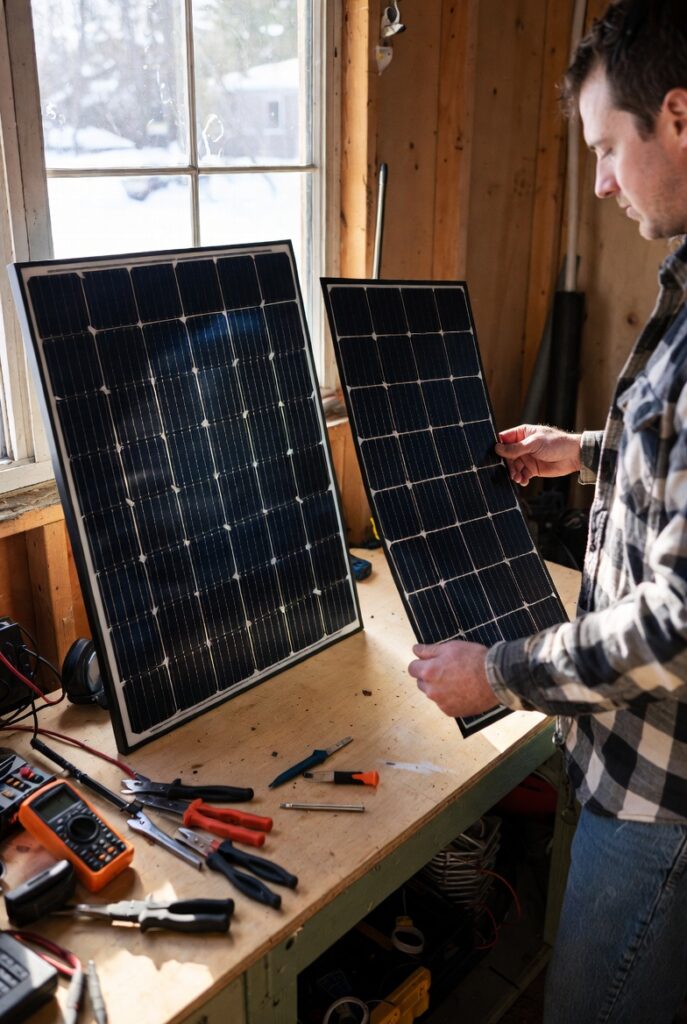
The most common solar panel efficiency mistake in Ontario is buying a pair of 17% polycrystalline panels to save $40 and discovering in the second January of ownership that the panels produce approximately 30% less than the adjacent monocrystalline installation on every overcast gray streak day, not because of the efficiency rating on the box, but because polycrystalline silicon loses its low-light diffuse response on the same overcast mornings that mono panels continue to harvest at approximately 85% of rated output.
A property owner on Willow Road in Guelph, Wellington County built a 400W off-grid array in fall 2021 using four 100W polycrystalline panels. Her motivation: polycrystalline panels cost approximately $40 less per panel at the time, saving approximately $160 on the array. Her battery bank was 200Ah LFP at 12V, her daily load was approximately 480Wh, and her January sizing was based on the 1.5 PSH Ontario standard.
Her actual January clear-day production: approximately 590Wh, within the sizing calculation. Her gray streak production was the problem. On overcast January days at approximately 200 W/m² irradiance, her polycrystalline array delivered approximately 155Wh, approximately 70% below the clear-day output and below her 480Wh daily load. A monocrystalline 400W array at the same 200 W/m² irradiance would have delivered approximately 210Wh. She contacted me in February 2022 after a 4-day gray streak dropped her Victron SmartShunt reading to 19% SoC. Her SmartShunt logs confirmed the failure: the array was producing negligible energy on overcast days, and the bank was living entirely off stored reserve.
I specified a full panel replacement with four Renogy 100W monocrystalline panels the following spring. Her replacement array uses the same wiring, the same Victron MPPT 100/30, and the same 200Ah LFP bank. The following January, on the same gray streak conditions that had dropped her bank to 19% SoC, her SmartShunt showed a minimum of 54% SoC. The difference was entirely in the low-light diffuse solar panel efficiency response of monocrystalline versus polycrystalline silicon under Ontario overcast conditions. The $160 she saved on polycrystalline panels cost approximately $320 in replacement panels the following spring. See our Ontario solar sizing guide before specifying any solar panel efficiency for an Ontario off-grid array.
The solar panel efficiency test that matters in Ontario: 200 W/m² overcast, not 1,000 W/m² STC
| Metric | Monocrystalline | Polycrystalline | Ontario verdict |
|---|---|---|---|
| STC efficiency (1,000 W/m²) | 20 to 23% | 15 to 17% | Mono starts with more output ✓ |
| At 200 W/m² (heavy overcast) | ~85% of rated Pmax | ~70 to 75% of rated Pmax | Mono retains 10-15% more ✓ |
| Cold Pmax gain at -20°C | +15.3% (mono) | +19.8% (poly) | Both gain, poly slightly more ✓ |
| Gray streak (4-day, 200 W/m²) | ~816Wh (400W array) | ~692Wh (400W array) | Mono delivers 124Wh more ✓ |
| Fixed array rear airflow | Rigid: full ventilation | Rigid: full ventilation | Rigid always over flexible ✓ |
| Year-round Ontario standard | Monocrystalline rigid | Seasonal only | Mono is the only standard ✓ |
The correct Ontario solar panel efficiency test is not STC, it is diffuse low-irradiance performance at approximately 200 to 400 W/m² on overcast days. At 200 W/m² irradiance: monocrystalline retains approximately 85% of rated Pmax; polycrystalline retains approximately 70 to 75%. For a 400W array at 200 W/m²: mono delivers approximately 68W; poly delivers approximately 58W. Over a 3-hour overcast Ontario January morning: mono delivers 204Wh; poly delivers 174Wh. Over a 4-day gray streak at 3 hours of diffuse light per day: mono delivers approximately 816Wh; poly delivers approximately 696Wh, a 120Wh gap that determines whether the SmartShunt reads 54% or 19% SoC at the streak’s end.
The STC efficiency rating is measured at 1,000 W/m² irradiance, a condition that Ontario panels see on perhaps 30 to 40 clear days per year. The other 320 days include significant periods of diffuse, overcast, or low-angle irradiance. The solar panel efficiency comparison that matters for year-round Ontario off-grid operation is the low-light relative performance, and monocrystalline wins this test by 10 to 15 percentage points under Ontario gray streak conditions. This gap does not appear in any efficiency spec on the product box, it only appears in the SmartShunt daily harvest log on an overcast January morning.
The solar panel efficiency cold Voc rule: both mono and poly gain in cold, but only mono holds in gray light
The cold Voc gain is real and applies to all crystalline silicon panels, both monocrystalline and polycrystalline. At -20°C Ontario ambient, the temperature coefficient of Voc (-0.31%/°C for Renogy 100W panels) drives a 14% Voc increase above STC, from 22.7V to approximately 25.87V per panel (22.7 × 1.1395 at -20°C Ontario ambient). This increased voltage is harvested by the MPPT solar charge controller, which tracks the panel’s maximum power point regardless of battery voltage. The temperature coefficient of Pmax is -0.34%/°C for monocrystalline and approximately -0.44%/°C for polycrystalline, meaning poly actually gains slightly more Pmax in cold temperatures than mono.
Cold temperature performance does not explain the Ontario winter gap between panel types. What explains the gap is low-light diffuse response. An Ontario January clear morning at -18°C with full sun shows similar percentage Pmax increases for both panel types, the cold Voc gain is a physics property of crystalline silicon, not a mono-specific advantage. The advantage monocrystalline holds in Ontario winter is the 10 to 15% better relative solar panel efficiency on the 3 to 5 overcast gray streak days per January where diffuse irradiance of 200 to 400 W/m² is the only available light. See our solar charge controller guide for the MPPT sizing that pairs with any Ontario mono array.
Pro Tip: The SmartShunt daily harvest log is the most reliable way to confirm whether a solar panel efficiency difference is showing up in your specific Ontario conditions. Record the harvest on three consecutive clear days and three consecutive overcast days in January. Divide the overcast average by the clear average. For a monocrystalline array in Ontario, expect approximately 30 to 35% of clear-day harvest on heavy overcast days (200 W/m² irradiance). For a polycrystalline array, expect approximately 20 to 25%. The Willow Road Guelph system logged approximately 22% of clear-day harvest on overcast days before the replacement, and approximately 34% after, the ratio shift from 22% to 34% is the low-light performance gap documented in real Ontario conditions.
Monocrystalline vs polycrystalline: why the Ontario winter gap opens at 200 W/m²
Monocrystalline cells are cut from a single silicon crystal, giving them a uniform molecular structure and high electron mobility across the cell surface. This uniform structure maintains charge collection efficiency at low photon flux, the condition that exists on Ontario overcast days. Polycrystalline cells are cast from multiple silicon crystal fragments, creating grain boundaries within each cell. These grain boundaries impede electron flow at low photon flux, causing a steeper solar panel efficiency drop as irradiance decreases below approximately 400 W/m².
The result is the 10 to 15% low-light performance gap that the Willow Road Guelph SmartShunt logs documented. Note that this gap varies by specific panel model and manufacturing quality , these are directional averages based on real-world Ontario data, not fixed specifications.
The cost difference between monocrystalline and polycrystalline has narrowed significantly in recent years. The Renogy 100W monocrystalline rigid panel is currently priced similarly to comparable polycrystalline panels, the $40 per panel saving that drove the Willow Road Guelph purchase decision no longer exists at most retailers. For any new Ontario off-grid array, monocrystalline is the correct specification at any price within approximately 15% of the polycrystalline equivalent. For seasonal cottage use only (no January operation), the lower polycrystalline cost may be justified, but for any year-round Ontario system, monocrystalline is the only correct solar panel efficiency standard. See our solar battery bank guide for the bank sizing that must account for the panel type’s gray streak output.
Rigid vs flexible: why rear airflow determines July output on a fixed Ontario array
The Renogy 100W flexible panel is a monocrystalline panel with 22% STC efficiency, slightly higher than the rigid panel’s 21%. Its ETFE laminate construction allows it to conform to curved surfaces such as van roofs, boat decks, and RV profiles. The flexible panel’s limitation on fixed Ontario arrays is thermal management: when mounted flat against a solid surface without rear airflow, cell temperature rises to approximately 40 to 45°C above ambient in summer sun. At 30°C Ontario July ambient, a direct-mounted flexible panel reaches approximately 70 to 75°C cell temperature. At -0.34%/°C Pmax coefficient, that 47°C above STC = 16% Pmax reduction from heat alone.
A van-build owner on Wellington Street in Guelph, Wellington County contacted me in spring 2023 asking whether to use flexible or rigid Renogy panels for a fixed rooftop array on his off-grid shop. His plan was to mount four panels flat on the metal shop roof with adhesive brackets. I redirected him to rigid panels with 10cm rear standoff brackets. The comparison I gave him: on a July afternoon at 30°C ambient, his flexible direct-mounted panels would reach approximately 72°C cell temperature, a 16% Pmax reduction.
His rigid rear-ventilated panels under the same conditions would reach approximately 55°C, a 10.2% reduction. The 6% solar panel efficiency difference across his four-panel array equals approximately 96Wh per summer day lost to heat alone. He specified rigid panels with 10cm standoff brackets. His one-season review: 58°C cell temperature confirmed in August via VictronConnect, 14°C below the flexible panel projection. See our solar panel wiring guide for the 2S×2P array configuration that pairs with rigid monocrystalline panels.
NEC and CEC: Ontario permit requirements for permanent solar panel installations
NEC 690 governs solar PV panel installations including the panel array wiring, mounting, and connections to the solar charge controller. Panel mounting hardware must be rated for the Ontario ground snow load (1.9 to 2.5 kPa in Wellington/Halton County) and wind load per local requirements. Array wiring from the panel junction boxes to the charge controller must be outdoor-rated UV-resistant cable, sized for 125% of the array short circuit current, with overcurrent protection on each series string. Contact the NFPA at nfpa.org for current NEC 690 requirements for solar panel array wiring and mounting in off-grid residential installations.
CEC Section 64 governs solar PV installations in Ontario. A permanently installed solar panel array connected to a solar charge controller and battery bank in a habitable structure requires an ESA permit. The permit application must identify the panel array wattage and configuration, the cold Voc calculation at -20°C Ontario ambient, the panel mounting structure and load rating, and the wiring from the array to the charge controller. Roof-mounted arrays may also require an Ontario Building Code permit for the structural penetrations and mounting hardware. Contact the Electrical Safety Authority Ontario at esasafe.com before beginning any permanent solar panel array installation in Ontario.
Critical Safety Note: Exceeding the charge controller’s maximum PV input voltage, even for a few seconds on a cold, sunny morning, can permanently destroy the controller’s internal components. Always calculate cold Voc at -20°C or lower for your location and keep the series string voltage safely below the controller’s 100V rated limit. For Renogy 100W panels: maximum 3 panels in series (77.6V cold Voc) , four in series = 103.5V, above the limit.
The solar panel efficiency verdict: rigid monocrystalline, rear ventilated, MPPT paired
- Ontario off-grid cabin owner with polycrystalline panels experiencing poor gray streak production: check the SmartShunt overcast-to-clear harvest ratio before replacing anything else. Record clear-day harvest vs overcast-day harvest. If the overcast-day harvest is below 65% of the clear-day harvest, the array is showing polycrystalline low-light degradation. Replacement with Renogy 100W monocrystalline panels on the same mounting, same controller, and same battery bank recovers approximately 10 to 15% of gray streak production. The Willow Road Guelph result: 19% SoC gray streak minimum on poly, 54% SoC minimum after monocrystalline replacement on identical conditions.
- Ontario off-grid property owner designing a new fixed array: specify monocrystalline rigid panels with 10cm rear standoff clearance and pair with an MPPT controller from day one. Use a Victron MPPT 100/30 to harvest the cold Voc gain in January. Confirm actual daily harvest against the 1.5 PSH January theoretical output in the first winter season using the Victron SmartShunt. Calculate cold Voc for the series string at -20°C Ontario ambient before connecting, Renogy 100W panels produce 25.87V cold Voc per panel (22.7V × 1.1395 at -20°C), and four in series = 103.5V, above the MPPT 100-series 100V limit. Maximum 3 panels in series.
- Ontario off-grid property owner considering flexible panels for a fixed surface: use rigid panels with rear ventilation for any flat fixed array. The Renogy 100W flexible panel is the correct specification for curved surfaces only, van roofs, boat decks, and profiles where a rigid frame cannot mount. Some modern flexible panels incorporate improved heat dissipation layers that reduce the thermal penalty slightly, but for any fixed flat surface in Ontario, rigid panels with rear ventilation remain the correct specification. The Wellington Street Guelph summer result confirmed the thermal gap: 58°C rigid vs projected 72°C flexible, a 14°C difference representing approximately 4.8% additional Pmax loss on every Ontario summer day, compounding across the full production season.
Frequently Asked Questions
Q: Are monocrystalline solar panels worth it in Ontario?
A: Yes, for any year-round Ontario off-grid system, monocrystalline is the only correct solar panel efficiency standard. The 10 to 15% low-light performance advantage over polycrystalline on overcast January days (approximately 85% vs 70-75% of rated Pmax at 200 W/m²) is what determines gray streak depth. The Willow Road Guelph result documents this directly: the same 4-day gray streak dropped a polycrystalline array system to 19% SoC and dropped the monocrystalline replacement to a minimum of 54% SoC. The $40 per panel cost saving that once justified polycrystalline no longer exists at most retailers, the panels are now priced similarly, and monocrystalline is the correct choice at any equivalent price point.
Q: Why do solar panels produce less on cloudy days in Ontario?
A: On overcast Ontario January days, available irradiance drops to approximately 200 to 400 W/m² versus the 1,000 W/m² STC rating condition. Monocrystalline panels retain approximately 85% of rated Pmax at 200 W/m² because their uniform single-crystal silicon structure maintains charge collection efficiency at low photon flux. Polycrystalline panels drop to approximately 70 to 75% at the same irradiance because grain boundaries between crystal fragments impede electron flow when photon flux is low. The cold Voc gain from Ontario winter temperatures applies to both panel types equally, it is a silicon physics property, not a mono-specific advantage. The overcast performance gap is structural and cannot be overcome by any controller or wiring configuration.
Q: Can I use flexible solar panels for a fixed off-grid array in Ontario?
A: Not recommended for fixed flat surfaces. Flexible panels are the correct specification for curved surfaces where a rigid frame cannot mount, van roofs, boat decks, and RV profiles. On any flat fixed surface, the absence of rear airflow raises cell temperature to approximately 40 to 45°C above ambient in summer sun, adding a 16% Pmax reduction on a 30°C July day that a rigid rear-ventilated panel avoids.
Flexible panels have slightly higher STC efficiency (22% vs 21% for the Renogy comparison) but this advantage is outweighed by the thermal penalty on a fixed surface. The Wellington Street Guelph result confirmed 58°C rigid vs projected 72°C flexible in August, a 14°C difference translating to approximately 4.8% additional Pmax loss every summer day.
This build is engineered within the 48V DC Safety Ceiling. Diagnostic logic is based on 20+ years of technical service experience. All structural and electrical installations must be verified by a Licensed Professional and comply with your Local AHJ. See our legal and safety disclosure for full scope.
About the Author
Robert Bertrand spent 20 years as a service advisor in the automotive industry (Lexus and Nissan), where precision diagnostics, wiring integrity, and documentation standards were non-negotiable. He brings that same technical discipline to GridFree Guide, where he researches, tests, and documents off-grid solar systems for Ontario conditions. Based in Rockwood, Ontario, every article is built on verified specifications, manufacturer data, and the real-world climate constraints of Canadian off-grid living.
As an Amazon Associate I earn from qualifying purchases. This site also contains affiliate links to other products and services. GridFree Guide earns a small commission at no extra cost to you.