
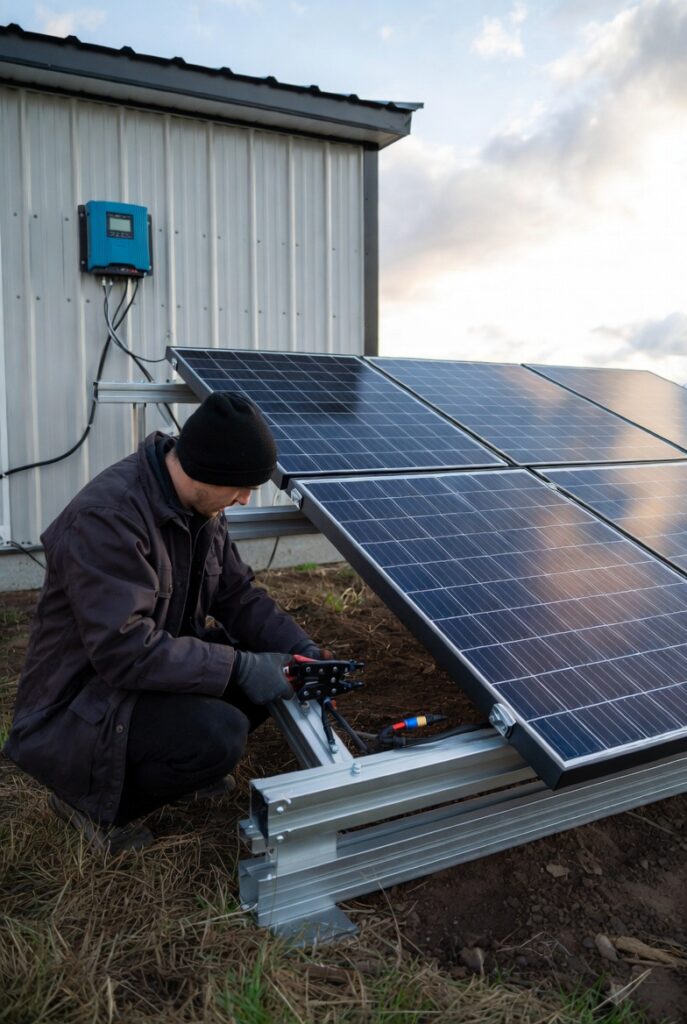
The most expensive solar panel wiring mistake in Ontario is connecting four 100W panels in series to a 50V MPPT charge controller and then watching that controller permanently fail on the first -20°C morning of the season, when the open circuit voltage spikes to approximately 102V, more than double the controller’s 50V rated maximum. A property owner on Speedside Road in Guelph, Wellington County wired his four 100W panel array in series in fall 2023, following an installation guide that specified series wiring for its lower wire current and thinner cable requirement. The guide did not include an Ontario cold temperature Voc correction calculation. His MPPT charge controller was rated for a maximum of 50V DC input.
On the first clear morning in November 2023 when the overnight temperature dropped to approximately -18°C, the controller showed a fault code and stopped charging. He contacted me the same day. The root cause was straightforward: his panels had a rated Voc of 22.5V at 25°C standard test conditions. At -18°C, each panel’s Voc increased to approximately 25.5V, four panels in series: 4 × 25.5V = 102V, exceeding the controller’s 50V input rating by 104%.
I confirmed the controller failure with a multimeter: the input protection circuit had failed and the MPPT stage was non-functional. His Victron SmartShunt showed zero charging current from commissioning day one. I specified a rewire to 2S×2P and a controller replacement with a Victron MPPT 100/30 rated for 100V maximum input. The 2S×2P cold Voc at -18°C: 2 × 25.5V = 51V per string, well within the 100V MPPT 100/30 limit. Total repair cost: approximately $180 for the MPPT 100/30 replacement plus 2 hours of rewiring time. See our Ontario solar sizing guide before finalizing any solar panel wiring configuration.
The solar panel wiring cold Voc problem: why Ontario -20°C destroys incorrectly sized controllers
| Configuration | Cold Voc at -20°C | Current (Isc) | MPPT 100/30 safe? |
|---|---|---|---|
| 4 panels all-series (4S) | ~102.8V | 7.5A | No, exceeds 100V limit ✗ |
| 4 panels all-parallel (4P) | ~25.7V | 30A | Yes, but 8 AWG+ cable ✓ |
| 2S×2P hybrid (2 strings × 2 panels) | ~51.4V per string | 15A | Yes, 49V safety margin ✓ |
| 3 panels series (3S) | ~77.1V | 7.5A | Yes, 23V safety margin ✓ |
The cold Voc calculation is essential for any Ontario solar panel wiring configuration. Formula: Cold Voc = STC Voc × (1 + 0.0032 × (25 minus coldest expected °C)). For Ontario -20°C: Cold Voc = STC Voc × 1.144. A 100W panel with a 22.5V STC Voc produces approximately 25.7V at -20°C. Four panels in series: 4 × 25.7 = 102.8V, destroying any controller rated below 103V. This calculation must be performed before any solar panel wiring configuration is finalized, the controller must be selected after the cold Voc is calculated, not before.
The correct controller selection sequence for Ontario solar panel wiring. Step 1: determine the cold Voc per panel at -20°C (STC Voc × 1.144). Step 2: determine the maximum panels in series in the planned configuration. Step 3: multiply cold Voc per panel × panels in series = cold Voc at controller input. Step 4: confirm the controller’s maximum input Voc exceeds that value by at least 10% safety margin.
The Victron MPPT 100/30 has a 100V maximum input, it correctly handles a 2-panel series cold Voc of 51V with a 49V margin, but cannot safely handle a 4-panel series cold Voc of 102.8V. See our solar panel size guide for the full Ontario cold voltage calculation and series configuration limits.
The cold Voc calculation: four steps before choosing any Ontario wiring configuration
The three solar panel wiring options for a 4-panel 400W array. All-series (4S): cold Voc = 102.8V at -20°C, requires a controller rated above 113V (102.8V × 1.10 safety margin), which eliminates the MPPT 100/30 and most residential MPPT controllers. All-parallel (4P): cold Voc = 25.7V, no series voltage risk, but 30A combined current requires 8 AWG cable for runs over approximately 5 metres. 2S×2P hybrid: cold Voc per string = 51.4V, within the MPPT 100/30’s 100V limit with a 49V margin, 15A combined current handled by 10 AWG cable over typical residential distances. For any Ontario off-grid solar panel wiring with the Victron MPPT 100/30, the 2S×2P is the correct specification for a 4-panel array.
A first-time builder near Gordon Street in Guelph, Wellington County designed his 400W solar panel wiring configuration in spring 2023. His four 100W panels had a STC Voc of 22.3V and a temperature coefficient of -0.32%/°C. At Ontario -20°C worst case: cold Voc per panel = 22.3 × 1.144 = approximately 25.5V. He evaluated three configurations and eliminated 4S at 102V (exceeds MPPT 100/30 limit), ruled out 4P at 30A (8 AWG cable required), and specified 2S×2P at 51V cold Voc and 15A, within the MPPT 100/30’s limits on 10 AWG cable.
He crimped all MC4 connectors with a WBHome MC4 crimping tool and installed a 15A fuse on each string positive. His SmartShunt commissioning log confirmed 320Wh on the first clear day, matching the 400W × 1.5h × 0.80 × 0.67 = 322Wh estimate. See our solar energy storage guide for the battery bank that receives charge from any solar panel wiring configuration.
The solar panel wiring configuration comparison: series, parallel, and the 2S×2P hybrid
MC4 connectors are the industry-standard waterproof connector used in solar panel wiring throughout Ontario. A correctly crimped MC4 connection produces approximately 0.001 ohm of resistance, negligible at typical array currents. An incorrectly crimped connection (using pliers rather than a purpose-built MC4 crimp tool) produces 0.1 to 1.0 ohm of resistance, generating 0.75W to 7.5W of heat per connector at 7.5A array current. Over time, that heat degrades the connector housing, increases resistance further, and can result in arcing and junction box fire.
The NEC 690.9 fuse requirement for parallel strings: each string positive requires a fuse rated at 125% of the string’s short circuit current. For a 2S×2P system with 7.5A Isc per string: 7.5 × 1.25 = 9.4A minimum, specify a 10A or 15A fuse per string.
Annual MC4 inspection is a maintenance requirement for any outdoor solar panel wiring installation in Ontario. Inspect each connector for: discoloration or melting of the housing (heat from resistance buildup), loosening of the mated connection (wind vibration works connectors apart over multiple seasons), and moisture ingress or corrosion at the conductor interface. A discoloured or loose MC4 must be replaced and re-crimped with a purpose-built tool. Ontario’s freeze-thaw cycle introduces repeated thermal stress on outdoor connector housing materials, specify connectors rated for -40°C to +85°C for any Ontario solar panel wiring installation.
Pro Tip: Before commissioning any series or hybrid solar panel wiring configuration in Ontario, use a multimeter to measure the actual open circuit voltage at the controller input terminals on a cold morning, ideally below -10°C. Compare the measured voltage to your cold Voc calculation. If the measured voltage exceeds 90% of the controller’s rated maximum input, the configuration is unsafe for Ontario winter conditions and must be rewired before the first -20°C event. The Speedside Road Guelph result: the builder never measured the cold Voc at the controller input before commissioning. A 30-second multimeter check on the first cold morning would have identified the 102V reading before the controller was energised, and prevented the $180 replacement entirely.
MC4 connectors and fuse requirements for parallel strings
NEC 690 governs solar panel wiring for photovoltaic systems in residential and off-grid applications. The DC wiring from the array to the charge controller must comply with NEC 690.8 (circuit sizing at 125% of the array’s short circuit current), NEC 690.9 (overcurrent protection for parallel strings), and NEC 690.12 (rapid shutdown for roof-mounted arrays). Wire must be outdoor-rated and UV-resistant, USE-2 or PV wire rated for direct burial and outdoor exposure is the correct specification for any solar panel wiring run from array to controller. MC4 connectors must be rated for the array’s short circuit current and maximum voltage under NEC 690. Contact the NFPA at nfpa.org for current NEC 690 requirements for off-grid solar panel wiring installations.
CEC Section 64 governs solar PV installations in Ontario. Any permanently wired solar panel array requires an ESA permit before wiring begins. The permit application must identify the solar panel wiring configuration (series, parallel, or hybrid), total array wattage, maximum array voltage (cold Voc at Ontario -20°C design temperature), maximum array current, wire gauge and type, conduit routing from array to charge controller, and overcurrent protection ratings. An ESA inspector verifies that the cold Voc calculation is correct for the stated configuration and that the controller’s maximum input voltage exceeds the calculated cold Voc. Contact the Electrical Safety Authority Ontario at esasafe.com before beginning any permanent solar panel wiring installation in Ontario.
The solar panel wiring verdict: cold Voc first, then configuration, then fuses
- Ontario off-grid builder who has already wired panels in series without performing the cold Voc calculation: perform the calculation before the first Ontario cold morning. Cold Voc = STC Voc per panel × panels in series × 1.144 (for -20°C). If the result exceeds the controller’s maximum input voltage, the solar panel wiring must be reconfigured before the first hard frost. The Speedside Road Guelph result confirms the failure mode: the controller is non-repairable once the input protection circuit fails from overvoltage, the ~$180 MPPT 100/30 replacement is the minimum cost outcome. The Victron SmartShunt on the battery negative line confirms zero charging current if the controller has already failed.
- Ontario off-grid builder designing a new 4-panel solar panel wiring configuration: specify 2S×2P with the Victron MPPT 100/30. The 2S×2P cold Voc of 51V sits within the MPPT 100/30’s 100V limit with a 49V safety margin. The 15A combined current is manageable with 10 AWG cable over typical residential distances. Install a 15A fuse on each string positive at the combiner block. Crimp all MC4 connectors with the WBHome MC4 crimping tool, the Gordon Street Guelph commissioning result confirmed 320Wh on the first clear day, matching the formula estimate precisely.
- Ontario off-grid builder sizing the controller for a larger array of 6 or 8 panels: apply the cold Voc calculation to the planned series string length before selecting any controller. For 3 panels in series at -20°C Ontario: 3 × 25.7V = 77.1V, within the MPPT 100/30‘s 100V limit with 23V margin. For 4 panels in series: 102.8V, exceeds the MPPT 100/30 and requires a higher-voltage controller. Maximum safe panels in series for the MPPT 100/30 at Ontario -20°C: 3 panels (77V cold Voc). See our solar panel installation guide for the complete Ontario ESA permit application that follows a correctly specified solar panel wiring design.
Frequently Asked Questions
Q: Should I wire my solar panels in series or parallel in Ontario?
A: For a 4-panel 400W array with the Victron MPPT 100/30, specify the 2S×2P hybrid configuration, two strings of 2 panels in series, wired in parallel. This keeps the cold Voc at approximately 51V per string (well within the MPPT 100/30’s 100V maximum input), uses 10 AWG cable for the 15A combined current, and requires a 15A fuse on each string positive. All-series (4S) solar panel wiring produces a cold Voc of approximately 102.8V at Ontario -20°C, this exceeds the MPPT 100/30’s 100V limit and permanently destroys the controller on the first cold morning, as confirmed by the Speedside Road Guelph result.
Q: What is the cold Voc and why does it matter for Ontario solar systems?
A: Cold Voc (cold open circuit voltage) is the actual voltage a solar panel or string produces at low ambient temperatures. As temperature drops below the 25°C standard test condition, panel voltage increases at approximately 0.32% per degree Celsius, at Ontario -20°C, each panel’s Voc is approximately 14.4% higher than its rated STC Voc. For solar panel wiring: a 22.5V STC Voc panel produces approximately 25.7V cold Voc at -20°C. Four panels in series produce approximately 102.8V cold Voc, destroying any controller rated at 100V or below if the array is connected before the cold Voc calculation is performed and verified against the controller’s maximum input rating.
Q: How many solar panels can I wire in series with the Victron MPPT 100/30?
A: A maximum of 3 panels in series for Ontario -20°C conditions. Three 100W panels with a 22.5V STC Voc produce a cold Voc of 3 × 25.7V = 77.1V at -20°C, within the MPPT 100/30’s 100V maximum input with a 23V safety margin. Four panels in series produce 102.8V cold Voc at -20°C, exceeding the 100V limit. For a 4-panel array, the correct solar panel wiring is 2S×2P (two strings of 2 panels in series, wired in parallel), this produces 51.4V cold Voc per string with a 49V safety margin on the same MPPT 100/30 controller.
This build is engineered within the 48V DC Safety Ceiling. Diagnostic logic is based on 20+ years of technical service experience. All structural and electrical installations must be verified by a Licensed Professional and comply with your Local AHJ.
This article contains affiliate links. If you purchase through these links, I earn a small commission at no extra cost to you.