
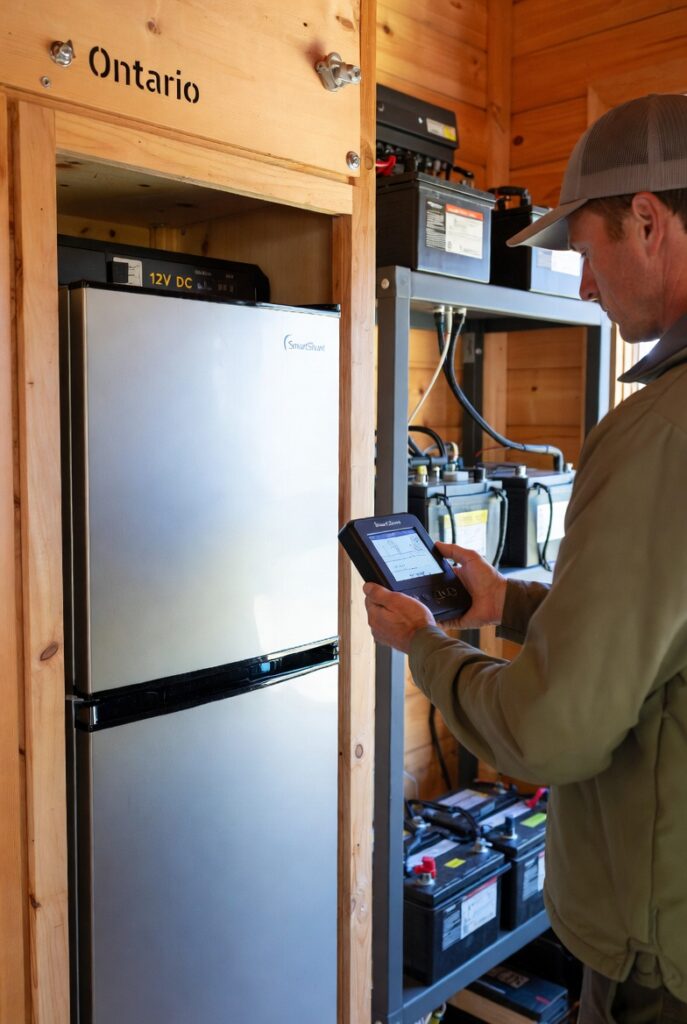
The most electrically expensive off grid refrigerator decision in Ontario is running a standard AC compressor fridge through a PSW inverter, the fridge draws approximately 400Wh per day, but the inverter’s 24-hour idle draw adds approximately 240 to 480Wh per day to that total, pushing the refrigeration cost to approximately 600 to 900Wh per day from the battery bank. A property owner on Edinburgh Road South in Guelph, Wellington County installed a standard 160-litre AC compressor fridge in her year-round off-grid cabin in fall 2022.
Her 2,500W PSW inverter ran continuously to power the fridge, the inverter remained on 24 hours a day to maintain the fridge’s operating temperature. Her SmartShunt showed the inverter drawing approximately 20W idle at all times: 20W × 24h = 480Wh per day from the battery bank for the inverter alone, before the fridge compressor ran a single cycle.
Her total refrigeration load from the SmartShunt log: approximately 440Wh per day for the fridge compressor cycles plus 480Wh per day for the inverter idle draw, approximately 920Wh per day total for one appliance. Her full system daily load was approximately 1,480Wh. The refrigeration load alone represented approximately 62% of her total daily consumption. Her 800W array in Ontario January produced approximately 960Wh on a clear day, her entire clear-day production was essentially absorbed by the inverter and fridge before a single light turned on.
I replaced the AC fridge with a 12V DC compressor off grid refrigerator of equivalent 130-litre volume in spring 2023. The 12V DC fridge connected directly to the battery bank, no inverter required, no idle draw, no AC compressor surge on startup. Her Victron SmartShunt confirmed the new daily refrigeration load: approximately 75Wh per day. Her total daily load dropped from approximately 1,480Wh to approximately 615Wh, the battery bank recovered to above 60% SoC after every Ontario winter gray streak, versus below 20% SoC before the swap. See our Ontario solar sizing guide before selecting any off grid refrigerator.
The off grid refrigerator electrical cost: why the inverter idle draw is the hidden load
| Off grid refrigerator type | Daily electrical load | Inverter required? | Ontario verdict |
|---|---|---|---|
| 12V/24V DC compressor fridge | 60 to 100Wh/day | No (direct to battery) | Year-round primary, correct ✓ |
| AC fridge + PSW inverter idle | 600 to 900Wh/day total | Yes (always on) | Tier 3+ large systems only ✓ |
| Propane absorption fridge | 0Wh/day (electrical) | No | Seasonal May,Oct correct ✓ |
A PSW inverter draws 10 to 30W continuously while powered on, regardless of whether any AC load is running. For an inverter kept on 24 hours to maintain refrigerator operation: 20W idle × 24h = 480Wh per day from the battery bank, approximately 6× the 80Wh daily draw of an equivalent 12V DC off grid refrigerator. The AC fridge itself draws approximately 350 to 500Wh per day for a compact Energy Star-rated unit. Combined total: approximately 600 to 900Wh per day for an AC inverter off grid refrigerator versus approximately 80Wh per day for a 12V DC unit of the same volume.
The inverter conversion efficiency is not the primary problem. A modern PSW inverter is approximately 90 to 95% efficient at converting DC to AC, a 400Wh fridge draws only approximately 420Wh from the battery bank through the conversion stage. The 480Wh idle draw is the dominant disadvantage, it applies regardless of conversion efficiency and occurs 24 hours per day whether the fridge compressor is running or not. The Edinburgh Road South Guelph SmartShunt confirmed this precisely: 480Wh idle draw and 440Wh fridge draw were approximately equal contributors to the 920Wh daily total. See our solar inverter size guide for the inverter specification that handles any AC off grid refrigerator load.
The 12V DC compressor fridge: direct battery connection and the 80Wh daily load
A 12V DC compressor off grid refrigerator connects directly to the battery bank without any inverter in the circuit. The DC compressor operates at variable speed from direct battery voltage, it starts smoothly with a startup surge of approximately 600W for 200 to 300 milliseconds, which the battery bank handles directly without any inverter surge trip risk. Daily electrical load for a 100 to 130L 12V DC fridge: approximately 60 to 100Wh, with 80Wh as the planning standard for a medium-sized unit. This load stays on the DC side of the system and draws zero inverter idle watts.
The 12V DC compressor off grid refrigerator maintains 3°C to 4°C interior temperature at Ontario ambient conditions and operates correctly from -10°C to +40°C ambient, including in an unheated Ontario utility room during winter. This is a significant advantage over propane absorption fridges, which stop operating correctly below approximately 10°C ambient. A Battle Born 100Ah LFP battery at 12V provides approximately 960Wh usable capacity at 80% DoD, sufficient to run the 12V DC fridge for approximately 12 days without any solar input, covering any Ontario gray streak with substantial remaining capacity for other loads.
See our solar energy storage guide for battery sizing that accounts for the fridge as the baseline daily load. See also our off grid appliances guide for the full five-category load audit that places the fridge in context.
Pro Tip: After installing any off grid refrigerator, 12V DC or AC, use the SmartShunt to measure the actual daily load in the first week of operation, not the nameplate specification. A 12V DC fridge rated at 60Wh/day will draw more if the ambient temperature around the fridge is above 20°C or if the fridge door seal is degraded. The Edinburgh Road South Guelph result showed 75Wh/day in a well-insulated utility room at approximately 12°C ambient, correct. A 12V DC fridge in a sun-exposed cabin kitchen at 30°C ambient in July can draw 120 to 150Wh/day from the same nameplate unit. Measure the actual load with the SmartShunt in the first week; use that number, not the datasheet number, for all subsequent battery bank sizing decisions.
The 3-day gray streak rule applied to refrigeration sizing
The 3-day Ontario gray streak rule applied to the off grid refrigerator load. For a 12V DC fridge at 80Wh/day: 80 × 3 = 240Wh usable needed, 240 ÷ 0.80 = 300Wh rated LFP minimum, 300Wh ÷ 12V = 25Ah minimum. A single 100Ah LFP battery at 80% DoD provides 960Wh usable, approximately 12 days of 12V DC fridge power with no solar input. The fridge load alone does not drive battery bank sizing in a correctly designed off-grid system; the full system load drives sizing and the fridge is one component of the daily budget.
For an AC fridge plus inverter at 880Wh/day: 880 × 3 = 2,640Wh usable needed, 2,640 ÷ 0.80 = 3,300Wh rated LFP minimum = 275Ah at 12V just for refrigeration through a gray streak. Adding the remaining system loads on top of this base means a system with an AC off grid refrigerator requires approximately 3 to 4 times the battery bank capacity of an equivalent system with a 12V DC fridge. This is the fundamental reason the 12V DC off grid refrigerator is the correct choice for any Ontario system where battery bank cost is a consideration.
The off grid refrigerator propane option: zero electrical draw and its Ontario limitations
A propane absorption off grid refrigerator uses a chemical absorption cycle powered entirely by propane heat, no compressor, no motor, zero electrical draw. The absorption fridge’s limitation in Ontario is its operating ambient temperature range: the absorption cooling cycle works correctly above approximately 10°C ambient. Below 10°C ambient, as occurs in any unheated Ontario building from approximately November through April, the absorption fridge stops maintaining temperature and may allow refrigerated contents to cool below 0°C in extreme cold. For year-round primary residences with heated interiors, the ambient temperature inside the building stays above 10°C and the propane fridge operates correctly year-round.
A weekend cottage owner near Regional Road 15 in Milton, Halton County uses his cottage approximately 40 to 50 days per year from May through October. He installs a propane absorption fridge in spring 2022, his motivation is zero electrical draw during the 6 days between visits when he does not want the electrical system energized. His propane absorption off grid refrigerator operates entirely from a 20 lb propane cylinder topped up approximately every 6 weeks at approximately $28.
The fridge is turned off in October. His battery bank, a single Battle Born 100Ah LFP battery, is dedicated entirely to LED lighting, phone charging, and a small water pump at approximately 80Wh per visit day. The Renogy 100W panel charges the bank to near 100% SoC on every clear visit day with no refrigeration load competing for production.
NEC and CEC: Ontario electrical requirements for off-grid refrigeration
NEC 690 governs the solar PV system components that power the off grid refrigerator. A 12V DC fridge connected directly to the battery bank is a DC load circuit that must comply with NEC 690 DC load wiring requirements, the wiring from the battery bank positive terminal to the fridge must be appropriately sized for the fridge’s maximum current draw (approximately 15A at 12V for a 100 to 130L unit) and protected by a fuse or breaker rated below the wire’s ampacity.
An AC fridge connected through a PSW inverter is part of the inverter’s AC output circuit, which must comply with NEC 240 branch circuit requirements for the fridge’s running and surge current. Contact the NFPA at nfpa.org for current NEC 690 and NEC 240 requirements for off-grid refrigeration circuits.
CEC Section 64 governs solar PV installations in Ontario. A permanently installed 12V DC off grid refrigerator connected to a permanent solar battery bank system is a DC load included in the ESA permit application for the solar electrical system. The fridge circuit must be identified in the permit application with its wire gauge, overcurrent protection rating, and connection point in the DC distribution system. A propane absorption fridge has no electrical connections and is not subject to ESA electrical permit requirements, however, its permanent propane gas line connections require a TSSA-licensed gas fitter. Contact the Electrical Safety Authority Ontario at esasafe.com before permanently installing any off grid refrigerator electrical circuit in Ontario.
The off grid refrigerator verdict: 12V DC for year-round, propane for seasonal, AC for large systems
- Ontario year-round off-grid cabin or primary residence owner who wants the lowest electrical load for refrigeration: specify a 12V DC compressor fridge. The Edinburgh Road South Guelph result confirms the impact: replacing an AC fridge plus inverter with a 12V DC off grid refrigerator dropped the refrigeration load from approximately 920Wh per day to approximately 75Wh per day, a reduction of approximately 845Wh per day. Install a Victron SmartShunt on the battery negative line from commissioning day one to confirm the actual daily fridge load against the 80Wh per day design estimate. If the SmartShunt shows the fridge contributing more than 100Wh per day, the fridge’s ambient environment is too warm and the unit is working harder than specified.
- Ontario seasonal cottage owner (May through October) who wants zero electrical load for refrigeration: a propane absorption off grid refrigerator is the correct choice. The Regional Road 15 Milton result: zero electrical refrigeration load, 20 lb propane cylinder every 6 weeks at $28, single 100Ah LFP battery dedicated entirely to lighting and electronics. The propane fridge’s zero electrical draw means the battery bank and solar panel are sized only for the non-refrigeration loads, typically 80Wh per visit day, well within the capacity of a 100W panel and 100Ah LFP. The condition: the fridge location must remain above 10°C ambient during the operating season, and the fridge must be turned off when the cottage is closed for winter.
- Ontario off-grid property owner who already has an AC fridge and a large PSW inverter and is evaluating whether to replace it: calculate the actual daily cost first from the SmartShunt log. Measure the inverter’s idle draw (amps × 12V × 24h = Wh per day idle). Add the measured fridge compressor cycle consumption from the same log. If the combined total exceeds 500Wh per day, replacing the AC off grid refrigerator with a 12V DC unit will recover more than 400Wh per day, approximately the production of four additional Renogy 100W panels on a clear January day without adding a single panel to the array.
Frequently Asked Questions
Q: What is the best refrigerator for an off-grid system in Ontario?
A: For year-round use, a 12V DC compressor off grid refrigerator is the correct choice, it draws approximately 80Wh per day directly from the battery bank with no inverter required, no idle draw, and no AC compressor surge risk. For seasonal cottages (May through October), a propane absorption fridge is the correct choice, zero electrical draw means the battery bank and solar array are sized only for the non-refrigeration loads. An AC compressor fridge through a PSW inverter is only appropriate for Tier 3+ systems with substantial daily production surplus, the combined fridge and inverter idle draw of approximately 600 to 900Wh per day makes it the wrong choice for any Tier 1 or Tier 2 Ontario off-grid system.
Q: How much power does a fridge use in an off-grid system?
A: A 12V DC compressor off grid refrigerator at 100 to 130L uses approximately 80Wh per day, measured from the SmartShunt in the first week of operation, not the nameplate. An AC compressor fridge at 120 to 160L uses approximately 400Wh per day for the fridge itself, plus the PSW inverter’s idle draw of approximately 10 to 30W × 24h = 240 to 720Wh per day, for a combined refrigeration cost of approximately 600 to 900Wh per day. The Edinburgh Road South Guelph SmartShunt confirmed 920Wh per day total for a 160L AC fridge on a 2,500W inverter, a load that consumed 62% of the system’s entire daily budget. A propane absorption fridge draws 0Wh electrical per day.
Q: Can I use a regular fridge off-grid in Ontario?
A: Yes, but only on a Tier 3+ off-grid system with a daily production of 1,200Wh or more. A standard AC fridge through a PSW inverter consumes approximately 600 to 900Wh per day when the inverter’s 24-hour idle draw is included, more than the total daily production of a Tier 1 or Tier 2 Ontario system. For most Ontario off-grid builds, the correct off grid refrigerator is a 12V DC compressor fridge that connects directly to the battery bank, eliminates the inverter idle draw entirely, and reduces the refrigeration load from approximately 900Wh per day to approximately 80Wh per day on the same system.
This build is engineered within the 48V DC Safety Ceiling. Diagnostic logic is based on 20+ years of technical service experience. All structural and electrical installations must be verified by a Licensed Professional and comply with your Local AHJ.
About the Author
Robert Bertrand spent 20 years as a service advisor in the automotive industry (Lexus and Nissan), where precision diagnostics, wiring integrity, and documentation standards were non-negotiable. He brings that same technical discipline to GridFree Guide, where he researches, tests, and documents off-grid solar systems for Ontario conditions. Based in Rockwood, Ontario, every article is built on verified specifications, manufacturer data, and the real-world climate constraints of Canadian off-grid living.
As an Amazon Associate I earn from qualifying purchases. This site also contains affiliate links to other products and services. GridFree Guide earns a small commission at no extra cost to you.