
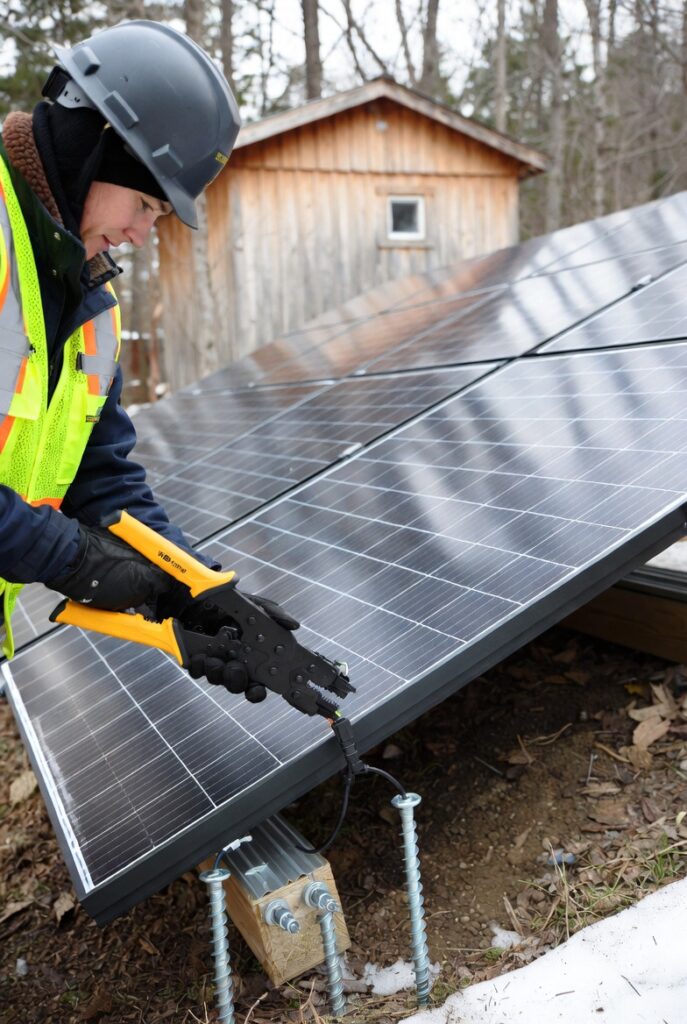
A solar panel installation that passes a visual inspection can still fail the ESA review, and the most common reason is a MC4 connector crimped with pliers instead of a calibrated crimping tool. A homeowner on Woodlawn Road in Guelph, Wellington County completed a 1kW rooftop solar panel installation in summer 2023. The array looked clean and professionally mounted, panels in tight alignment, wiring neatly bundled, all connections made. He had not filed the ESA permit before starting, assuming it was a post-installation formality. He filed after completion and the ESA inspector came to the site within two weeks.
The inspector flagged the MC4 connectors immediately. The connectors were not CSA-listed for the specific wire gauge used in the installation, and the crimps showed visible deformation consistent with plier crimping rather than a calibrated MC4 crimping tool. Two of the 20 connectors showed signs of early corrosion from moisture ingress at the improperly sealed crimp joint. The inspector required full replacement of all 20 MC4 connectors before approval.
I assisted with the MC4 replacement work in August 2023. Re-crimping 20 connectors on a completed rooftop solar panel installation required ladder access, connector disassembly, re-crimping with a calibrated WBHome MC4 crimping tool, and re-testing each connection. Total additional cost: approximately $400 in labour time plus approximately $60 in replacement connectors. The system passed the re-inspection without further issues. See our Ontario solar sizing guide before beginning any solar panel installation to confirm the system specification is complete.
The solar panel installation site decision: roof mount vs ground mount in Ontario
| Mount type | Space requirement | Snow clearing | Frost anchor | Seasonal adjustment |
|---|---|---|---|---|
| Roof mount (steep, 35°+) | None | Self-clears ✓ | Not required ✓ | Fixed (tilt frame optional) |
| Roof mount (shallow, <30°) | None | Manual clearing ✗ | Not required ✓ | Fixed at roof pitch |
| Ground mount | Requires lot space | Easy to clear ✓ | 1.5m below frost line ✓ | Full angle control ✓ |
A steep south-facing roof above 35 degrees provides nearly the same annual production as a fixed 40-degree ground mount while eliminating the frost anchor requirement entirely. The tradeoff is accessibility, any snow clearing, MC4 inspection, or tilt adjustment on a roof mount requires safe ladder or scaffold access. A shallow roof below 30 degrees accumulates snow and keeps it, requiring manual clearing after every Ontario snowfall to maintain January production. For shallow-roof properties, a ground mount with a 60-degree winter adjustment recovers the January production that the roof mount loses to snow accumulation.
The frost heave risk for Ontario ground mount solar panel installation requires attention at the anchor stage. A ground mount anchor that terminates above the frost line moves vertically as the ground freezes and thaws each winter cycle. A 1kW ground mount with four anchors experiencing differential frost heave across uneven soil racks the railing system, tilting individual panels out of design angle and, in severe cases, cracking the panel frame at the mounting point.
The solution is anchor depth: 1.5m minimum at Wellington/Halton County latitude, confirmed before backfill by measuring from finished grade. All Renogy 100W monocrystalline panels mount to standard racking hardware compatible with both roof and ground mount configurations. See our solar panel angle guide for tilt specifications by season.
The 3-step physical installation sequence: anchor, wire, commission
Step 1 is anchoring the solar panel installation. For roof mounts: locate rafters, mark attachment points, install flashing and lag bolts through roof into rafters, then attach rail systems. All roof penetrations must be flashed and sealed, improper flashing is a common Ontario solar panel installation failure mode across freeze-thaw cycles. For ground mounts: install anchors below the frost line, verify plumb and level before proceeding, attach vertical posts and horizontal rails. The Campbellville contractor used 5-foot helical ground screws anchored well below the 1.2-metre frost line in fall 2023, providing three seasons of stable array alignment through Wellington County freeze-thaw cycles with no movement detected.
Step 2 is wiring. Route DC cables from panel junction boxes through conduit to the charge controller using minimum 3/4 inch EMT for a single 2-wire run, larger for multiple circuits. Size cable for the panel short-circuit current (Isc) plus 25% safety factor. All MC4 connectors must be CSA-listed and crimped with a calibrated tool. Step 3 is commissioning. Verify open-circuit voltage (Voc) at the panel output before connecting to the charge controller.
Connect the battery to the charge controller first, then the array. Install the SmartShunt on the battery negative line before any load connections. His 600W array produced 960Wh on the first clear October day after commissioning, matching the design specification within 5%, and his ESA inspection passed on the first visit without a single deficiency noted. See our solar power system integration guide for the full 4-component connection sequence.
Pro Tip: Before making any MC4 connection on a solar panel installation, perform the pull-test protocol on one sample crimp from each batch of connectors. Crimp a connector on a 15cm length of the actual installation wire, grip the connector housing in one hand and the wire in the other, and apply approximately 25N of steady pulling force, roughly the force of a firm handshake held for 3 seconds. A correctly crimped MC4 connector does not move or pull free. If the wire pulls through the crimp or the connector separates from the wire at less than 25N, the crimping tool is out of calibration, the wrong die is being used, or the connector is not rated for the wire gauge. Do not proceed until a test crimp passes. This 2-minute test before the installation begins prevents the $460 rework that the Woodlawn Road Guelph installation required after commissioning.
The solar panel installation MC4 failure: why plier-crimped connectors cost $460 in rework
A correct MC4 crimp deforms the contact pin around the conductor to a precise depth and deforms the cable jacket retention insert to seal the cable entry point. A plier crimp applies inconsistent, uncontrolled force, the pin deformation is irregular, leaving micro-gaps at the conductor interface, and the jacket retention seal is incomplete. Ontario’s humidity and freeze-thaw cycle drives moisture through these micro-gaps with each thermal cycle.
Corrosion builds at the pin-to-conductor interface, increasing resistance. At 10A continuous in a 400W array, a 0.5-ohm resistance at one MC4 connector generates 50W of localised heat, enough to melt the connector housing and ignite adjacent wiring or mounting materials. The Woodlawn Road Guelph re-do: 20 connectors, $460 total, because the initial solar panel installation used pliers.
Prevention requires three steps. First: use only CSA-listed MC4 connectors rated for the specific wire gauge used in the solar panel installation. Second: use a calibrated WBHome MC4 crimping tool for every connection without exception. Third: pull-test each crimp before mating the connector halves, grip the housing and wire and pull approximately 20 to 30N. A correctly crimped connector does not pull free. For parallel array configurations, use MC4 branch connectors at every branch point to ensure rated electrical connections throughout the array. Inspect all MC4 connections annually for discolouration, deformation, or corrosion and replace any suspect connector before the next Ontario winter.
ESA permit timing: why filing before wiring saves the rework cost
Ontario rule: file the ESA permit before beginning any permanent wiring on a solar panel installation. The ESA permit application identifies the complete system, panel array, conduit route, charge controller, battery bank, and inverter output wiring. The inspector reviews the application and may require pre-inspection of the conduit route before the conduit is sealed in walls or enclosed in junction boxes. If the ESA inspector finds non-compliant wiring or components after the conduit is sealed and the installation is complete, remediation requires opening sealed conduit and junction boxes, significantly more expensive than corrections made before sealing. The Woodlawn Road result: $460 in rework on a completed installation because non-compliant MC4 connectors were flagged after the system was sealed and commissioned.
NEC 690.12 requires rapid shutdown capability for any roof-mounted solar panel installation on an occupied structure in Ontario. The rapid shutdown system must de-energize the rooftop conductors to within 1 metre of the array within 30 seconds of activation. A rapid shutdown initiator at the main disconnect, either integrated into the inverter or as a separate device, satisfies this requirement. Ground mount systems not attached to an occupied structure typically do not require rapid shutdown under current Ontario interpretation, but confirm with the ESA at the time of permit application.
Some Ontario municipalities also require a building permit for ground mount structures above a certain footprint, confirm with the local building department before installing any ground mount solar panel installation structure.
NEC and CEC: Ontario requirements for residential off-grid array installations
NEC 690 governs solar PV installations. A permanently installed solar panel installation must comply with NEC 690 requirements for panel mounting, DC wiring from the array to the charge controller, overcurrent protection at the array output and battery terminal, disconnecting means, and battery storage. NEC 690.12 requires rapid shutdown capability for any roof-mounted system on an occupied structure. The DC cable from the panel array must be sized for the panel Isc plus a 25% safety factor, with appropriate fusing at the array positive output.
All conduit runs must comply with NEC requirements for the conduit type and fill ratio for the wire gauge and number of conductors. Contact the NFPA at nfpa.org for current NEC 690 requirements for residential solar panel installation.
CEC Section 64 governs solar PV installations in Ontario. A permanent solar panel installation requires an ESA permit filed before wiring begins. The permit application must identify the panel array wattage and configuration, the conduit route from array to charge controller, the charge controller, the battery bank, the inverter, and the overcurrent protection at each circuit. A ground mount solar panel installation may also require a building permit for the mounting structure, confirm with the local municipality before installing any ground mount structure. All components including panels, connectors, conduit fittings, and wiring must be CSA-listed for the specific application. Contact the Electrical Safety Authority Ontario at esasafe.com before beginning any permanent solar panel installation in Ontario.
The solar panel installation verdict: the three rules that pass ESA first time
- Ontario property owner installing a rooftop solar panel installation on a south-facing roof above 35 degrees: roof mount is the correct choice. Snow self-clears on steep roofs. File the ESA permit before beginning wiring. Use CSA-listed MC4 connectors and a calibrated WBHome crimping tool for every connection. Pull-test each MC4 crimp before mating. The Woodlawn Road result: MC4 rework on a completed roof installation cost $460. The same work done correctly before ESA inspection costs approximately $30 to $60 for CSA-listed connectors plus a calibrated crimping tool at approximately $40 to $60 as a one-time purchase, preventing the rework permanently for the life of the installation.
- Ontario property owner installing a ground mount solar panel installation on accessible lot space: anchor below 1.5 metres to clear the frost line in Wellington/Halton County. Confirm the racking is rated for 1.9 to 2.5 kPa ground snow load for the local municipality. File the ESA permit before wiring. Use a calibrated MC4 crimping tool for all connections and pull-test before mating. The Campbellville Halton result: 5-foot helical screws below frost line, WBHome crimper all 24 MC4 connections, ESA permit before wiring, passed first visit, zero deficiencies, producing 960Wh on the first clear October day within 5% of design specification.
- Ontario property owner who completed a solar panel installation without an ESA permit or with plier-crimped MC4 connectors: file the ESA permit immediately. If the inspector flags the MC4 connectors, replace all of them with CSA-listed connectors using a calibrated crimping tool before the re-inspection. Do not operate the system with suspect MC4 connections, a corroded MC4 in a 400W array generating 50W of arc fault heat is a fire risk regardless of whether the system otherwise appears to function correctly. The replacement cost is approximately $60 to $120 in CSA-listed connectors plus labour, consistently less than the fire risk and insurance implications of an uninspected installation with deficient electrical connections. See our solar garage guide for how these installation rules apply to detached workshop arrays.
Frequently Asked Questions
Q: Do I need a permit to install solar panels in Ontario?
A: Yes. Any permanent solar panel installation in Ontario requires an ESA permit filed before beginning any permanent wiring. The permit must be filed before wiring starts, not after completion, filing after the installation is complete risks requiring the inspector to open sealed conduit and junction boxes to verify code compliance, adding significant rework cost. Some Ontario municipalities also require a building permit for ground mount structures above a certain footprint. Contact the Electrical Safety Authority Ontario at esasafe.com and the local building department before beginning any permanent solar panel installation.
Q: What causes MC4 connector failures on solar panels in Ontario?
A: Incorrect crimping is the leading cause. An MC4 connector crimped with pliers rather than a calibrated MC4 crimping tool leaves micro-gaps at the conductor interface and an incomplete jacket seal. Ontario’s humidity and freeze-thaw cycle drives moisture through these micro-gaps, causing corrosion that increases resistance at the connection. In a 400W array producing 10A continuous, a 0.5-ohm resistance at one MC4 connector generates 50W of localised heat, enough to melt the housing and ignite adjacent materials. Prevention: CSA-listed connectors, calibrated WBHome crimping tool, and pull-test every crimp before mating. The Woodlawn Road Guelph MC4 rework cost $460 after a visual-pass installation failed ESA inspection.
Q: What is the difference between roof mount and ground mount solar in Ontario?
A: Roof mount is space-efficient with lower racking cost and no frost anchor requirement. Steep roofs above 35 degrees self-clear snow; shallow roofs below 30 degrees accumulate snow and require manual clearing for January production. Ground mount requires anchors below the 1.5m frost line in Wellington/Halton County to prevent frost heave, racking rated for 1.9 to 2.5 kPa ground snow load, and possibly a municipal building permit. The advantage of ground mount is full seasonal angle control, 60 degrees in October through March for maximum January production, 25 degrees in April through September, and easy access for MC4 inspection and snow clearing without ladder or scaffold work at height.
This build is engineered within the 48V DC Safety Ceiling. Diagnostic logic is based on 20+ years of technical service experience. All structural and electrical installations must be verified by a Licensed Professional and comply with your Local AHJ.
About the Author
Robert Bertrand spent 20 years as a service advisor in the automotive industry (Lexus and Nissan), where precision diagnostics, wiring integrity, and documentation standards were non-negotiable. He brings that same technical discipline to GridFree Guide, where he researches, tests, and documents off-grid solar systems for Ontario conditions. Based in Rockwood, Ontario, every article is built on verified specifications, manufacturer data, and the real-world climate constraints of Canadian off-grid living.
As an Amazon Associate I earn from qualifying purchases. This site also contains affiliate links to other products and services. GridFree Guide earns a small commission at no extra cost to you.